The Romani spirits in Umbanda are spirits of the Romani people, linked to the Linha do Oriente, which many houses worship in their own festival, separate from the routine giras. In the research by Lívia Macedo and José Francisco Bairrão (USP), the line "is not part of the seven traditional lines" and is sometimes considered "a separate cult." They work with cards, crystals, and advice. They receive a table full of fruits and sweet liqueurs. And almost everything about them changes from one house to another.
Who are the Romani spirits in Umbanda
They are spirits that present themselves as spirits of Romani men and women from other lives: men with headscarves and earrings, women with full skirts and gold necklaces, as Brumana and Martinez described them in 1991. They attend with the deck and read the hand. They speak of the road, freedom, and joy. Cigana Lola, in a house in São Paulo, "works with crystal, reads tarot and hands."
No one knows when the line began. "It is not known when the Linha do Oriente began," summarizes Macedo's monograph, supported by Brumana and Martinez. In a terreiro in Jardinópolis (SP) with more than 60 years, the Romani spirits were the last line to arrive. This was about ten years before the research, and today they have their own room and altar.
The Linha do Oriente is broader than the Romani spirits. In a center in Rio de Janeiro, the "Povo do Oriente" gathers "Arabs, Romani, Hindus, Japanese, and Chinese." The Romani spirits are, however, the most numerous in the line.
The Romani spirits of the gira are a spiritual category of Umbanda, and not a portrait of real Romani people. The research itself asks for this separation.
Where the Romani people are in each house
Here the houses disagree, and this is the honest answer. There are at least four recorded arrangements:
- A separate line: in the four houses in São Paulo studied by USP, the Romani spirits (cigano) are outside the seven lines and have their own rite.
- One of the seven: in a tent studied by Fernando Guerra (UFMG), the "Linha do Oriente" is the second of the seven lines of the house. The author notes that "nothing is a rule in Umbanda, not even the lines." See how each house sets up the 7 lines of umbanda.
- Between the right and the left: "They do not like the left nor do they fit with the right," says a leader interviewed by Macedo. In a center in Rio, the statue of a Romani spirit stays in the Casa dos Exus, next to an Exu and a Pombagira.
- Linha de Exu: in Rio Grande do Sul, the anthropologist Ari Pedro Oro records that the "povo do oriente" is almost extinct. There, "today the 'povo cigano' was transformed into Linha de Exu," a typical arrangement of the Linha Cruzada.
The regency also varies. One umbanda school puts the Romani spirits under the orixá Egunitá; in a house in São Paulo, the Cigana Marguerita works "with the energy of Iansã (Oya), the same as her medium." No academic research open for this text gives a ruling orixá for the entire line.
What is the Romani festival like
In the houses studied, the festival happens "two to three times a year, outside the calendar of the routine giras," only for the Romani line. It is a lot of work, and not by chance: "If it is not done with great abundance, the way they want it, it has to be done again," a medium said.
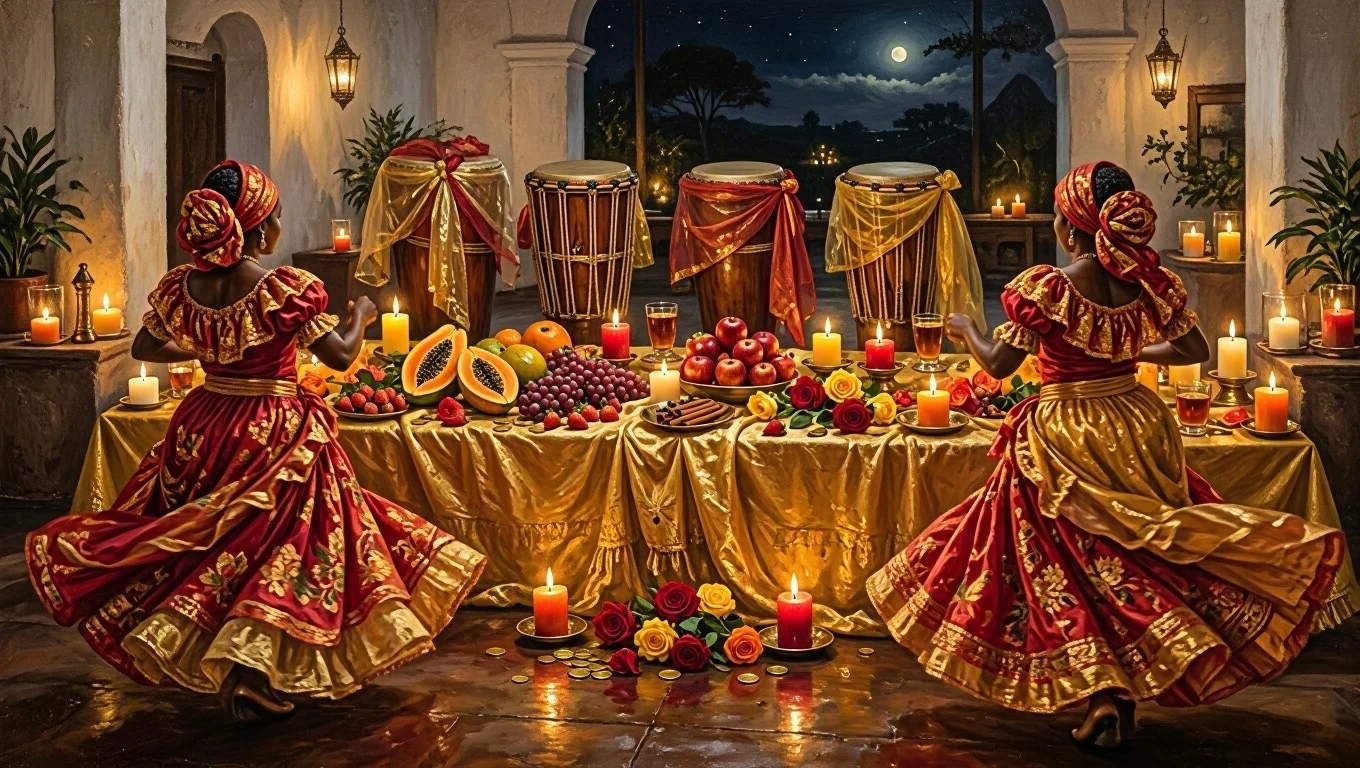
The atabaques receive cloths with gold and red stripes, "frequent colors in rituals of the line." On the altar, there is a large table of food, and next to it, there may be an altar only for the Orient, with the statue of Saint Sarah, crystals, and a painted sun. Clove and cinnamon perfume everything: these are the spices that the Portuguese used to seek in the Orient, and they mark the festivals of the line.
In a tent in Nova Iguaçu (RJ) that only worships Romani spirits, the center of the rite is the salamandra. It is a bonfire where request candles are handed over and incense is lit. The rite is described in fogueira cigana. There, the Romani spirits refuse animal sacrifice. They only ask for "green blood," which is the ritual work with herbs, flowers, and elements of nature.
The festival closes with a sung chant. The Romani spirits' sung chants speak of the moon, violin, and the road, and the greeting that researchers heard was "Hail the Romani people!" See more about sung chants in Umbanda.
Day, colors, and greeting: what is recorded
Day: no fixed day of the week in research | Date: May 24 | Colors: gold, red, yellow, orange | Greeting: Optchá and "Hail the Romani people!"
- Day: the "Friday of the Romani" circulates a lot, but no open research supports it. The record is of festivals two or three times a year or, in one tent, of a rite on Sundays after 6 p.m. The fixed date is May 24, the day of Saint Sarah Kali and National Romani Day.
- Colors: gold and red on the cloths; on the described tables, yellow, red, orange, white, and light blue candles, each of a single color. The writer Isabel Fonseca, who studied the Rom, says that red is the characteristic color of the Romani people.
- Greeting: Optchá is the most heard word and even gives its name to academic essays, but no research explains where it comes from. In the studied giras, the sung chant closes with "Hail the Romani people!" and the gira ends with "Sarava the ascent of all Romani!".
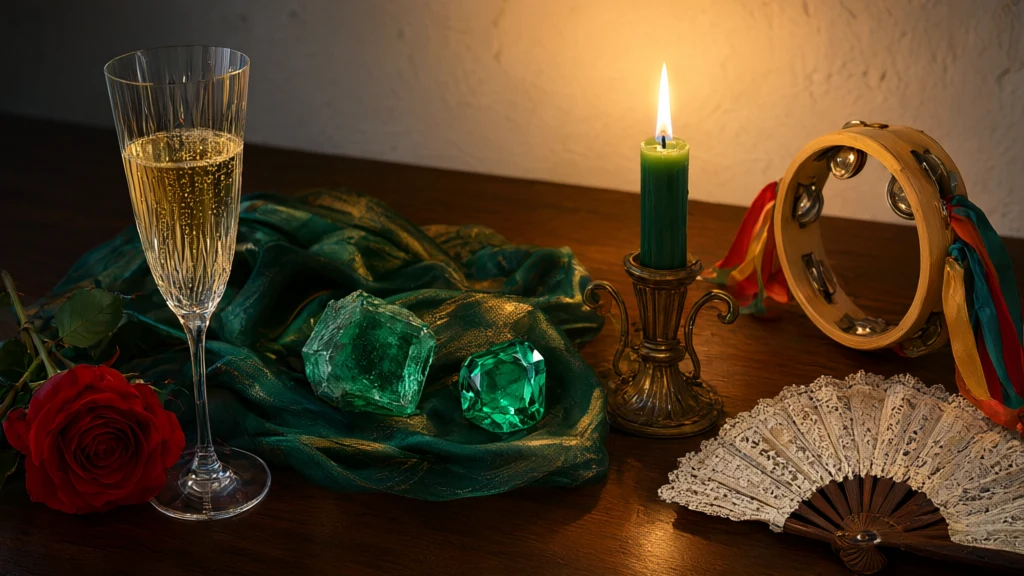
- Elements: deck of cards, crystals, coins, scarves, flowers, and cups.
A statement collected by Bairrão summarizes the temperament: "Romani spirit is fire and air. Fire is light, it illuminates, but not always." If you want to know your path with the line, take the Romani path test.
Romani candles
The Romani candle is a request candle with the Romani couple on the label, and each color carries an intention. The colors that appear on the tables described by researchers have their own: the yellow, the red, the white, the light blue, and the golden, which recalls the gold of the cloths. The seven colors one has the colors melted and joins several requests in a single candle. There is also the green, the pink, the lilac, the navy blue, the brown, and the black.
All can be lit for 7, 14, or 21 days: the 7-day one serves for most requests, and the longer ones are for those who want more time of firmeza. The color your home asks for is worth more than any table. To light at home, follow the basic care of the how to use ritual candles guide.
The names that the houses register
Each medium has their own Romani spirit, with their own preference for clothing, drink, and cigarette. The life and death story is also told by the spirit, in their house: Cigana Dulce speaks of a fire in the camp, Marguerita of a shooting attack, and Lola does not even tell hers. Therefore, no name has a unique biography. These are the ones that appear in research:
Ramírez and Juan Ramirez
It is the most registered name. It appears in Brumana and Martinez and in the list of the most well-known Romani spirits (cigana) of Manaus. In Rio, Juan Ramirez is the spiritual head of the Tenda Tzara Ramirez. It was he who opened space for people from Umbanda and Candomblé to care for their Romani spirits (cigano).
Romani spirit Wladimir
There is a record: the sung chant (ponto cantado) "Cigano Wladimir", published by Maria Helena Farelli in 1999, which speaks of full moon and violin and ends in "Come to Umbanda to work". His color, day, drink and history have no published source; what he receives is what the house and the medium teach. Those who have devotion can light the candle of Cigano Wladimir.
Cigana Esmeralda
She is studied as Pombagira Cigana Esmeralda in an academic psychology journal, and is on the Manaus list. The name recalls Esmeralda of Victor Hugo, and the story circulating about her death is admitted as a legend by the very portal that publishes it. All this is in the article about Cigana Esmeralda.
Sulamita, Dulce, Lola, Marguerita
Sulamita appears in Manaus; Dulce, Lola and Marguerita are the Romani spirits (cigana) of the São Paulo houses described by USP. Other names very repeated on the internet (Carmencita, Sarita, Pablo, Igor) did not appear in open research for this text.
Cigana da Estrada
In all sources she is Pombagira. In a tent in Rio, she wears red and black, stays in the Roncó de Exu next to Maria Padilha and receives red roses and champagne. Her place is next to Pombagira Cigana.
Cigana do Oriente or Pombagira Cigana
They are two figures who dress similarly and work differently.
- A cigana do Oriente is the spirit (entity) of the Romani line described above: own party, table of fruits and sweet liqueurs, cards and advice, without sacrifice.
- The Romani Pombagira is a Pombagira, a spirit of the left with Romani attire. In a terreiro in Maracás (BA), she wears red silk, receives perfume and roses, and drinks champagne "both in glasses and from the bottle itself." Researchers say she combines Exu, the iabás Oxum (Oshun) and Iansã, and the "popular sertanejo imaginary regarding the Romani."
The border is not fixed. In the beginning, Baldiotti says, the Romani were "easily confused with the Exus and Pombas Giras," as they presented themselves as Romani of the souls or of the Cruzeiro. Ask your house which of the two is the Romani who works with you. The difference between the traditions lies in Umbanda and Quimbanda.
Romani spirits of Umbanda and real Romani
The Romani peoples exist and have been in Brazil since the 16th century. The first official record is from 1574: João Torres, a Romani condemned to five years of exile in the colony. The Calon, of Iberian origin, arrived first; the Rom came later. Since 2024, the federal government recognizes them as traditional peoples and communities and has as its first objective to "combat anti-Romani sentiment."
European literature helped fix the stereotype of the thief Romani, which is already in Cervantes. Edluza de Oliveira and Maria Cristina Marques are researchers and practitioners of the cult. In 2026, they wrote that their criticism "is not directed at the ritual use of the Romani line in terreiros." The problem lies in those who perform a Romani identity on social media to sell. They ask that Umbanda make it clear that the spirit is spiritual, and remind that the Romani seer "was historically constructed by external gazes."
The meeting point between the two worlds is Saint Sarah Kali, patron saint of the Romani people, celebrated on May 24. In 2006, a decree established this date as National Romani Day. Her history is in the article about Saint Sarah Kali.
What is offered to the Romani people
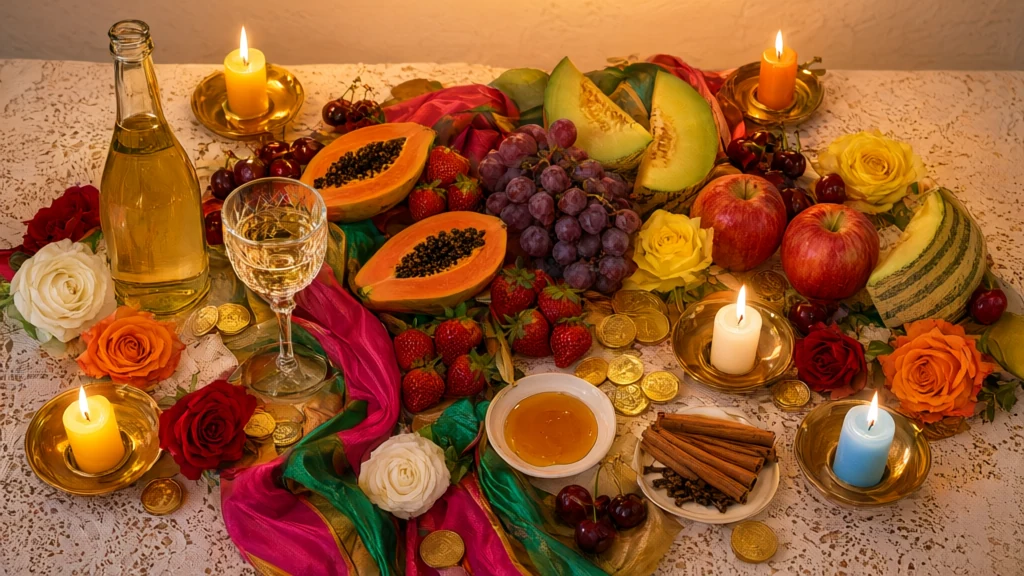
The tables that researchers saw have fruits (papaya, strawberry, apple, grape, cherry, melon), white wine, cider, sweet liqueurs, pudding, clove and cinnamon, roses of various colors, candles and coins. The Romani spirits like "sweet drinks, such as mint liqueur." Champagne and red roses appear more on the table of the Pombagira Cigana.
No open research records a street delivery location for the Romani people; what is described is the table in the terreiro. The complete list, with what is included and what is left out, is in the article about the Romani table. For the candle, the incense, the coins and the scarf, follow what your house requested. If you have doubts about the material, Joia Mística Laroyê will check with you via WhatsApp.
Frequently asked questions
Do the Romani people belong to the 7 lines of Umbanda?
It depends on the house. In the São Paulo houses studied by USP, the Romani line is outside the seven and has its own celebration. In a tent studied by UFMG, the Oriente Line is one of the seven. In Rio Grande do Sul, the Romani people began to be worked as an Exu line.
What is the color of the Romani candle?
The tables described by researchers have yellow, red, orange, white and light blue candles. The Romani candle, with the couple on the label, exists in eleven colors and in the seven-color one, and each color accompanies a type of request. If in doubt, follow the color that your house requested.
What is the day of the Romani people?
There is no fixed day of the week recorded in the research. The houses studied hold the Romani festival two or three times a year, and a tent in Rio performs the rite on Sundays. The date common to all is May 24, the day of Saint Sarah Kali and National Romani Day.
What does Optchá mean?
It is the most heard greeting in the Romani giras and even gives its name to an academic study, but no open research explains the origin of the word. What researchers recorded in the giras was the closing "Hail the Romani people!"
Is the Romani spirit a right-side or left-side spirit?
The houses do not agree. A leader heard by USP says that the Romani spirits "do not like the left nor do they fit with the right". There are houses that place them next to the Exus. The Pombagira Cigana, however, is a left-side spirit.
References
- Macedo and Bairrão, Memorandum (UFMG, 2021): The Romani Orient in Umbanda
- Macedo, monograph (USP, 2014): Endless roads: the Orient line and the Romani people in Umbanda
- Guerra, Revista Três Pontos (UFMG, 2014): There is sertanejo in the boiadeiro Umbanda
- Paiva, dissertation (UFRRJ, 2016): Brazilian Oriente in Fluminense circuits
- Baldiotti, dissertation (Unincor, 2020): the spiritual spirits in the sung points of Umbanda
- Oro, Estudos Afro-Asiáticos (2002): Afro-Brazilian religions of Rio Grande do Sul
- Maia and Campos, Áltera (UFPB, 2018): Romani spirits and spirits of Romani
- Maia, GIS (USP, 2022): Optcha! Cigano is not a religion?
- Lages and D’Ávila, Pesquisas e Práticas Psicossociais (UFSJ, 2007): Romani life: women, possession, and transgression
- Aguiar and Machado, Odeere (UESB, 2017): The Romani pomba-gira in the sertão Candomblé
- Santos, Revista Wamon (UFAM, 2020): challenge points between marias-padilhas, witches and Romani spirits
- Vale, dissertation (UERJ, 2022): Pombagire-se!
- Oliveira and Marques, REVER (PUC-SP, 2026): Between the gira and the networks, Romani signs, Umbanda and ethnic recognition
- Sathler and Meihy, Travessia (2024): Artistic-cultural performances in Romani ethnicities
- Presidency of the Republic: Decree of May 25, 2006, National Romani Day
- Presidency of the Republic: Decree No. 12,128, of 2024, National Policy Plan for Romani Peoples
- iQuilibrio: the legend of Cigana Esmeralda, presented as a legend