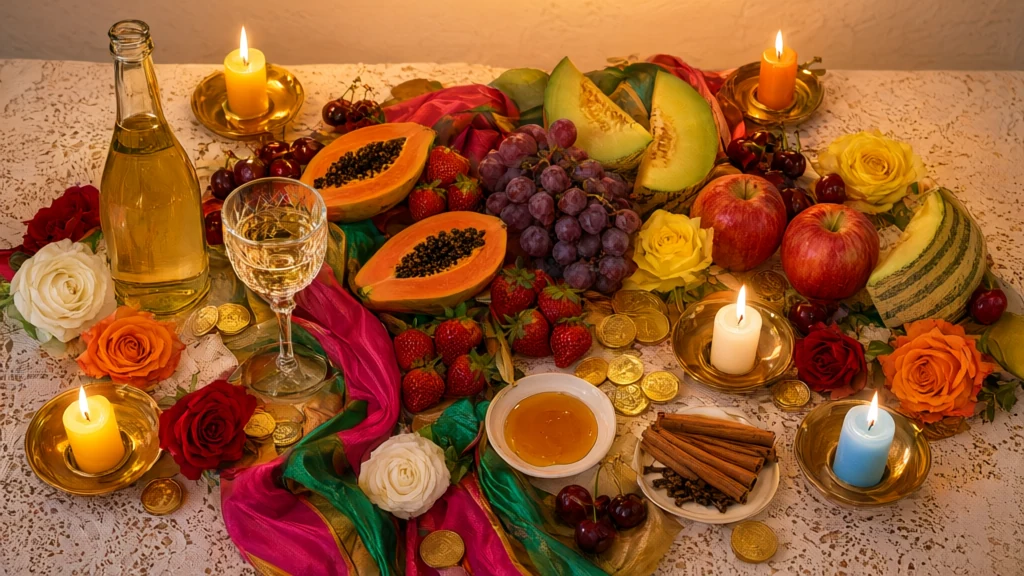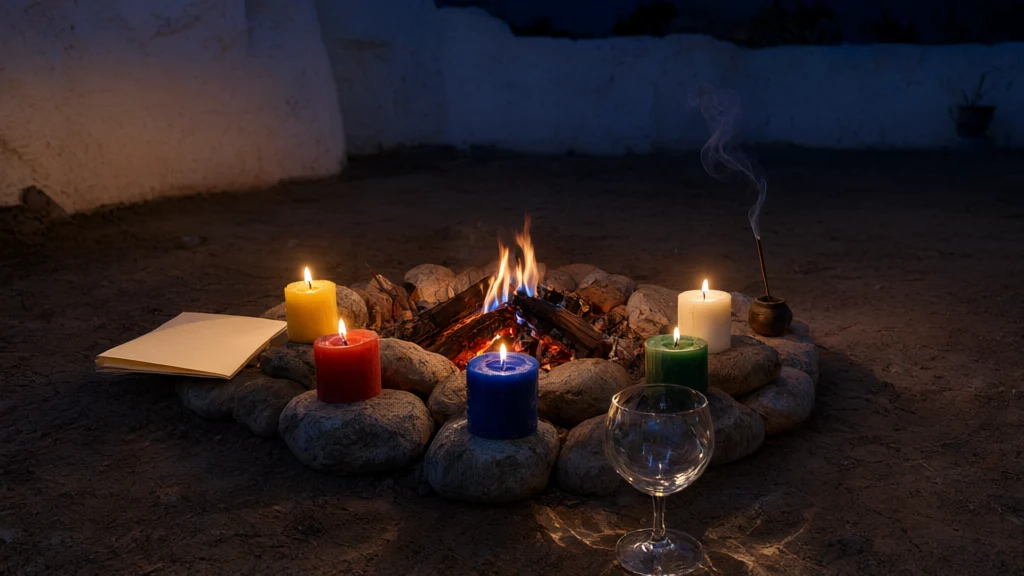
The fogueira cigana is the fire rite of houses that worship Romani spirits: the request candles go into the fire, and the mediums in spirit incorporation dance around it until the fire dies down. In a tent in Nova Iguaçu (RJ), it has its own name: Salamandra. There, the mediums say, the fire "is the Romani spirit".
What is the Romani bonfire (fogueira cigana)
It is a ritual fire, lit outdoors, where the requests and the ritual works of the day are delivered. The most complete description comes from the anthropologist Cleiton Maia (UERJ), who accompanied the Tenda Cigana Espiritualista Tzara Ramirez. There, the rite of spirit incorporation "occurs in the fire that is named by the mediums as Salamandra, lit in a central location of the Tent's space".
In Tzara Ramirez, only Romani spirits are incorporated, and the mediums also attend other religions. Other tents in Rio, the "tzaras", perform the same ritual. To understand where the Romani people stand in the houses, see the article about Romani spirits in Umbanda.
For the tent, the fire is not just fire. An incorporated Romani spirit pointed to it and said: "it dances, we dance with it". In a note, Maia explains that the followers attribute to the fire "the Romani spirit of the caravan".
How the tents perform the fire
What follows is a description of a house, not a recipe. In Tzara Ramirez, the rite has this order:
- The request candles. During the day, the Romani spirit recommends that each attendee light a candle, "according to the need perceived during the consultation". The candles "are the 'requests', 'desires' or 'ritual works' performed during the day".
- The passage. At night, the attendees pass the candles "hand to hand, from back to front", until all are deposited and "together they light the great fire".
- The invocation. It plays the same track of eleven recordings, in the same order. The second is the "Invocation of the Salamandra", which ends in a shout calling the bonfire by name.
- The dance. The mediums incorporate around the fire. There are Romani spirits who dance "with their cups full of drink in their hands", or who put "the cup at the feet of the salamandra to dance".
- The end. The bonfire "consumes the requests" for more than two hours, and "only with the end of the bonfire" do the spirits say goodbye.
- The ashes. They remain untouched, and the Salamandra is only cleaned during the setup of the next one.
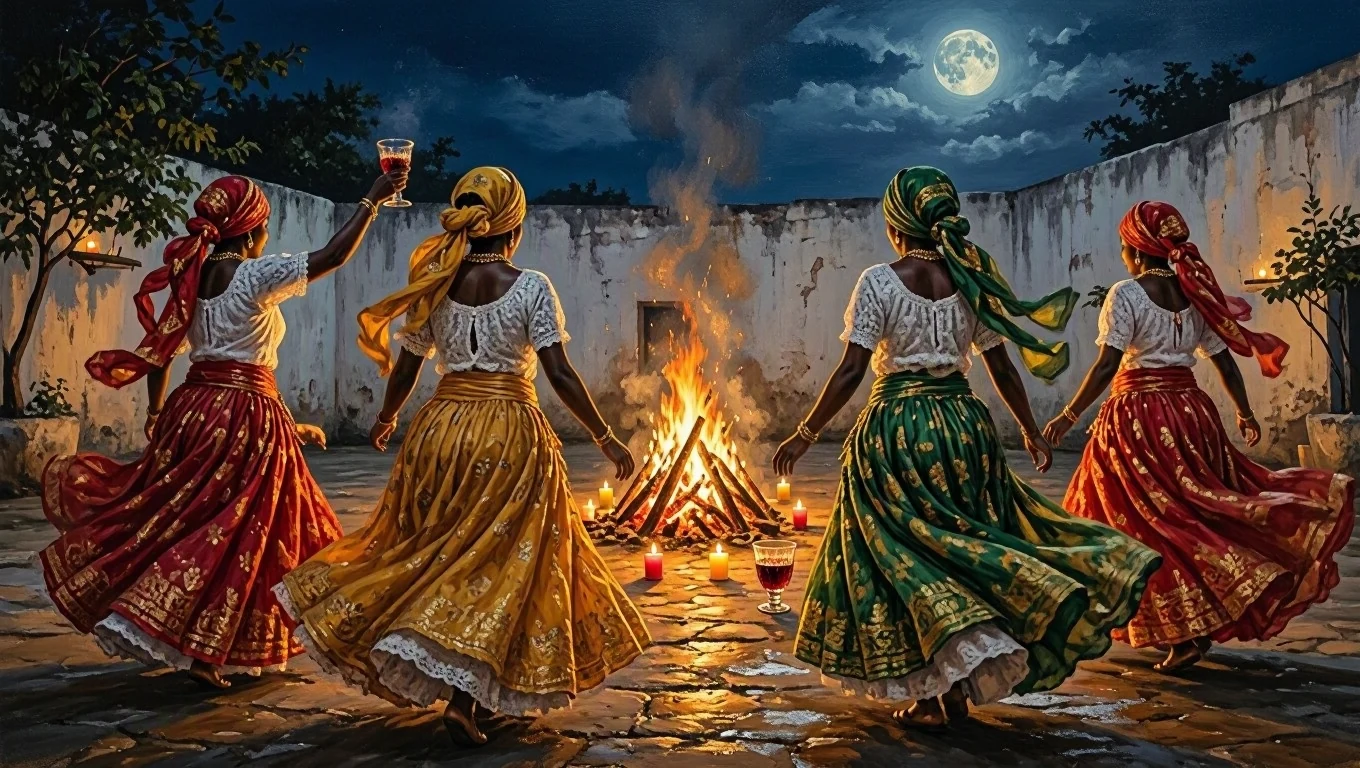
There is no sacrifice there. The Romani spirits of the tenda ask only for "green blood", which is the ritual work with herbs and flowers. The rite takes place on Sundays, after 6 p.m.
What is the Romani bonfire for
It serves to deliver the requests. It is what all sources repeat, each in their own way:
- In Tzara Ramirez, the bonfire is "the consummation of the requests and ritual works developed during the day".
- In an Umbanda house in São Paulo, Cigana Lola lit a bonfire in the backyard. After a prayer to Saint Sarah, she burned "papers written with the intentions of the faithful". The requests were for health, love, and work.
- The same Lola explained the gesture: "we ask the fire to illuminate new passions, to illuminate all enemies".
Among Umbandistas, the researcher José Francisco Bairrão heard a phrase that summarizes the relationship: "the Romani are fire and air. Fire is light, it illuminates, but not always. It can be destructive". The fire illuminates, but it also burns, and the houses treat it that way.
The bonfire is not a rule of the line. In the São Paulo houses studied by USP, the Romani festival takes place two or three times a year. There, the center of the festival is the Romani table.
Three different bonfires
Those who search for "Romani bonfire" (fogueira cigana) find three things with the same name.
The tent bonfire, of spirit incorporation, which is the Salamandra and the bonfire of Lola. It is religious: the Romani spirits are present.
The bonfire of devotion to Saint Sarah. At the National Romani Day festival, the cave of Saint Sarah in Ipanema also has fire. The attendees "burn their incense representing their requests in a bonfire," and then blessed breads are distributed. The festival follows guidelines from the Pastoral of Romani Peoples of the Catholic Church. In Campo Grande (MS), descendants and "Romani at heart" lit the bonfire with kitchen fire, prayed to Saint Sarah and offered grains to the fire with a request. The story of the saint is in Saint Sarah Kali.
The fire of the Romani peoples. Among the Calon, fire appears in mourning. Calon authors record that families, "after mourning the loss of a loved one, usually burn their clothes and belongings." Historians Lucas Vale and Lourival Andrade Júnior remind us that this happens "in some cases," and that the rites vary "from family to family."
The three are not the same thing. The Salamandra is a ritual of a Brazilian religious house, and not an old custom of the Calon, Rom, and Sinti. The research itself asks for this separation between the Romani spirit (cigano) and actual Romani people.
And at home? The answer is the candle
The tent bonfire is large. At Tzara Ramirez, "its flames exceed two meters in height." It stays in an open courtyard, with an entire community taking care of it. This does not happen in an apartment or a small backyard.
At home, the gesture that the tents themselves use is the candle: in Salamandra, each request is a candle. Light a single-colored candle on a firm plate or candlestick. The Fire Department advises keeping "curtains, clothes, mattresses, furniture, papers, and other flammable materials" away from the fire, and only leave after being sure it is out. The guide on how to use ritual candles provides the rest.
An incense, a cup, and the statue of Saint Sarah complete the gesture. Those who prefer can light the Saint Sarah Kali candle here on the site, without any flame. For the single-colored candle, there are Romani candles of 7, 14, or 21 days.
Bonfire in the woods, roadside, or vacant lot, no. Starting a fire in vegetation is a crime, even without intent.
If you are from a house that lights a bonfire, the one who teaches the rite is your house. To check the material beforehand, Joia Mística Laroyê helps via WhatsApp.
Frequently asked questions
How to make a Romani bonfire?
The tents that make a bonfire light a large bonfire in an open courtyard, with the request candles of the attendees, and the mediums dance around it. It is a house rite, with people tending the fire. At home, the equivalent gesture is lighting a single-colored candle on a firm plate.
What is the Romani bonfire of the road?
No research records a rite with that name. The Cigana da Estrada appears in sources as Pombagira, in a Rio tent. About her, see the article on Pombagira Cigana.
What are the lyrics of the Fogueira cigana sung chant?
There is no author or lyrics recorded in a published source. In the studied tent, the bonfire is called by recordings, such as the "Invocação da Salamandra". The sung chant is learned at the house. More about the subject in sung chants in Umbanda.
What is fogueira cigana escorpião?
It is the name of a video channel for zodiac sign predictions, which has a channel for each sign. It is not a ritual.
References
- Maia, Intratextos (UERJ, 2014): Salamandra: where the Romani spirits (cigano) meet
- Maia, GIS (USP, 2022): Optcha! Cigano is not a religion?
- Maia and Campos, Áltera (UFPB, 2018): Romani spirits and spirits of Romani
- Macedo and Bairrão, Memorandum (UFMG, 2021): The Romani Orient in Umbanda
- Batista, Silva and Câmara, Kixará (2025): The Romani experience among gadjes
- Vale and Andrade Júnior, ANPUH annals: One hundred ways to say goodbye: the Romani people and Death
- Oliveira and Marques, REVER (PUC-SP, 2026): Between the gira and the networks
- Campo Grande News (2022): Around the bonfire, the Romani people gather in Campo Grande
- Presidência da República: Environmental Crimes Law, art. 41
- Corpo de Bombeiros Militar do RS: Safe Winter campaign