



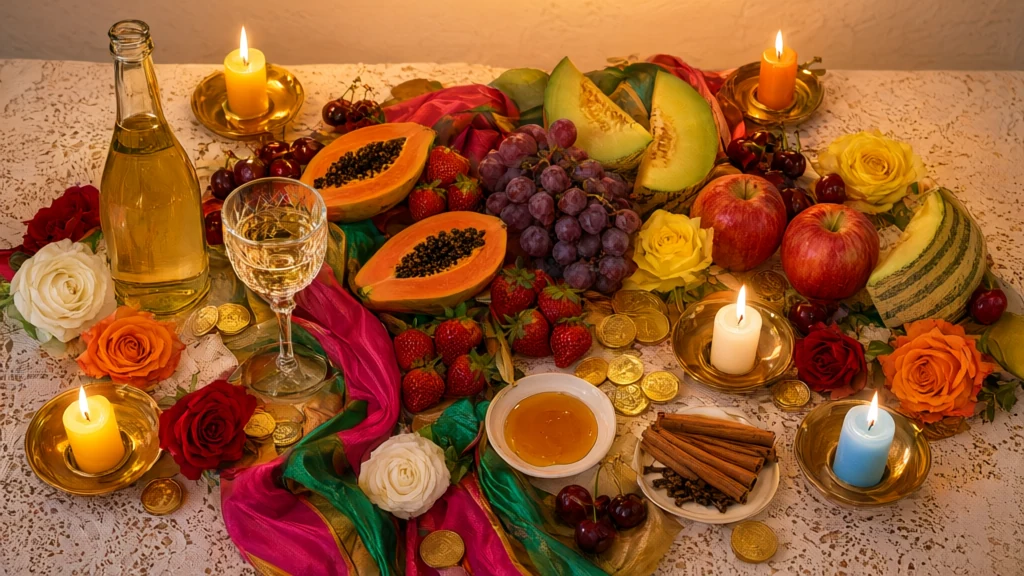
The mesa cigana is the abundant table that Umbanda houses set up for the Romani people festival: fruits, sweet liqueurs, white wine, cider, clove and cinnamon, coins, roses and colored candles. It stays on the altar or right in front of it, and at the end it is opened for everyone to eat. "If it is not done with great abundance, the way they want it, it has to be done again," a medium from São Paulo told researcher Lívia Macedo.
The name also serves for two other things. There is the wooden table sold as a "mesa cigana" and there is the Mesa Real, the 36 card spread of the baralho cigano. In the terreiro, mesa cigana is the one of festival and devotion.
What is the Romani table (mesa cigana) in Umbanda
It is the center of the festival of the Romani spirits in Umbanda. In the São Paulo houses studied by Macedo and Bairrão (USP), this festival happens "two to three times a year," outside of the routine giras. On the altar stays "a large table of food." The tables are "colorful, with strong smells and tastes," of spices like clove and cinnamon.
The table is also a place of ritual work. In one of the houses, the Romani leader (cigana) "invites everyone present to eat and drink abundantly before the consultations begin." The authors note the difference: in other lines, festival day has no consultation; in the Romani line, "the ritual works happen in a festival."
What goes on the Romani table (mesa cigana), house by house
There is no single list. What exists are tables described by those who were there:
- A house in São Paulo: papaya, strawberry, white beer, cider, sweet and sour farofa and white wine, with yellow, red, orange and white candles.
- Another house in São Paulo, the most abundant: plum, melon, apple, grape, cherry, cherry in syrup, pudding, sweet liqueurs and doce de leite. There were also white, red, yellow and orange roses, light blue, white, orange and yellow candles, and coins.
- The party of Cigana Lola: altar with statues of Romani spirits, of Saint Sarah and candles of four colors, and in front a table of drinks with wine and raisins. Lola mentions apple and honey as elements of her "Romani magic".
- A Romani tent in Baixada Fluminense (only worships Romani spirits; the mediums come from Umbanda and Candomblé): each medium arranges their rug with what their Romani spirit asks for. "My Romani spirit uses these fruits, that is why I bring them," one of them told the anthropologist Cleiton Maia.
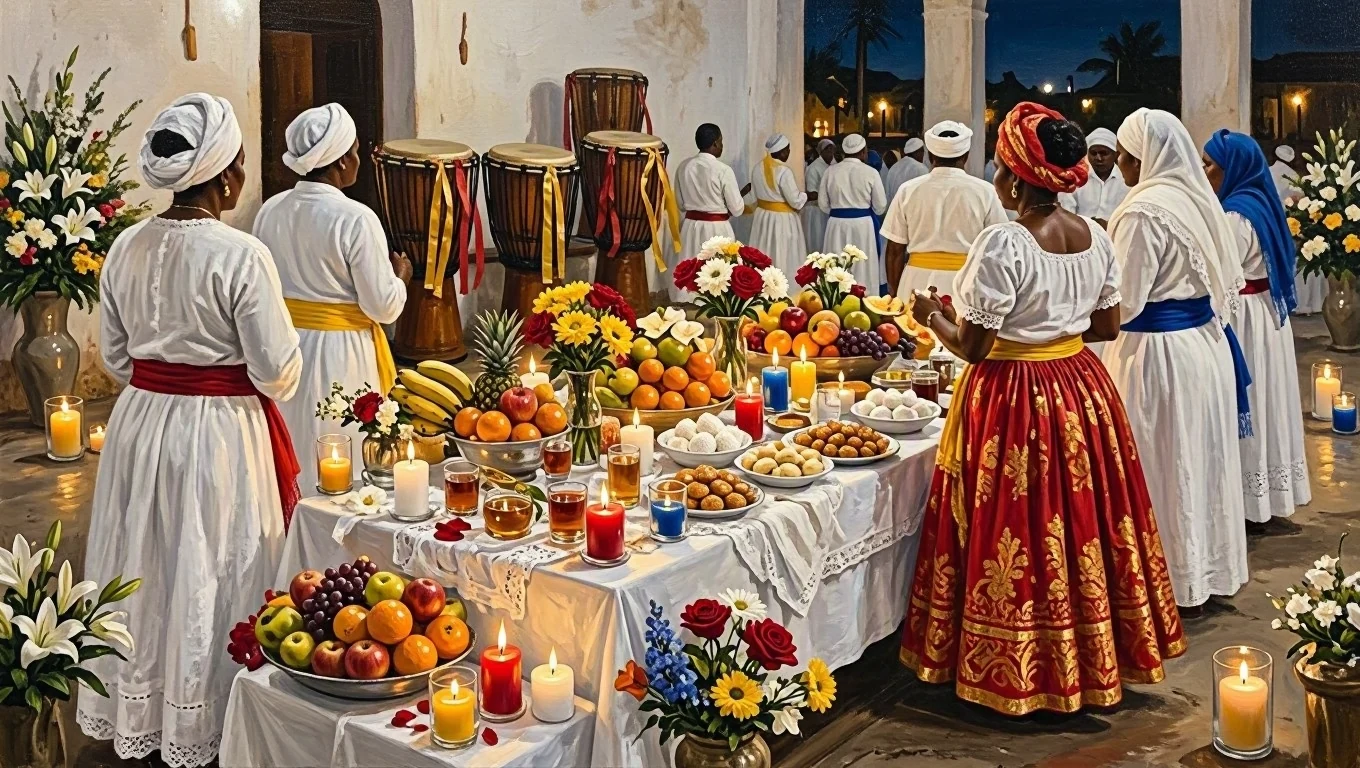
What repeats on the tables: fruits, sweet drink, clove and cinnamon, flowers, coins and candles of various colors. The Romani spirits of one house like "sweet drinks, such as mint liqueur." The liqueurs stay in the middle of the path: "Neither pinga, nor guaraná. But something that combines both."
And does the Romani spirit like honey? In two parties of the same research, yes: Lola uses apple and honey, and in the party of Cigana Dulce the leftover roses went to the altar "along with a little honey".
How the table is arranged
The sources show a repeating pattern, not a mandatory order:
- The altar: statue of Saint Sarah, statues of Romani spirits, crystals and lit candles.
- The food and drink table, on the altar or slightly in front.
- The altar of each Romani spirit, on a table or on a cloth on the floor, with cards, coins, crystals, wine and candles.
In the Rio de Janeiro tent, every mat carries "the cup, the candle (in the most varied colors), perfume (incense) and the dagger". The atabaques are also dressed: cloths with gold and red stripes, "frequent colors in rituals of the line".
When setting up, the candles require a firm plate and distance from towels, handkerchiefs, and dried flowers. The guide on how to use ritual candles brings this care. The fluminense tent also lights the ritual bonfire that it calls salamandra, but that is a tent rite, outdoors.
What does not go on the Romani table (mesa cigana)
Three things appear in the sources:
- Animal sacrifice. In the Rio de Janeiro tent, the Romani spirits do not ask for "red blood", only "green blood", which is the work with herbs, flowers, and elements of nature. A house in Bocaiuva (MG) that has Romani spirits also does not perform sacrifice.
- The face of padê de Exu (Eshu). The writer Maria Helena Farelli says that the Romani offering "cannot be similar to the padê de Exu, which has nothing to do with the Linha dos Ciganos".
- What the house prohibits. The most abundant house accepts pudding, but "except coconut pudding", without saying why. Each house has its own.
Cigana do Oriente or Pombagira Cigana: the offering changes
Whoever asks "what to give as an offering to a Romani spirit" needs to know which Romani spirit is being spoken of. The Pombagira Cigana is a Pombagira, a spirit of the left, and her table is different.
In a terreiro in Maracás (BA), the Pombagira Cigana receives perfume and bouquets of roses, and "her characteristic drink is champagne". In a tenda in Rio, the Cigana da Estrada, who is Pombagira, receives red roses, moscatel champagne, costume jewelry, and makeup. In Bocaiuva, the house separates: wine for the Romani spirits (Ciganos), sparkling wine for the Pombagiras.
As for the table of the Romani spirit (cigana) of the Orient, in the houses described, it consists of fruits, sweet liqueurs, white wine, and cider. The historian Lourival Andrade Júnior records that confusion between the offerings of the two is common. In case of doubt, the question goes to your house.
Party table and individual offering
The party table is collective. At Lola's party, the cigana asked for applause from the Romani people. Then she "opened the table of food and drinks in consonance with the toque of the atabaques," and she herself ate and danced. At the party of Saint Sarah of the Rio de Janeiro tent, the mediums bring sweets, savory snacks, breads, fruits, and drinks, which are "distributed" during the day.
The individual offering is what each medium does for their Romani spirit (cigano). In the Rio de Janeiro tenda, each medium pays for the party of their Romani spirit on the date they performed their initiation rite. There, they give a gift, "a piece of clothing or an important object like a dagger or veil." In Manaus, the Romani spirits (ciganas) "like to receive gifts," but they do not usually give them.
The calendar changes with the house: two or three parties per year in São Paulo and birthday parties for the Romani spirits at the tenda in Rio. Everywhere there is May 24th, the day of Saint Sarah and National Romani Day.
What to do with the table afterwards
In the parties described, the food is eaten by the guests. In the Rio de Janeiro tent, after the saint's parties, the statue, the veils, the flowers, and the requests go to "their place": the one for Saint Sarah goes to a cave dedicated to her in Ipanema, in Rio. It is the only delivery location that the research records, and it is for flowers and requests, not for food. In a house in Minas Gerais, "the seclusion (recolhimento) of the offered material is mandatory."
No open research for this text instructs leaving food from the Romani people in the street, in the field, or on the road.
Romani table at home: a simple gesture
Those who want to honor the Romani people at home do not need a recipe. What the houses do on a small scale is valid: a plate of fruits, a glass of liqueur or juice, a flower, some coins, a little clove and cinnamon, and a single-colored candle on a firm plate. Those who want to light one through the site can choose the yellow Romani spirit candle, of 7, 14, or 21 days. The Saint Sarah Kali candle also serves as a gesture of devotion. For the altar location, see how to set up an Umbanda altar.
If you are from a house, ask first: what goes on the table is what your Romani spirit (cigano) and your house request. Afterwards, eat the fruits or give them to those in need, and do not let anything spoil on the altar. If you want to check the material before setting up, Joia Mística Laroyê helps via WhatsApp.
The Romani table is not a fixed menu. It is abundance, sweetness, and sharing, the way the house teaches.
Frequently asked questions
What to put on the Romani table?
In the studied houses: fruits such as papaya, strawberry, grape, apple, and cherry, sweet liqueurs, white wine or cider, clove and cinnamon, roses, coins, and candles of various colors. Quantity matters: the rule that the mediums repeat is abundance. Each house has its items and its prohibitions.
Does the Romani spirit (Cigana) like honey?
In two parties from a USP research, yes. Cigana Lola uses apple and honey in her magic, and in the party of Cigana Dulce, the leftover roses went to the altar with a little honey. It is not a rule for all houses.
Can you give champagne to a Romani spirit?
In the sources, champagne appears on the table of Pombagira Cigana, who is a spirit of the left. The table of the Romani spirit of the Orient, in the described houses, has sweet liqueurs, white wine, and cider. Ask your house which Romani spirit it concerns.
Where to deliver the offering for a Romani spirit?
In the described festivals, the table is set in the terreiro and the food is shared by those present. A Rio tent takes flowers and requests for Saint Sarah to a cave of the saint in Ipanema. No research records the delivery of food from the Romani people on the street.
References
- Macedo and Bairrão, Memorandum (UFMG, 2021): The Romani Orient in Umbanda
- Macedo, monograph (USP, 2014): Endless Roads
- Maia, dissertation (UFRRJ, 2014): May I read your hand?
- Maia and Campos, Áltera (UFPB, 2018): Romani spirits and spirits of Romani
- Andrade Júnior, Journal of Human Sciences (UFV): Sebinca Christo, a Romani cemetery miracle worker
- Gonçalves, dissertation (UFMG, 2017): food in the terreiros of Bocaiuva
- Aguiar and Machado, Odeere (UESB, 2017): The Romani pomba-gira in the sertão Candomblé
- Santos, Revista Wamon (UFAM, 2020): essay on marias-padilhas, witches and Romani spirits
- Presidency of the Republic: 2006 Decree, National Romani Day


