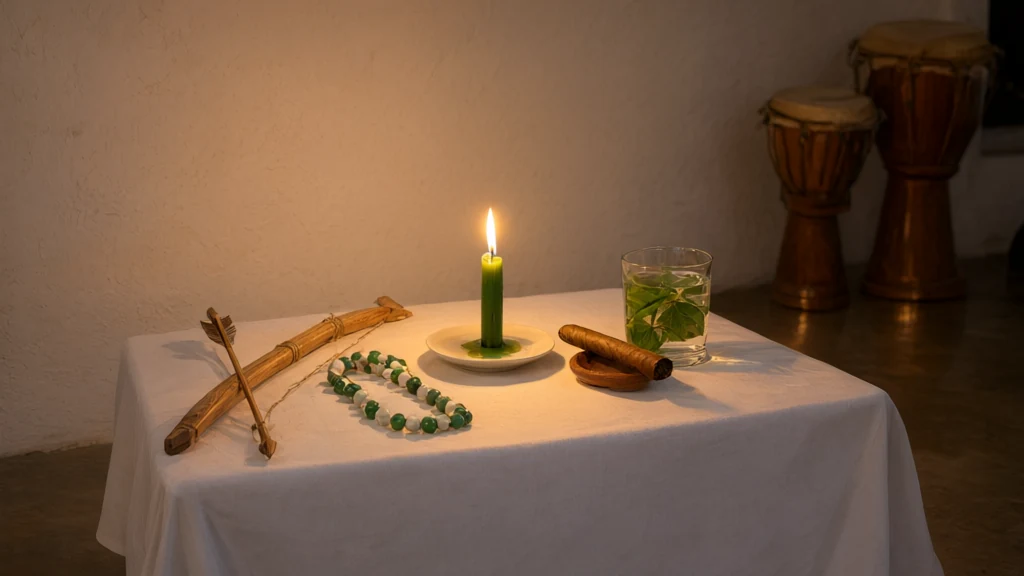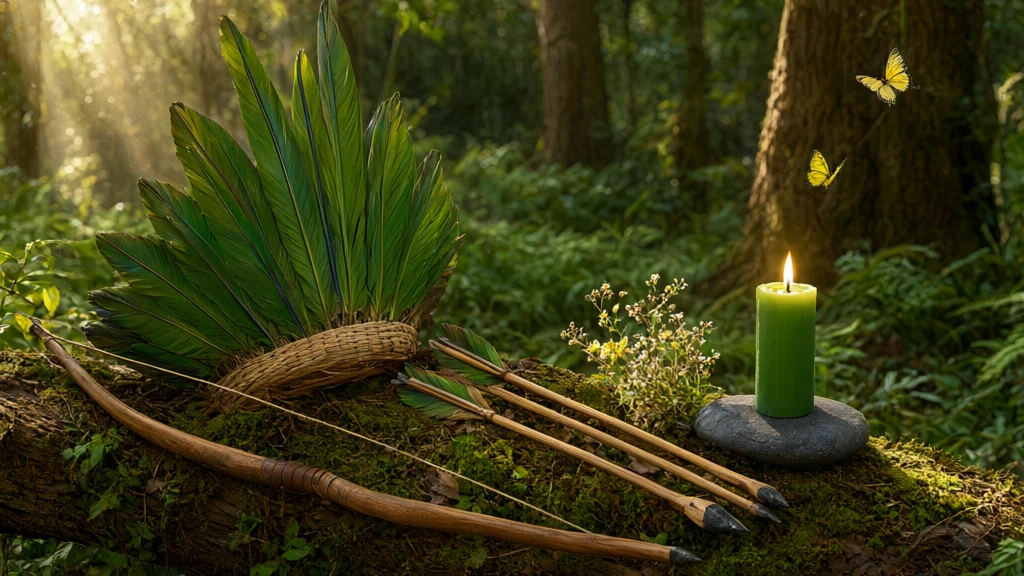
The caboclas of umbanda are the feminine face of the caboclo people, and the most frequently sung are Jurema, Jupira, Jandira, Iracema and Iara. Each one has their own name and history, and the same name repeats in many houses. The line of each cabocla changes according to the author and the terreiro.
Who are the caboclas of umbanda?
The most cited caboclas in research about umbanda are these, with the line that each source provides:
| Cabocla | Line or orixá, according to the source |
|---|---|
| Jurema | Oxóssi in Matta and Silva and in a house in Campo Grande; streams of Oxum (Oshun) in a painting by Raul Lody |
| Jupira | Iansã in the candomblé of caboclo; sung in the sung chants of Oxóssi at Zélio de Moraes's house |
| Jandira | Iemanjá in a UFJF study; Iansã winds in Lody's painting |
| Iracema | Iemanjá in the UFJF study; waterfall cabocla in a ponto riscado |
| Iara | Iemanjá in Matta e Silva, in Lody and in the caboclo candomblé |
| Indaiá | Iemanjá in Matta e Silva and in the UFJF study |
| Jussara | Oxóssi points from Zélio's house; messenger of Iemanjá for an Umbandista |
Raquel Rotta and José Bairrão, from USP, who interviewed mediums in possession, write that studies dedicated only to caboclas are "extremely rare". For them, the caboclas "are individualized, have their own names and stories".
The name is of a falange. In a Campo Grande gira, researcher Thaís Constantino saw "the Juremas, Jaciras, Iracemas, Indaiaras" dancing. Cristiane Barros, from UFJF, notes that there are no two identical Indaiá caboclas. What the line of the caboclos is in caboclos in umbanda.
Which orixá is cabocla Jurema from?
In most sources, Cabocla Jurema is from the line of Oxóssi. In the esoteric Umbanda of Matta and Silva, she is one of the phalanges of this line, alongside Caboclo Arranca Toco and Caboclo Araribóia. In the Templo de Umbanda Pai Oxalá (Obatala), in Campo Grande, the caboclas and caboclos "generally work in the line of Oxóssi".
There are other readings. In the chart of Raul Lody reproduced by researcher Pedro Nogueira, Jurema stays in the streams of Oxum. Barros puts "juremas" in the water people of Iemanjá. In the caboclo Candomblé of São Paulo, studied by Reginaldo Prandi, Jurema appears among the caboclos of Oxóssi.
A sung chant cited by researcher Sônia Lages sings that "Jurema is the daughter of Tupinambá". It is a narrative of a sung chant, not doctrine. The hunter line is in Oxóssi in Umbanda.
In houses in Petrópolis, the mediums of Cabocla Jurema wear green and use green feather headdresses. One of them works with tobacco leaf in the right hand.

Who are the caboclas of Iemanjá?
The most cited caboclas of Iemanjá are Iara, Indaiá, Jandira and Iracema. In the esoteric Umbanda of Matta and Silva, the line of Iemanjá has seven phalanges of caboclas: Yara, Indaiá, Nanã (Nana Buruku), Estrela do Mar, Oxum, Iansã and Sereia do Mar.
Barros records in the same line "the phalanges of sailors, caboclas iaras, juremas". The vibration of Iemanjá, for her, appears in the caboclas Indaiá, Iara, Jandira and Iracema. A sung chant from the house of Zélio de Moraes has Jandira say she is a mermaid:
I am Cabocla Jandira, / I am the Sereia do Mar. Book of Sung Chants, Tenda Espírita Nossa Senhora da Piedade.
The orixá of the sea in Umbanda has a bead necklace in Iemanjá in Umbanda, and the sailors, in sailors in Umbanda.
And the caboclas of Oxum and of Iansã?
In the Candomblé of caboclo from São Paulo, Prandi and his colleagues list Lua Nova, Jandaia, Cabocla Menina, and Estrela Dourada among the caboclos of Oxum. For Iansã, the same research gives Jupira, Ventania, and Vento. In Lody's chart, Jandira is one of the winds of Iansã. The caboclas of Oxum in Umbanda also appear in Oxum in Umbanda.
Jupira, Jandira, Jussara, and Jurema in the sung chant (ponto cantado) of Zélio's house
The Tenda Espírita Nossa Senhora da Piedade, the house founded by Zélio de Moraes, keeps a sung chant (ponto cantado) of Oxóssi that joins four caboclas. Each verse gives a sign of one of them:
Jandira brings a rose in her hair, Jupira brings a jasmine on her chest, Jussara is a beautiful Cabocla of feather, Jurema feels sorry for me. Book of Sung Chants (Pontos Cantados) of the TENSP.
The sung chant (ponto cantado) does not say they are sisters. The idea that Jurema, Jupira, and Jandira are sisters appears only in a draft of a municipal law in Porto Alegre, from 2023. In Petrópolis, an Umbanda house has Caboclo Iran and Cabocla Jupira as its leaders. Other sung chants (pontos cantados) are in sung chants (pontos cantados) in Umbanda.
Iracema and Jandira: the names of the romances
Iracema and Jandira are names of characters by José de Alencar. Rotta and Bairrão recall that, in the romance, "Iracema is forbidden to love, as she keeps the secret of Jurema". Jandira appears in Ubirajara.
The authors do not say that the cabocla is the character. They see the caboclas as constructions "influenced, in a selective way," by the feminine models of literature. And they note a difference: in the interviews, the caboclas "practically never narrate sufferings for love."
There are two readings in academia. For Paula Montero, summarized by Lages, the caboclas bring the stereotype of the "young virgin," beautiful and pure. For Rotta and Bairrão, who heard the caboclas themselves, they are hunters and gatherers of the forest, and not the submissive indigenous women of the romance.
Are cabocla Jurema and Jurema Sagrada the same thing?
No. The word Jurema "does not designate a single entity," writes researcher Gustavo Santos, from UFTM: it names a tree, a cult, a caboclo spirit of Umbanda, and a drink. The cult comes from the Northeast and, in a third moment, becomes a line of Umbanda. The caboclo people of Jurema Sagrada, alongside the masters, are in caboclo da Jurema.
The Jurema Sagrada is a religion of indigenous origin from the Northeast, centered in Alhandra and Conde, in Paraíba. State Law 13.760, sanctioned on July 16, 2025, recognized it as intangible heritage of the state. The cabocla Jurema that descends in the Umbanda gira is something else. The religion has its own page in Jurema, and the caboclo rite of Candomblé, in candomblé de caboclo.
Greeting, color, and what the cabocla asks
The greeting is the same as the caboclos: Okê Caboclo, adapted from Okê Oxóssi. In a house in Campo Grande, the gira opens with "Okê Arô, caboclas and caboclos!" In the right-side giras of this house, the medium wears white.
The sources do not provide a specific color or day for each cabocla. The only color recorded is the green of the mediums of Cabocla Jurema in Petrópolis. For the offering, the same house in Campo Grande mentions candles, water, flowers, and fruits, without a specific recipe for each cabocla. Rotta and Bairrão record a sign: "Finding one or several butterflies is a sign that caboclas are nearby."
Who says which cabocla accompanies someone is the house. The discover your spirit test points to the caboclo line, not the name of the cabocla. What to take to the gira is in what to ask the caboclo. If your house asked for a green candle or herbs for the caboclo gira, Joia Mística helps check the material via WhatsApp.
Frequently asked questions
Which orixá is Cabocla Jupira from?
In the Candomblé de caboclo of São Paulo, Jupira is among the caboclos of Iansã. In Umbanda, she is sung in the points of Oxóssi of the house of Zélio de Moraes. The line changes according to the terreiro, and her house has the final word.
Is Mata Virgem a cabocla?
In the sources we consulted, Mata Virgem is a caboclo, masculine. Nogueira records the Caboclo Oxóssi Mata Virgem in a house in Petrópolis. Prandi also places him among the caboclos of Oxóssi.
Is there a cabocla in the line of the sailors?
Nogueira records the Cabocla Dona Mariana, who is a sailor, as a feminine exception among the sailors. It is a record from one house.
What is the color of the cabocla Jurema?
In Umbanda houses in Petrópolis, the mediums of Cabocla Jurema wear green and use green feather headdresses. There is no fixed color published for all of Umbanda. In other houses, the caboclo giras are white.
References
- Rotta and Bairrão, Revista Estudos Feministas (2007): Inscriptions of the feminine: romantic literature and the trance of caboclas in umbanda
- Thaís Constantino, UFMS (2023): Enchanted body: the (in)corporation of caboclas and caboclos
- Prandi, Vallado and Souza (2001): Candomblé de caboclo in São Paulo
- Pedro Nogueira, UFJF (2014): The intra-religious dialogue in Umbanda: a study based on the figure of the Caboclo
- Sônia Lages, UFJF (2003): Exu, light and shadows
- Cristiane do Amaral de Barros, UFJF (2006): master's thesis in Religious Studies
- Lourival Andrade Júnior, Mneme, UFRN (2014): The caboclos in Afro-Brazilian religions
- Tenda Espírita Nossa Senhora da Piedade: Book of Chanted Points
- Gustavo Santos, Revista do NUFEN (2022): Jurema and the being of the Brazilian woman
- Legislative Assembly of Paraíba: Law 13.760, of 2025, Sacred Jurema
- Municipal Chamber of Porto Alegre (2023): draft of Cabocla Jurema Day