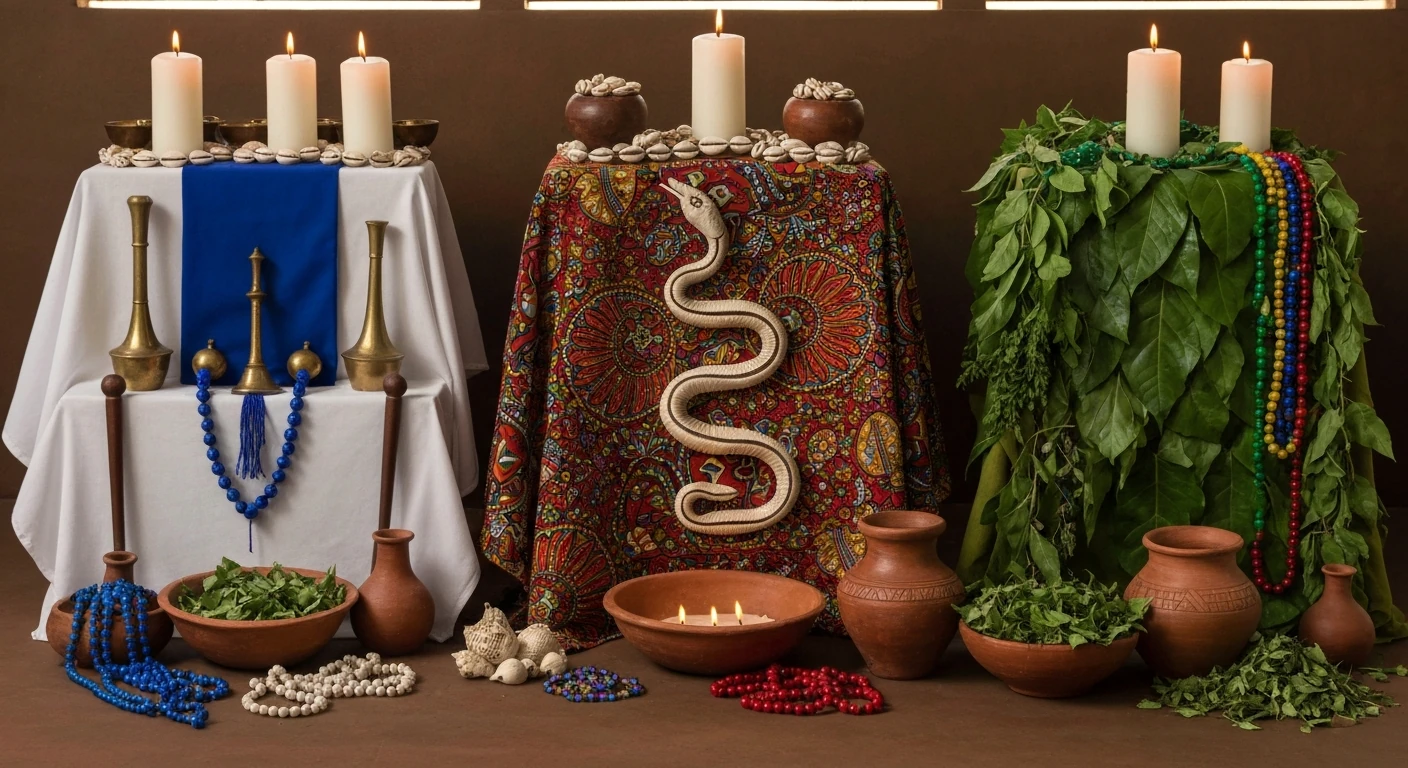
The xirê ends, the orixás withdraw, and the atabaque changes its toque. Other people enter the circle: leather hats, feather headdresses, lit cigars. And, for the first time in the night, someone speaks Portuguese to everyone.
The candomblé de caboclo is the worship of the enchanted ones of the land within the house of the orixás (casa de santo). It is not umbanda, it is not a parallel line: it is the part of candomblé in which the original owners of this ground are called by name.
This guide explains what candomblé de caboclo is and why it was born in the houses of angola. It also shows who the caboclos are and what separates this caboclo from the caboclo of umbanda.
What is candomblé de caboclo
Candomblé de caboclo is any candomblé that, in addition to worshipping orixás, voduns, or inquices, also worships the spirits of the original peoples of the Americas.
The caboclos are encantados. The term has a precise definition in Reginaldo Prandi's research. They are spirits of men and women who died, or who passed directly from this world to a mythical and invisible world. It is said they became enchanted.
They are not orixás. They are spirits who lived on the land, and each caboclo is considered a filho de um Orixá. A son of Oxum (Oshun) has a caboclo of Oxum, a son of Xangô (Shango) has a caboclo of Xangô.
Today, people speak of "nação de caboclo," and the term circulates in the meetings of nations. In practice, however, candomblé de caboclo almost always functions inside a house of angola, ketu, or jeje, and rarely alone.
Why the caboclo was born in the houses of angola
The root is banto. The peoples we would call Angolans and Congolese today worshipped the inquices in Africa, deities linked to the land, the river, the stone of a specific place.
Here is the point: inquice does not travel. It is bound to the territory. Kidnapped and brought to another continent, this people was left without the ancestor of the land where they began to live. And they found here another owner of the ground.
The caboclos were adopted as the true and first owners of the Brazilian land. Worshiping the caboclo was the way to re-establish, in Brazil, a relationship with the place that the crossing had broken.
Prandi, Vallado and Souza locate the origin in the ancient terreiros of angola and congo in Bahia. The two biggest names are the Bate Folha and the Tumba Junçara, both in Salvador, both centenarian. Regarding inquices and the Bantu logic, the article on what is a nkise is worth reading.
The coexistence between the two presences was studied closely. Miriam Rabelo and Ricardo Aragão researched how caboclos and orixás share the terreiro in houses in Salvador. They describe a relationship of symbiosis, not of hierarchy: each maintains its nature, and the house organizes space and time so that both fit.
A curiosity that explains many fights: the expression "candomblé de caboclo" was born among the povo de santo of ketu, to mark distance from the terreiros that received caboclo. The name came from outside, with a charge of disqualification. Today the caboclo is present in houses of almost all the nações.
Who are the caboclos
The most well-known origins are three:
- Caboclo de pena: the indigenous caboclo, who uses a headdress and feathers in trance
- Boiadeiro: lived in the sertão in the cattle work, and comes with a leather hat
- Marujo: sea caboclo, always staggering from the tilting of the ships
There are also turcos and caboclos from mythical places like Vizala and Hungria. The names follow nature: Pena Verde, Sete Flechas, and Jurema in Oxóssi; Cobra Coral in Oxumaré (Oshumare); Sete Ondas and Iara in Iemanjá (Yemoja); Pedra Branca and Pena Branca in Oxalá (Obatala).
The greeting documented in the caboclo candomblé is of Bantu root:
“Xeto marrumbaxeto! Xeto na Vizala! Xeto á!”
Before the caboclos arrive, the mãe de santo intones the Angoroci, the set of praise prayers. Each caboclo also has their ilá, the specific shout with which they announce their arrival.
How is the caboclo festival
There are two different ceremonies, and confusing the two is a common mistake.
The toque is the periodic public session where the caboclos come to work and give consultations. The festa is the annual celebration where they come to be honored, dance, and eat, without public service.
The sequence of the toque begins with the padê, passes through the xirê to the orixás or inquices, follows with the Angoroci, and only then do the caboclos arrive. The three atabaques are played with the hands, in the angola style. The chants are in Portuguese, and it is the only moment of the night when everyone inside the barracão speaks the common language.
On the table, moranga is never missing. Along with it come cooked corn, farofa, fruits in abundance, tobacco leaf, and honey. The ritual drink is jurema, prepared with the bark of the shrub, sweet wine, honey, nutmeg, ginger, clove, and cinnamon. In some houses, it is called menga.
The caboclo drinks the jurema from a cuia and offers it to those present. Etiquette dictates that whoever drinks turns their back to him, a legacy from the times when one did not drink in front of the elders.
Caboclo de candomblé is not caboclo de umbanda
This is the most frequent confusion, and it has historical roots. Umbanda was born in Rio de Janeiro, in the 30s, from the meeting of the caboclo cult with Kardecist Spiritism. The caboclo came first; the Kardecist framework came later.
| Aspect | In Candomblé de caboclo | In Umbanda |
|---|---|---|
| Origin | Bahia, houses of angola and congo | Rio de Janeiro, 30s, with Kardecism |
| Nation | Declared, angola in first place | No organization by nation exists |
| Ethics | Without the Kardecist division of good and evil | Spirit of light, evolution, charity |
| Assentamento | It has one, as an iron tool in the alguidar | Firmeza with candle, bead necklace (guia), and ponto riscado |
| Initiation | Caboclo baptism, short and specific rite | Mediumship development in the gira |
| Greeting | Xeto marrumbaxeto! | Okê Caboclo! |
| Relationship with the Orixá | The caboclo is a son of the Orixá | The caboclo works in the line of the Orixá |
One difference is very concrete: in Candomblé, the caboclo receives sacrifice and has an assentamento. In Umbanda, no. For the complete picture of both religions, see the difference between Umbanda and Candomblé, and for the Umbandista caboclo, the article about caboclos in Umbanda.
It is worth noting what the people of santo themselves say about the scope of the consultation. The caboclo teaches ritual bath and remedy, relieves, and guides. What defines fundamento continues to be the cowrie-shell divination.
July 2: the caboclo of the Independence of Bahia
On July 2, 1823, Portuguese troops were expelled from Bahia. The following year, there was already a procession, and on the chariot went the figure of a Caboclo, an indigenous man adorned with leaves and fruits. Then came the two statues, the Caboclo and the Cabocla.
The choice was not casual. According to the Salvador City Hall, the white figure reminded people of the Portuguese oppressor and the black figure carried the stigma of slavery. The indigenous person was chosen to materialize Brazilian identity in the parade, and the image was already circulating in the religion of the Bahians.
In the terreiros, the date became a caboclo festival. The newspaper A Tarde records that the Candomblé of Angola tradition were the first to incorporate the worship of caboclos. The statues receive offerings of pumpkin with tobacco leaf and fruits, the same ones that go to the table of the casa de santo.
Frequently asked questions
What is caboclo Candomblé?
It is any Candomblé that, in addition to worshipping orixás, voduns, or inquices, also worships the caboclos, spirits of the original peoples of the Americas. It was born in the Bahian houses of Angola and Congo tradition, and today it appears in terreiros of practically all nations, with its own festival, toque, and assentamento.
Is Caboclo an orixá?
No. Caboclo is an encantado, a spirit of someone who lived on this land or who passed directly to an invisible world. Orixá is a divinity. Every caboclo is considered a child of an Orixá and, in many houses, functions as his messenger, saying what the Orixá does not say.
What is the difference between caboclo of Candomblé and caboclo of Umbanda?
They are distinct cults. In Candomblé, the caboclo has an assentamento, receives a sacrifice, arrives after the xirê, and is greeted with "Xeto marrumbaxeto". In Umbanda, formed in Rio in the 30s with Kardecism, he works in the gira, without sacrifice, and is greeted with "Okê Caboclo".
What is the jurema of caboclo Candomblé?
It is the ritual drink of the festival, made with the bark of the jurema shrub, sweet wine, honey, nutmeg, ginger, clove, and cinnamon. In some houses, it is called menga. The caboclo drinks from the cuia and offers it to the guests, who must turn their backs to drink.
Why is the caboclo celebrated on July 2?
Because the date marks the expulsion of the Portuguese troops from Bahia in 1823, and the civic procession adopted the figure of the Caboclo as early as 1824 as a symbol of Brazilian identity. The terreiros of the Angola tradition, which already worshipped the caboclo, incorporated the date into the festival calendar.
Where to buy items for the caboclo worship
At Joia Mística Laroyê, you will find:
- Cigars and tobacco leaf: the cigar accompanies the caboclo at all times
- Cuias and alguidares: for the jurema and for fruit offerings
- White pemba: used in the ponto riscado that gives rise to the assentamento
- Bead necklaces (guias) and beads: in the colors of the orixá to which the caboclo is affiliated
- Herbs and fresh leaves: for the junça and for the indicated baths
Visit our shop in Extrema, Minas Gerais or talk to us via WhatsApp and we ship all over Brazil.
Anyone who wants to go to the source can find the chapter “Candomblé de caboclo em São Paulo”, by Prandi, Vallado, and Souza, open on the researcher's site at USP.
References
- Scielo: research by Miriam Rabelo and Ricardo Aragão on the coexistence between caboclos and orixás in the terreiro
- A Tarde: report on July 2 and the alliance between indigenous and African peoples
- Reginaldo Prandi (USP): Candomblé de caboclo chapter in São Paulo, by Prandi, Vallado and Souza