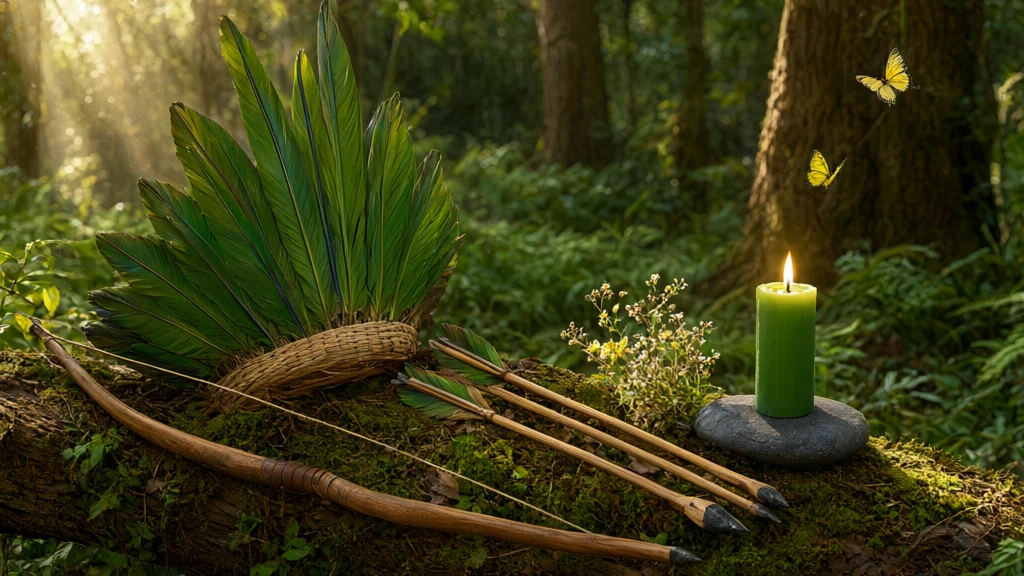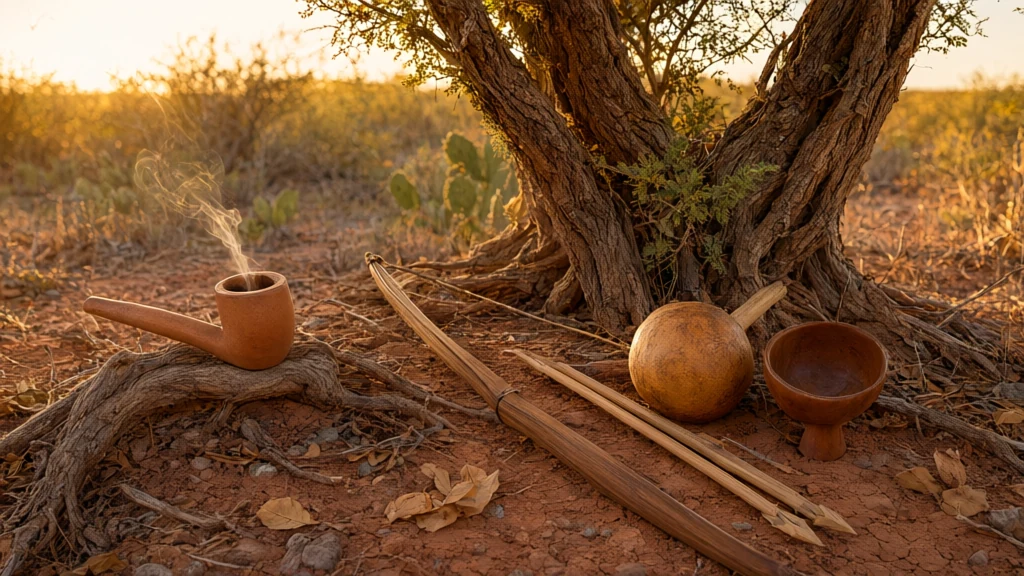
The caboclo of Jurema is the enchanted spirit of indigenous origin from the Jurema Sagrada of the Northeast. With the masters and the mistresses, he forms the center of the worship. He arrives at the gira with the gesture of the bow and arrow and heals with herbs and smoke. For many juremeiras, he is a living spirit who became enchanted in the forest.
Who is the caboclo of Jurema?
The caboclo of Jurema is one of the great families of spirits in the religion. Roberto Motta, from UFPE, writes that the spirits of the Jurema of Recife fall "above all into two categories: masters and caboclos". Sandro Guimarães de Salles defines Jurema as a worship "to the masters, caboclos and kings". The origin is in the indigenous peoples of the Northeast.
The caboclo brings indigenous memory. In the Jurema that Motta met, this identity came "symbolized by the mimicry of the bow and arrow". Lísias Negrão, read by Maria Acselrad, sees the caboclos as healers, "holders of the science of herbs", chiefs and warriors.
Religion: Jurema Sagrada or catimbó-jurema | Region: Paraíba, Pernambuco and Alagoas | Family: enchanted, alongside the masters and the mistresses | Sign in the gira: bow and arrow, maracá and smoke
Jurema Sagrada has been intangible heritage of Paraíba since Law 13.760, of July 16, 2025. The religion, the tree and the worship are on the Jurema Sagrada page.
What is the difference between caboclo and master in Jurema?
The caboclo is enchanted, and the master was a person. The one who explains is Mãe Nininha, juremeira and ialorixá of Ilê Asé Oyá Onira, in Goiana (PE). She spoke to the researcher Maria Acselrad:
And there are the encantos of Jurema who are the caboclo. The caboclo are enchanted. The masters were people like your father, my father, my great-grandfather. Mãe Nininha, in Acselrad, Locus, 2024.
For her, the caboclo "enchanted himself in a tree, at the foot of the angico", in a vine, in a root. That is why the caboclo leaves the medium hot. The master, spirit of someone who died, leaves the medium cold.
Motta saw the difference in the body. In Recife in recent decades, there are "evident differences between masters and caboclos in the gestures that accompany the dance and the trance". It was not always like this. In 1949, Oneyda Alvarenga recorded a "Mestre Caboclo Tupi" in a catimbó: the two families had already mixed.
The most well-known master outside of the Northeast is Zé Pelintra, malandro in Umbanda and master in Jurema.
What are the caboclos of Jurema?
The caboclos of Jurema come in tribes, and each tribe is a falange. Mãe Nininha names four: "the canindé, the tapuia, the tupinambá, the orubá". The caboclo almost has no biography of his own. He carries "a collectivized identity", such as caboclo canindé or caboclo tupinambá, notes Acselrad.
The registered names change from place to place:
| Caboclo | Where it was registered |
|---|---|
| João da Mata, Jurandir, Pena Branca | Jurema do Recife, in Motta |
| Jacira and Jandira | Jurema do Recife, in Motta |
| Rei Canindé, Rei Tamandaré | Jurema do Recife, in Motta |
| Rei de Orubá, or Urubá | Recife (Motta), Goiana (Acselrad), Bayeux (Boaes) |
| Tupinambá, called "Royal Tupinambá" | gira toada studied by Mont’mor |
| Caboclos d’água | jurema de mesa, in Goiana |
Motta puts Rei Canindé and Rei Tamandaré among the caboclos. Salles counts the kings as his own family, alongside masters and caboclos. In jurema de mesa, the mediums work seated and receive "the caboclos d’água, the mermaids" and the masters.
Hunting and arrow are the signs of the caboclo. In a toada recorded by Mont’mor, the caboclo sings "Daddy was a hunter, mommy let me hunt". The author reads hunting there "as an attribute of the Caboclos". The archer caboclo and the hunter caboclo are this same people.
The cities of Jurema, where the caboclo lives
The juremeiros call the world of the enchanted cities, kingdoms or encantos da Jurema. Mont’mor, from UFPB, records that there live "masters, mistresses, caboclos, kings and enchanted ones". For Mário de Andrade, the Kingdom of Jurema has seven cities: Vajucá, Junça, Catucá, Manacá, Angico, Aroeira and Jurema.
The city is also on the ground of the terreiro. For Mont’mor, a jurema planted and consecrated is already an enchanted city. In jurema de mesa, the "princess", a vessel with water, is surrounded "by cups and glasses, which represent the cities of jurema". In Alhandra, under the jurema tree of Mestra Aderita, Mestre Siriaco sang this toada:
In the city of Jurema I want to work, with my arrow in hand, shake my maracá. Toada sung by Mestre Siriaco, recorded by Mont’mor (UFPB, 2017).
Right after came "Jurema has, the cities gives, Caboclo good to work". Then the master greeted "the Caboclos and the virgin forests".
Not every caboclo lives in the cities. Pai Osias told Mont’mor that the caboclos juremeiros are part of them. As for the “clean caboclos, they do not roam inside” the cities. It is the vision of one house, and other houses say otherwise.
Pipe, smoke and drink: how the caboclo works
The caboclo of Jurema works with tobacco leaf, smoke and counsel. Motta calls Jurema “eminently the cult of tobacco, smoked from pipes, cigars and cigarettes”. When they descend, masters and caboclos “like to sprinkle the consultants with smoke”. For Motta, it is “the simplest and most accessible of all healing rituals”. The trance “is eminently verbal”: the caboclo speaks in popular Portuguese and advises on health, employment and other urgent problems.
What does the caboclo of Jurema ask for? Jurema, cachaça and tobacco leaf. Roger Bastide wrote in 1945 that the caboclos come “above all” to ask for this. In theory, the jurema drink comes from the root of the jurema preta. In practice, Motta says, the main ingredient is “cane spirit, to which some pieces of the sacred root are added”. Each house has its own preparation, and the house is the one that prepares it.
At the Centro Espírita Santa Cecília, in Maceió, the pipe for the jurema ritual work is called gaita. There, the pulp of the herbs that remains from the drink dries in the sun. Then it becomes smoke cleansing (defumação) “in the houses of the filhos de santo”, as Caboclo Índio indicated, and goes “mixed with the tobacco leaf used in the pipes”.
The caboclo also defends. In the terreiros of Goiana, the healing power of the caboclos is unanimous, and they protect the house and its people. Did the house ask for a clay pipe, tobacco leaf or smoke cleansing herbs for the gira? Joia Mística helps check the material via WhatsApp. What to take and what not to ask the caboclo is in what to ask the caboclo.
The caboclo of Jurema in Umbanda and Candomblé
In northeastern Umbanda, the caboclo of Jurema shares the terreiro with other lines. With Umbanda, the "Caboclos, Masters, and Kings of Jurema coexist in terreiros with Pretos-Velho, Exus, and Pombagiras", record Souza and Andrade Júnior. In the houses of Goiana, the caboclos are chanted after Exu (Eshu), Pombagira, and Malunguinho. The masters close the gira.
In Candomblé, the caboclo of Jurema appears in the houses of xangô of the xambá nation, in Pernambuco and Alagoas. The Terreiro Santa Cecília, in Maceió, practices "jurema, or the cult of the caboclos, and xangô, as a cult to the orixás (orishas)". There, jurema is "the part of the caboclos". The terreiro Santa Bárbara, in Olinda, does the opposite. There, "total separation between the cult of the orixás and the cult of jurema" applies. The caboclo of baiano Candomblé, of angola roots, is another story, told in candomblé de caboclo.
And the cabocla Jurema? She is the cabocla of Umbanda who bears the name of the tree. Boaes recalls that Jurema "is also the name of a cabocla, the daughter of Tupinambá". Which orixá she belongs to is in caboclas da umbanda. The line of the caboclos in the Southeast is in caboclos na umbanda. The test discover your spirit indicates if your line is of caboclo. Who says which caboclo accompanies someone is the house.
Frequently asked questions
Is the Caboclo da Jurema an orixá?
No. For Mãe Nininha, from Goiana, "in jurema, you do not work with divinity": the orixá is divinity, and the caboclo is an encantado. Some houses of xangô bring caboclos and orixás closer, like the one in Maceió. Others separate the two cults.
What does the caboclo da Jurema drink and smoke?
According to Bastide, the caboclo asks for jurema, cachaça, and fumo. He smokes a pipe, cigar, or cigarette and blows the smoke over whoever is consulting. In Maceió, the pipe is called gaita.
Are Caboclo da Jurema and cabocla Jurema the same spirit?
No. The caboclo da Jurema is the enchanted indigenous people of Jurema Sagrada, with many tribes and names. The cabocla Jurema is a spirit of Umbanda, remembered as the daughter of Tupinambá.
References
- Roberto Motta, Revista del CESLA (2020): Xangô, Jurema and Umbanda: notes on three forms of popular religion in the Recife region
- Maria Acselrad, Locus, UFJF (2024): Jurema is body, not head: enchantment, learning and transformation between caboclos and caboclinhos
- Luís Felipe Cardoso Mont’mor, UFPB (2017): The enchanted plans of Jurema: Acais, Tambaba, other cities and kingdoms
- Morôni Laurindo do Nascimento, UFPE (2012): study on the worship of the caboclo in Terreiro Santa Cecília
- Marta Sanchís Clemente, Anais da ABHR (2015): elements of Jurema in a carnival indigenous tribe in João Pessoa
- Souza and Andrade Júnior, Anais da ANPUH: Enchanted Northeast: the worship of enchantment in Jurema
- Giovanni Boaes, CAOS, UFPB (2009): Afro-Brazilian religiosities
- A União (2025): The faith that is born under Jurema Sagrada