Dreaming of water, in the tradition of the orixás, leads to the iabás of the waters: Oxum in fresh water, Iemanjá in the sea and Nanã in the mud and in still water. No terreiro has a dream table. Water speaks of cleansing, of origin and of new beginnings, and who reads your dream is your house, with its oracle.
| Orixá | Her water in the tradition | Source |
|---|---|---|
| Oxum | fresh water; rivers, lagoons and waterfalls | Prandi; Verger |
| Iemanjá | great waters and sea; in Africa, a river | Prandi; Verger |
| Nanã | mud from the bottom of the waters; murky and still water | Prandi; FUCESP |
The general reading is in the guide of dreams in Umbanda. Fire is in dreaming of fire, the serpent in dreaming of a snake and those who have left in dreaming of a person who has already died.
What does dreaming of water mean for the orixás?
For the orixás, water is the domain of the iabás, and each water has its own. In the table of queto terreiros of Reginaldo Prandi, Oxum is with rivers, lagoons and waterfalls. Iemanjá is with the sea and the great rivers, and Nanã with the mud and the swamp. The dream does not gain a fixed meaning because of this. It gains a path of reading: what water appeared, and to whom it belongs.
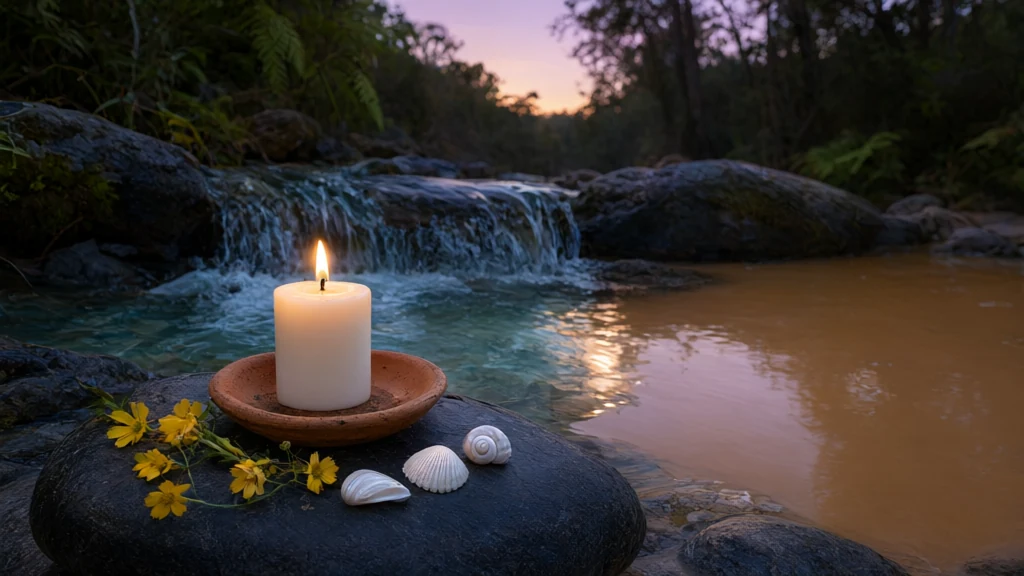
Oxum: fresh water | Iemanjá: sea | Nanã: mud and still water
Oxum: the fresh water of rivers and waterfalls
Oxum is the orixá of fresh water. Pierre Verger calls her "the queen of all rivers," mistress of the fresh water "without which life on earth would be impossible." In Umbanda, the FUCESP record says she receives offerings in rivers, springs, and waterfalls. A medium heard in Cristiane Barros's dissertation summarizes it the same way: Oxum is "the queen of the waterfall." More about her in who is Oxum.
Iemanjá: the river that became the sea
Iemanjá is, in Prandi's table, the “orixá of the great waters, of the sea.” In Africa, Verger says, she lived in a river: first the Yemojá river and, after the wars of the egbá, the Ògùn river, which became her new home. In Brazil, the sea is hers. In the Barros dissertation (UFJF), Iemanjá “reigns over all the waters of the Earth.” The National Sanctuary of Umbanda delivers the offerings in the sea, the “calunga grande.” The complete history is in who is Iemanjá. The fish, the animal of Iemanjá and Oxum, has its own reading in dreaming about fish.
Nanã: the mud of the bottom and the still water
Nanã is the oldest of the iabás and stays with the water that does not flow. Prandi calls her the "orixá of the mud at the bottom of the waters," with dominion over mud, the swamp, seniority, and death. The FUCESP record says she "reigns in the muddy waters" and describes Nanã as "still water, water of life and of death." See who she is in who is Nanã.

Is dreaming of dirty or muddy water bad?
Not by itself. No terreiro source open for this text says that dreaming of dirty water is a bad warning, nor does it give meaning to muddy, murky, or muddy water. Those who claim this are dream dictionaries, without a source. What tradition has is the owner of the dark water.
The murky water belongs to Nanã. FUCESP records her dominions in "murky waters, muds, and mangroves." The National Sanctuary of Umbanda places Nanã in lakes, in swamps, in mud, and in the meeting of the river with the sea.
And the mud, in the myth, is the matter of life. In the itã reproduced by FUCESP, Oxalá (Obatala) tries to create the human being with water, air, fire, and palm wine, and man falls apart. Nanã brings the mud from her domains, and with it, man is created. The Sanctuary tells the same: Nanã used the ibiri to take the mud of creation from the bottom of the lake. In the myth, Nanã's mud is the beginning of human life.
In Cuba, according to Lydia Cabrera cited by Verger, Yemaya Asesu, messenger of Olokum, "lives in agitated and dirty water" and is slow to attend. It is a Cuban record, outside of Brazilian terreiros.
In the Umbanda chants (pontos), the dirt goes away through the water. Marina Graminha and José Bairrão (USP) read about 1,200 sung chants (ponto cantado) and separated 155 that speak of water. In the study, fresh water "dissolves and transports to the sea", and the most common destination of this dirt is the bottom of the sea.
“All the evil of these children, oh Mermaid / Take it to the bottom of the sea” (Umbanda chant (ponto) transcribed by Graminha and Bairrão, Memorandum, 2009)
The water that cleans: waterfall, sea and Waters of Oxalá
Clean water appears in tradition as cleansing and as a new beginning. Among the meanings that Graminha and Bairrão found in the 155 chants are motherhood, light, baptism, life and death, and cleansing. The authors write that this cleansing is ritual, "but it is also the cleansing of pain, of sorrows and of evil".
In Umbanda, the waterfall is the place of this water. For NUSS, an Umbanda center, the waterfalls are consecrated to Oxum, along with Xangô (Shango). Waterfall baths "discharge and purify". The same house warns that a lit candle in the waterfall only dirties the place. The chant cited by the USP researchers sings the scene: "In mommy Oxum's waterfall / Crystal clear water runs
In Candomblé ketu, clean water marks a new beginning. According to Gaia and Scorsolini-Comin, the name Águas de Oxalá recalls the bath of Oxalá upon leaving prison: in the itã, Xangô discovers that the prisoner was the father and orders to bring "clean water and clothes." The festivities mark "a new beginning." The rite, which belongs to the house, is in Águas de Oxalá.
What to do when waking up from a dream with water
Upon waking, write down the dream, say a prayer, and keep what you felt. A priest of umbanda heard by Bressan and Oliveira says that the dream is not read literally. The message needs to be confirmed with the incorporated spirit. For him, one of the benefits of the dream is entering into communion with natural forces, such as earth, fire, water, and air.
- Write it down immediately. What kind of water it was, if it was clear, muddy, or still, if it was running or rising, and what you felt.
- Light a white candle to your Guardian Angel next to a glass of clean water and say a prayer in your own words. Those who cannot light one at home have the Guardian Angel candle on the virtual altar.
- Do not take action out of fear. A dream is not read literally and is not a sentence.
- Take it to your house if the dream returns, feels heavy, or brings an orixá. In Candomblé, even the dreams of the initiate are read as signs, but inside the terreiro. The one who reads is the zelador or the mãe or pai de santo. Joice does not throw búzios and does not perform this reading.
If the house asks for a herbal bath, the which bath to take test helps find the recipe. If it asks for a candle for the iabá, the color is also from the house; the candles of Oxum, Iemanjá and Nanã are on the virtual altar. To check the material the house requested, the shop can be reached via WhatsApp. And, to know which orixá rules your head, the discover your orixá test gives a first clue; the true answer comes from the house.
A recurring dream of a flood or drowning that takes away your sleep also calls for a conversation with a doctor or psychologist. One thing does not exclude the other.
Frequently asked questions
What does it mean to dream about the sea?
The sea belongs to Iemanjá, the orixá of the great waters in the Prandi table, and in Umbanda, offerings are received in the sea, the "calunga grande." No source says that dreaming of the sea is a call from her. If the dream repeats or brings Iemanjá, take it to the zelador of your house.
Is dreaming of a flood of dirty water a warning?
There is no source of Candomblé or Umbanda that reads this dream. Turbid water and mud are the domain of Nanã, and in Umbanda chants (pontos), fresh water takes the evil to the bottom of the sea. Note the dream, say a prayer and, if it returns, seek your house.
Does dreaming of water inside the house have a spiritual meaning?
No open source for this text gives a meaning for water inside the house. An Umbanda priest heard by Bressan and Oliveira reminds us that the dream is not read literally. The weight depends on what the dream brought and what you felt, and the reading is from the house.
References
- PRANDI, Reginaldo. Horizontes Antropológicos (UFRGS), 1995. article African gods in contemporary Brazil
- VERGER, Pierre. Orixás: deuses iorubás na África e no Novo Mundo. Corrupio, 1981. Book record
- BARROS, Cristiane Amaral de. UFJF, 2006. Iemanjá e Pomba-gira
- GRAMINHA, Marina Rachel; BAIRRÃO, José Francisco M. H. Memorandum, 2009. Torrents of meanings
- GAIA, Ronan; SCORSOLINI-COMIN, Fábio. Memorandum, 2020. Candomblé Ketu and religious syncretism
- BRESSAN, Renato; OLIVEIRA, Andréa. Sacrilegens (UFJF), 2025. Terreiros of the psyche
- ORTEGA MARÍN, Alexander. Revista Iluminus (UFMA), 2026. Salvador de Bahia photographed
- FUCESP. Oxum and Nanã
- Santuário Nacional da Umbanda. Nanã Buruquê and Iemanjá
- NUSS. The Waterfalls