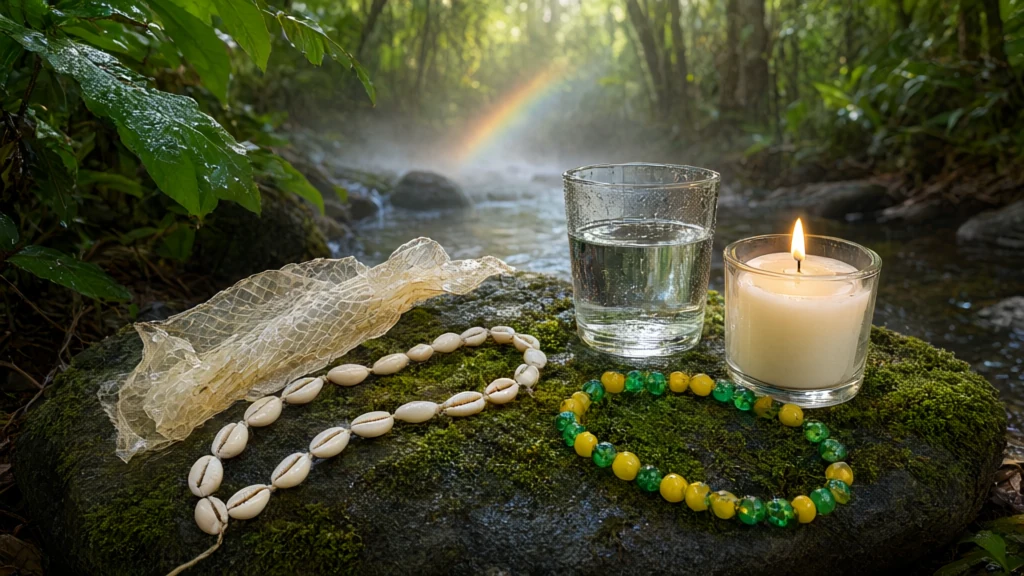
Dreaming of a snake, according to the Afro-Brazilian tradition, is dreaming of a sacred animal: the snake is Oxumaré in Candomblé Ketu and Dan, worshipped as Bessém, in Jeje. It speaks of movement, renewal, and wealth, not of betrayal. Who reads each person's dream is the house of the orixás (casa de santo), not a dictionary.
| Nation or religion | The snake is | How it appears |
|---|---|---|
| Candomblé queto | Oxumaré, the orixá of the rainbow | two metal snakes intertwined in the assentamento |
| Candomblé jeje | Dan, worshipped as Bessém | serpent vodun, one of the "kings" of the nation in Bahia |
| Candomblé angola | Angorô | inquice that corresponds to Oxumaré |
| Umbanda | Oxumaré, linked to Dã | renewal, the spirit that "sheds its skin" (record of a house) |
What does it mean to dream of a snake in Candomblé?
In Candomblé, the snake in the dream refers to Oxumaré and the voduns of the serpent, the owners of the cycle, the rain, and wealth. In this tradition, the snake is not a bad omen. It is the form of an orixá. Each nation gives it a name, and the correspondence between nations is an approximation.
Oxumaré, the rainbow serpent
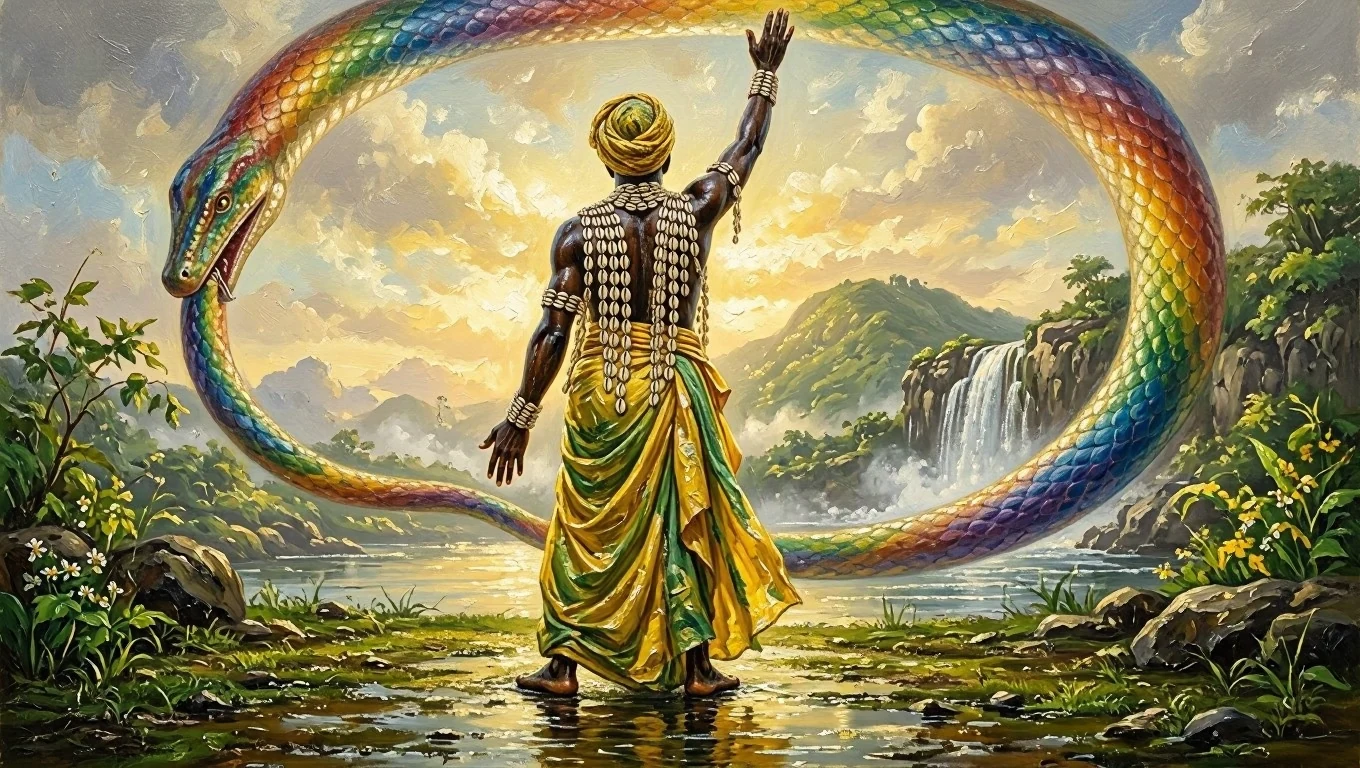
Pierre Verger writes, in Orixás, that Oxumaré is the rainbow serpent. Sometimes he appears as the snake that bites its own tail and coils around the earth so that it does not fall apart. It is the image of the cycle. It ends to begin again.
In the table of Reginaldo Prandi for the queto, Oxumarê is the orixá of the rainbow, linked to rain and "wealth coming from harvests". His consecrated foundation (assentamento) is two intertwined metal snakes. Verger tells that the initiates use the brajá, a cowrie shells necklace that mimics snake scales. In the dance, they point now to the sky, now to the earth. The complete portrait of the orixá is in who is Oxumaré.
Colors: yellow, green, and black (queto, Prandi) | Day: Tuesday, with variation by house | Greeting: Arroboboi | Associated saint: Saint Bartholomew
Dan and Bessém, the snake of the voduns in Jeje
In Jeje, the snake carries even more weight. Verger says that Oxumaré comes from Mahi, in ancient Daomé, where he is called Dan. There, Dan weighs more than Oxumaré among the Yorubas: he is the vodun who brings wealth. In Candomblé Jeje, Dan is worshipped under the name of Bessém.
The historian Luis Nicolau Parés, cited in the Revista Brasileira do Caribe, places the serpent vodun Bessen among the "kings" of the Jeje nation in Bahia. The sacred art collection of Duke University holds a Bahian piece of forged iron made for him, with the spear and the two serpents. The other voduns of the nation are in voduns in Brazil.
In Angola, the snake deity is Angorô, a nkisi that corresponds to Oxumaré. And Ewá (Yewa) also has a snake: her consecrated foundation (assentamento), in Prandi's table, features an iron snake and pebbles. The relationship between the two is in Oxumaré and Ewá.
Is dreaming about a snake good or bad?
By tradition, dreaming about a snake is not a bad sign in itself. The snake is sacred in Candomblé, and what it brings, in the myths, is continuity, renewal, and wealth. The rest depends on your life and your house.
The idea that a snake in a dream is betrayal or falsehood comes from elsewhere. FUCESP recalls that, for the Catholic gaze, there was no animal "more venomous, dangerous, and sinful" than the snake, because of Adam and Eve. The same page says that researchers did not find in the myths of Oxumaré a division between good and evil. In the federation's record, he lives half the year as a rainbow in the sky and half as a snake on the earth.
The snake that sheds its skin is not lying to anyone: it is growing.
Psychology agrees. Psychoanalyst Priscila Diniz, heard by O Povo, says that the most important thing is how you relate to the snake in the dream. Fleeing, confronting, or just looking says a lot. And a dream is not a literal prediction.
And in Umbanda, what does it mean to dream about a snake?
In Umbanda, the snake also appears linked to Oxumaré and renewal. The Núcleo de Umbanda Águas de Oxum (Oshun) places Oxumaré in the Generation line, as renewal and reincarnation, when the spirit "sheds its skin," as Dã does. It is the record of one house. Others read it differently.
What Umbanda has in common about dreams is in the guide dreams in umbanda: how to separate a common dream from a warning, the signs in the body and in the room, and when to take the dream to the leader. The snake follows the same rule, as does the fire of Xangô (Shango) and Iansã (Oya) in dreaming with fire and the water of Oxum, Iemanjá (Yemoja), and Nanã (Nana Buruku) in dreaming with water. It also applies to the dog of Ogum (Ogun) in dreaming with a dog and to the fish of Iemanjá in dreaming with a fish. A clear dream, which does not leave the memory and returns, deserves a conversation in the gira.
What the tradition does not say: color, bite, and dead snake
No source from a terreiro or academic source consulted has a dream table for snakes. There is no reading for green, black, or coral snakes, of a snake biting, or of a dead snake. These lists come from dream dictionaries. They have no source.
The color of the snake in the dream
What exists with a source are the colors of the orixá. In Ketu, Prandi records yellow, green, and black. In Jeje, the beads of Oxumaré are yellow and black striped. A snake of these colors can remind Oxumaré to someone who is a child of santo. Saying that the dream "is" theirs belongs only to the house.
Who reads the dream is the house
In Candomblé, who says the head orixá is the pai or mãe de santo, by the house's game. Even the dreams of an initiate are read as signs, but always within the terreiro, as recorded by the Revista Iluminus. If the doubt is which orixá you are a child of, the Discover your Orixá test is an entry point, not a game answer.
What to do upon waking after dreaming of a snake
Without haste and without fear. The steps below serve for anyone.
- Write down the dream immediately. Color, place, what the snake did, what you felt.
- Light a white candle to the Guardian Angel, next to a glass of clean water, and say a prayer in your own words. The step by step is in firmeza na umbanda. Away from home, the virtual white candle serves as a remembrance.
- If you are from Candomblé, you can greet the orixá. Verger records the shout "Aoboboí" to greet Oxumaré; the umbanda house Águas de Oxum writes Arroboboi.
- Take the dream to your zelador or zeladora if it repeats or brings a prayer request. If the house asks for a candle, herb, or beads, the shop confirms the material with you via WhatsApp.
- Take care of your sleep too. Nightmares that return every night and waking up without air require a conversation with a doctor, in addition to the house.
Frequently asked questions
What does it mean to dream of a snake biting?
No consulted terreiro source gives a reading for the bite in a dream. What the sites say, "betrayal" or "disappointment," comes from popular dictionaries, without a basis in tradition. In tradition, the snake is sacred. If the dream left you with fear or repeats, note the details and take them to your zelador or zeladora.
Dreaming of a yellow or green snake is Oxumaré?
Yellow and green are colors of Oxumaré in the ketu, and the jeje uses yellow and black. But no source says that a snake of these colors in a dream is the orixá. The color may remind those who are de santo of Oxumaré. Who confirms, when there is something to confirm, is your house.
What does it mean to dream that you killed a snake?
The tradition consulted does not bring a reading for killing or seeing a dead snake in a dream. The phrase "in Candomblé one does not kill snakes" circulates on the internet, but we did not find a house or research that supports it. If the dream felt heavy, note it, say a prayer, and talk to your house.
Dreaming of a snake is a call to be initiated?
There is no source that treats a dream with a snake as a call for initiation. In Candomblé, the head orixá comes from the game of the Pai or the Mãe de santo, and the dream is only a sign read within the terreiro. Initiation is a decision of the house, with Tempo and conversation.
References
- PRANDI, Reginaldo. Horizontes Antropológicos, 1995. African gods in contemporary Brazil
- VERGER, Pierre. Corrupio, 1981. Orixás: Yoruba gods in Africa and the New World
- CASTRO, Vinícius Vasconcelos. Religious Diversity (UFPB), 2012. Dan: the rainbow serpent
- MONTGOMERY, Eric J.; GONZALEZ, Rene. Brazilian Caribbean Journal (UFMA), 2019. Missing Vodun and Questions of Authenticity
- ORTEGA MARÍN, Alexander. Iluminus Journal (UFMA), 2026. Salvador de Bahia photographed on a night of Candomblé
- Duke University, Sacred Arts of the Black Atlantic. Brazilian Altar piece for the Snake God
- Wikipedia. Entries for Dã (vodun) and Oxumaré
- FUCESP. Page of Oxumaré
- Núcleo de Umbanda Águas de Oxum. Page of Oxumaré
- O Povo, 2025. Dreaming of a snake: what psychoanalysis says