Dreaming of fire, in the tradition of the orixás, leads to Xangô and Iansã, the owners of fire in Candomblé, and to Exu, who in the myth prepares the magic of the flames. No terreiro has a dream table: fire speaks of strength, justice and change, and the one who reads your dream is your house.
| Orixá | His fire in the tradition | Source |
|---|---|---|
| Xangô | orixá of thunder and justice; fire element; the fire from his mouth became the lightning | Prandi; Prandi and Vallado |
| Iansã (Oiá) | orixá of lightning; air, water, and fire element; shares the control of fire with Xangô | Prandi; Santos (USP) |
| Exu | fire and earth element; in the itã, prepares the fire magic | Prandi; Gill Sampaio Ominirò |
The general reading of dreams in the terreiro is in the guide of dreams in Umbanda. Here is the fire; the serpent of Oxumaré (Oshumare) is in dreaming with a snake, the dream with those who left is in dreaming with a person who already died, and the water of the iabás is in dreaming with water. The dog of Ogum (Ogun) and of Omolu (Omulu) is in dreaming with a dog, and the erês are in dreaming with a child.
What does dreaming about fire mean for the orixás?
For the orixás, fire is the power of Xangô and Iansã. In the table of queto terreiros by Reginaldo Prandi, the mythical element of Xangô is fire. That of Iansã is air, water, and fire, and that of Exu is fire and earth. The dream does not gain a fixed meaning because of this. It gains a path of reading.
Xangô: the fire that became lightning
Xangô is the orixá of thunder and justice. Prandi describes him as "God of thunder and justice". In the myth told by Prandi and Vallado, Xangô begins to launch fire from his mouth from the top of a hill. The people, in fear, call that lightning, and the boom, thunder.
Xangô's fire is the fire of the king who judges. As obá, he was the supreme judge of his people, and the double axe aims justice at both sides of the fight. The complete file is in who is Xangô.
In June, there are terreiros that light Xangô's bonfire. In Salvador, the newspaper A Tarde recorded logs and sticks lit in the terreiro, with atabaque and cantiga. Prandi and Vallado call Airá Ibonã the "father of fire": in his bonfire, Ibonã dances with Iansã over the embers.
Iansã: the orixá who spat fire first
Iansã is the orixá of lightning and winds. It was she who sought the fire potion in the realm of the baribas, at the request of Xangô. Curious, she tasted it on the path and spat fire before him. The entire myth of the couple is in Iansã and Xangô.
Therefore, Vagner Santos writes in Revista Ingesta (USP), Iansã shares with her husband "the control of fire and the mastery of lightning." The acará, the bean cake fried in dendê, had the nickname "fireball." The IPHAN records that, in Candomblé, the acarajé is offered to Xangô and Oiá without filling. More about her in who is Iansã.
"Xangô and Iansã compete to swallow the acarás." (Vagner José Rocha Santos, Revista Ingesta, USP, 2019, about the rituals of the gods of fire)
Exu: who prepared the fire magic
Exu enters through myth. In the itã told by the babalorixá Gill Sampaio Ominirò, Xangô asks Exu for a magic to have mastery over fire. Exu prepares the potion and commands that Oyá be the bearer. In Prandi's table, Exu's element is fire and earth, and he is the first to be honored in any ceremony. Who he is is in who is Exu.
Is dreaming of a fire or a house catching fire a warning?
No open terreiro source for this text says that dreaming of fire is a warning, nor does it give a meaning for a house catching fire. Those who claim this are dream dictionaries, without a source. What tradition shows is the difference between cult fire and fire that escapes.
The ritual fire is cared for. In a column by CartaCapital, Paula Gomes, cultural ambassador of the Palace of the Alaafin of Oyó, speaks about who can get close to the fire. Only the elegun of Xangô, the person in a trance with the orixá. The same column mentions that, in Benin, the fire of the ritual to the vodun Sogbo appears in a controlled and ritual way.
The fire is in the myth. In one of the exercises with the new weapon, Xangô missed his aim and set fire to his own palace. The fire passed from roof to roof, and "the proud city of Oió turned to ashes." After that, Xangô lost the throne. Prandi and Vallado give the same trait to Agodô, the Xangô who throws lightning and fire over his own kingdom.
The two faces also appear in Umbanda. FUCESP puts fire as an element of Xangô. For the federation, his power is in the fire "that destroys on Earth, but that transforms, that protects, that illuminates the path." It is an orixá profile, not a dream reading. It serves to think about what, in your life, is heating up and what is getting out of control.
The ajerê, the fire pot of Xangô and Iansã
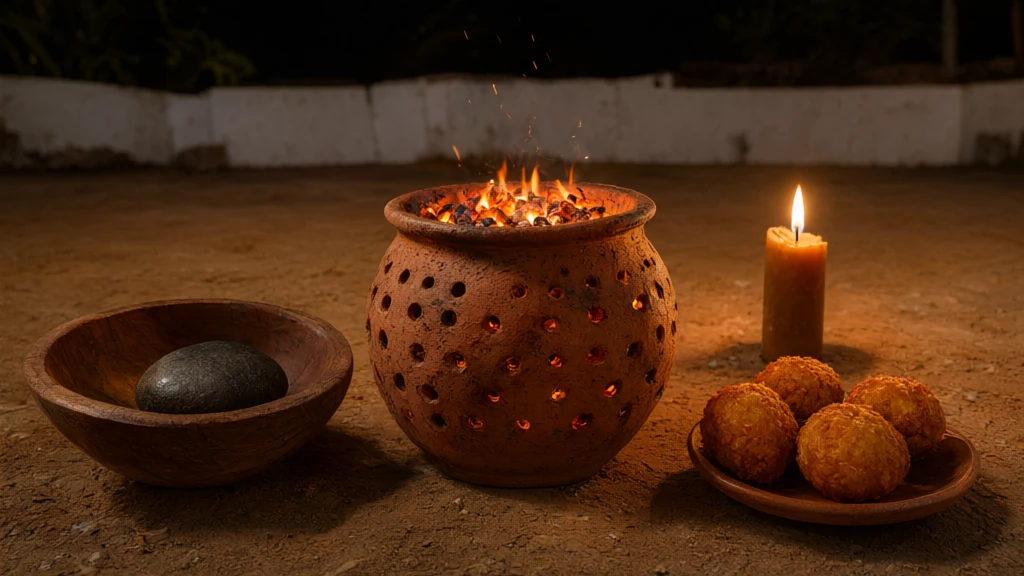
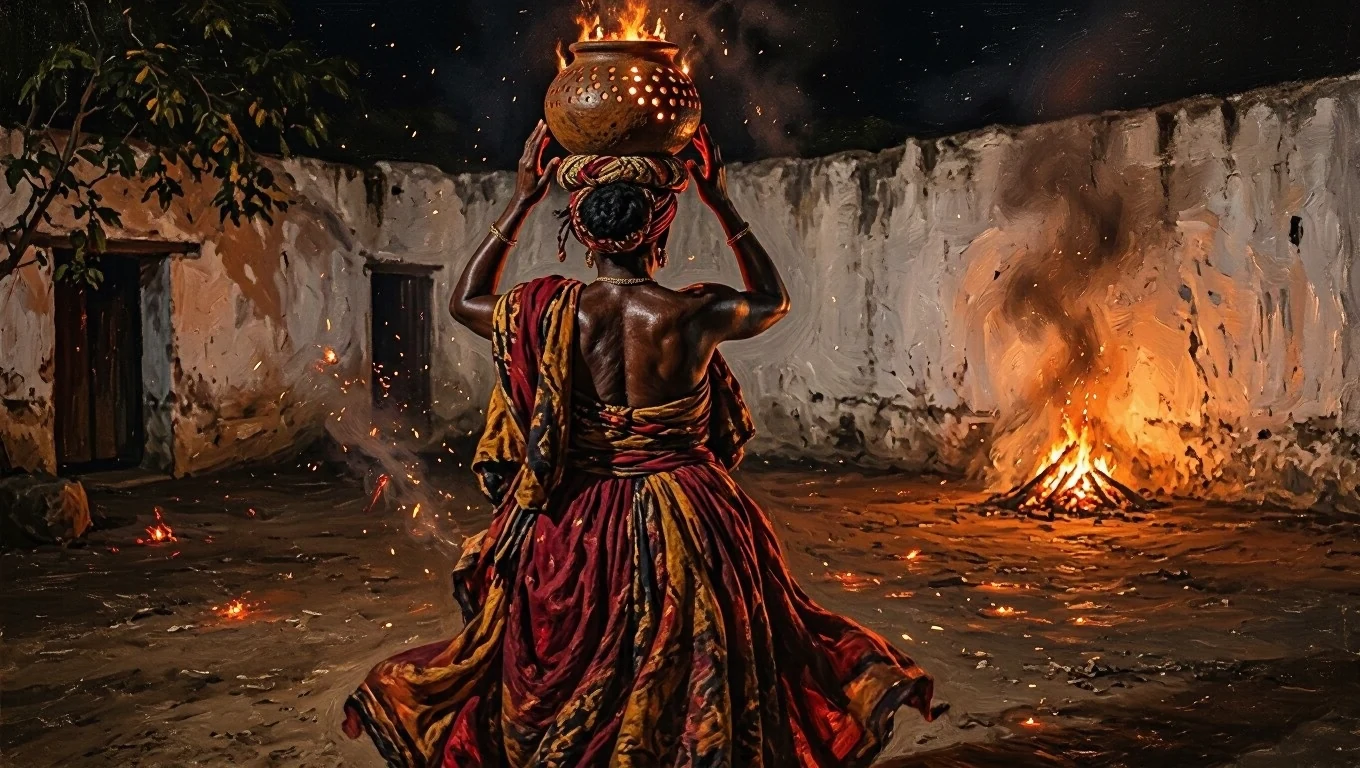
The ajerê is the clay pot full of holes used in a Candomblé ritual that reenacts the dispute of Iansã and Xangô over the fire. Through the holes come "tongues of fire," according to the text by babalorixá Gill Sampaio Ominirò published on the blog O Candomblé.
Oyá brings the pot of embers on her head, to the toque of the alujá, dances, and hands it to Xangô. He dances and returns it, and the pot passes from one to the other. In the end, Xangô keeps it, a sign that the power of fire is his. The ajerê (in the source, "ajere") is a house ritual, danced by the orixás in a trance. It is not something to do at home.
The same pair appears in the bonfire and in the acará. In all, the fire passes from hand to hand within a ritual, with an owner and with a rule. To know which orixá rules your head, the discover your orixá test gives a first clue; the true answer comes from the house.
What to do when waking up from a dream with fire
Upon waking, write down the dream, say a prayer, and keep what you felt. The care is simple and serves for any strong dream:
- Write it down immediately. Where the fire was, if it was warming or burning, who was there, and what you felt.
- Light a white candle to your Guardian Angel and say a prayer in your own words. Those who cannot light one at home have the Guardian Angel candle on the virtual altar.
- Do not take action out of fear. A dream is not a sentence, and no orixá punishes someone for dreaming.
- Take it to your house if the dream returns, feels heavy, or brings an orixá. The zelador or the mother or pai de santo reads the dream with the house oracle. Joice does not throw búzios and does not perform this reading.
If the house asks for a candle for Xangô, the color is also from the house. In Ketu terreiros, his clothing is red, brown, and white. At Terreiro Pai Maneco, of Umbanda, Xangô is brown and white, and his amalá takes brown and white candles. The brown candle is also on the virtual altar. To check the material the house requested, the shop assists via WhatsApp.
A recurring fire dream that takes away sleep also calls for a conversation with a doctor or psychologist. One thing does not exclude the other.
Frequently asked questions
What does it mean to dream of a house catching fire?
No open terreiro source for this text gives a fixed meaning for a house catching fire. In tradition, the escaping fire appears in the myth of Xangô, who set fire to his own palace in Oió. Write down the dream, say a prayer and, if it returns, take it for a reading at your house.
Is dreaming that you are putting out a fire good?
There is no source of Candomblé or Umbanda that reads this dream. What tradition records is that the cult fire has an owner and a rule: only the elegun of Xangô gets near it, according to Paula Gomes, from Oyó. The reading of who puts out the fire in the dream stays with the house.
Dreaming of fire on the body is something from Xangô?
No open source says this. Xangô and Iansã spit fire in myth, and in the ajerê Iansã carries the pot of embers on her head, but none of this becomes a dream meaning. If the dream brought an orixá or if it repeats, the zelador of your house is the one who reads.
Is dreaming of fire a bad sign?
Not by itself. In the FUCESP file, the fire of Xangô destroys, but it also transforms, protects, and illuminates the path. The weight of the dream depends on what it brought and what you felt, and the reading is from the house, without promise or fear.
References
- PRANDI, Reginaldo. Horizontes Antropológicos (UFRGS), 1995. African gods in contemporary Brazil
- PRANDI, Reginaldo; VALLADO, Armando. 2010. Xangô, king of Oió
- SANTOS, Vagner José Rocha. Revista Ingesta (USP), 2019. The acará of Iansã in the feast of Saint Barbara
- IPHAN. Ofício das Baianas de Acarajé
- OMINIRÒ, Gill Sampaio. Blog O Candomblé, 2015. Ajere: Oyá and Xangô in the dispute for fire
- FRIARY, Vitor. CartaCapital, 2024. Is Xangô São João?
- GOMES, Franciely. A Tarde, 2026. Not every bonfire is for Saint John
- FUCESP. Xangô
- Terreiro de Umbanda Pai Maneco. Xangô