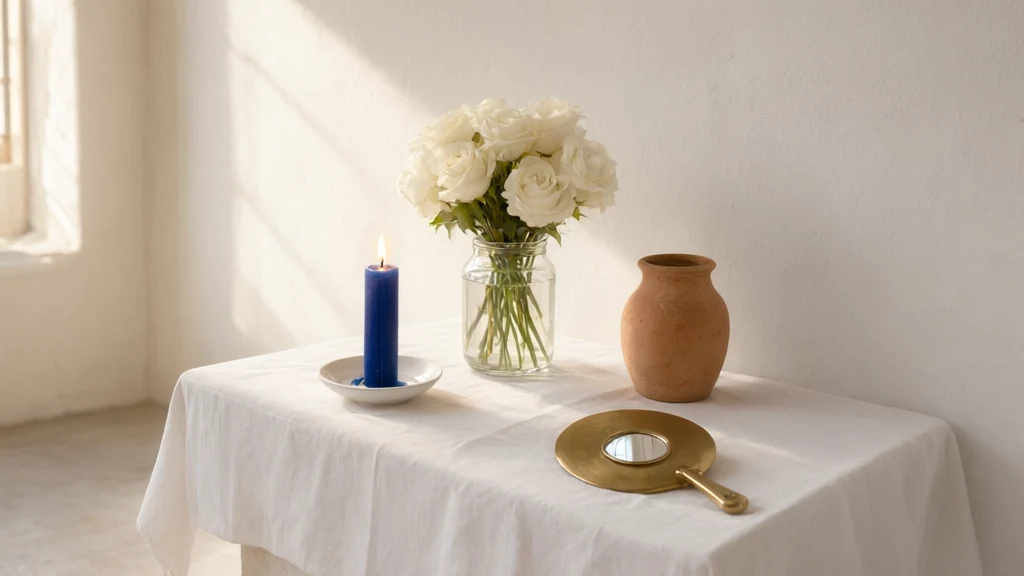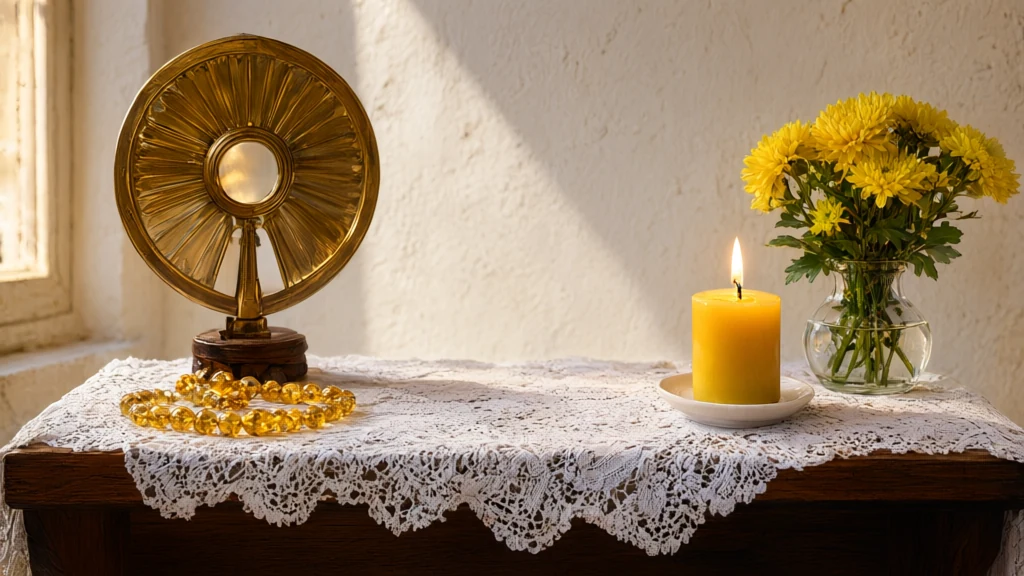
The statue of Oxum on the umbanda congá is, in many houses, an Our Lady, Aparecida or da Conceição depending on the region. When it is the statue of the orixá, made of plaster or resin and painted, she comes crowned and with the abebé, the mirror fan, in her hand. The clothing is yellow and gold or blue, depending on the house.
The two forms coexist in terreiros and in shops, and the choice belongs to the house.
What the statue of Oxum is like: the existing forms
The history of the orixá and the myths are in who is Oxum. Here the subject is the piece, which appears in four forms:
- Our Lady on the congá: in a terreiro in Passo Fundo (RS), "Our Lady Aparecida is the statue used for the assentamento of Oxum".
- The orixá in plaster or resin: woman in yellow or blue with the mirror in her hand, as umbanda houses describe.
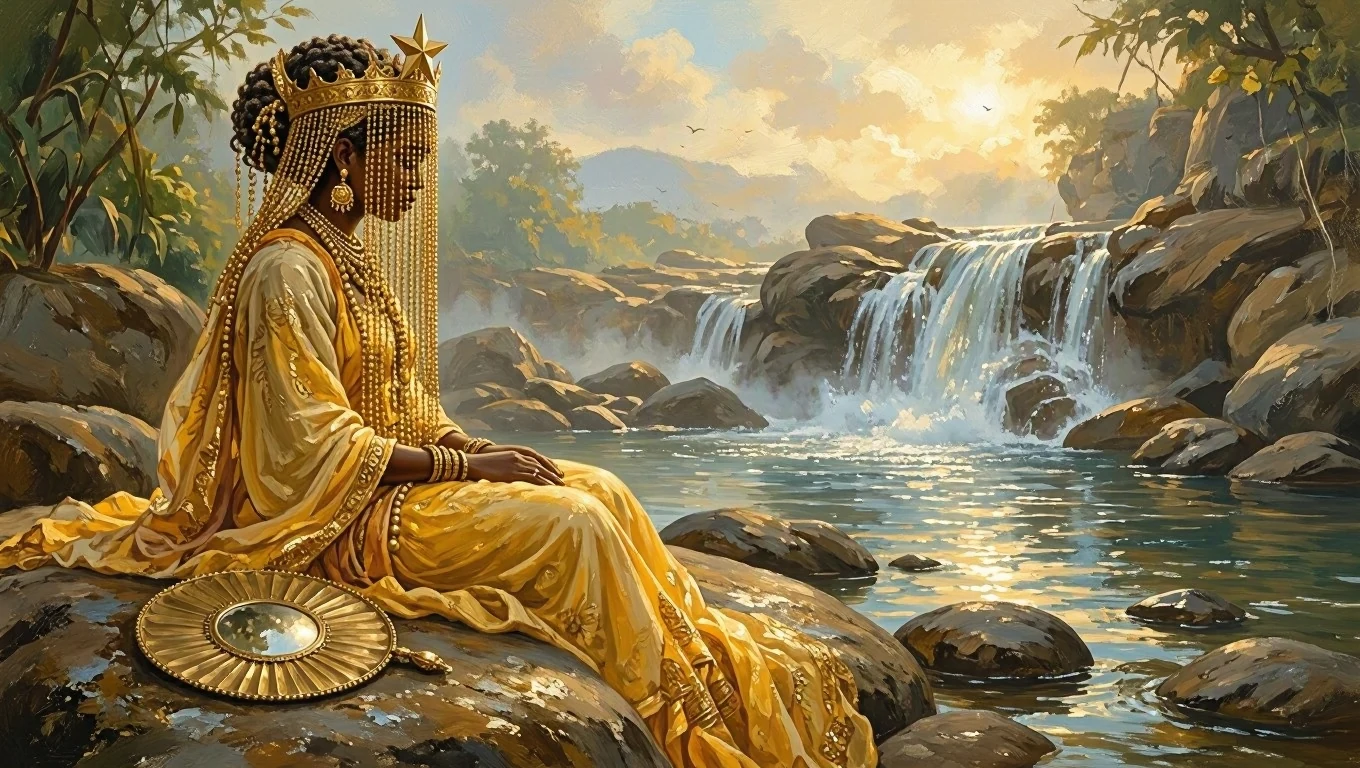
- The Candomblé figure: brass crown with a bead veil, gold clothing, abebé and sword.
- The public image: statues on beaches and lakes, such as the one in Guaíba (RS).
In the figures that Google Images shows for "Oxum", the researcher Viviane Caldas (UERJ) found the same elements: woman, water, waterfall, jewelry, mirror, fish, yellow color, child and crown.
In the hand: abebé with mirror | On the head: crown, sometimes with a bead veil | Metal: gold brass | Color: yellow and gold in Candomblé, blue in many umbanda houses
Crown, chorão and abebé: what the statue of Oxum carries
The object that identifies Oxum is the abebé, the circular metal fan. Researcher João Augusto dos Reis Neto (UFSJ) writes in the magazine Calundu:
“In these parts of the Atlantic, the abebé was redefined as a mirror”
Citing another research, he says that Oxum's abebé is “made of golden brass” and “almost always carries a small mirror in its center.” The Federation of Umbanda and Candomblé of the State of São Paulo (FUCESP) speaks of a “fan (abebé) with a star and mirror”.
For Raphael de Jesus (PUC Minas), the abebé of Iemanjá has a mermaid, star, or moon cutout, and Oxum's, “for example, a heart”.
The coroa is the second sign. In Duke's record about a crown from baiano candomblé, gold and yellow are Oxum's colors, and that is why the crown looks like brass. The five-pointed star fits because five is her number, and the veil of beads, the chorão, suggests tears. In some terreiros, the adê, the crown, becomes a fabric ornament, records Caldas.
There are statues of Oxum with a sword. In Reginaldo Prandi's table about Ketu candomblé, the emblems are the “abebé: yellow metal fan; sword.” In Duke, Amilton Sacramento Costa explains that she holds the sword because she is also a warrior.
Yellow, golden, or blue: the color of the Oxum statue
The color of the clothing changes with tradition. In Ketu candomblé, Prandi gives “yellow or golden with a bit of blue.” In umbanda, the houses with an open page lean towards blue:
| House | Color of Oxum |
|---|---|
| FUCESP (SP) | dark blue in umbanda, gold yellow in candomblé |
| Santuário Nacional da Umbanda (SP) | blue, “despite some temples using yellow” |
| Umbanda Tenda Caboclo Tupinambá and Vó Catarina (SP) | dark blue and yellow |
| Umbanda Terreiro Pai Maneco (PR) | yellow |
That is why the same Oxum appears in yellow in one shop and in blue in another. The candle and the bead necklace (guia) of each house are in Oxum na umbanda.
Why the statue of Oxum in Umbanda is an Our Lady
Umbanda received Oxum through the figure of Maria. In 1933, the writer Leal de Souza noted that the umbandistas called the Virgin "Mãe Axum (Oxum)". In a ponto (sacred song) of Zélio de Moraes's house, they sing "the sacred mantle of Mamãe Oxum". The pontos are in ponto de Oxum.
The saint of the congá depends on the region. Prandi, heard by the Folha de Pernambuco, links Aparecida and Oxum because they are great mothers. Water, he says, is "just a coincidence":
| Region | Our Lady linked to Oxum |
|---|---|
| Rio de Janeiro and São Paulo | Aparecida |
| South | Conceição |
| Minas Gerais | Dores |
| Bahia | Candeias e Prazeres |
| Pernambuco | Carmo |
| Norte | Nazaré |
Approaching is not the same as equating. The Tenda de Umbanda Caboclo Tupinambá writes that syncretism "does not mean that the two figures are exactly the same deity." The history of the saints is in Our Lady Aparecida and Oxum, in Our Lady of the Conception and Oxum and in orixá and Catholic saint.
Public statues of Oxum: Guaíba, Porto Alegre and Salvador
The UFRGS Religion Study Center records two public statues of Oxum in Rio Grande do Sul:
- Guaíba: a priestess installed the statue at Praia da Alegria in the 1970s; it returned in 2013, in a new cave, and suffered attacks in 2019, 2020 and 2023. During the 2024 flood, the city hall removed it.
- Porto Alegre: the Praia de Ipanema monument is from 1999 and was listed as a heritage site by the municipality in 2023.
In Salvador, Oxum is among the orixá sculptures by Tatti Moreno at Dique do Tororó, installed in the 1990s.
For the Anthropological Museum of Rio Grande do Sul, the statue of Guaíba is an object of worship and a "witness to the black presence in Guaibense territories." Attacking a sacred statue is religious racism, and it is possible to report religious intolerance.
How to choose the statue of Oxum for the congá
The first question is for the house: does it use the Our Lady of the region or the statue of the orixá? In the Umbanda centers that Morena Freitas studied in Rio, the congá follows an order: Jesus at the top, the celebrated spirits in the center, exus and pombagiras near the entrance. The place of Oxum is defined by the leader.
For Freitas, the statue that leaves the shop "ceases to be a commodity and becomes a sacred object" when it passes through the house's consecration ritual. The terreiro does this.
In the purchase, three details matter:
- Size: the factory that Freitas followed makes polychrome plaster statues of 30, 40, or 60 centimeters up to one meter, with eyes, hair, and clothes painted by brush.
- The color: the one of your house, blue or yellow.
- What she carries: abebé with a mirror and crown; the sword appears in some pieces.
The shop has plaster statues of orixás. The one of Oxum goes to the congá with the candle of the color the house uses. To check the model or the size your house requested, Joice assists via WhatsApp. How to clean and store the statue is a house precept: ask the leader. The altar is in how to set up an umbanda altar and in set up your altar; the illustration of the orixá is in the Oxum sheet.
Frequently asked questions
What is the statue of Oxum in Umbanda?
In many houses, it is an Our Lady: Aparecida in Rio and in São Paulo, Conceição in the South, according to Prandi. In a terreiro in Passo Fundo, Aparecida is the statue of the Oxum assentamento. Other houses use the statue of the orixá, crowned and with the abebé. Whatever form your house uses is valid.
What does Oxum hold in her hand?
The abebé, a golden brass fan that in Brazil gained a mirror in the center, according to Reis Neto. In Ketu candomblé, Prandi also records the sword, and the Duke's record says she holds it because she is also a warrior. Some statues bring the ofá, the bow and arrow.
What is the statue of Oxum Opará like?
Pierre Verger describes Opará as "the youngest of all, of warrior genius," and Caldas records that the sword can be used by Oxum Opará. A specific statue of Opará has no description published in open sources. The paths of the orixá are in qualities of Oxum.
Can I have a statue of Oxum at home?
You can. Freitas describes the domestic altars of umbanda with statues of saints and spirits of whom the family is devoted. If you attend a terreiro, ask the leader which form to use and if the house consecrates the statue beforehand. To know if Oxum is your orixá, there is the discover your orixá test.
References
- Reginaldo Prandi, Horizontes Antropológicos: African gods in contemporary Brazil
- Pierre Verger: Orixás
- Reis Neto, Calundu: Thinking-living-water in Oxum
- Viviane Caldas, UERJ: Axé, Orixá!
- Morena Freitas, Etnográfica: Making Children
- Duke University: Crown of the Goddess Oxum
- Duke University: Metal Crown for Oxum
- Raphael de Jesus, In Society: In the sway of the sea
- Edinan Bertocho, UFFS: Terreiro Ogum Beira Mar
- Leal de Souza: The seven lines of Umbanda
- TENSP: Book of Sung Chants (Pontos Cantados)
- Pernambuco leaf: Aparecida and Oxum
- UFRGS NER: Festivals of Oxum
- MARS and UFRGS NER: Oxum Cave
- Bahia Notícias: Monuments of Salvador
- FUCESP: Oxum
- National Sanctuary of Umbanda: Oxum
- Tenda Caboclo Tupinambá and Vó Catarina: Oxum
- Terreiro Pai Maneco: Oxum