



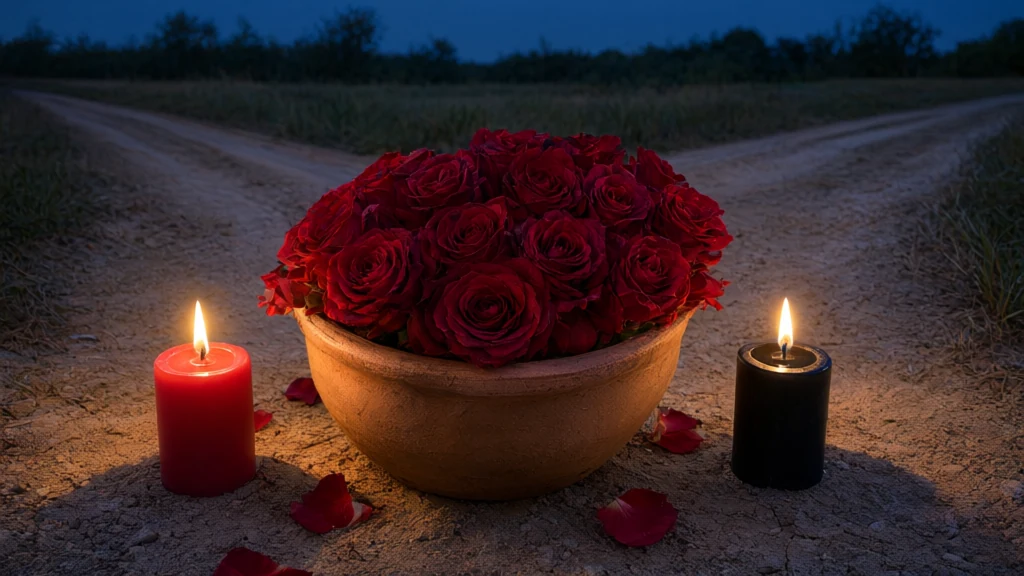
The Pombagira Rosa Vermelha is a falange (spiritual legion) of Pombagira from Umbanda and Quimbanda that works, in most records, at the crossroads. Field research finds her in terreiros of Minas Gerais, Paraná, and Mato Grosso. The name comes from the open red rose, the flower of every Pombagira, and she is not the same as Rosa Caveira.
Type: falange of Pombagira | Most cited realm: crossroads, and there are houses that also chant her in the calunga | Flower: open red rose, without thorns | Colors: red and black, like every Pombagira | Registered greeting: Laroiê Pombagira, Rosa Vermelha! | Date in law: November 11, only in Porto Alegre
Who is Pombagira Rosa Vermelha?
Rosa Vermelha is a Pombagira, a feminine Exu, and her name is a falange. Falange means that several spirits work with the same name. According to Ana Laura Brito and Nara Takaki, from UFMS, they "do not necessarily share the same history and life." The general concept is in who is Pombagira.
She appears in real terreiros. Three field records:
- Bocaiuva (MG). In the Zambi-Iris terreiro, she is one of the ten pombagiras worshipped, along with Maria Padilha and Rosa Caveira. The record is by Fábio Gonçalves, from UFMG.
- Pato Branco (PR). In the thesis of Jean Favaro, from UTFPR, she operates in the realm of the crossroads.
- Cuiabá (MT). Heloisa Carvalho, from UFMT, saw her arrive at a Candomblé party. In an Umbanda house, she heard her name during the opening of the gira de Exu.
The mãe de santo opened this gira with “Laroiê Pombagira!” and called the falanges, Rosa Vermelha among them. It is the recorded greeting.
Is she from the crossroads or from the calunga?
In most records, of the crossroads. In the house of Pato Branco, this realm belongs to the spirits who regulate the paths through streets, markets, roads, bars, and squares. The color red, says Favaro, "accompanies the composition of their clothes, candles, and elements." More about this territory in crossroads in Quimbanda and realms of Quimbanda.
But there are houses that sing both things. At the Terreiro de Umbanda Pai Maneco, in Curitiba, a sung chant (ponto cantado) of hers says "Pomba Gira da Calunga / And also of the crossroads". Another, with "Composition: Eli" noted in the terreiro booklet, sings that "Her crown shines in the crossroads" and calls her the "queen of the roses".
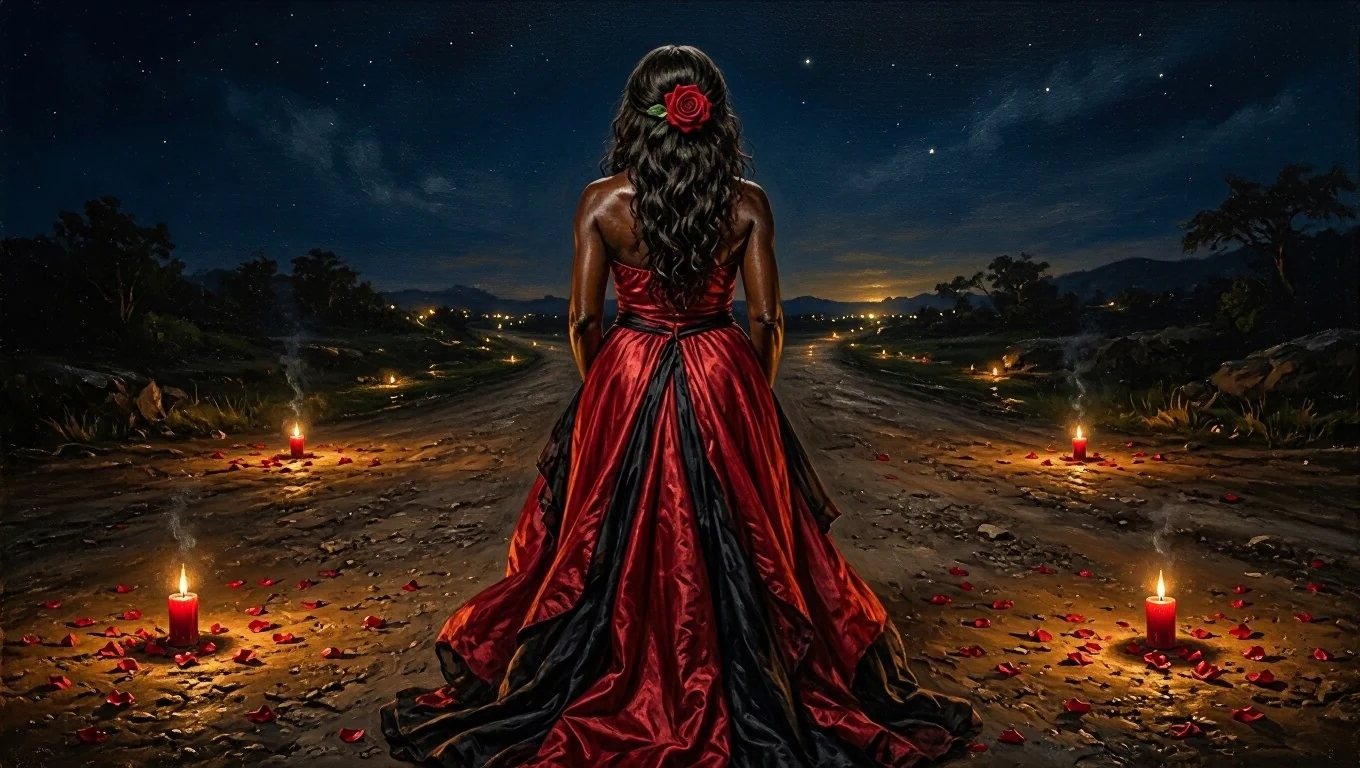
Are Rosa Vermelha and Rosa Caveira the same?
No. Three field studies list the two as different names. In Bocaiuva, both are among the ten pombagiras of the same terreiro. In Cuiabá, Carvalho's dedication names "Pombagira Rosa Preta, Pombagira Rosa Vermelha" and, separately, "Pombagira Rosa Caveira".
The difference becomes clear in Favaro. Rosa Vermelha is at the crossroads. Rosa Caveira joins the group of Exu Caveira, those with names linked to the passages "between the world of the living and the dead." For Cristiane Barros, from UFJF, Rosa Caveira is "crossed with the souls." In her, white joins red and black. The profile is in Pombagira Rosa Caveira.
Rosa Negra is also another spiritual legion (falange). Favaro lists "Pomba-Gira Rosa Vermelha, Pomba-Gira Rosa Negra" as distinct names, and the opening of the Cuiabá gira calls both separately. In Curitiba, Rosa Negra has her own sung chant (ponto cantado) in the calunga.
| spiritual legion (falange) | Where research places her | Registered colors |
|---|---|---|
| Rosa Vermelha | crossroads; one house also sings the calunga | red, the color of the kingdom of the crossroads |
| Rosa Caveira | passage between the living and the dead, crossed with the souls | red, black and white |
| Rosa Negra | calunga, in a terreiro in Curitiba | no own record |
Why is her name Rosa Vermelha?
Because the red rose is the flower of every Pombagira, and she carries the flower in her name. Reginaldo Prandi, from USP, lists among the gifts of the Pombagira the "open red roses (never buds)". Barros, from UFJF, completes: open and "without thorns".
In a thesis at USP, the psychologist Mariana Leal de Barros visited several terreiros. The only "universal rule" she saw was this: "the preference for the red rose." And she summarizes: "It is not the representation of the pombagira, it is the pombagira itself."
In Pato Branco, Favaro puts Rosa Vermelha among the spirits who "receive plant names," which bring the strength of the plant in the name. In a point in Curitiba, she sings: "I am the owner of the rose." The flower in each religion is in rosa, the flower of Oxum, Iemanjá and Pombagira.
What is the story told about Rosa Vermelha?
The best known story is that of a rejected girl who planted roses in the backyard cemetery. It was recorded in a public document: the justification for the project that created the Day of Pomba Gira Rosa Vermelha in Porto Alegre, by councilman Claudio Janta.
The text says it was "a girl, the youngest of 4 siblings, with skin different from her parents." Rejected, she played alone "in the small cemetery the family had in the backyard," where she "planted a garden of roses." She was beaten by her father. One day she fled and was found dead over the grave of the roses. And "the spirit of the grandmother, whom she resembled so much, then guarded her soul."
It is the account that circulates, and not the biography of a woman: the spirits of a falange do not share the same life. The version with a woman named Rúbia has no record in research.
The project became Law 13.132, of 2022, which put the date "on November 11" on the city's calendar. It is a municipal date of Porto Alegre, and not a day of fundamento. The other dates of Pombagira are in dia de Pombagira.
Is Rosa Vermelha a Maria Padilha?
Not according to the field lists. In Bocaiuva, Cuiabá and Pato Branco, the two appear with separate names.
The confusion has a reason: "rosa vermelha" is also a nickname for Maria Padilha in points. In Curitiba, it is sung "Rosa vermelha, rosa encarnada / It is the Maria Padilha of the Encruzilhada." The profile of the other is in Maria Padilha.
What has a source and what belongs to the house
Aside from the name, the kingdom, and the flower, Rosa Vermelha's record has no specific registration. No research gives her a day of the week, orixá, partner Exu, drink, clothing, or ponto riscado.
What exists is the general record of Pombagira. Prandi lists red and black fabrics, perfume, champagne, open roses, and red and black candles. In Cuiabá, at the festival where she arrived, "red and black predominated, flowers in the hair." For the offering for Pombagira, follow what your house asks: the red and black candles and the Pombagira drink are included in that. Doubt about the material the terreiro requested? Speak with the shop via WhatsApp.
Serious Pombagira does not sell love back nor does she bind anyone's will. If someone promises this in the name of Rosa Vermelha, they are not speaking for the spirit.
The what is my Pombagira test shows affinity with five lineages, among them Rosa Caveira and Maria Padilha. Rosa Vermelha is not among the results. Other points are in Pombagira point.
Frequently asked questions
Is Pombagira Rosa Vermelha a Cigana?
No research records Rosa Vermelha as a Cigana. In Carvalho, from UFMT, the ciganas with rose names appear separate from her: Cigana Rosa da Estrada and Cigana Rosa Amarela.
Which orixá does Pombagira Rosa Vermelha work for?
No published source links Rosa Vermelha to an orixá. In Umbanda, this connection changes from house to house and is taught by the leader of the terreiro.
With which Exu does Rosa Vermelha work?
There is no fixed partner Exu with a source. In the house of Pato Branco, she shares the kingdom of the crossroads with other Exus and pombagiras, without a named partner. Who her companion is in the gira, your house is the one that says.
What is the day of Pombagira Rosa Vermelha?
There is no specific day of the week with a source. In Porto Alegre, a 2022 law created the Day of Pomba Gira Rosa Vermelha on November 11. It is a city date, and not a day of foundation for the houses.
References
- Ana Laura Mota de Brito and Nara Hiroko Takaki, UFMS: Between words and sung chants, Revista Sede de Ler, UFF, 2025
- Fábio da Silva Gonçalves, UFMG and Unimontes: If you give me to drink, it also drinks, if you give me to eat it also eats, dissertation, 2017
- Jean Filipe Favaro, UTFPR: Territorialities of axé in the southwest region of Paraná, thesis, 2023
- Heloisa Lima de Carvalho, UFMT: Women and pombagiras in the terreiros of Cuiabá, dissertation, 2018
- Terreiro de Umbanda Pai Maneco, Curitiba: Pomba Gira handout
- Cristiane do Amaral de Barros, UFJF: dissertation in Religious Sciences, 2006
- Reginaldo Prandi, USP: Pombagira and the unconfessed faces of Brazil, chap. IV of Herdeiras do Axé, Hucitec, 1996
- Mariana Leal de Barros, USP: Labareda, teu nome é mulher, thesis, 2010
- Porto Alegre City Council: bill 476/2021, statement of reasons and Law 13.132/2022


