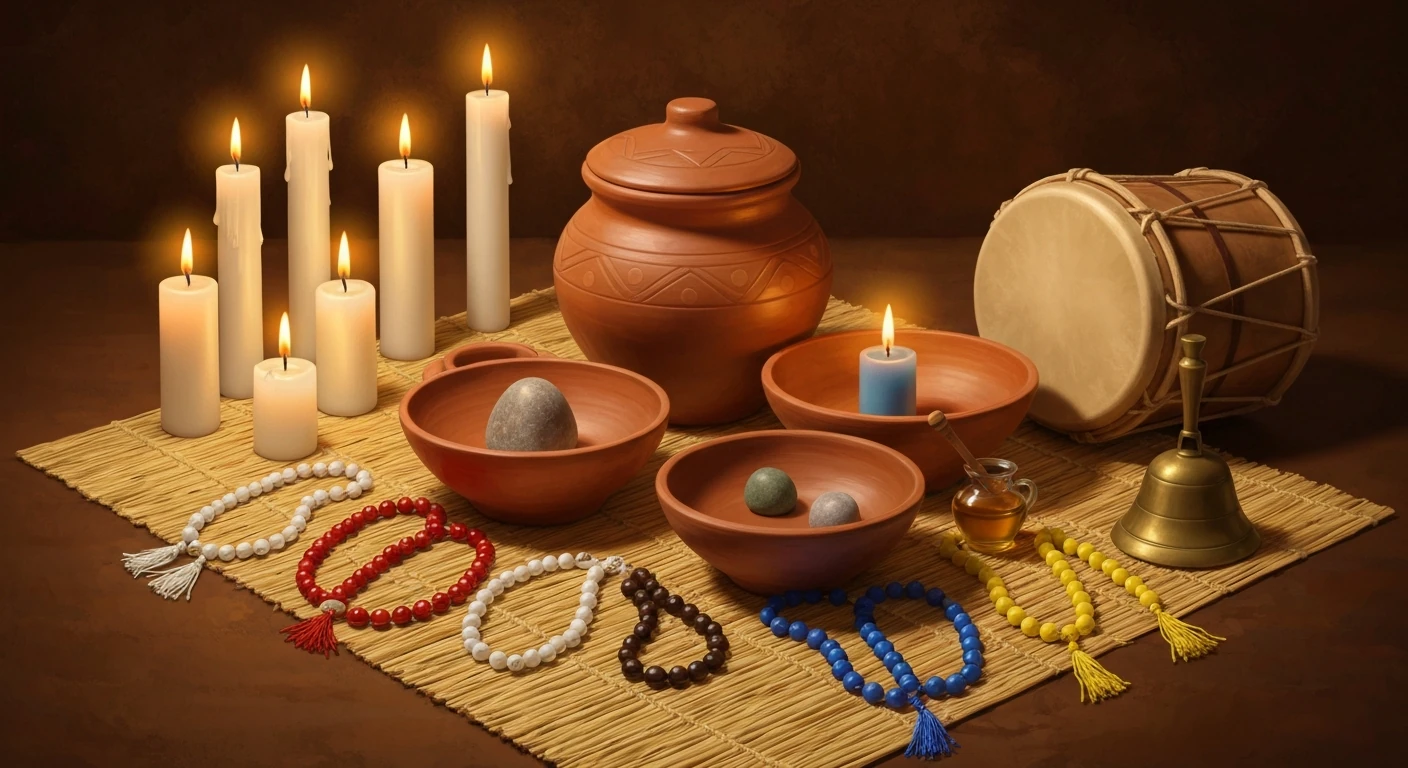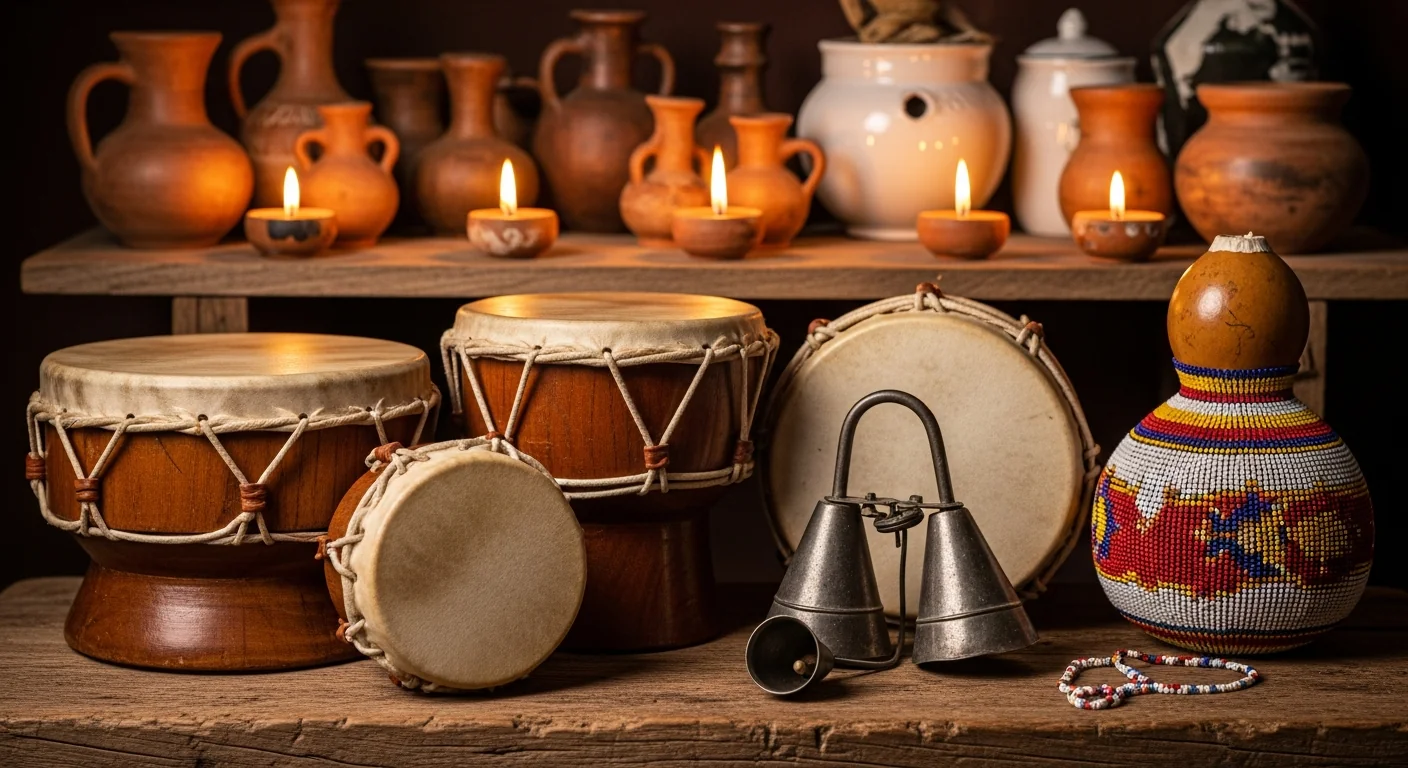
The nations of Batuque are what give identity to each terreiro of orixá in Rio Grande do Sul. Before knowing the name of the pai or mãe de santo, the practitioner usually asks something else: “from which nation is your house?” It is the nation that defines the drum toque, the language of the prayers, the order of the xirê, and the fundamentals that that ilê preserves.
In this guide, you will understand what “nation” means in Batuque, get to know the five main Oyó, Jeje, Ijexá, Cabinda, and Nagô and see, side by side, what distinguishes each one. At the end, we explain why almost no house today is “pure” from a single nation.
What “nation” means in Batuque
In Batuque do Rio Grande do Sul, nation, also called “lado,” is the African tradition of origin that organizes the entire liturgy of a house. It defines four things that the practitioner recognizes immediately:
- The ritual language in which it is sung (Yoruba, Fon, or Kimbundu, depending on the root).
- The drum toque, that is, the way of playing that calls each orixá to the circle.
- The order of the prayers in the xirê: the sequence in which the orixás are greeted.
- The specific foundations: assentamentos, initiation rites, and specific cults.
Therefore, the question “from which nation is your house?” is, in Batuque, the fundamental question. It is equivalent to asking from which African root everything done in that ilê descends.
The nation is not a stylistic detail. It is the pillar that sustains the axé of the house: it changes the language, changes the toque, changes the order in which the orixás appear, and yet, they are the same orixás worshipped throughout the diaspora.
The five nations of Batuque
Batuque recognizes five main nations: Oyó, Jeje, Ijexá, Cabinda, and Nagô. Three of them have Yoruba (Sudanese) roots, one comes from ancient Daomé, and one is of Bantu stock. The table summarizes what distinguishes each one:
| Nation | African root | Ritual language | Distinctive ritual mark | Highlight |
|---|---|---|---|---|
| Oyó (or Oió) | Yoruba (Oyó region, Nigeria) | Yoruba | Prayer for the male orixás and then for the female orixás | Xangô and Iansã (Oya), the royal couple |
| Jeje | Fon-ewe (ancient Daomé / Benin) | Fon | Fast drum toque; chants that survive in almost every house | Root of the voduns |
| Ijexá | Yoruba (Ijexá region, Nigeria) | Yoruba | Nation with the most houses and filhos de santo today | Oxum, the queen |
| Cabinda | Banto (Angola/Cabinda) | Kimbundo | Starts with Balê (cult to the Eguns); own cults | Xangô and the Balê of the ancestors |
| Nagô | Yoruba (Nagô) | Yoruba | Original nation, now almost extinct; own rites | Individualized deities |
Oyó
Of Yoruba root, the Oyó nation is recognized primarily by the order of prayers: one first prays for the male orixás and then for the females, ending with Iansã, Xangô, and Oxalá. Xangô and Iansã are treated as the king and queen of Oyó. The liturgy is chanted in Yoruba, with great proximity to the Ijexá nation.
Jeje
The Jeje nation comes from the ancient Dahomey (current Benin), from the fon-ewe trunk, and has the fast drum toque as its signature. Today it almost no longer exists as an exclusive modality, but it is the most living of absences: the jeje chants survive in almost all Batuque houses, mixed with the ijexá liturgy.
Ijexá
Coming from the Yoruba region of Ijexá, it is the predominant nation of current Batuque, with the largest number of houses and initiates (filhos de santo). It has Oxum as queen and the liturgy in Yoruba. Its rituals were gradually associated with those of the other nations, to the point that today they serve as the axis of the most common foundation of the religion.
Cabinda
From the banto trunk, with a ritual language of kimbundo root, the Cabinda nation keeps the most distinct ruptures. All ritual work begins with the Balê (also written as Igbalé), the assentamento and worship of the Eguns, the ancestors. It has exclusive worships such as that of Leba (a vodun) and that of Xangô Kamucá, a path of Xangô linked to the dead. Although banto at its root, it adopted the pantheon of Yoruba orixás.
Nagô
Of Yoruba base, Nagô is considered the original nation of worship in the South, but it is practically extinct as an exclusive modality. It maintained its own burial and initiation rites and preserved deities in an individualized way, without agglutination. As in the case of Jeje, its heritage did not disappear: it persists in foundations and chants kept by the houses.
The Jeje-Ijexá foundation: why almost no house is "pure"
In practice, a terreiro rarely follows a single nation in a pure state. Most houses in Rio Grande do Sul today worship the Jeje-Ijexá foundation, a combination of foundations that also brings together elements from Cabinda, Nagô, and Oyó. It is a mixture of rites of Banto and Sudanese origin, in which the Yoruba elements stand out.
The expression was consecrated by the researcher Reginaldo Gil Braga, in Batuque jêje-ijexá em Porto Alegre (1998), a study on music in the worship of the orixás. More than a label, it describes a fact: the nations intertwined over more than a century of coexistence in the South, and it is common for a house to combine roots instead of isolating just one.
This does not erase the differences. Even in a Jeje-Ijexá house, the order of the prayers, the toque, and the foundation rituals reveal which side the tradition leans toward. Whoever opens the ritual work, in any nation, is always Bará, the orixá of the paths, the first to be greeted. (It is worth knowing who Bará is in Batuque to understand why nothing begins without him.)
Nation in Batuque is not the same as nation in Candomblé
An important caution: the word "nation" also exists in Bahian Candomblé (ketu, jeje, angola), but the traditions are distinct, even if related. Batuque was formed in Rio Grande do Sul over the course of the 19th century, through its own paths, with toques, prayer orders, and foundations that are not those of Bahia.
There are still fine theological differences. In Batuque, for example, one speaks of "occupying the orixá", and not "incorporating" a specific way of naming the presence of the orixá in the filho de santo. To understand the greater contrast between Afro-Brazilian traditions, it is also worth reading what is Candomblé and the difference between Umbanda and Candomblé. And, to get to know the pantheon behind all of them, see what the orixás are.
For an academic and encyclopedic overview, the Wikipedia page on Batuque brings together the five nations and the twelve orixás; meanwhile, the Historiando Axé portal details the toques and languages of each side with more depth. Researchers such as Ari Pedro Oro (UFRGS) also document the Afro-religious presence in the South.
Frequently asked questions
How many nations exist in Batuque?
There are five main nations: Oyó, Jeje, Ijexá, Cabinda, and Nagô. In addition to these, there is talk of "mixed nations," such as Jeje-Ijexá, Jeje-Nagô, and Nagô-Ijexá, which combine foundations from more than one root. In practice, most current houses follow one of these combinations, rather than an isolated nation.
What is the predominant nation in Batuque today?
The Ijexá, of Yoruba root, is the most widespread, with the highest number of houses and filhos de santo. In practice, however, what predominates is the Jeje-Ijexá foundation: the fusion of the two roots, with elements of Cabinda, Nagô, and Oyó. Almost no house is "pure" from a single nation.
What does "nation" mean in Batuque?
Nation, or "side," is the African tradition of origin that defines the ritual language, the drum toque, the order of prayers, and the foundations of a house. It is the root that organizes the entire liturgy of the terreiro. Therefore, "what nation is your house from?" is the foundational question among practitioners.
What is the difference between the nations of Batuque and those of Candomblé?
They are similar concepts in different traditions. The nations of Candomblé (ketu, jeje, angola) were structured in Bahia; those of Batuque (Oyó, Jeje, Ijexá, Cabinda, Nagô) were formed in Rio Grande do Sul in the 19th century, with rhythms and prayer orders specific to the South.
What are the 12 orixás of Batuque?
They are: Bará, Ogum (Ogun), Iansã (Oyá), Xangô, Odé, Otim, Ossanha, Obá (Oba), Xapanã, Oxum, Iemanjá (Yemoja) and Oxalá. Bará opens all ritual works. The spellings and the order of the prayers vary according to the nation and the house, but the pantheon is the same as the Yoruba tradition.
Where to buy items for your Batuque
At Joia Mística Laroyê, you find what the house and the obrigação require, whatever your nation may be:
- Quartinhas and alguidares in clay and porcelain for assentamentos and offerings
- Statues and tools of the orixás from Bará to Oxalá, the entire pantheon of Batuque
- Beads and bead necklaces in the colors of each orixá
- Herbs and baths for cleansing, smoke cleansing and firmeza
- Dendê oil, honey and offering items for the care of the assentamentos
Visit our physical store in Extrema-MG or talk to us via WhatsApp, with delivery to all of Brazil. Want to continue studying the religion? Follow the Batuque category here on the blog.
References
- Wikipedia: page about Batuque, an Afro-Gaúcho religion, with the five nations and the twelve orixás
- Historiando Axé: article about the Gaucho Batuque, with the rhythms and languages of each nation