There is a phrase that runs through the houses of Rio Grande do Sul and almost never leaves it: cars, ships, and machines are things of Obá. The reason is simple. To her belong the wheel, the rudder, and everything that cuts or changes direction.
Obá in Batuque is not the sad orixá of the ear myth. She is the owner of the razor, the helm, and the decision. She closes the class of the new orixás and resolves what was stuck.
This guide gathers her profile in Batuque, with position in the line, colors, day, greeting, foods, tools, and syncretism. And it records, without hiding, what changes from nation to nation.
Who is Obá in the Batuque line
In Batuque, the orixás are called in a fixed sequence called linha. Obá enters after Odé and Otim and before Ossanha and Xapanã.
This position carries a ritual meaning. Obá closes the class of the new orixás, the block that begins with Bará and ends with her. After her come the orixás considered older.
Class, here, is not mythical age or hierarchy of importance. It is a ritual category of Batuque, linked to the order of the line and the way to treat each orixá in the obrigação.
Her domain also has its own name. Obá rules the rough waters, the river floods, and the overflows. She also rules the demands, the fights, and everything that needs a cut to be resolved.
In the South, it is said that Obá does not undo the problem by talking. She cuts, turns the rudder, and points in another direction.
Technical profile of Obá in Batuque
| Item | In Batuque |
|---|---|
| Name | Obá |
| Regency | rebellious waters, floods, demands, cut, direction |
| Position in the line | after Odé and Otim, before Ossanha |
| Class | new orixá (closes the block) |
| Color | pink |
| Number | 7 and its multiples |
| Bead necklace | pink beads, with pink and brown in some houses |
| Day | Monday in Ijexá, Wednesday in Cabinda |
| Greeting | Exó |
| Tools | razor, helm, wheel, coins and cowrie shells |
| Adjuntó | Bará, Xangô and Xapanã |
| Syncretism | Saint Catherine |
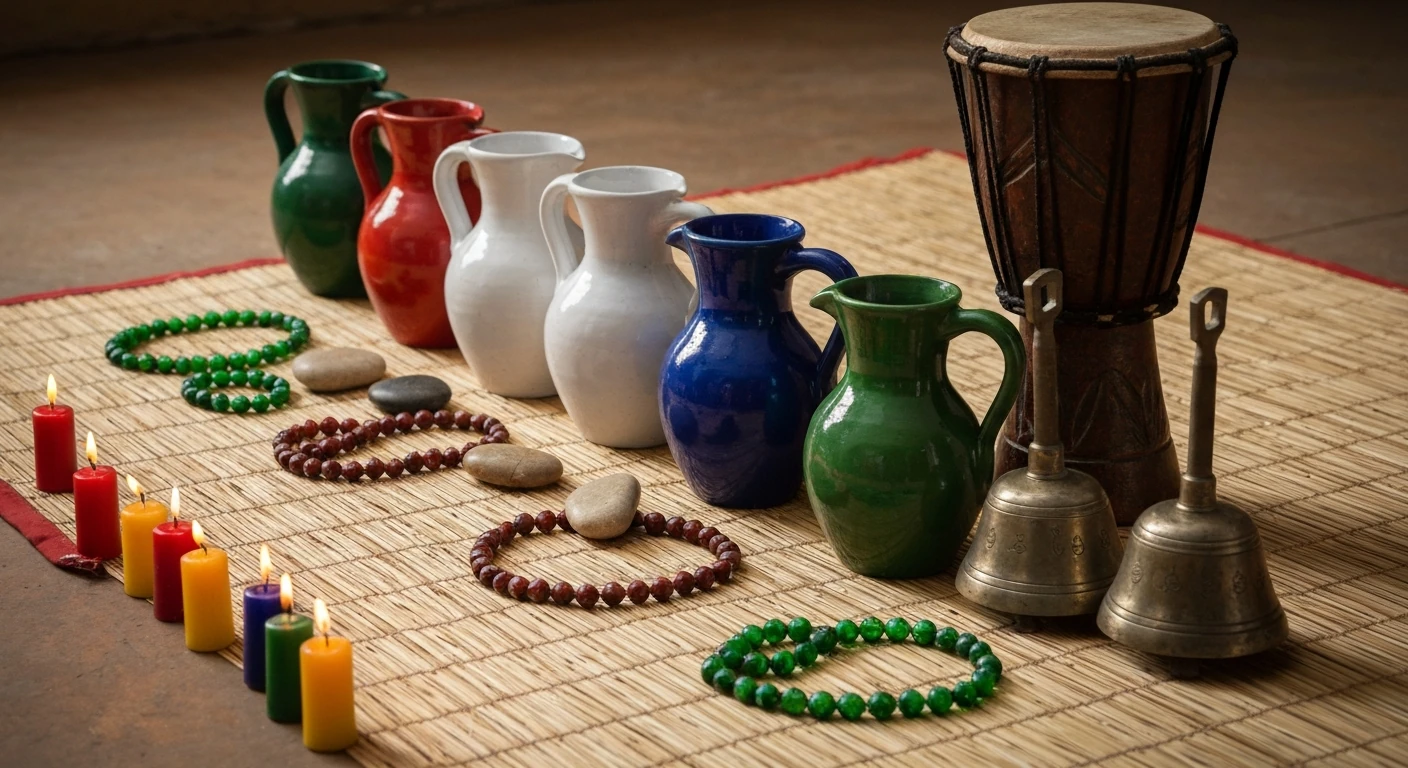
The consecrated foundation (assentamento) is made over the otá, the stone that guards the axé of the orixá, in a clay alguidar and with a water quartinha. The detail of the dish, the color and the content is a house foundation, not a general rule.
The most cited food is canjica or small beans sautéed with green seasoning, served with slices of pineapple. The epô, the dendê, accompanies the obligations. In the four feet appears the mocha goat, without horns, and in the bird the gray hen.
Regarding qualities, the usual caution applies. They exist and are revealed to the child by the game, but we do not find a reliable record of the names used in Batuque. Whoever gives you a ready-made list on the internet is guessing.
The owner of the razor, the wheel and the helm
This is the strongest and least publicized reading of Obá, and it is born in the South. The Sociedade Africana Reino de Xangô Aganjú, an Ijexá house in Viamão, registers her domain over the cut and the direction.
The list is concrete and modern:
- Razor and scissors: everything that cuts, separates, and ends
- Needle: the sewing, what mends and remakes
- Circle: what turns, the movement that does not stop
- Helm and rudder: the direction, the choice of course
- Machines: by extension, cars and ships enter her domain
Notice the size of the difference. In the most widely shared Bahian reading, Obá appears almost exclusively as a warrior wounded by love. In the Gaúcho Batuque, this same force becomes a tool of decision.
That is why she is called when the problem demands a cut. A job that is not moving forward, a partnership that turned sour, love crossed by jealousy and falsehood. Obá does not promise a result, she works the untying.
The usual caution applies. This describes the field of action of the orixá, not a guarantee. The sayings of tradition tell who she is, not what will happen to you.
Adjuntó: with whom Obá is settled
Adjuntó is the Batuque term for orixás worshipped together, settled in the same places and receiving obrigação jointly. It is a concept with no exact equivalent in Ketu Candomblé.
Obá makes adjuntó with Bará, with Xangô and with Xapanã. Some houses also include Ossanha.
The connection with Xangô has history. Obá is one of his women in the Yoruba repertoire, and in the South this connection survives in the joint assentamento. The pair with Xapanã brings the orixá closer to the cut of the orixá of healing and disease.
Each house arranges the orixá room (quarto de santo) in its own way. The list above is a reference, and the final word is always from the pai or the mãe de santo.
What changes from nation to nation
Batuque has five historically relevant nations: Oyó, Jeje, Ijexá, Cabinda, and Nagô. The anthropologist Ari Pedro Oro, from UFRGS, records that Ijexá is currently the predominant one and that Oyó is practically extinct in the state.
Whoever seeks a single answer about Obá will find conflicting information. The conflict is real and is part of the religion.
| Item | Registered versions |
|---|---|
| Day | Monday in Ijexá houses, Wednesday in the Cabinda nation |
| Color | pink in most; pink and brown in Cabinda houses and in old records |
| Adjuntó | Bará, Xangô, and Xapanã in all; Ossanha in some of them |
| Tools | razor, helm, roda, coins, and búzios in the core; shield and sword in some houses |
Two honest caveats close the picture.
The first is about the day. Pinning Monday or Wednesday as the only answer misses half of the houses. Ask in yours.
The second is about quizila. We did not find a reliable record of a quizila specific to Obá in Batuque. Where the subject appears, it varies by house and by quality. See more about this in the nations of Batuque.
The itan of the ear and the gesture of the dance
The myth is known. Obá, married to Xangô, asks Oxum (Oshun) the secret to please her husband. Oxum lies, Obá cuts off her own ear and serves it, and Xangô repels her. Since then, she has lived in the turbulent waters.
The blog already told this itan in full in who is Obá, including the variants recorded by Reginaldo Prandi in Mitologia dos Orixás. Here, something else is of interest: what remains of it in the South.
In Batuque, the itan survives as a ritual gesture. In Obá's dance, one of the hands goes to the ear, in direct reference to the narrative. The myth became choreography, not gossip.
Two reading precautions make a difference. The first is not to reduce the orixá to the woman who mutilated herself for love. The second is not to make Oxum the villain, since both are worshipped in the same houses.
| Item | Batuque (RS) | Widely circulated Ketu reading |
|---|---|---|
| Greeting | Exó | Obá Xirê |
| Day | Monday or Wednesday | Wednesday |
| Colors | pink | brown striped, red and yellow |
| Syncretism | Saint Catherine | Joan of Arc |
| Emphasis | cut, circle, direction | turbulent waters and war |
Santa Catarina and Obá: syncretism as resistance
In Batuque, Obá was associated with Saint Catherine, celebrated on November 25. The Catholic saint linked to the wheel and the sword served as a facade so that the orixá of the cut could continue receiving worship.
This does not make one the other. Obá is an orixá of Batuque, Saint Catherine is a saint of the Catholic Church. Syncretism was a survival strategy in the face of repression, not a theological fusion.
Notice the coincidence of symbols. The saint carries the wheel in the iconography, and the orixá carries the wheel among the tools. It was no accident: the symbolic fit is exactly what made the disguise possible.
In the baiano and Umbandista reading, the most common association is with Joan of Arc. These are different regional paths, and neither is correct against the other.
Frequently asked questions
What is the day of Obá in Batuque?
It depends on the nation. In the Ijexá houses, the predominant one in Rio Grande do Sul, the day is Monday. In the Cabinda nation, the record is Wednesday. There is no single answer, and insisting on only one ignores half of the houses. Confirm with your pai or mãe de santo.
What is the greeting of Obá?
In Batuque, one greets Exó, also written as Êxó. The form "Obá Xirê" that circulates on the internet comes from baiano Candomblé and Umbanda, not from gaúcho Batuque. If you are in a house in the South, the correct greeting is the first one.
What is the food of Obá?
The most cited is canjica or small beans sautéed with green seasoning, served with pineapple slices. The dendê, called epô, accompanies the obligations. Pineapple is the most remembered item when talking about Obá in the South, and it appears in both the food and the ritual offerings.
What is the difference between Obá and Oiá?
They are distinct orixás, and confusion is common because both are warriors. Oiá rules winds, lightning, and eguns, is the third of the line, and her color is red with white. Obá rules turbulent waters, cutting, and direction, comes after Odé and Otim, and her color is pink.
How do I know if I am a child of Obá?
The one who answers this is the cowrie-shell divination performed by a pai or mãe de santo. Traits attributed to the children of Obá in the Gaucho registry include courage, direct honesty, and a fighting temperament when provoked. A trait is not confirmation: only the ritual consultation answers.
Where to buy items for Obá
At Joia Mística Laroyê, you find what the house asks to set and care for Obá:
- Pink bead necklaces: assembled in the orixá's pattern, ready for the pai or mãe de santo to cross
- Metal tools: razor, helm, and wheel in the size of a quarto de santo
- Clay alguidar and quartinha: for the assentamento and for laying down (arriar) food
- Pink and white candles: the replacement items that sell the most among batuqueiros
- Dendê, canjica, and small beans: the base of the orixá's votive foods
Visit our shop in Extrema, Minas Gerais or talk to us via WhatsApp and we ship all over Brazil.
To delve deeper into the Afro-Gaucho religion, two open works by anthropologist Ari Pedro Oro help a lot. The first is Religiões afro-brasileiras do Rio Grande do Sul: passado e presente, on SciELO. The second is As religiões afro-brasileiras do Rio Grande do Sul, in the UFRGS repository. And the foundational work on the theme continues to be O Batuque do Rio Grande do Sul, by Norton F. Corrêa.
References
- Sociedade Africana Reino de Xangô Aganjú: Obá's file, Ijexá house in Viamão (RS)
- Reginaldo Prandi (USP): academic page with records on the mythology of the orixás
- Ari Pedro Oro, SciELO: Afro-Brazilian religions of Rio Grande do Sul, past and present
- Ari Pedro Oro, UFRGS repository: The Afro-Brazilian religions of Rio Grande do Sul