
Evil eye is the covetousness of what belongs to another: the desire to have the house, the job, the business, or the luck that another person achieved. In popular belief, this envy weighs on the conquest and makes plants wither, things break, and business stall. To ward it off, Umbanda guards the door.
What is olho gordo?
Olho gordo is an informal expression for covetousness and envy, and "olho grande" means the same thing. The Michaelis dictionary is more precise: olho gordo is the "desire to have what belongs to another," the envy of the goods that the other enjoys. That is why it is said that someone "put the big eye" on what is yours.
Everyday speech describes the envious person by their gaze. A study published by Unicamp gathers the expressions: who casts mau-olhado, who has olho gordo, who will "pierce the eyes" and who has a "seca-pimenta" look. The target is always a concrete thing, an achievement that the other sees and wants.
Olho grande is also an accusation, and a heavy one. Among fishermen in Niterói, studied by a researcher from UnB, they call olho grande whoever does not share the fish or hides the fishing spot. The word functions as an "accusatory category." Therefore, before pointing a finger at someone, think twice.
Are olho gordo and mau-olhado the same thing?
Olho gordo and mau-olhado are close relatives and, for many people, synonyms. Mau-olhado is the general name for the evil that arises from a bad look, including exaggerated praise. It is removed with benzedura, ritual bath, and smoke cleansing (defumação), as explained in the article about mau-olhado. Olho gordo puts the weight on covetousness: what attracts the gaze is what you have.
A study on belief in Maranhão summarizes the logic: mau-olhado "gains ground when society produces goods worthy of being envied" and distributes them unequally. Where there is a visible achievement, there is a fear of olho gordo.
Signs of olho gordo, according to popular belief
The signs of evil eye that popular belief points out are almost all in the conquest, not in the body. The research conducted in Imperatriz (MA) records damaged objects, animals that die, and plants that wither as effects attributed to the gaze:
- chili plant that dries after a visit; one resident told that "the chilies all dried up"
- plant at the entrance that withers suddenly
- object that breaks without reason, especially the new and the beautiful
- baby and small child weakened, because belief sees them as the most vulnerable
- business that stalls after a good phase, which is why commerce also protects itself
In Maranhão, parents still put a red ribbon on the baby's arm to protect them from the evil eye.
Before blaming the evil eye: a weakened baby, fever, and lack of appetite require a pediatrician first. And none of these signs point to a culprit. Protecting what is yours does not require suspecting your mother-in-law, colleague, or neighbor.
How to ward off the evil eye from your conquest?
To ward off the evil eye, tradition protects the entrance, because that is how the gaze arrives. In Maranhão, people guard house, commerce, boat, and truck with herbal bath, figa, and plants like pinhão roxo and comigo-ninguém-pode. A merchant heard in the research calculated that about 70% of what they sold was "for the evil eye".
The door guarded by Exu and Ogum
In Umbanda, Exu is the guardian of the entrance. Prandi, from USP, records that the images of exu stay in the tronqueira, "the room of the exus," a small house next to the entrance door. In a house of Umbanda in Santa Catarina studied by Univille, the tronqueira is described as "an energetic field planted at the gate" of those who need protection. The one who plants the tronqueira is the house of the orixás (orishas), guided by the spirit; it is not something to set up alone. More details in the article about the tronqueira.
Ogum completes the guard. For the Núcleo de Umbanda Águas de Oxum (Oshun), he is the orixá who "overcomes demanda, protects his children, and guards his house." Learn more about who is Ogum.
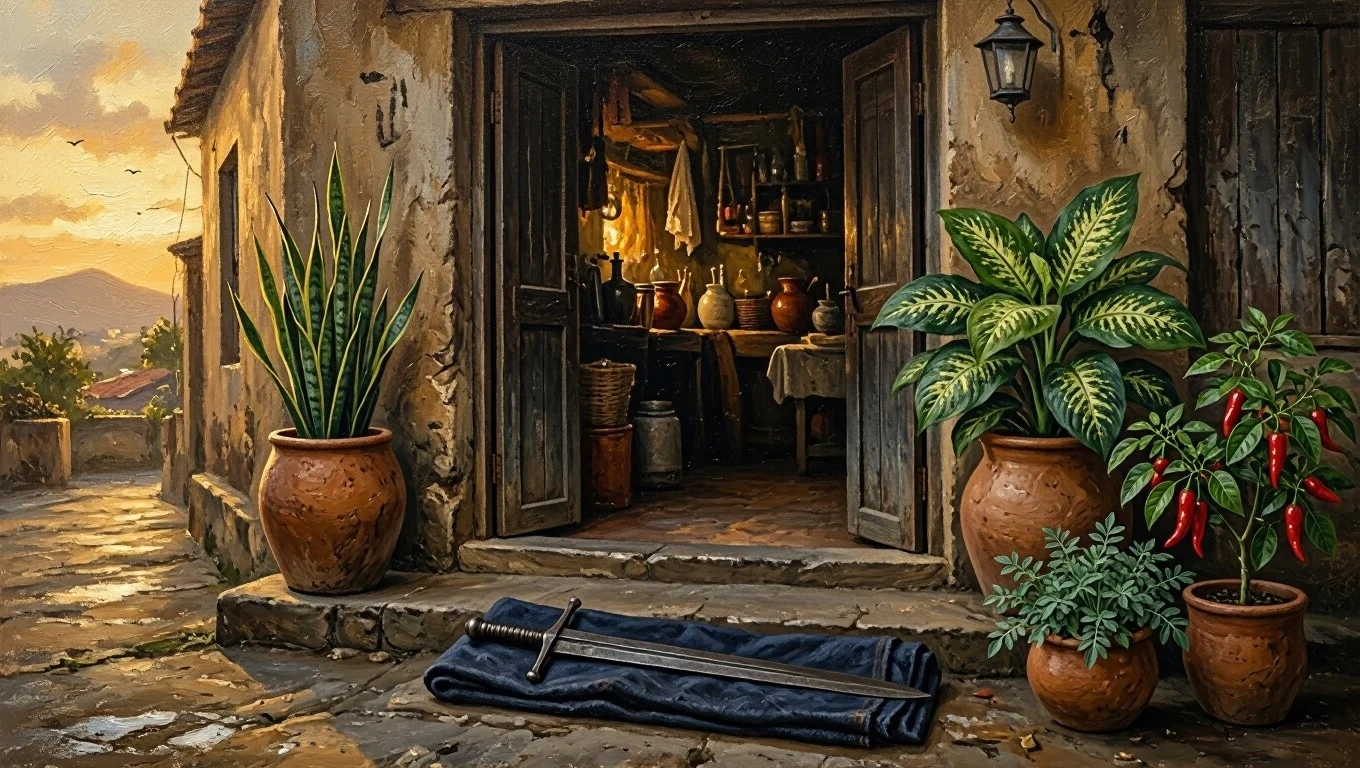
Entrance plants against the evil eye
Ogum's plants are the sentinels of the door. The snake plant and the dumb cane are among his herbs. In a terreiro of Umbanda in Bahia, the snake plant is "a sword that cuts demandas" and the rue "combats envy".
| Plant | What tradition says | Careful |
|---|---|---|
| Espada de São Jorge | of Ogum, cuts demanda | toxic if ingested |
| Comigo-ninguém-pode | of Ogum and Iansã (Oya), guards the entrance | the whole plant is toxic |
| Pinhão roxo | protects house and commerce | toxic, do not ingest |
| Arruda and guiné | they fight envy, use in the vase and in the bath | for external use only |
The dumb cane (comigo-ninguém-pode) has calcium oxalate crystals in all parts and, if bitten, swells the lips and tongue and can cause asphyxiation. Keep in a high vase, away from children and animals, and wear gloves when pruning.
Bath and smoke cleansing for the house and for you
When the conquest already feels heavy, cleansing comes before protection. The spiritual cleansing bath removes the weight from the body, and the smoke cleansing for house cleansing does the same for the rooms. At the shop in Extrema (MG), Joice performs spiritual cleansing and advises on the protection of the house and the business; you can talk to her via WhatsApp.
Symbols that ward off the evil eye
The Unicamp research lists the most common amulets against envy: pepper, greek eye, figa, Saint George chain, and arruda. The greek eye, which the Turks call nazar, exists to ward off the evil eye. The hamsa, called the hand of Fatima by Muslims and the hand of Miriam by Jews, appears on doors and necklaces with the same purpose. In Umbanda, the patuá consecrated in the terreiro plays this role.
Frequently asked questions
What is good to avoid the evil eye?
To avoid the evil eye, tradition guards the entrance: vases of snake plant (espada de São Jorge), dumb cane (comigo-ninguém-pode), rue, or guinea hen weed near the door, a figa or patuá near the body, and a herbal bath when the weight appears. In Umbanda, the firmest protection is the tronqueira, made by the house of the orixás (casa de santo).
What does the Bible say about envy and the evil eye?
The Bible speaks of the "evil eye." Proverbs 23:6 commands not to eat the bread of one who has an evil look, which another translation calls an envious person, and Proverbs 28:22 links "envious eyes" to the haste to get rich. In Matthew 6:22 and 23, the eyes are "the lamp of the body": evil eyes leave the body in darkness.
What is the symbol to ward off the evil eye?
The most used symbols to ward off the evil eye are the Greek eye, the figa, the Hand of Fatima, the pepper, and the rue branch. In Umbanda, the patuá consecrated in the terreiro fulfills this role, and the figa of guiné joins both traditions.
References
- Michaelis (Melhoramentos): entry eye, with the phrase olho gordo
- Idéias (Unicamp): Rodrigues and Caniato, olho-gordo and envy
- Revista Espaço Acadêmico (UEM): Lima Júnior, the belief in the evil eye in Imperatriz
- Vivência (UFRN): Tardelli, the category olho grande among fishermen
- Brazilian Journal of History of Religions: Hasselmann, Meira and Bandeira, Exu and the tronqueira
- UNIFAL-MG: toxic plants manual
- Online Bible: Proverbs 23, Almeida Revista e Atualizada