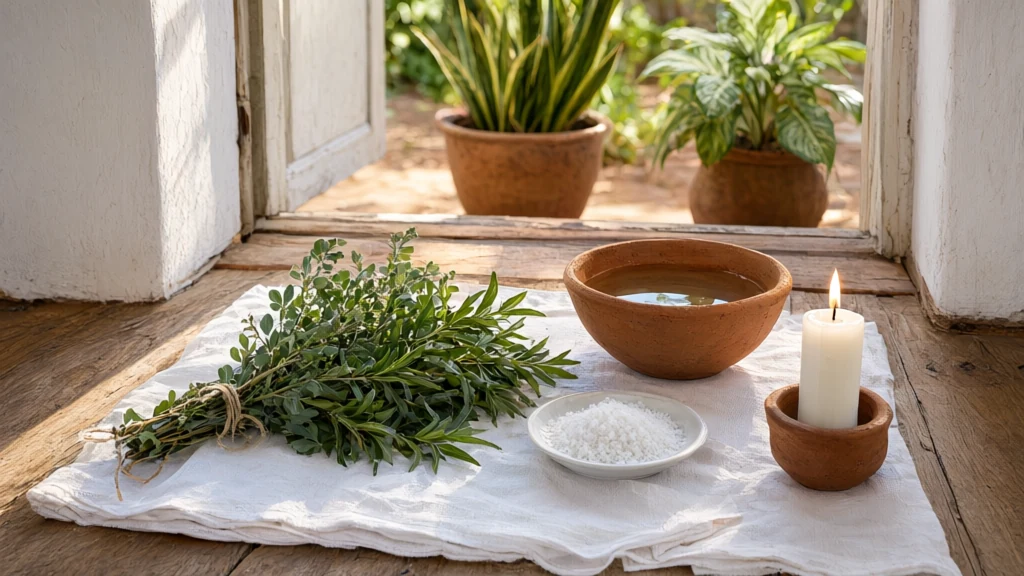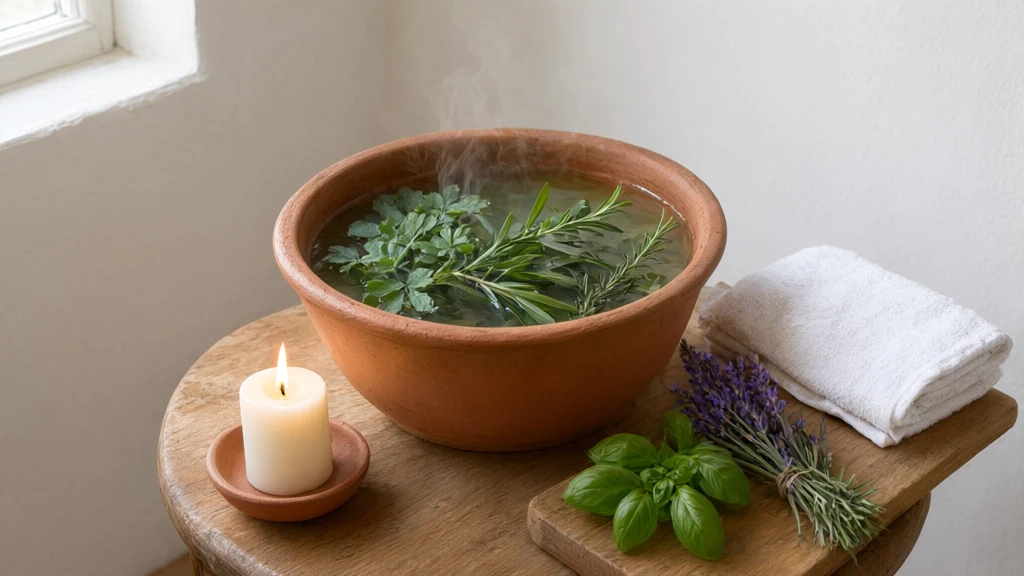
The spiritual cleansing ritual bath is a preparation of herbs in water, poured from the neck down after the hygiene bath. It is done in two stages: first the spiritual cleansing (descarrego), with strong herbs like rue and guinea hen weed, and then a sweet ritual bath, with rosemary or lavender, to replenish the energy that left along with it.
How to do the spiritual cleansing ritual bath?
To do the spiritual cleansing ritual bath, boil the water, remove it from the heat, put in the herbs, cover, and wait for it to cool. This is what the Instituto das Almas, an Umbanda house in Curitiba, instructs. After the hygiene bath, the preparation goes from the neck down, slowly.
- Choose the herbs for the ritual bath, in an odd number, as requested by the São Paulo federation of Umbanda and Candomblé.
- Boil the water and, when it reaches a boil, turn off the heat and add the leaves.
- Cover the pot and let it cool until it is lukewarm.
- Strain and take it to the bathroom.
- Take a normal hygiene bath first.
- Pour the preparation from the neck down, without rushing: a Umbanda manual asks that the bath "should not be thrown brutally over the body but rather gently".
- Do not dry yourself and put on light-colored clothes.
- Return the used herbs to a plant or to clean running water.
In a study of 27 terreiros on Santa Catarina Island, UFSC researchers recorded the same preparation method: an infusion poured over the body, which dries on its own.
The two stages: descarrego and then a sweet bath
The cleansing bath has two halves. In the terreiros of Santa Catarina, there is the descarrego bath, which removes dense energies, and the harmonization or "sweetness" bath, which brings joy and prosperity. A manual from the Sociedade Espiritualista Mata Virgem calls the two "Descarga/Limpeza" and "Energização/Fixação".
The order matters. In a house of Umbanda in Vila Velha (ES), studied at UFES, the descarrego is the cleansing of the physical and spiritual body, and the recharge is "the imantation after the descarrego". The explanation comes from the same manual: the descarrego takes away negative energies and also positive ones, and the person becomes "de-energized". Therefore, after the descarrego, comes a bath with herbs of Oxalá (Obatala) or of the person's orixá (orisha).
The priest Diego de Oxóssi (Oshosi) gives the same warning for the coarse salt bath: it drains all energy, positive or negative, and asks for a second bath of protection and harmonization herbs immediately after.
Which herbs to use in the spiritual cleansing bath?
The herbs of the spiritual cleansing bath are divided into strong ones, for the descarrego, and sweet ones, to replenish. In the terreiros of Santa Catarina Island, the descarrego uses arruda, abre-caminho, and guiné, and the harmonization uses rosemary, lavender, and mint.
| Herb | Bath Tempo | What tradition says |
|---|---|---|
| Arruda | descarrego | ”excellent astral protector”; strong herb |
| Guiné | descarrego | breaks low thought-forms |
| Abre-caminho | descarrego | strong plant of the cleansing bath (banho de descarrego) |
| Aroeira | descarrego | Ogum (Ogun) herb on the FUCESP list |
| Rosemary | sweet bath | cleanses and purifies; sweet plant |
| Basil | sweet bath | removes negative energies and brings life |
| Lavender | sweet bath | helps balance energies |
This division relates to that of hot and cold herbs. In a terreiro of Mina de Santarém (PA), the cold, aromatic ones go in natura and serve the body and the head; the classification also appears in terreiros of Salvador. Mãe Manu da Oxum (Oshun) teaches to mix 1 hot herb with 2 or more cold ones, and only hot for those who are very heavily charged. The article about hot and cold herbs brings the complete list, and the seven herbs bath is a ready recipe that joins both.
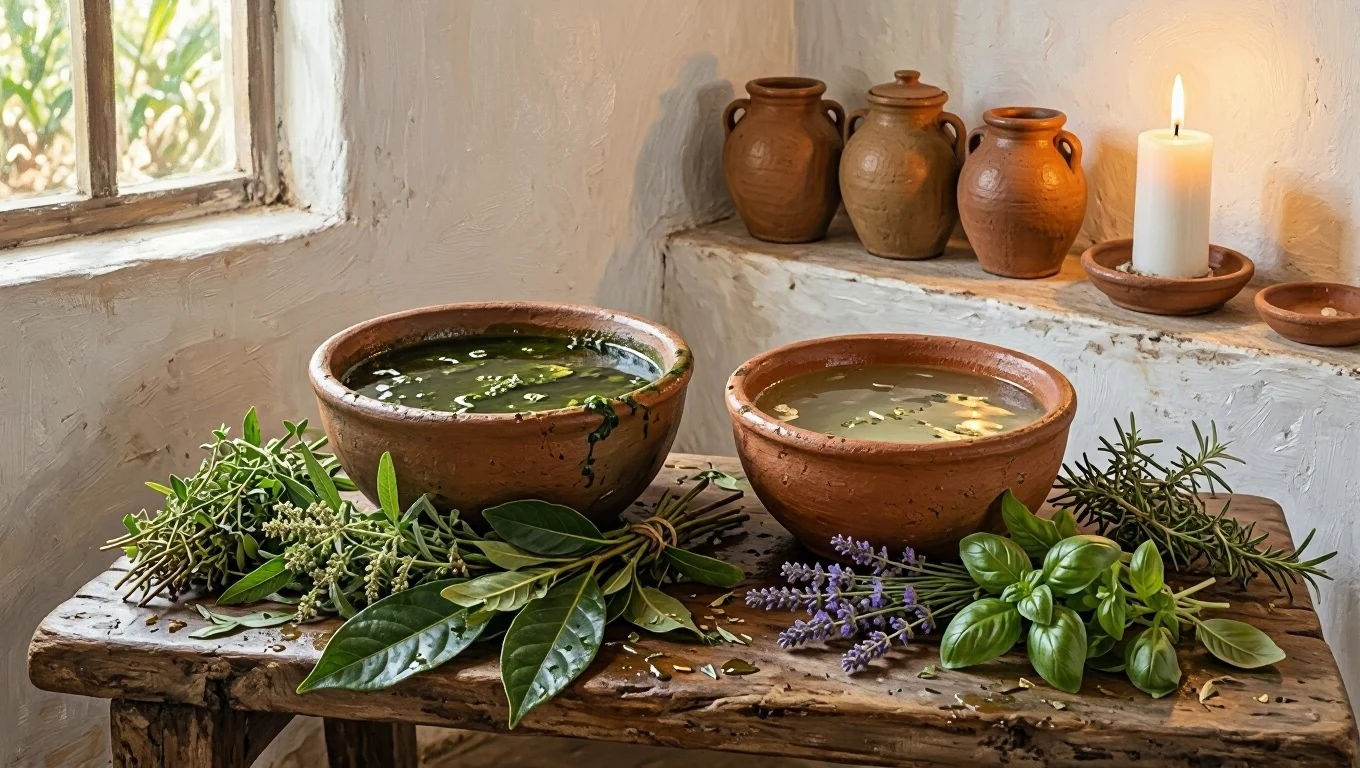
In doubt about which herb is yours, take the which bath to take test. And remember: for the São Paulo federation, "the best bath is the one that the Spirit Guide or the Spiritual Pai/Mãe advises".
Why does the head stay out?
The head stays out because the head bath has its own foundation and is a matter of the house of the orixás (casa de santo). FUCESP teaches that a bath of boiled herbs is taken "from the neck down, never on the ori". A Umbanda terreiro in São Paulo describes the bath as prepared "to wash the body from the neck down".
The baths that wash the head have another name. The amaci is the washing of the mediums' heads with the plants of each one's orixá. In the Candomblé of Bahia, the abô is prepared with leaves macerated in the water of the roncó's quartinhas, to bathe the heads of the initiates. The home exception, for the São Paulo federation, are chamomile, lavender (alfazema), white rose, and sage, which can go from the head down.
When the weight does not leave with the home bath, the cleansing passes to those who have the foundation, as in the sacudimento. In the shop in Extrema (MG), Joice performs spiritual cleansing and indicates the right bath for each case; you can talk to her via WhatsApp.
When to take a spiritual cleansing bath
The spiritual cleansing bath is taken when the body and the house feel heavy, after an evil eye or a phase of evil eye, and not as a daily routine. The Mata Virgem booklet warns that the coarse salt spiritual cleansing (descarrego) should not be intensive, neither every day nor every week. Mãe Manu da Oxum links the cleansing bath (banho de descarrego) to the waning moon.
Regarding the time, a Umbanda professor from São Paulo recommends cleansing and balance herbs at night and energizing herbs during the day.
Care with rue (arruda)
Rue requires two precautions. A case report published in the Revista Brasileira de Queimaduras tells of a woman who took a rue infusion ritual bath on the eve of the beach and developed blisters and spots on her body. The guidance is to wash the skin with soap and water and avoid the sun for the following 48 hours. And rue is one of the most used plants to try to induce abortion in Brazil, so pregnant women should also avoid it in the ritual bath.
Frequently asked questions
What is the best spiritual bath?
The best spiritual bath is the one your spirit guide or your Pai or Mãe de santo advises, according to the São Paulo federation of Umbanda and Candomblé. Each bath causes different reactions depending on the person's energy. Without guidance, the safe path is a light spiritual cleansing (descarrego) followed by a sweet bath.
What happens after a herbal bath?
After a herbal bath, tradition asks that you do not dry yourself, wear light-colored clothes, and return the herbs to a plant or running water. After a spiritual cleansing (descarrego), a person may feel drained of energy, and for this reason, houses ask for a sweet bath immediately after.
What is the psalm for spiritual cleansing?
In popular Catholicism, the psalm that speaks of cleansing is 51: "Purify me with hyssop, and I shall be clean; wash me, and I shall be whiter than snow." For protection, the most prayed is Psalm 91. In Umbanda, the ritual bath prayer is the prayer to your orixá and to your spirit guides.
References
- Journal of Ethnobiology and Ethnomedicine: Pagnocca, Zank and Hanazaki, the use of plants in the terreiros of Santa Catarina Island
- Nova Revista Amazônica (UFPA): Barboza and others, cold and hot plants in a terreiro of Mina de Santarém
- Boletim do Museu Paraense Emílio Goeldi (SciELO): Carlessi, possibilities of existence in umbanda
- FUCESP: herbal bath
- Revista Brasileira de Queimaduras: Bravo and Balassiano, phytophotodermatitis from rue
- Infarma (CFF): Clarke, Rates and Bridi, an alert about the use of plant-based products during pregnancy