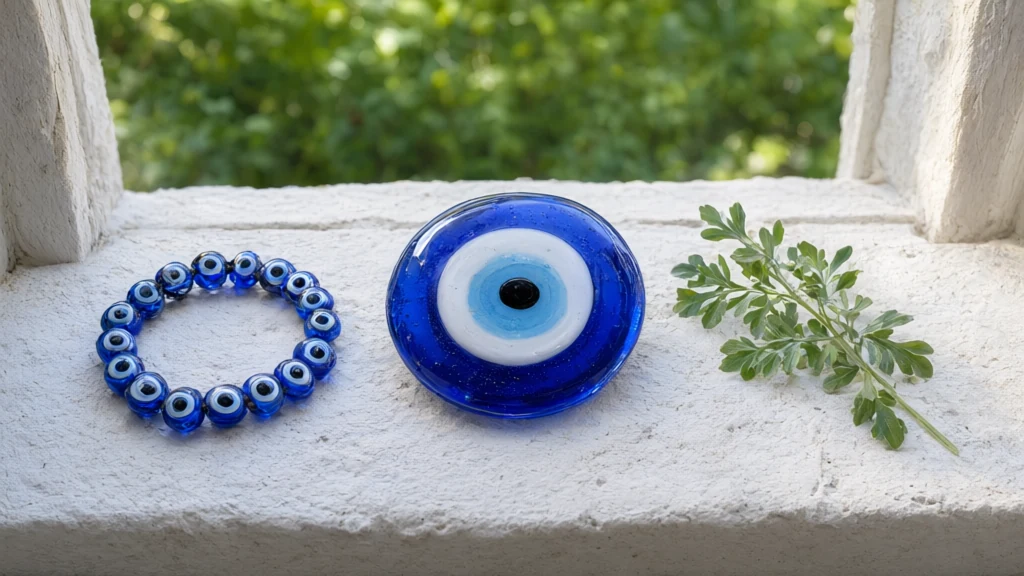
The Greek eye means protection against the evil eye and envy. It is a blue and white glass eye, with a black pupil. In the belief, it attracts the first bad look and deflects it from the wearer. In Turkey, it is called nazar boncuğu, the "eye bead".
What does the Greek eye mean?
The Greek eye means vigilance: an open eye that returns the gaze. The Turkish word nazar comes from Arabic and means "look" or "sight". The idea is simple. The first look from the envious person is the strongest. Therefore, the amulet draws attention: it receives that look instead of the person.
Turkish name: nazar boncuğu | Traditional material: handmade glass | Traditional colors: dark blue, white, light blue, and black | Function: deflect the evil eye | Where to place: in plain sight
The Pitt Rivers Museum, at the University of Oxford, has kept one of these glass eyes since 1885. According to the museum, it mimics an eye to attract the evil eye and spare the owner. The Turkish Ministry of Culture agrees: the bead deflects the bad look elsewhere.
In Brazil, the Greek eye entered the list of amulets against envy, along with pimenta, figa, and arruda. It is the same fear described in the article about the evil eye.
Where does the Greek eye come from?
The Greek eye comes from Turkey and the Mediterranean. The first glass beads against the evil eye were made in the village of Görece, in the province of İzmir. The technique arrived with artisans coming from Egypt. With colored glass, the eye began to be placed on the bead to protect people.
Görece and Nazarköy still make the beads the old way, in pine wood-fired ovens. The old Kurudere became Nazarköy in 2007, in tribute to the nazar it produces.
The belief in the evil eye is much older than the amulet. One of the first mentions is in a Sumerian text over 4,000 years old. In Greece, the evil eye is called mati, and the little blue eyes of protection are called matakia. In Brazil, the amulet gained the name Greek eye, and many people also say "Turkish eye".
Why is the Greek eye blue?
The Greek eye is blue because blue is the color of the shield in this belief. In Turkish tradition, blue protects and absorbs what is negative. In Greece, blue would have "preventive power." There is still another explanation. Light eyes are rare in the Mediterranean, and the blue gaze of the foreigner was feared.
What does each color of the Greek eye mean?
The traditional color of the Greek eye is blue, in circles of dark blue, white, light blue, and black, sometimes with a yellow or gold border. The piece in the Oxford museum has white, yellow, and blue rings around the black pupil.
As for the table with a meaning for each color (pink for love, green for health), that is a jewelry store thing. It changes from shop to shop. A newspaper from Pernambuco says that brown brings order and black brings prosperity. Other sites say the opposite. Turkish and Greek sources do not provide these lists.
In practice: choose the color that pleases you. For those who follow tradition, the glass blue is the "real" Greek eye. The different color counts as an ornament and personal intention.
How to use the Greek eye and where to place it
The Greek eye works, in belief, when it is in sight. That is why the Turks place it in places where everyone can see. It stays in the car, in the shop, at home, and even on the "cavalo".
- Bracelet and necklace: the way to wear the Greek eye on the body. The glass bead bracelet is the most searched on Google.
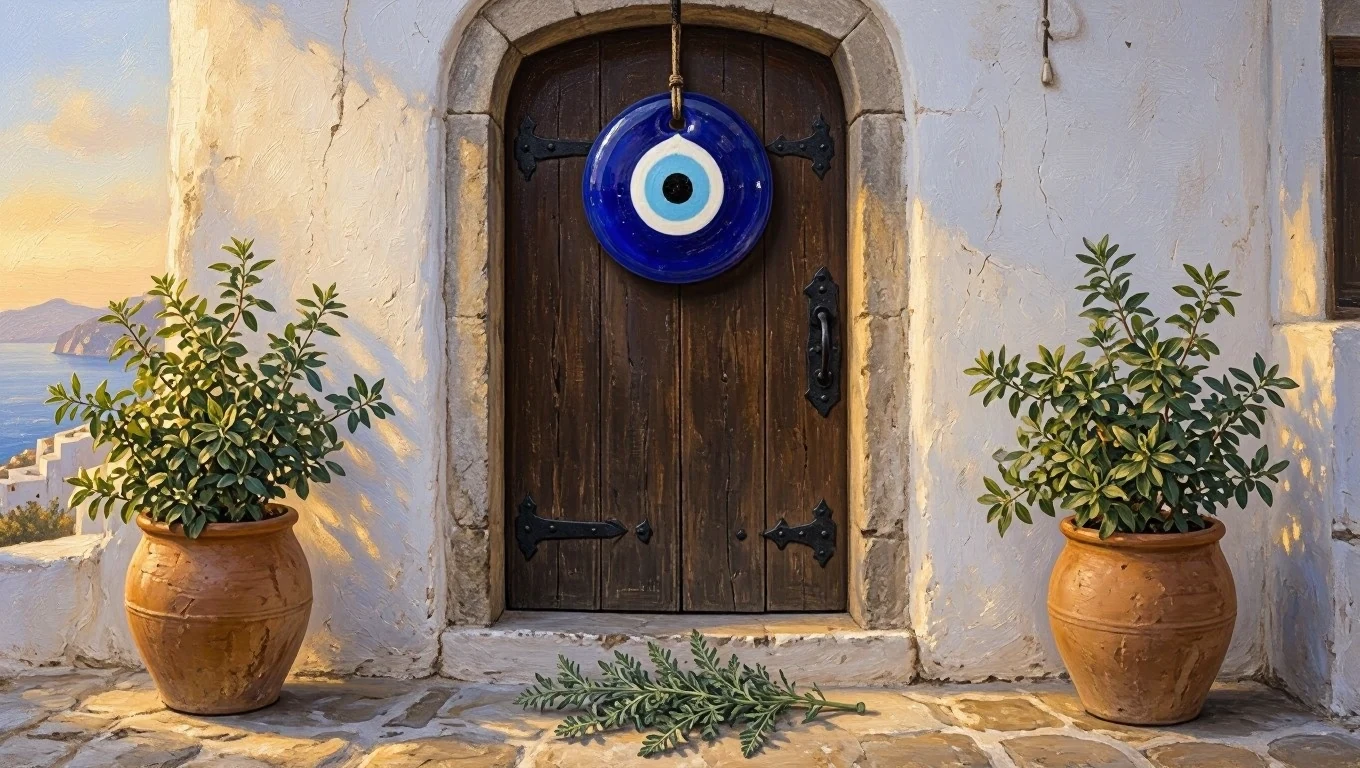
- On the door: the hanging eye goes above or next to the entrance door, facing outward.
- In the car and at work: keychain on the rearview mirror or on the key, and an eye on the shop counter.
- Baby and child: belief says they are the most vulnerable. Small bead away from the mouth: it is a choking risk.
At the Joia Mística shop, in Extrema (MG), there are bracelets, keychains, and door Greek eyes. Joice also performs spiritual cleansing and advises on the protection of the home and business; you can clear up doubts with her via WhatsApp.
Is it good to have a Greek eye at home?
Yes, for those who believe, the home is a classic place for the Greek eye. Turkish tradition protects living beings and things with it. The door is the point that receives the gaze from outside. It combines with entrance plants, such as the comigo-ninguém-pode.
What to do when the Greek eye breaks?
When the Greek eye breaks or cracks, popular belief says that it held a very strong gaze and fulfilled its role. The recommendation is to replace it with another as soon as possible. It is a custom, not a religious rule.
A respectful way to do it:
- Collect the pieces carefully, without touching with bare hands if it is sharp glass.
- Give thanks for the protection, out loud or in your thoughts.
- Discard wrapped in paper, in the common trash or buried in a pot, away from children.
- Put a new Greek eye in the same place.
If the house feels heavy, the break is a good warning. A spiritual cleansing ritual bath and a smoke cleansing (defumação) close the cycle before the new amulet.
Greek eye, figa, and rue: Brazilian protection
The Greek eye arrived in Brazil and mixed with the amulets that the people already used against envy: pepper, figa, Saint George chain, and rue. The logic is similar: the amulet stays in sight, near the body or the door, and stands guard.
Those who fear the evil eye over an achievement usually gather everything. Greek eye on the wrist, figa on the keychain, and rue at the entrance.
It is worth separating the things. The Greek eye is a Turkish amulet, adopted by popular devotion. In Umbanda, personal protection comes from the patuá, consecrated in the terreiro. One does not replace the other.
Remember: an amulet is a guard, not a guarantee. If the weight continues, the path is spiritual cleansing and, in the terreiro, the guidance of the house.
What does the Catholic Church say about the Greek eye?
The Catholic Church does not speak of the Greek eye by name, but the Catechism says that "the use of amulets is also reprehensible". The text is in paragraph 2117, along with magic practices. 2111 calls superstition a deviation from religious feeling.
The Orthodox Church of Greece follows a similar line. It recognizes the evil eye, but does not approve of personal protection amulets. For the practicing Catholic, the answer is clear. For those who follow another faith or popular devotion, the Greek eye remains as an eye that watches.
Frequently asked questions
What is the Greek eye called?
In Turkey, the Greek eye is called nazar boncuğu, "bead of the gaze," or göz boncuğu, "eye bead." In Greece, the little blue eyes are called matakia. In Brazil, besides Greek eye, many people say Turkish eye, and the word nazar is also used alone.
What is the envy emoji?
The emoji linked to protection against envy is the Nazar Amulet, a blue Greek eye with code U+1F9FF. It entered Unicode 11.0, in 2018, as an eye-shaped amulet against the evil eye. On the phone keyboard, it appears when searching for "nazar" or "eye."
Is the Greek eye a sin?
For the Catholic Church, the Catechism says that the use of amulets is reprehensible, in paragraph 2117. The Greek Orthodox Church also does not approve of protection amulets. For other traditions and for popular devotion, the Greek eye is a symbol of protection like the figa and the rue.
Does a Greek eye tattoo have the same meaning?
Yes, the Greek eye tattoo carries the same meaning as the amulet: protection against the evil eye and envy. In the belief, the eye needs to be in sight to receive the gaze. The blue with the black pupil follows the traditional design.
References
- Ministry of Culture and Tourism of Turkey: Traditional Arts Using Glass
- Directorate of Culture and Tourism of İzmir: Evil Eye Bead
- University of Kansas, CREES: Nazar
- Unicode Consortium: Anshuman Pandey, Nazar symbol proposal, 2015
- Pitt Rivers Museum, University of Oxford: Amulets and Charms
- Culture & Tradition (Memorial University): Stampliaka, the evil eye in Greek culture, 2025
- Holy See: Catechism of the Catholic Church, paragraphs 2111 and 2117
- Idéias (Unicamp): Rodrigues and Caniato, olho-gordo and envy
- Emojipedia: Nazar Amulet
- Folha de Pernambuco: Danilo Israel, Greek eye jewelry, 2022