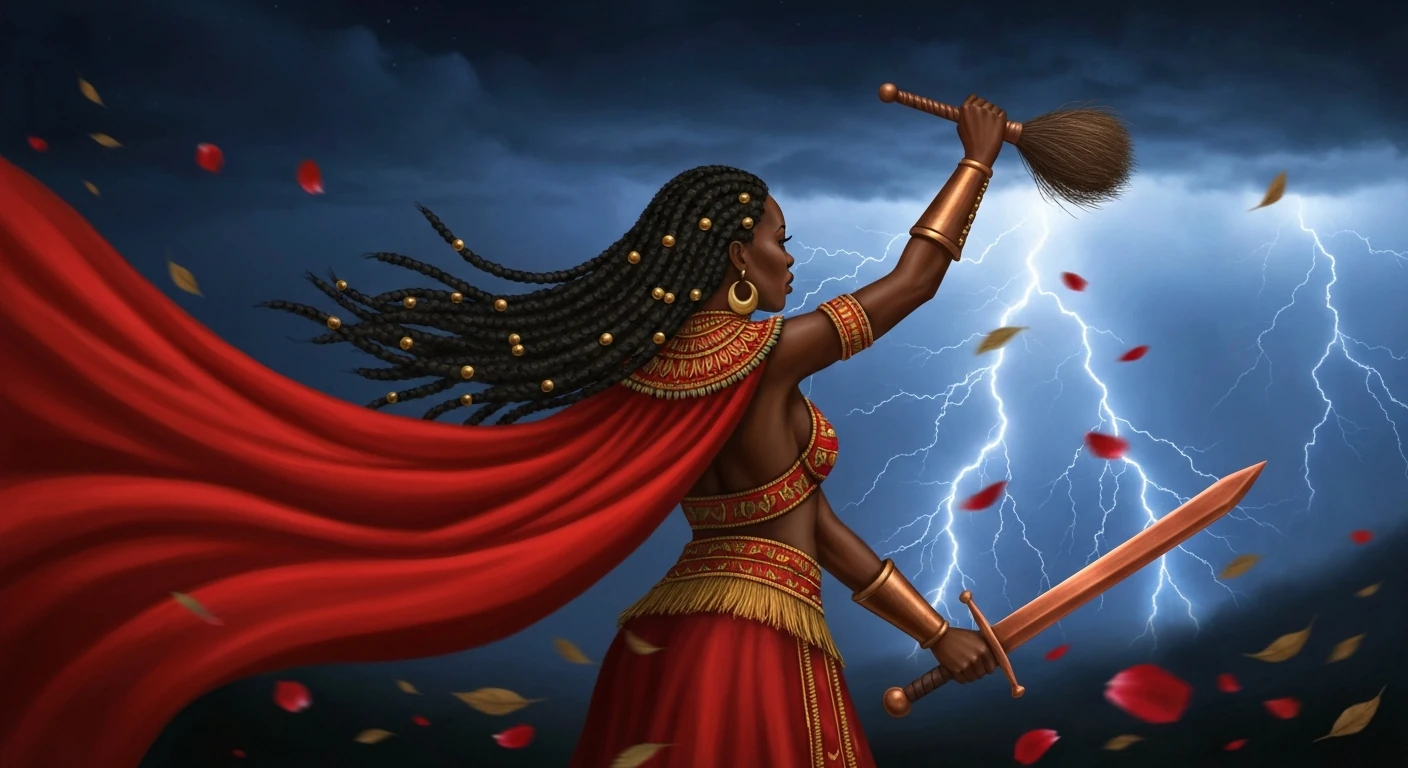
When the wind kicks up dust and beats against the windows in Rio Grande do Sul, the batuqueiro has a phrase ready: Oiá is waving her skirt. This is how the Gaúcho tradition speaks of the orixá of winds, lightning, and eguns, the one who opens the passage between life and death.
Oiá in Batuque occupies a specific place, different from the one she occupies in Bahia. She is the third called in the line and the first female orixá of all nations. And she carries a title that almost no one from outside knows: mistress of the roof and the pot.
This guide gathers her profile in Batuque, with colors, day, greeting, foods, tools, and syncretism. And it records, without hiding, what changes from nation to nation.
Who is Oiá, the third of the Batuque line
In Batuque, the orixás are called in a fixed sequence called linha. It runs like this: Bará, Ogum (Ogun), Oiá, Xangô (Shango), Odé and Otim, Obá, Ossanha, Xapanã, Oxum (Oshun), Iemanjá (Yemoja) and Oxalá (Obatala).
Oiá comes in third. Before her only Bará, who opens the paths, and Ogum, who cuts, pass. No other female orixá is called before.
This does not make her more important than the others. In the cosmology of Batuque, there is no hierarchy between orixás: they complete each other, and the order of the line is ritual, not of value. Anyone who confuses the two things receives a reprimand from any pai de santo.
The name comes from the Yoruba Ìyá Mésàn-Òrun, "mother of the nine heavens." The reference is to the Niger River, called Odò Ọ̀ya in Africa, and the nine branches it forms. In the South, the consecrated spelling is Oiá, with Iansã appearing as a synonym and as a prefix for some qualities.
In Batuque, whoever has Oiá receives an orixá of two hands: one that agitates and opens, another that shelters and sustains.
Technical profile of Oiá in Batuque
| Item | In Batuque |
|---|---|
| Name | Oiá (Iansã as a synonym) |
| Regency | winds, storms, lightning, passions, eguns |
| Position in the line | third, first feminine |
| Colors | red and white, with emphasis on red |
| Number | 7 and its multiples |
| Bead necklace | 7 red beads and 7 crystal white beads |
| Day | Tuesday |
| Greeting | Epaiêio |
| Instrument | eruexim, the horsehair with a handle |
| Adjuntó | Ogum |
| Syncretism | Saint Barbara |
The assentamento is made over the otá, the stone that guards the axé of the orixá, generally in a clay alguidar. Records of Jeje-Ijexá houses in Rio Grande do Sul also mention an iron or clay pot for the street Oiás. This varies by house, and the final word is always from the pai or the mãe de santo.
The most cited tools are sword, pair of rings, chalice, coins, búzios, and lightning. In specific qualities, a dagger, feather fan, mirror, comb, and two or four pointed lightning appear. The list is never closed.
Owner of the roof and the pot
This is the most beautiful and least publicized reading of Oiá, and it was born in the South. The batuqueiros say that who has Oiá is neither left homeless nor goes hungry.
Hence the nickname: mistress of the roof and the pot. Roof because she covers, pot because she sustains.
Notice the size of the difference. In the most widely shared Bahian version, Iansã appears almost exclusively as a warrior and lady of the dead. In the Gaúcho Batuque, this same strength also becomes a provider of home and food.
Take the usual care: this is a saying of the tradition, not a guarantee. The phrase describes the nature of the orixá and the way her children read their own lives, not a promise of results.
Oiá and the eguns: the eruexim and the Cabinda nation
Egum is the spirit of the dead, the ancestor. It is not a haunting, nor a bad thing, nor a backward spirit. This confusion comes from outside of Batuque and hinders understanding.
Oiá is the lady of the eguns. She controls them and leads them with the eruexim, a horsehair tail attached to a handle. The gesture of waving the eruexim is the gesture of ruling the passage.
In a house of Batuque studied by Carina Dias, the pai de santo says that Xangô "is not afraid of egun" and left the eguns for Iansã (Dias, 2019). The couple is in Iansã and Xangô. Therefore, she watches the final transition and guards the border between the two worlds.
In the practice of the terreiro, this has a direct use: when the problem involves disturbance caused by egum, it is Oiá who is called first. It is a religious function, not a suspense plot.
There is a bridge here that almost no one makes. The anthropologist Ari Pedro Oro, from UFRGS, records that the Cabinda nation is the Bantu nation of Batuque with a focus on the worship of eguns. In other words: precisely where the ancestors receive more attention, Oiá appears linked to more orixás and to more people.
Adjuntó: why Oiá walks with Ogum
Adjuntó is the term used in Batuque for orixás who are worshipped together, settled in the same places, and receive obrigação together. It is a concept that has no exact equivalent in Ketu Candomblé.
Oiá makes adjuntó with Ogum. The two come side by side in the line and share the same space in the orixá room.
In Cabinda, the arrangement expands: there, Oiá also makes adjuntó with Xangô, with Bará, and with Xapanã. Not by chance, many children of Xapanã bring Oiá as an adjuntó, which reinforces her connection to the cult of the dead.
What changes from nation to nation
Batuque has five nations, and each one keeps its own variations. Whoever seeks a single answer about Oiá will find conflicting information on the internet. The conflict is real and is part of the religion.
| Item | Registered versions |
|---|---|
| Day | Tuesday in most houses; Tuesday and Thursday in Ijexá houses of Viamão |
| Greeting | Epaiêio, and Paieio in the Cabinda nation |
| Qualities | Dirã and Timboá converge; Nique and Funique appear in some of the sources |
| Foods | popcorn, sweet potato opeté with dendê, red apple, seven slices of fried potato, red roses |
Two honest caveats close the picture.
The first is about the greeting. “Eparrei” is the form popularized by Baiano Candomblé and Umbanda, not the one from Batuque. In the South, Epaiêio is said.
The second is about food. Acarajé, abará, and ekuru are offerings from the Yoruba tradition and Candomblé, and are not confirmed as food for Oiá in Batuque. Meanwhile, the amalá appears as a votive food shared by Xangô, Oiá, Obá, and Ibeji.
Regarding quizila, the same caution applies. The prohibition of pumpkin is recorded in Candomblé, and in Batuque, the quizila varies by house and by quality. Confirm with your pai or mãe de santo before assuming any rule.
Saint Barbara and Oiá: syncretism as resistance
Oiá was associated with Saint Barbara during the colonial and republican repression of Afro-Brazilian worship. The Catholic saint of lightning and storms served as a facade so that the orixá of lightning could continue receiving worship.
This does not make one the same as the other. Oiá is an orixá of Batuque, Saint Barbara is a saint of the Catholic Church. Syncretism was a survival strategy, not a theological fusion.
In some qualities, other associations appear, such as Saint Therese and Joan of Arc. The theme is extensive, and the blog covers it in Saint Barbara and Iansã.
Frequently asked questions
What is the difference between Oiá and Iansã?
They are names of the same orixá. "Oiá" is the common form in the Batuque of Rio Grande do Sul and comes from the Yoruba Ọ̀ya, linked to the Niger River. "Iansã" became popular through the Baiano Candomblé and Umbanda. In the South, both forms coexist, and "Iansã" usually appears as a prefix for qualities.
What is the greeting of Oiá in Batuque?
In Batuque, one greets Epaiêio, with the variant Paieio recorded in the Cabinda nation. The famous "Eparrei" is a form of the Baiano Candomblé and Umbanda, not of the Gaúcho Batuque. If you are in a terreiro in the South, the correct greeting is the first one.
What can the children of Oiá not eat?
The most cited quizila is pumpkin, with lamb and lizard in some versions. However, these records come from Candomblé, not from Batuque. In the Gaúcho tradition, the quizila varies by house and by the quality of the orixá. Never assume a general rule: ask your pai or mãe de santo.
How do I know if I am a child of Oiá?
What defines this is the cowrie-shell divination performed by a Pai or Mãe de santo, never a personality test. Traits attributed to the children of Oiá include a quick temperament, courage for change, and an ease of starting over. A trait is not a confirmation: only the ritual consultation answers.
Who is Oyá in Candomblé?
In Ketu Candomblé, Oyá or Iansã is worshipped on Wednesdays, receives acarajé and abará, and has the same mastery over winds, lightning, and eguns. The energy is the same, but the calendar, the foods, and the greeting follow another liturgy. See the full profile in Who is Iansã.
Where to buy items for Oiá
At Joia Mística Laroyê, you find what the house asks to set and care for Oiá:
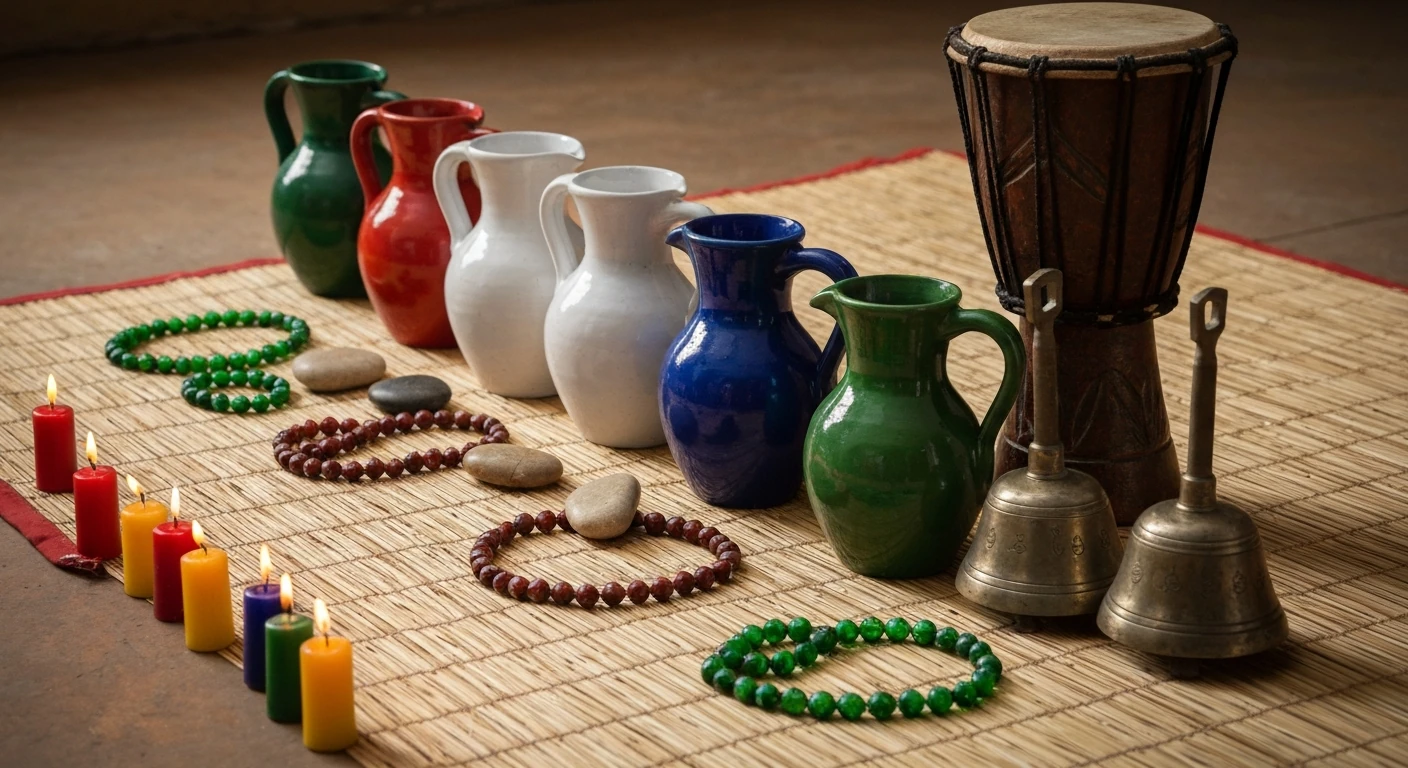
- Bead necklaces of 7 red beads and 7 white crystal beads: assembled in the orixá pattern, ready for the Pai or Mãe de santo to cross
- Sword and tools in metal: consecrated foundation (assentamento) pieces in the size of a quarto de santo
- Clay alguidar: for the assentamento and for laying down (arriar) food
- Red pano de costa: for ritual use and to cover the consecrated foundation (assentamento)
- Dendê, popcorn, and red and white candles: the replacement items that sell the most among batuqueiros
Visit our shop in Extrema, Minas Gerais or talk to us via WhatsApp and we ship all over Brazil.
To delve deeper into the Afro-Gaúcha religion, two open works by anthropologist Ari Pedro Oro help a lot. The first is Afro-Brazilian religions of Rio Grande do Sul: past and present, published on SciELO. The second is The Afro-Brazilian religions of Rio Grande do Sul, in the UFRGS repository. For the myths of Oiá with the eguns, the reference is Mythology of the Orixás, by Reginaldo Prandi. And the foundational work on the theme continues to be The Batuque of Rio Grande do Sul, by Norton F. Corrêa.
References
- Ari Pedro Oro: Afro-Brazilian religions of Rio Grande do Sul, past and present, published on SciELO
- Ari Pedro Oro: Afro-Brazilian religions from Rio Grande do Sul, in the UFRGS repository