



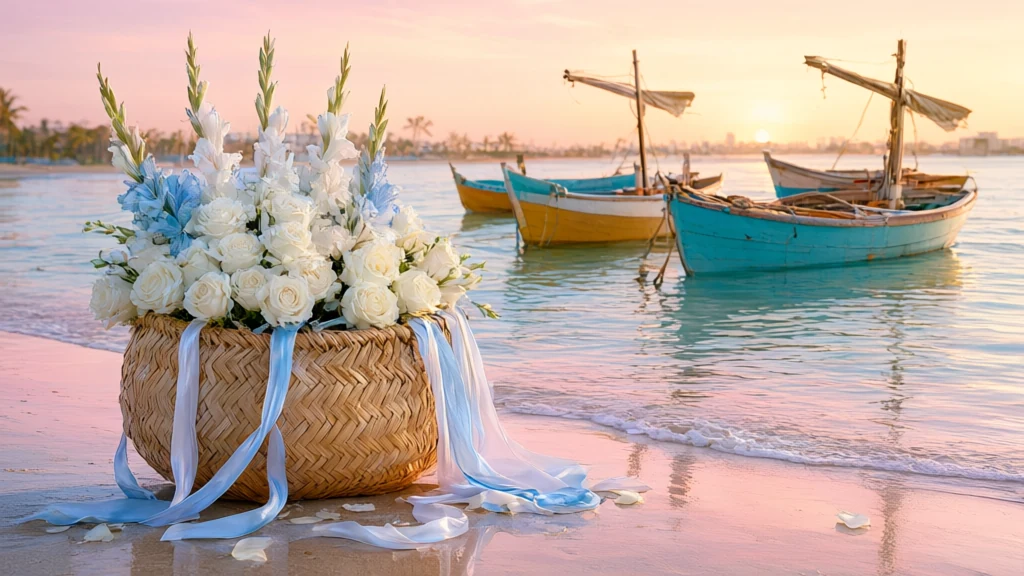
The Festa de Iemanjá in Salvador takes place every February 2 in Rio Vermelho, when the fishermen of Colônia Z1 take the gift of the orixá (orisha) to the sea. In 2027, the date falls on a Tuesday and is not a municipal holiday. The day begins at dawn with fireworks, and the gift goes out to the sea in the late afternoon.
Why is the festa de Iemanjá in Salvador on February 2?
The festa is on February 2 because the fishermen of Rio Vermelho shared the date and the place with the festa de Sant’Ana. Iemanjá's gift remained on this day when the saint changed her date. In the 1940s, the Church moved Sant’Ana to July 26, and the gift remained on February 2.
February 2 is, in the Catholic calendar, the day of Our Lady of Candeias, or of Light. Pierre Verger writes that, in Bahia, the syncretism of this date links Candeias to Oxum, not to Iemanjá. The newspaper A Tarde records the same correspondence. For Iemanjá, Verger gives the Immaculate Conception, on December 8.
For the Correio, it is the only large popular festival in the city without a connection to syncretism. The newspaper says there is no consensus on the relationship of the date with the saint. The complete profile of the orixá is in who is Iemanjá.
How did the Rio Vermelho festa begin?
The festa began with the neighborhood fishermen in the 1920s, when fishing was weak. In the version of the chroniclers, recorded by the anthropologist Ordep Serra, the priest of Santana refused the request of the fishermen. They then went to a mãe de santo, who suggested the offering to Iemanjá.
The year is disputed. The Fishermen's Colony counts 1923. Historian Edilece Couto and researcher Ubaldo Marques Porto Filho point to 1924. Anthropologist Cristiane Sobrinho, who conducted the technical report on the heritage, told A Tarde: "There is nothing to prove if it was in 1923 or 1924." And researcher Armando Vallado found a reference to a festival in Rio Vermelho as early as 1896.
The person who taught the offering also has two spellings. A Tarde writes Julia Bogum; Correio writes Júlia Bugan. The babalorixá and anthropologist Vilson Caetano, from UFBA, says it was a Candomblé of the ijexá nation, Língua de Vaca, founded by her, that organized the first gift. The fishermen bought a basket, a clay carving, flowers, and blue and white ribbons.
"It was a Candomblé of the Ijexá nation that organized the first gift of Rio Vermelho, back when there was still a river." Vilson Caetano, to Correio.
The separation from the Church came later. Correio reports that in 1930 the priest of Sant'Ana refused to bless the gift, and the fishermen kept the festival without it. The name "Festa de Iemanjá" only took hold in the late 1950s.
Who makes the main gift
The main gift is made by a Candomblé house that the Colony invites every year, with an artist who assembles the basket work following the priests. In 2019 it was Mãe Jacira de Obaluaê, from Ilê Axé Jibayê, in Lauro de Freitas, for the fourth year. In 2025 and 2026, the gift came from Terreiro Olufanjá (Ilê Axé Iyá Olufandê), with Mãe Nicinha de Nanã (Nana Buruku).
Before the one for Iemanjá, comes the gift of Oxum, delivered at midnight at Dique do Tororó. "By the foundations of Candomblé, the gift of Oxum needs to come before the one of Iemanjá," recorded Correio.
The oldest terreiros in Salvador do not make the festival their obrigação. Gantois and Casa Branca fulfill the obligations to Iemanjá at another time in the house calendar, and Casa de Oxumarê has its own date. An ogã from the house summarized: "February 2nd is one more commemorative festival." Serra notes that the present at the hut has the toque of atabaque and looks like a xirê, but it is a celebration.
What time does the present of Iemanjá leave? The day's itinerary
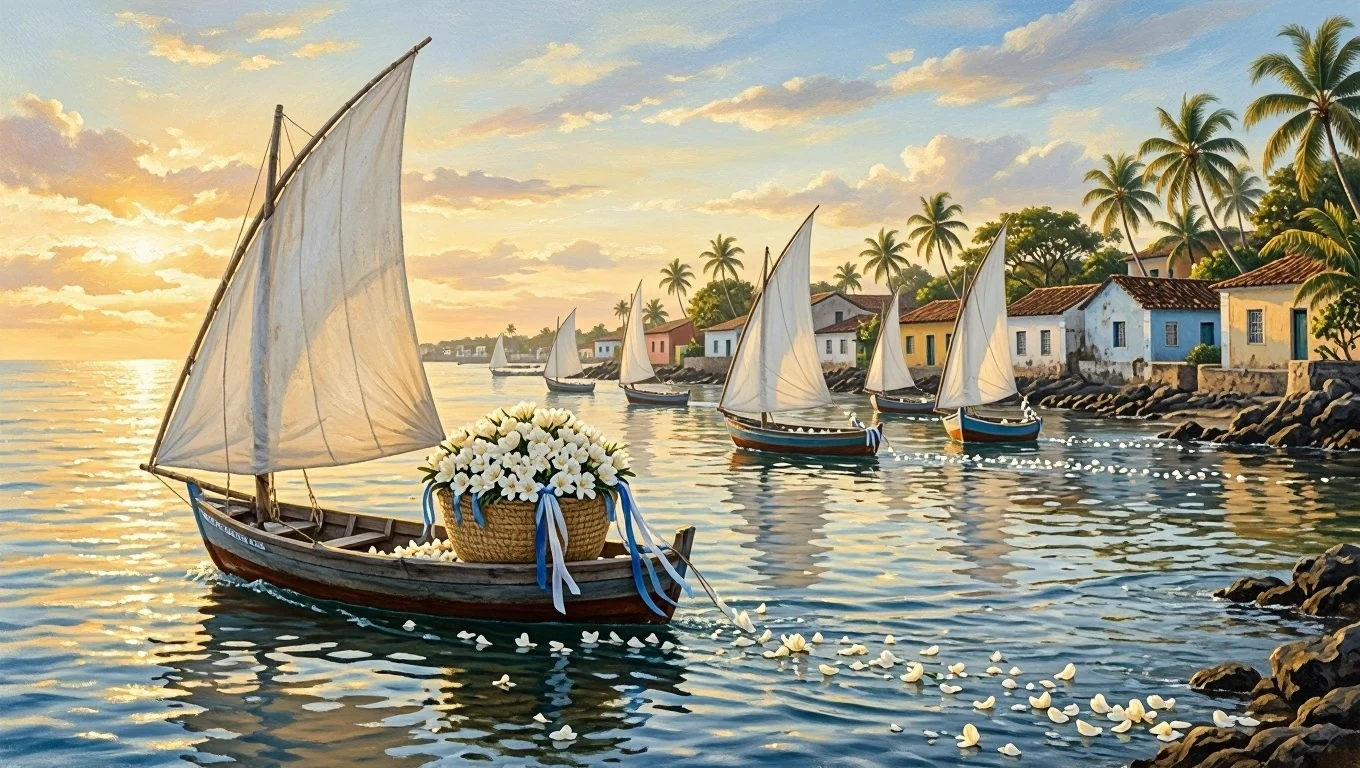
The present of Iemanjá usually heads to the sea around 4:00 PM, after spending the day on display at the Colônia de Pescadores. The 2027 schedule will only be released in January, but the pattern of recent years repeats:
| When | What happens | Source |
|---|---|---|
| Eve, near midnight | present of Oxum at Dique do Tororó | |
| Around 5:00 AM on the 2nd | the main present arrives at Santana beach with the dawn of fireworks | |
| Morning and afternoon | lines at Casa de Iemanjá and at the barracão to deliver flowers and baskets | |
| Around 4:00 PM | the fishermen take the present in boats to Buraco de Iaiá, three nautical miles away |
Serra records the line growing since six in the morning. Those who arrive late leave the offering on the beach. In 2026, before 5:00 AM, there were already lines that circled the neighborhood.
The Casa de Iemanjá is the old house where fishermen weighed the fish, renovated in 1970. Next to it, in Largo de Santana, is the 3.74 m mermaid by Manoel Bonfim, from 1969. The discussion about the white statue of the orixá is in Iemanjá statue.
What to take to the Iemanjá festival and what not to throw into the sea
Take plastic-free flowers and lavender*, and pour the perfume without throwing the bottle. "We do not throw the glass into the water, only the liquid," a devotee told A Tarde in 2026. Fishermen sort the offerings in the caramanchão before taking the gift.
What not to take to the sea, according to the list of what appears at the bottom after the festival:
- Plastic and cloth, including the cellophane from the flowers.
- Glass bottles and flasks, such as those for lavender and beer.
- Mirrors, earrings, nail polish, and soaps, which make up a good part of the trash found.
The president of the Colônia, Nilo Garrido, estimates that 30% of the gifts that arrive are not biodegradable. The priestess Cici de Oxalá (Obatala) told Mongabay that the comb, she gives to people, instead of throwing it away. In the tradition cited by Verger, the offering accepted is the one that sinks. Roses, palms, and lavender also serve for the offering to Iemanjá on other dates. To check the material before traveling, Joia Mística can be reached via WhatsApp.
The same rule applies on the turn of the year, in Iemanjá on New Year's.
Is the Iemanjá festival a heritage of Salvador?
The Festa de Iemanjá has been Cultural Heritage of Salvador since February 1, 2020, registered in the book of events and celebrations of the Fundação Gregório de Mattos. The request came from the OAB of Bahia, with the agreement of Colônia Z1, "responsible for organizing the festival." The registration is municipal; the sources we opened do not mention registration in IPHAN or IPAC.
Another religious summer festival in Salvador is the Lavagem do Bonfim, and the saint and the orixá behind it are in Senhor do Bonfim and Oxalá. The other dates of Iemanjá across Brazil are in dia de Iemanjá.
Frequently asked questions
When is the Iemanjá festival in Salvador in 2027?
It is on Tuesday, February 2, 2027, in Rio Vermelho. The festival begins on the eve, with the gift of Oxum at Dique do Tororó, near midnight. The 2027 schedules are released in the programming of Colônia Z1 and the City Hall in January.
Is February 2 a holiday in Salvador?
No. According to Correio, the date is not in the federal holiday law. The four municipal religious holiday spots in Salvador are already taken by Good Friday, Corpus Christi, São João, and Conceição da Praia.
Where is the Iemanjá festival in Salvador?
In Rio Vermelho, at Santana beach, in front of Colônia de Pescadores Z1 and Casa de Iemanjá. The gift leaves by boat to Buraco de Iaiá, three nautical miles off the coast.
Can people who are not from Candomblé go?
Yes. The festival is public and organized by fishermen, with a line of devotees all day long. The city's large terreiros, such as Gantois, fulfill their obligations to Iemanjá on their own house's date.
References
- Ordep Serra, EDUFBA (2009): Rumors of the festival: the sacred and the profane in Bahia
- Edilece Souza Couto, Unesp (2004): Tempo of festivals, doctoral thesis
- Leila Blass, Revista Nures, PUC-SP (2007): February second, Iemanjá Day, Day of Festival at Sea
- Pierre Verger (1981): Orixás: Yoruba gods in Africa and the New World
- Armando Vallado, Le Monde Diplomatique Brasil (2010): Iemanjá, the powerful mother
- Fundação Gregório de Mattos: record of the monument to Yemanjá
- A Tarde (2023): Fishermen's Colony celebrates centenary of offering delivery
- A Tarde (2026): Sustainable gifts mark February 2 in Rio Vermelho
- Correio (2019): The priest, the fishermen and the Iemanjá festival
- Correio (2025): Why Rio Vermelho hosts the Iemanjá festival
- Correio (2026): Official schedule of the Iemanjá Festival 2026
- Correio (2026): Faithful go to Rio Vermelho on Iemanjá's day
- Correio (2026): Is Iemanjá's day a holiday in Salvador?
- Bahia Notícias (2020): Iemanjá Festival becomes Cultural Heritage of Salvador
- Bahia Notícias (2025): Schedule of the Iemanjá festival
- Bahia Notícias (2025): Festival attracts crowd to Rio Vermelho
- Mongabay Brasil (2025): Iemanjá Festival aims to reduce pollution from offerings in the sea



