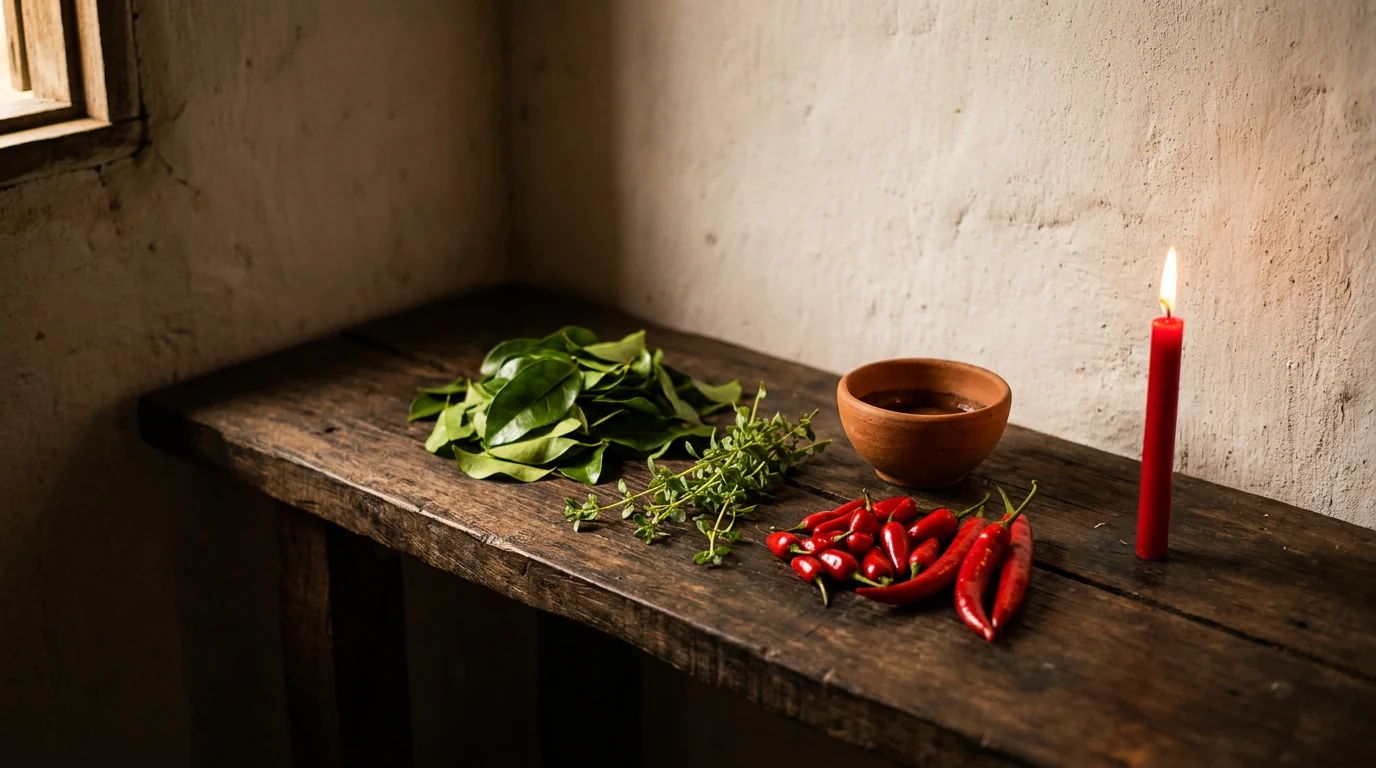
The herbs of Exu best attested in field research are pepper (malagueta and dedo-de-moça), aroeira-branca and corredeira. They appear in studies conducted in terreiros of Candomblé and Umbanda, and the complete list changes from house to house [D2, D3, D4, D9].
This map shows what each source records, in which tradition and in which house. Where there is no source, it says there is none.
What are the herbs of Exu
The best basis is the dissertation by Bianca Purcino, from the Federal University of Southern Bahia, who identified 118 species in two terreiros of Candomblé: one from the ketu nation, in Itabuna, and one from the ijexá nation, in Arataca. Seven plants were attributed to Exu.
| Plant | Name in Yoruba | What the survey records |
|---|---|---|
| Aroeira-branca | ájobi fumfum | Exu and Iansã (Oya); head obligations, baths and sacudimento |
| Pimenta-malagueta | atá | attributed to Exu |
| Corredeira | fálakuni | Exu; ornaments and ebós |
| Vassourinha-de-relógio | ásárágogo | Exu; sacudimento and ornament in ebós |
| Quarana | not informed | Exu; sacudimento |
| Gameleira-branca | irokò | ritual bath "of the children of Exu and Oxalá (Obatala)" |
| Graveto-do-cão | égún mó | attributed to Exu, without religious use in the table |
The table does not say which of the two houses gave each attribution. Therefore, the correct way to speak is "two terreiros, one ketu and one ijexá," and never "in the ketu".
Four of these plants (vassourinha-de-relógio, quarana, gameleira, and graveto-do-cão) have only this survey as a source. Pepper is the only one with a source in two traditions, Candomblé and Umbanda. Gameleira is also the home of Iroco, and this connection is not with Exu.
Which Exu is being spoken of
Before any list, it is worth asking which Exu. In Candomblé, Exu is a multiple divinity: "each house, each street, each city, each market has its guardian," writes Reginaldo Prandi. The anthropologist Vagner Gonçalves da Silva counts fewer than a dozen avatars of Exu in Candomblé, against legions in Umbanda.
In Umbanda, the exus are understood as spirits of deceased people. A leader interviewed in Senhor do Bonfim, in Bahia, summarizes: "there is the Exú Orixá and the one that is not Orixá, which is a spirit guide." The history of this separation is in who is Exu, and the names of the guardians, in names of Exu.
A list of "herbs of Exu" changes according to the answer. The one of the orixá comes from Candomblé. The one of the guardian comes from the Umbanda house that receives him.
What Umbanda records
In Umbanda, there is less field study, but the pimenta-dedo-de-moça appears in two different houses:
- Teixeira de Freitas (BA): in the Terreiro de Umbanda Luz Divina de São Jorge, of the 39 plants cited, one was attributed to Exu, the pimenta-dedo-de-moça, "used in passes, points, and mandalas".
- Curitiba (PR): the herb notebook of the Terreiro do Pai Maneco says that the same pepper "is used in the amalás of Exu and of Pombagira." Amalá is the offering food, and the notebook classifies it as a hot herb.
jurema-preta comes from a secondary source. A study on terreiros in the Bahia backcountry cites an Umbandist book that places it in the fire element, with Exu as the ruling orixá. In the same study, an Umbanda terreiro consecrates jurema to Exu, the Exu orixá (Bará), and has another Exu, Tranca Rua, as the house's spirit guide. The tool's file in jurema brings other orixás, and the two readings coexist.
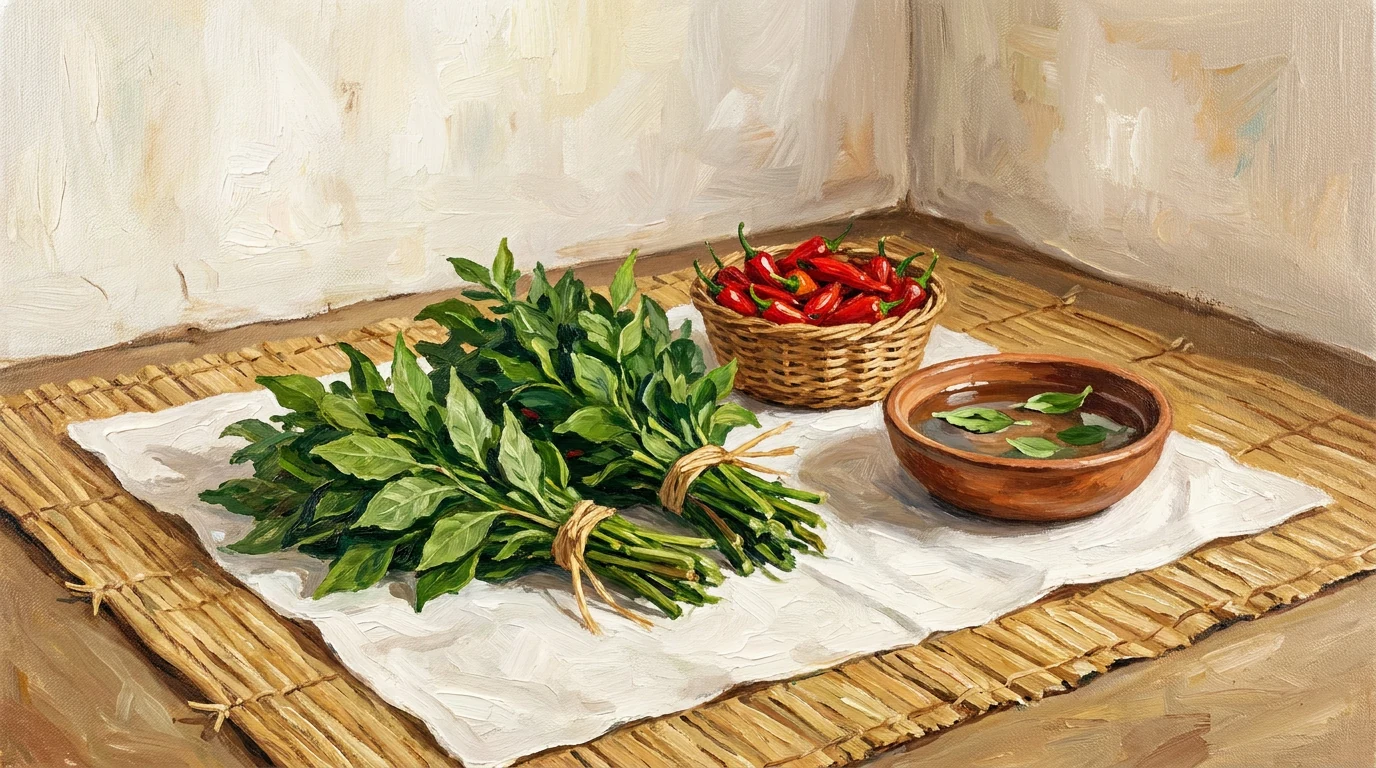
Exu herbs in the ritual bath
For the ritual bath, the strong source is short. Aroeira-branca appears in the Bahia survey in "head obligations, baths, and sacudimento." Gameleira is indicated for the baths of the children of Exu and Oxalá, according to the interviewees. Jurema, in the Umbandist reading, enters strong descarrego ritual baths.
That is all. There is no recipe with a field source, and therefore the map does not invent one. The bath precautions are in the neighbors:
- Aroeira ritual bath: the plant, skin care, and who should avoid it.
- Arruda, herb of Ogum and Exu and guiné, herb of Ogum and Exu: the two herbs that the blog already treats as hot herbs of Exu.
- Hot and cold herbs: the logic that explains why hot leaf goes from the neck down.
No plant makes an "Exu" bath alone. Ossaim (Osanyin) is the owner of the leaves, and Exu, Ogum (Ogun), and Oxóssi (Oshosi) are called "street orixá" by a baiano leader heard by Pedro Botelho: without leaf there is no orixá.
Pepper does not go in the eyes or on the mucous membranes. The graveto-do-cão has latex that irritates the skin, and the source does not give it for a ritual bath.
What has no source: named guardian, angola, jeje, and quimbanda
Google autocomplete asks for "herbs of Exu Caveira," "of Exu Tranca Rua," and "of Exu Tiriri." The open field studies do not attribute a herb to a named guardian. What circulates are lists from websites without authorship, which do not enter here.
Other gaps that the text prefers to declare:
- Angola and jeje: open field studies do not bring Exu plants for these nations.
- Quimbanda: only the guardian context; no plants.
- Defumação and amaci of Exu: no strong source found.
Whoever looks for "Exu herb for assentamento" finds another answer. Assentamento is done by the house, with the leader, and what enters it is fundamento. What it is and who makes it is in assentamento of Exu. If your house asked for a specific leaf, Joice helps check the material via WhatsApp.
How to read a list of Exu herbs on the internet
Website lists usually repeat the same records, with Yoruba names and the classification of hot leaf. The Saber Não Ocupa Espaço blog and the Àsé Dan Fè Èrò site publish identical records. They seem to come from the same source, the book by Pessoa de Barros and Napoleão, from 1999 [D14, D15]. They are a single voice, and not two independent sources.
An example of the variation: the Saber blog says that "7 leaves are used for Exu baths and 16 for orixá baths" are used. It is the rule of one house. Take it as a clue to ask your house, and not as a norm.
Before believing a list, three questions help:
- Does it say which Exu it speaks of, the orixá or the guardian?
- Does it say the nation or the house?
- Does it cite a field source, or just copy another list?
If the answer is "no" to all three, it is a blog list. To check symbols and colors of the same Exu, also see símbolos de Exu and guia de Exu.
Frequently asked questions
Which herb belongs to Exu?
The most well-attested is pepper: it appears in baiano Candomblé (malagueta) and in Umbanda (dedo-de-moça), in three sources. Aroeira-branca and corredeira come from a survey in two terreiros in southern Bahia. No list applies to all houses.
Which herbs to use in the Exu ritual bath?
The field source only links aroeira-branca and gameleira to the Exu ritual bath, and does not provide a recipe. Pepper does not go in mucosa. The one who indicates the bath is the house leader, who knows your obrigação. Basic precautions are in the aroeira ritual bath.
Is there a herb for Exu Caveira or Exu Tranca Rua?
Open field studies do not attribute a herb to a named guardian. The lists circulating are from websites without authorship. Each house has its guardian and its leaf, and it is the leader who is asked.
Is Exu herb used for assentamento?
Assentamento is the foundation of the house, performed by the leader. Therefore, this map does not list plants to set one up. What the Exu assentamento is and who performs it is in the article dedicated to the theme.
References
- Bianca Purcino: Ethnobotanical profile in Candomblé terreiros in southern Bahia, dissertation, UFSB, 2022
- Joyce Santos and Jorge Fortuna: The ethnobotany of the Luz Divina de São Jorge terreiro, Research, Society and Development, 2023
- Lílian Santos and Juracy Marques dos Santos: Orixá, nature and man, Núcleo do Conhecimento, 2021
- Pai Maneco Terreiro Study Group: herb and plant notebook
- Pedro Botelho: Ewé awo, the secret of the leaves in the Candomblé of Bahia, 2011
- Reginaldo Prandi: Exu, de mensageiro a diabo, Revista USP, 2001
- Vagner Gonçalves da Silva: Exu do Brasil, Revista de Antropologia, 2012
- Juliana Carvalho and José Bairrão: Umbanda and quimbanda, Psicologia USP, 2019
- Blog Saber Não Ocupa Espaço: Herbs and their applications, 2013