You enter a casa de Angola and the words arrive before the translations: they ask for "Maza" to wash hands, warn that the "Nguidiá" is ready, tell you to get the "Ngoma". The dialect of Candomblé de Angola is not a secret code or an ornament: it is the Bantu language that survived slave-era Brazil inside the terreiro, living in the daily life of the roça.
This dictionary brings together more than 70 words from the dialect, organized by theme and carefully translated, from "Nzambi" to "Sakidila". The golden rule comes before any list: spelling and speech vary from house to house, and the final word is always that of your zelador or zeladora de santo.
What is the dialect of Candomblé de Angola
What is called "dialect" in the Angola nation is, in fact, a set of words from Bantu languages, especially kimbundu and kikongo, spoken in the regions of current Angola and Congo. Kimbundu is the second most spoken Bantu language in Angola and gave Brazilian Portuguese words like "samba" and "quilombo". In the terreiro, this vocabulary coexists with Portuguese in daily life.
Different from the Ketu nation, which worships the orixás in Yoruba, the Angola nation comes from the Bantu peoples and worships the inquices (from the term nkisi). To situate this difference, it is worth reading the nations of Candomblé: Ketu, Jeje and Angola and the overview of what is Candomblé.
An honest warning before the tables: Banto spelling in Brazil was never standardized. You will see the same word written in different ways depending on the root and the house. The translations here serve as a map, not a law. There are also broader community glossaries, such as the usual Angola-Kongo vocabulary, which show this variation well.
Greetings and courtesy in daily life
The first words you hear are those of arrival. They mark respect for the house and the hierarchy. For the step by step of the greeting and the request for blessing, the guide Candomblé de Angola greetings deals only with this theme.
| Term | Translation | How to use |
|---|---|---|
| Mene Mene | Good morning, arrival greeting | Greeting upon entering the house |
| Anenguaiu | Good afternoon | Afternoon greeting |
| Usuku Mbote | Good night | Night greeting |
| Toma Kwiza | Welcome | Welcomes those who are arriving |
| Tumbandagira | Excuse me | Expected response: “Giraê” |
| Sakidila | Thank you, gratitude | To thank for a gesture or a blessing |
| Aweto | So be it, you are welcome | Closes a speech, responds to a thank you |
| Nzambi ua Kuatesa | God bless you | Blessing spoken in gratitude |
These formulas are not loose phrases. Saying "Mene Mene" upon arrival is recognizing the house; responding "Giraê" to someone asking for permission is opening a passage with respect. Courtesy, here, is part of the liturgy.
The religious family (família de santo): roles and kinship
In the terreiro, everyone forms a family, the família de santo. The names of kinship and roles mark the hierarchy, from the oldest in the santo to the newcomer.
| Term | Translation | Notes |
|---|---|---|
| Taata | Masculine role or treatment (father) | Form of respect to the oldest man in the santo |
| Kota | Feminine role (mother, oldest) | Position of responsibility given to the woman of the house |
| Mama | Mother | Affectionate and respectful treatment |
| Mam’etu | My mother | Affectionate way addressed to the mãe de santo |
| Mama ria Nkisi | Mãe de santo | The keeper, spiritual leader of the house |
| Tata ria Nkisi | Pai de santo | The keeper, spiritual leader of the house |
| Mona | Son | Blood son or house son |
| Mona Nkisi | Filho de santo | Who belongs to the religious family |
| Muzenza | Initiated filho de santo | Has already passed through the house rites |
| Ndumbi | Non-initiated filho de santo | Not yet initiated, in preparation |
| Ndandu | Family | The network of ritual kinship |
| Kakulukaji | Old man, elder | The oldest, guardian of knowledge |
The Mama ria Nkisi and the Tata ria Nkisi occupy the center of this family. It is to them that the blessing is first requested, before the ranks and the siblings. Respecting this order is the first lesson for those who arrive.
The human body in kimbundu
The body appears all the time in the house's orientations, from the ritual bath to the preparation. Knowing these names helps to understand what is being requested.
| Term | Translation |
|---|---|
| Mutuê | Head |
| Mukunã | Hair |
| Mêsu | Eye |
| Mukuila | Mouth |
| Divumba | Belly |
| Menga | Blood |
| Bajé | Menstruation |
The Mutuê, the head, has special weight: it is the seat of the orixá, cared for with its own foundations. Meanwhile, the Menga, the blood, and the Bajé, the menstruation, appear in rules of protection that belong to the internal knowledge of the house, not to a public text.
The house, the objects and the utensils
Nzo is the house, the terreiro, the world where everything happens. Inside it, every room and every object has its name in the dialect.
| Term | Translation |
|---|---|
| Nzo | House, terreiro |
| Kianvipi | Bathroom |
| Rifula | Kitchen |
| Tarimba | Bed |
| Dicísa | Mat |
| Dilongá | Agate plate |
| Dilônga | Agate mug |
| Lutó | Spoon |
| Pokó | Knife |
| Pokoré | Fork |
| Oberó | Clay alguidar |
| Batá | Footwear |
| Lêli | Clothing |
| Ojá | Headscarf |
| Muíla | Candle |
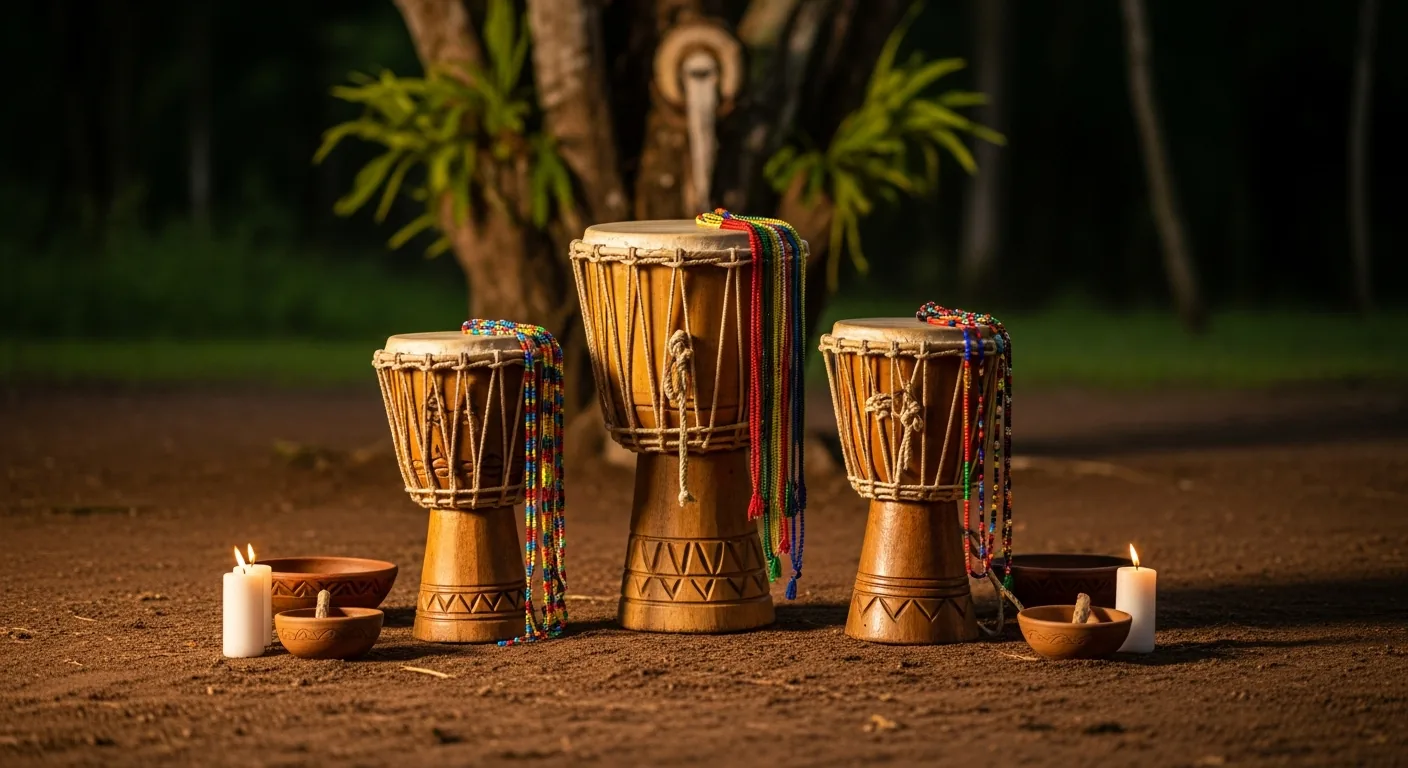
| Ngoma | Drum, atabaque |
| Fundanga | Gunpowder |
| Zímbi | Money |
Notice how sound and meaning go together. The Ngoma, the drum, is the sonic heart of the house: it is what calls the inquices in the circle. And the Ojá, the head cloth, covers and protects the Mutuê, uniting object and body in a single gesture of care.
Food and drink in the terreiro
Eating is sacred in the house of Angola. The kitchen feeds people and orixá, and each item has its own name.
| Term | Translation | Notes |
|---|---|---|
| Nguidiá | Food | Food in general |
| Maza | Water | The base of everything, from the ritual bath to the preparation |
| Maiáka | Flour | Present in farofas and food for orixá |
| Diasanji | Egg | Used in foods and fundamentos |
| Sanji | Chicken | Bird of great ritual importance |
| Alobassa | Onion | Seasoning for the orixá kitchen (cozinha de santo) |
| Kézu | Kola nut, obí | Seed used in games and offering |
| Mateme | Black coffee | Breakfast or afternoon snack |
| Uiki | Honey, sugar | The sweet that pleases certain inquices |
| Marafo | Aguardente, cachaça | Drink of firmeza in many houses |
| Mijo de égua | Beer | Humorous nickname for the drink |
The Kézu, the kola nut, deserves a note. Brought from Africa, it is a seed of fundamento and appears in cowrie-shell divination and in offerings. The Marafo, the aguardente, firms ritual work in many houses of Angola, and also in Quimbanda, a Bantu root tradition that you know in what is Quimbanda.
Nature, animals and the path
The world around the Nzo also speaks kimbundu. Rain, herbs, street and some animals have names in the dialect, many of them linked to fundamentos.
| Term | Translation |
|---|---|
| Nvula | Rain |
| Nsaba | Herbs |
| Njila / Nzila | Street, path |
| Diembê | Pigeon |
| Kolombôlo | Rooster |
| Kibiambiam | Butterfly |
The Nsaba, the herbs, are the living green of axé, present in baths and fumigations. And the Njila, the path, holds a spiritual meaning: it is a territory of opening and passage, the same that the street and the crossroads represent in so many Afro-Brazilian traditions.
The sacred: Nkisi, Nzambi and the vital force
Here are the words that sustain the worship. They name the divine, the force and the gestures that link the house to the spiritual world.
| Term | Translation | Notes |
|---|---|---|
| Nzambi | Supreme God | The creator, above all |
| Nkisi | Orixá, divinity (inquice) | The force worshipped in the Angola nation |
| Nguzu | Vital force, axé | The energy that moves life and worship |
| Muímbu / Zuela | Chant, music | The chanted prayer that calls the inquices |
| Kufumala | Smoke cleansing | Cleansing and preparation by the smoke of herbs |
| Maianga / Maionga | Purification ritual bath | Ritual bath for cleansing |
| Dijína | Name | Includes the religious name received at initiation |
| Lerí | Secret | The foundation that is not revealed |
| Ndaka | Conversation, tongue | The speech, the very dialect |
The Nkisi, or inquice, is the heart of the Angola worship, and it gets an entire guide in what is a Nkise. The Nguzu, the vital force, is the same principle that the Ketu nation calls axé, explained in what is axé. And the Muímbu, the chant, is the voice of the house: you hear it in the zuelas of Candomblé de Angola and in the section of chants with lyrics and meanings.
Verbs and needs of the body
Finally, some words of more direct use, actions and needs that appear in the simple coexistence of the house.
| Term | Translation |
|---|---|
| Sukula | To wash |
| Nzala | Hunger |
| Nena | Cocô |
| Sussa | Xixi |
There is nothing small about these words. A house of the orixás (casa de santo) is also a house of people, and the dialect accompanies a whole life, from the sacred to the most everyday.
How to use the dialect without making mistakes
The first precaution is to remember that this dictionary is a map, not a closed manual. Bantu spelling varies greatly, and each root has its forms. Note how your house writes and speaks, because that is the version that matters to you.
The second precaution is about limits. Some words touch the foundation, the secret, the Lerí. When a term linked to initiation or to the assentamento arises, the best path is not to look for a ready-made definition on the internet, but rather to ask your zelador simply.
To remember: learning the dialect is not about memorizing translations, it is about entering a memory of resistance with respect. Every Bantu word that survives in the terreiro is a victory over the historical attempt to erase these languages. Speaking with care is honoring those who kept them alive.
To avoid confusing traditions, remember that this dialect is from the Angola nation of Candomblé, not from Umbanda. The two dialogue, but have distinct origins and structures, as shown by the difference between Umbanda and Candomblé.
Frequently asked questions
What language is spoken in the Candomblé of Angola?
The Angola nation uses words from Bantu languages, especially Kimbundu and Kikongo, spoken in the regions of current Angola and Congo. This vocabulary coexists with Portuguese in the daily life of the terreiro. Unlike the Ketu nation, which worships the orixás in Yoruba, the Angola nation greets the nkisi in these Bantu languages.
What is the difference between nkisi and orixá?
Nkisi, or inquice, is the divine force worshipped in the Angola nation, of Bantu matrix. Orixá is the divinity worshipped in the Ketu nation, of Yoruba matrix. Many energies correspond between the nations, but each has its own name, its own language, and its own liturgy. Nzambi, in the dialect, is the supreme God above all.
Why does the same word appear written in different ways?
Because the spelling of Bantu languages in Brazil was never standardized. The tradition is oral, passed from voice to voice, and each raiz de santo recorded the sounds in their own way. Therefore, "Maionga" and "Maianga", or "Muímbu" and "Zuela", appear in variations. The correct form is always the one of your house.
What do Sakidila and Nguzu mean?
Sakidila means thank you, gratitude, and is one of the most used words in the life of the house. Nguzu (also written as ngunzo or nguzo) is the vital force, the energy that sustains life and worship, the Bantu equivalent to the axé of the Ketu nation. Wishing "much Nguzu" to someone is a profound vow of strength.
Is this dialect also used in Umbanda?
Some Bantu words circulate in Umbanda and in Quimbanda, traditions that also have Bantu roots. But the liturgical set described here belongs to Candomblé de Angola, a nation of Candomblé with its own language, beats, and foundations. Umbanda and Candomblé are distinct religions, even if they dialogue.
Where to find items for your Angola house
At Joia Mística Laroyê, you find what you need to live the faith in your terreiro:
- Ritual candles in the colors of the inquices, to light with respect
- Alguidares and agate dishes for the foods and offerings of the orixá
- Herbs for baths and smoke cleansings, separate or in combos
- Beads, threads and cloths for devotional use
- Atabaques and instruments to accompany the muimbus
Visit our physical store in Extrema, Minas Gerais and we ship to all of Brazil. For guidance on the correct use of each item, talk to us via WhatsApp.
References
- Wikipedia: entry on the Kimbundu language, its reach and influence on Brazilian Portuguese
- Candomblé: Usual Angola-Kongo vocabulary, community glossary of Bantu terms
=== IMAGE PROMPT === A photorealistic still life on a warm rustic wooden table, representing the Bantu ritual language of Candomblé de Angola. An open handwritten notebook shows African-style words with translations. Around it: a traditional wooden ngoma drum (atabaque), a brown clay bowl (alguidar), a lit white candle, cowrie shells, kola nuts, and fresh green herbs. Soft natural window light, earthy brown and ochre color palette, serene and reverent atmosphere. No people visible, no faces. 16:9 aspect ratio, photorealism, high detail.