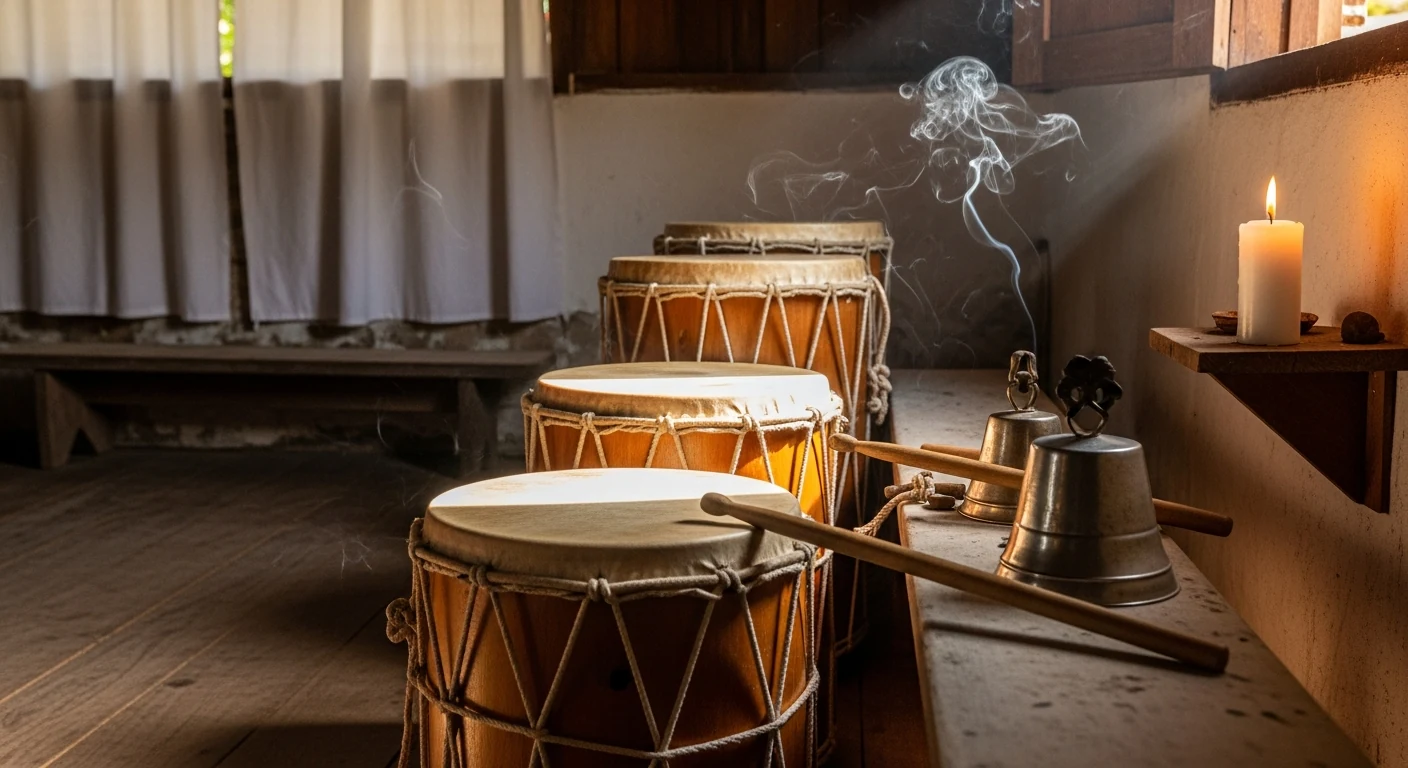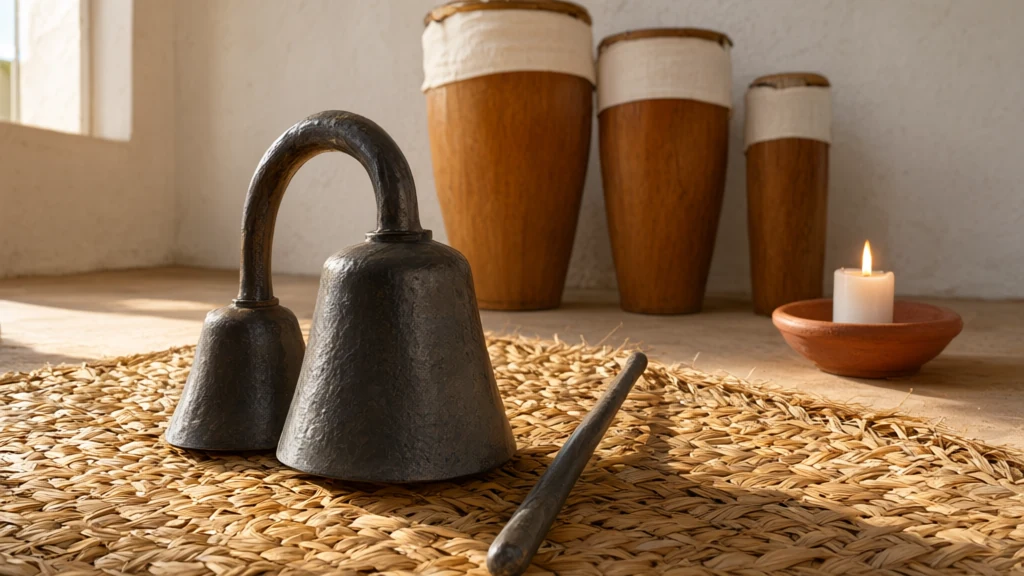
The agogô is an iron bell without a clapper, with one or two bells, played with a rod, and in Candomblé it is what provides the guide-line of the toque. In Ketu, it forms the set with the three atabaques, rum, rumpi, and lé. In general, it is the agogô that starts the toque, and the skins enter later.
What is the agogô and what is its purpose in Candomblé
The agogô serves to hold the tempo of everything that happens in the toque. It repeats a short and fixed phrase, the guide-line, from the beginning to the end of each toque, and the atabaques, the singing, and the dancing rely on it. Researcher Edilberto Fonseca, from UERJ, writes that the gã or agogô has the status of "maestro" of the ensemble.
Family: metal idiophone | Shape: one or two bells | Material in the terreiro: iron | Played with: rod | Function: guide-line | Other names: gã, gan, gonguê, ferro
Guide line (linha-guia) is Carlos Sandroni's translation for the timeline of the Ghanaian J. H. Kwabena Nketia.
In the thesis The language of the drums, conducted at the Casa Branca do Engenho Velho, in Salvador, Ângelo Cardoso recorded what the musicians say.
When you lose the rhythm, pay attention to the gã.
The agogô player does not make variations: once the pattern is fixed, he maintains it until the next toque. For this reason, researcher Angela Lühning, cited by Cardoso, says that he has "a task of extreme responsibility." In Gantois, in the classes of the Rum Alagbê project, an error in the gã was seen as the cause of the breakdown of the entire ensemble.
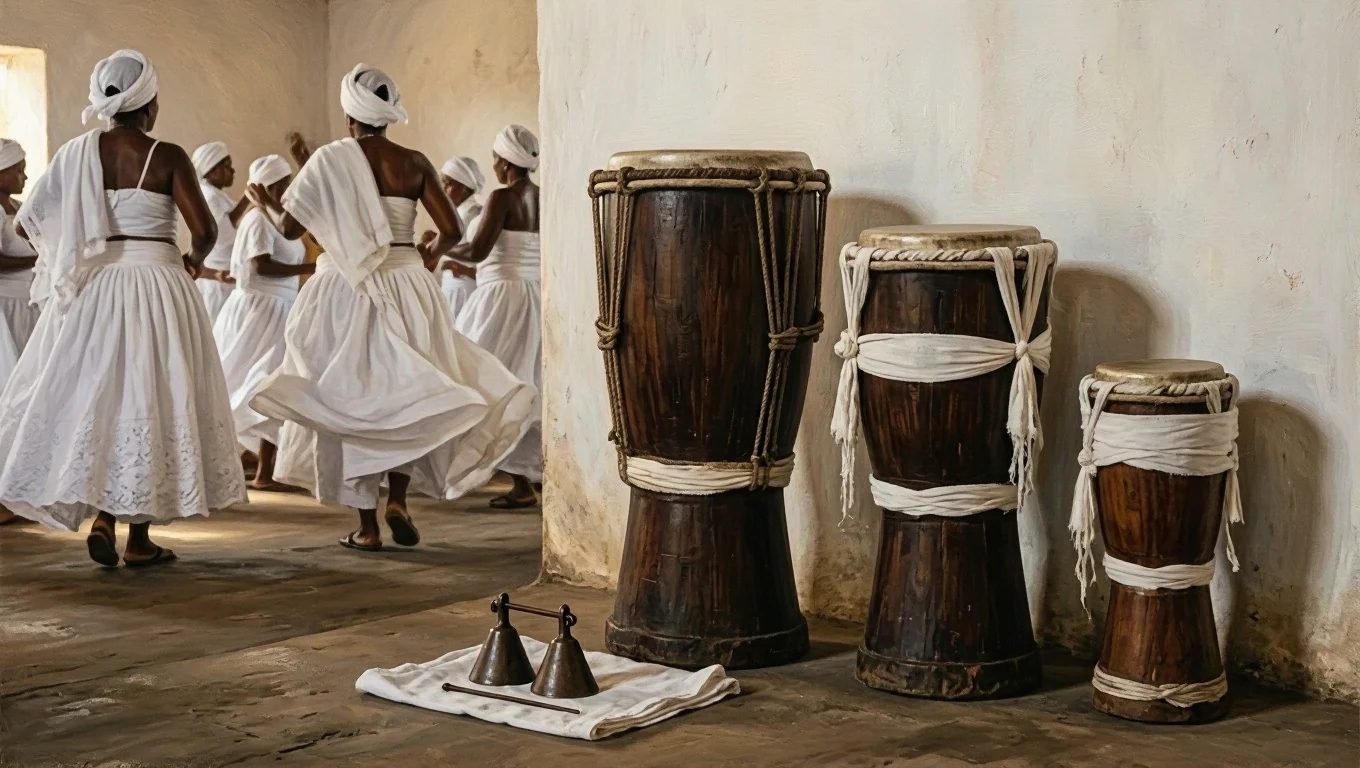
Agogô, gã, and gonguê: the difference by nation
In the practice of the terreiro, agogô and gã are the same instrument. Some authors call the single bell gã and the double bell agogô, but Cardoso observed that most faithful use the names as synonyms. Almost always, a single bell is played; the exception is the ijexá, which sometimes uses both.
The name changes with the nation and the region. See the complete map in candomblé nations: ketu, jeje, and angola.
- Ketu or nagô: agogô or gã, as synonyms. In some terreiros, only "ferro".
- Angola: in the Templo de Cultura Bantu Redandá, in Greater São Paulo, the name is gã or gonguê, and it is the sound of the gonguê that opens the ceremony and calls the atabaques.
- Jeje: the word gã would be of Ewe origin, according to Olga Cacciatore.
- Nordeste: gonguê, also in capoeira and in maracatu.
The origin of the name has two readings. For Barros, agogô is a Yoruba word meaning "bell"; for Lühning, also Yoruba, but with the meaning of "time". Gonguê would come from ngunga, from ambundo.
Who plays the agogô in the terreiro
In candomblé, who plays the agogô is an ogã of the ensemble, under the command of the alabê, the owner of the drum. The alabê leads the chants, teaches, cares for the instruments, and provides their consecration ceremonies. The positions are explained in positions and hierarchy in candomblé.
The learning begins with the iron. The alabê first teaches the agogô line of each toque; then come the lé and the rumpi, and the rum comes last. Whoever has not yet established the guide line does not go to the leather.
In Cardoso's field, in Salvador, a woman playing the instruments was an "extremely rare" occurrence. In umbanda, the rule changes from house to house.
Purchased agogô and the house agogô
The agogô of the barracão undergoes the consecration conducted by the alabê, and this rite is a foundation of the house. The one in the shop has not yet undergone it. It serves to study the linha-guia (the guiding rhythmic pattern) at home, for the curimba that will cross it, or to take to the zelador. In the double agogô, the two iron bells have different sizes and produce unequal sounds.
In most of the houses studied, the rod is made of metal. There are records of wooden rods, more common in samba and capoeira. If your house requested a specific model, you can check via WhatsApp before buying.
Agogô in Umbanda: the iron of the curimba
In Umbanda, the agogô plays in the curimba, along with the atabaques and the chanting of the pontos. The curimba masters heard by the historian Victória dos Santos, from USP, call the agogô the "maestro", the instrument that marks the beat. The functioning of the curimba is in curimba in umbanda.
Its presence is not the same in every terreiro. In Templo Amor e Caridade Pena Verde, in São Paulo, the curimba almost never uses the agogô. Meanwhile, Mestre Obashanan says that "every ritual orchestra must have an agogô".
In the three São Paulo terreiros studied, drums and agogôs are consecrated objects. In Templo de Umbanda Caboclo Pena Branca, in Taubaté, the curimba has a firmeza for Caboclo Girassol, with a candle and flowers. Beside it, macerated herbs for the curimbeiros to wash their hands before playing. The firmeza of each house follows what is in firmeza in umbanda.
Agogô and Ogum: the iron of the orixá
Ogum is the orixá of forged iron, metallurgy, and war. Since the agogô is made of iron, there are masters who dedicate the instrument to him: Mestre Roncali says that "some traditions of Candomblé" do this. It is a custom of some houses, not a rule.
In Casa Branca, the iron instrument linked to Ogum is another: the cadacorô, two pieces of iron struck against each other in his festivals. The agogô is not among the five foundation instruments of this house.
Colors in ketu: dark blue or green | Day: Tuesday | Greeting: Ogunhê | Jeje: Gun | Angola: Roximucumbe
The candles of the orixás that appear in the toque
No source orders to light a candle for the agogô. The candle enters through the orixá, with the color of the tradition. The virtual candles of the orixás in this article are together here:
- Ogum: the candle of Ogum, or a dark blue candle, the color of his beads in ketu. In many houses of umbanda, due to the syncretism with Saint George, Ogum also wears red and white.
- Exu (Eshu): in any Candomblé ceremony he is the first to be honored; the candle of Exu wears red and black, his colors in ketu.
- Oxalá (Obatala): the adjá, the metal bell of the barracão, is linked to him. White is the color of the candle of Oxalá.
All colors are in the virtual candle catalog. To know if Ogum rules your head, the discover your orixá test is a first step. The confirmation comes from the reading (jogo) of your house.
The agogô outside the terreiro
The agogô left Candomblé and took to the streets. Nei Lopes records that it became popular in the batteries of the Rio de Janeiro samba schools between the years 1940 and 1950. Enslaved Africans brought the instrument to Brazil, according to the Instituto Musica Brasilis.
- Afoxé: keeps the agogô as a reference, alongside the ilus and the xequerê.
- Capoeira, maracatu and maculelê: with the name of gonguê.
In the barracão, however, the agogô does not accompany the party: it calls the orixá along with the skins, at the moment the alabês call it "dar rum ao orixá". Its place in the circle is in what is xirê.
Frequently asked questions
What is agogô in Candomblé?
It is the iron bell, with one or two bells, that plays the guide line of the toque. In ketu, it forms the set with the rum, rumpi, and lé atabaques. Musicians call the agogô the maestro, because drums, singing, and dancing are oriented by it. In general, it is what starts the toque.
What is the difference between agogô and gã?
In the terreiros, almost none. Some authors call the one with one bell gã and the one with two agogô, but the majority of the faithful use both names as synonyms. Almost always, only one bell is played; the ijexá sometimes uses both. In angola, it is also called gonguê.
Who plays the agogô?
In Candomblé, an ogã of the set, under the command of the alabê, who teaches the toques and takes care of the consecration of the instruments. Learning begins with the agogô line, before the lé, the rumpi, and the rum. In Umbanda, it is played by whoever the house's curimba authorizes, and the rule varies.
Is the agogô from Ogum?
There are masters who dedicate the agogô to Ogum, orixá of forged iron, and they say that some houses of Candomblé do this. It is not a general rule: in Casa Branca, the iron of Ogum is the cadacorô, played in his parties. Follow what your house teaches.
What does the word agogô mean?
The word comes from Yoruba. For Barros, it means bell; for Angela Lühning, time. The name gã would be of Ewe origin, and gonguê would come from ngunga, from Ambundu. The sources diverge, and both readings of agogô appear in the research on Candomblé.
References
- UERJ, Edilberto Fonseca: Dar rum ao orixá: rhythm and rite in ketu-nagô Candomblés (2006)
- UFBA, Ângelo Cardoso: The language of the drums, doctoral thesis (2006)
- UDESC, Luciano Candemil: The guide lines of the melodies of candomblé ketu (2017)
- UnB, Leonardo Malagrino: The rhythms in the candomblé of nation angola (2017)
- USP, Victória dos Santos: We cross the paths for curimbá (2023)
- Revista USP, Alberto Ikeda: The ijexá in Brazil (2016)
- Horizontes Antropológicos, Reginaldo Prandi: African gods in contemporary Brazil (1995)
- Anais da ANPPOM, Costa e Queiroz: the Vassi toque from the Gantois terreiro (2024)
- Instituto Musica Brasilis: Agogô entry
- UFPB, LABEET: Agogô entry in the idiofone collection