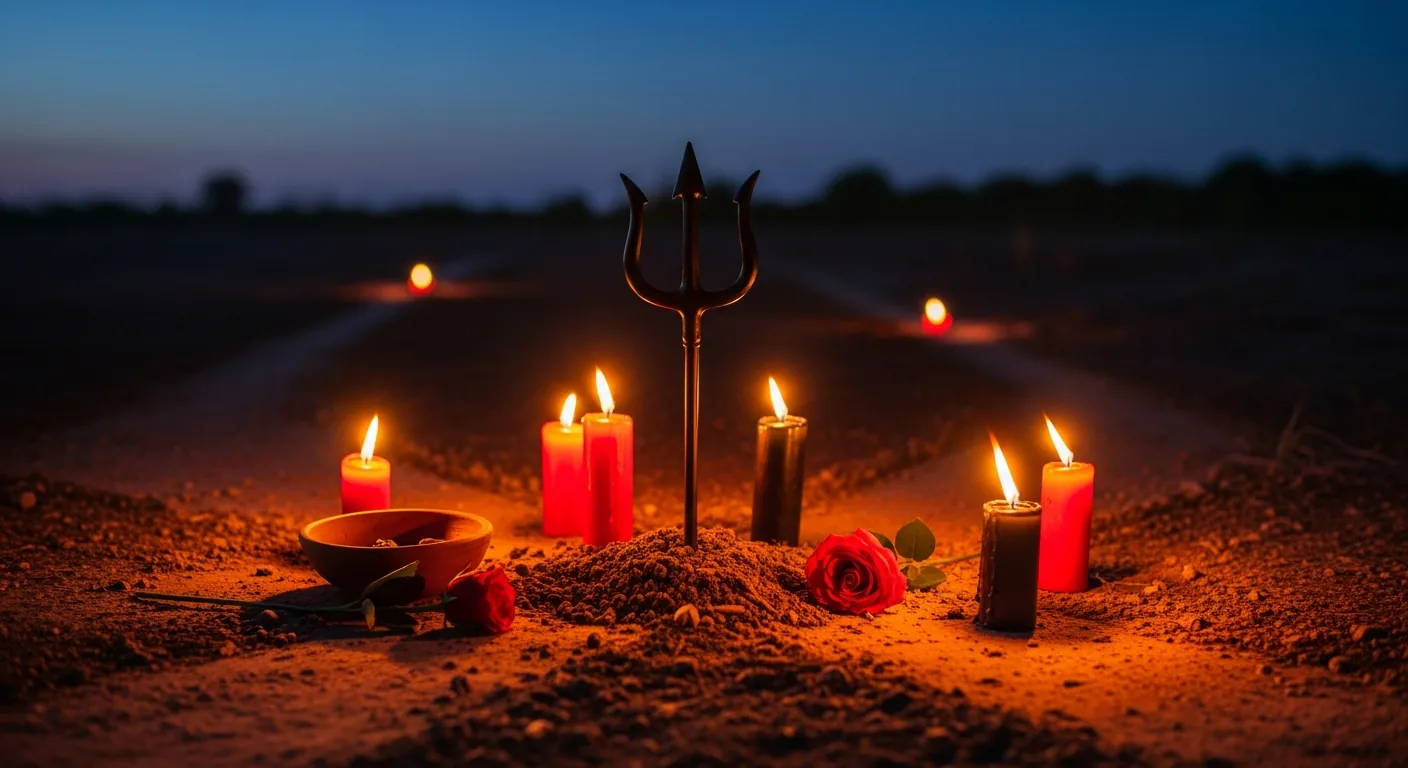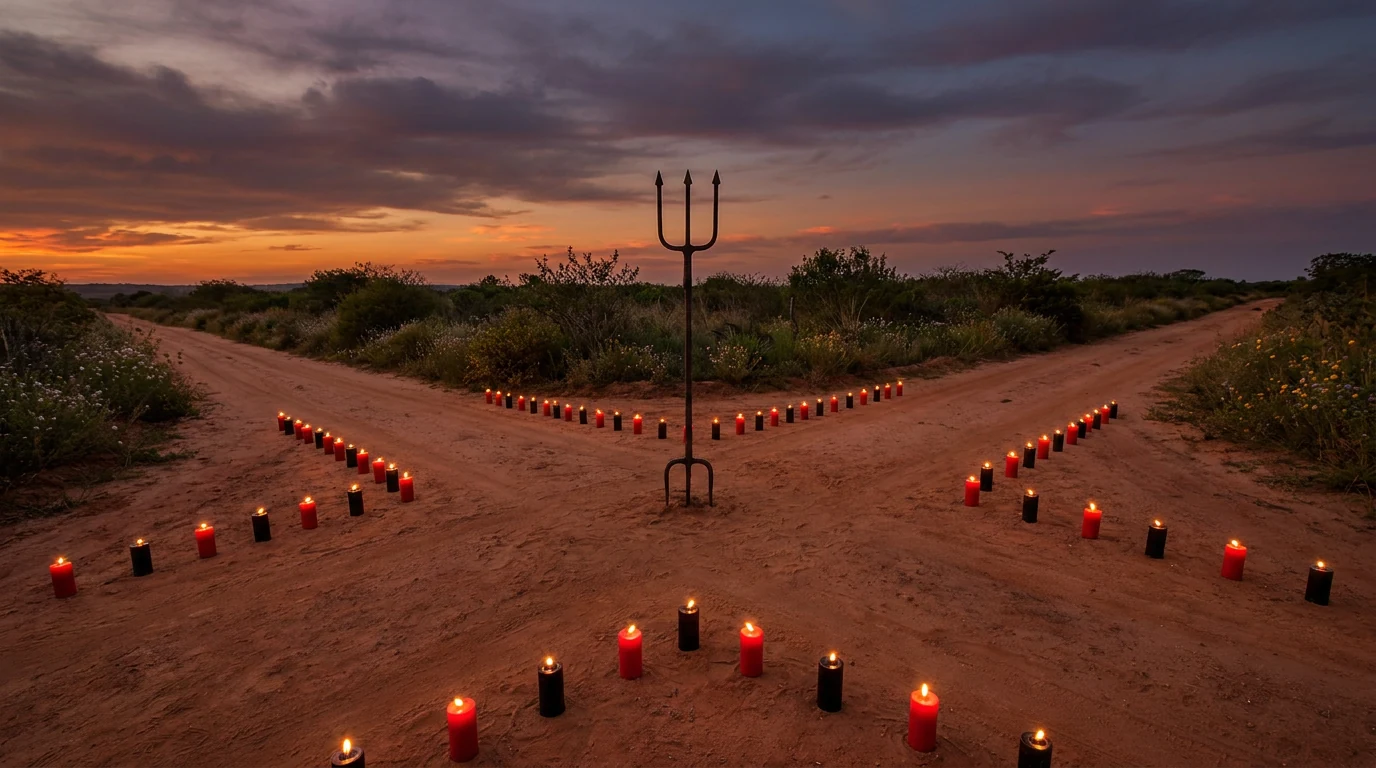
Exu Capa Preta is the guardian who works without being seen. In the povo de rua, where each falange has a way of acting, he is the one of silent movement: he enters, resolves, and leaves no trace.
The comparison helps to understand. Tranca Ruas guards and closes the passage. Tiriri cuts and cleans. Capa Preta does the work in the dark, when drawing attention would be a mistake.
This guide gathers the profile of the spirit, explains where the name comes from, and shows, with honesty, where the houses diverge from each other.
Exu orixá (orisha) and Exu guardian are not the same thing
Before any profile, it is necessary to separate two things that the internet mixes up.
Exu orixá is the lord of paths and communication of the Yoruba pantheon, the first to receive in any rite. About him, the correct text is who is Exu.
Exu guardião is another category. They are spirits that work in Quimbanda and in the gira of the left side of Umbanda, organized in falanges with their own names.
Capa Preta belongs to the second group. And falange means an entire people under the same name, not a single spirit. That is why there is no official biography of him: there is a way of working that several spirits assume under the same name.
Why he is called Capa Preta
The name is a description of method, and this is the key to understanding the spirit.
The black cape covers whoever wears it. It erases the outline, hides the silhouette, and lets whoever walks pass without being noticed. This is exactly what the falange does in the ritual work: it acts where a fuss would interfere, and the result appears later, without anyone having seen the path.
Part of the houses add a layer. In them, Capa Preta is not just a spirit of the asphalt crossroads: he is povo das matas, linked to the science of herbs and to Jurema. The cape, in this reading, is also the closed foliage that hides who enters the woods.
The two readings coexist, and neither cancels the other. What changes is the place of power that the house uses to deliver the offering.
Exu Capa Preta profile: day, colors, greeting and offering
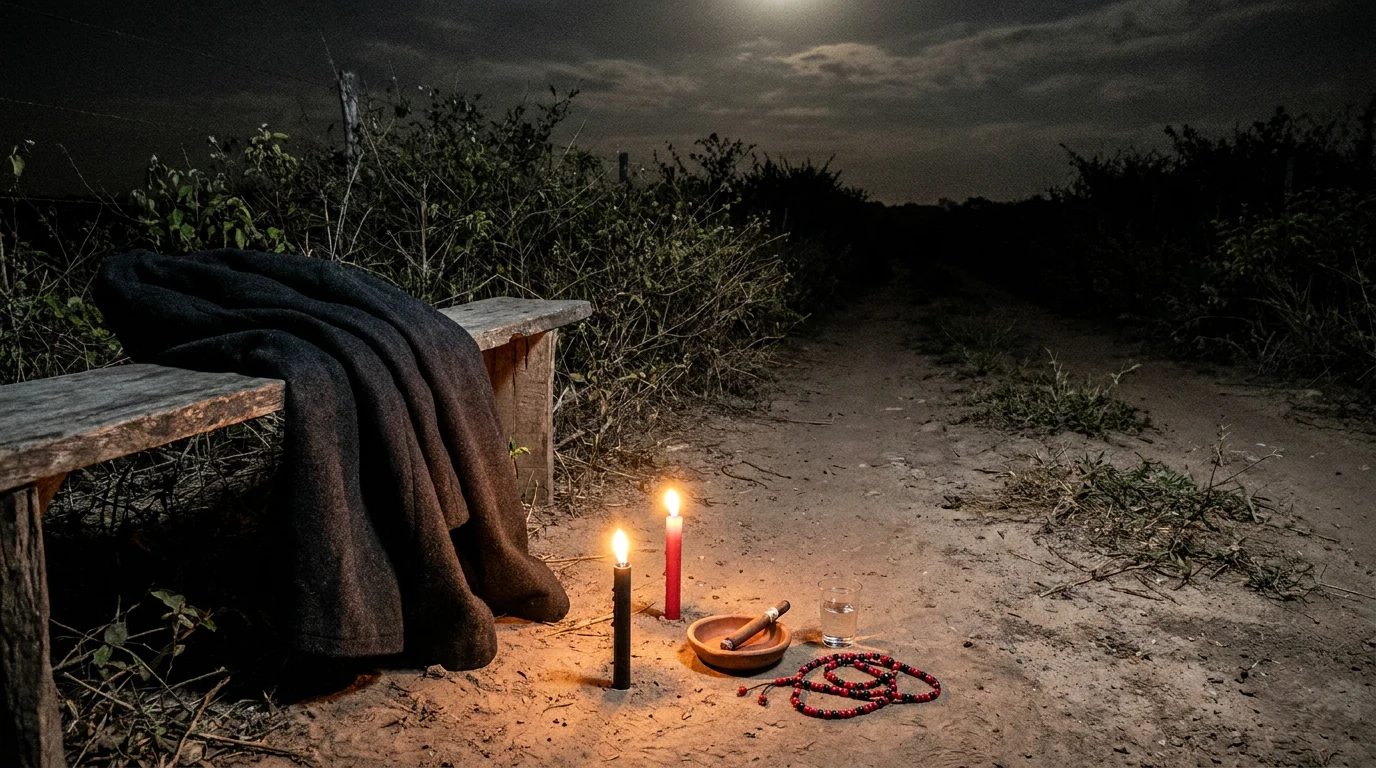
Day: Monday | Colors: black and red | Candles: black and red | Greeting: Laroyê, Capa Preta! | Point of strength: crossroads, or the location the house indicates | Offering: candle, cigar and drink, according to the tradition of the house
Regarding the drink, there is real variation. Most houses record marafo, which is cachaça, and some of them work with red wine. There are houses that do not offer alcoholic drinks in any gira, and this is not a lack of foundation: it is the foundation of that house.
The cigar is the most constant item on the lists. Black and red candles appear in practically all of them.
The rule that matters more than any list on the internet: whoever says what goes into your offering is the leader of your house. If you do not have a house, the path is to visit one before consecrating anything.
What is asked of Capa Preta
His field of ritual work is protection and clearing of obstacles, in that order.
- Discreet protection, when the person does not want to expose the situation to anyone
- Opening of a blocked path, especially those that stalled for no apparent reason
- Breaking of demanda and cleaning of a charged environment
- Firmeza to cross a phase that requires walking in the dark
What stays outside of his field is the same as what stays outside of any serious entity's field: a request that affects a third party, a request that tramples over another person's decision, and what belongs to the doctor. No entity resolves what is a health treatment.
The divergence that no one resolves
Ask about the regency of Capa Preta in five terreiros and you receive different answers.
There are houses that place him under Ogum (Ogun), for the function of opening paths by force. There are houses that place him under Omulu, for the connection with the dark and with what is buried. And there are houses that treat him as people of the woods, under Oxóssi (Oshosi), for the science of leaves.
This is not confusion or anyone's mistake. Quimbanda never had a central authority that standardized spirit profiles, and the house literature that exists was written by different leaders, in different regions, based on what each one received.
The honest text records the divergence. The text that chooses one side and presents it as a general rule is inventing a consensus.
Capa Preta is not the demon
This association is an imposition of Christian demonization, and it has a date and an author.
Reginaldo Prandi shows, in Exu, from messenger to the devil, that the identification of Exu with the devil was the work of the missionary and colonial gaze, and it does not belong to the Yoruba tradition.
Carvalho and Bairrão go further in Umbanda and Quimbanda as a black alternative to white morality: the moral hierarchy that places Quimbanda underneath concerns Brazilian society, not the religions.
A guardian who works in the dark scares those who see from the outside. Inside the religion, dark is the time for work, and the work of a guardian is to protect.
Frequently asked questions
Is Exu Capa Preta from Umbanda or Quimbanda?
Both. He is worshiped in Quimbanda, where the povo de rua is the center of worship, and he works in the left gira of Umbanda, which is the part of the worship dedicated to the guardians. The difference is in the place he occupies in each religion, not in the spirit.
What is the offering for Exu Capa Preta?
The registered base is a black and red candle, cigar, and drink, delivered at the crossroads or where the house indicates. The drink varies: marafo in most houses, wine in some, no alcoholic drink in houses that do not work with alcohol. Confirm with your leader before setting up.
What is the day of Exu Capa Preta?
Monday, like most of the povo de rua. Some houses also set on Friday night, and there are those who work with the turn of Monday, after midnight on Sunday.
Can I set Exu Capa Preta at home alone?
Lighting a candle and speaking with respect is prayer, and everyone can do prayer. Setting an assentamento is something else: it requires fundamento, and fundamento is received inside a house, with someone who is responsible for you. Start with the gira, not the assentamento.
Where to find the material for Exu Capa Preta
At Joia Mística Laroyê you find what the ritual strengthening (firmeza) calls for:
- Black and red candles, stick and seven day
- Cigars for the gira and for the offering
- Exu statue and black and red bead necklace
- Clay alguidar, flour, dendê, and pemba
- Herbs for cleansing bath (banho de descarrego), with instructions for use
Talk to us via WhatsApp or stop by the shop at Rua Benedito Zingari, 460, Bela Vista, in Extrema-MG. We serve all of Brazil.
If you are just starting now, read first what is quimbanda and offering for Exu.
References
- Reginaldo Prandi: Exu, from messenger to the devil, on the demonization of the orixá during colonization, Revista USP
- Carvalho and Bairrão: umbanda and quimbanda as a black alternative to white morality, Psicologia USP
- Cruz and Arruda: field research on the povo de rua in umbanda terreiros in Rio de Janeiro, Memorandum, UFMG
- Axé Umbanda: Exu Capa Preta profile, with day, colors, greeting, and offering