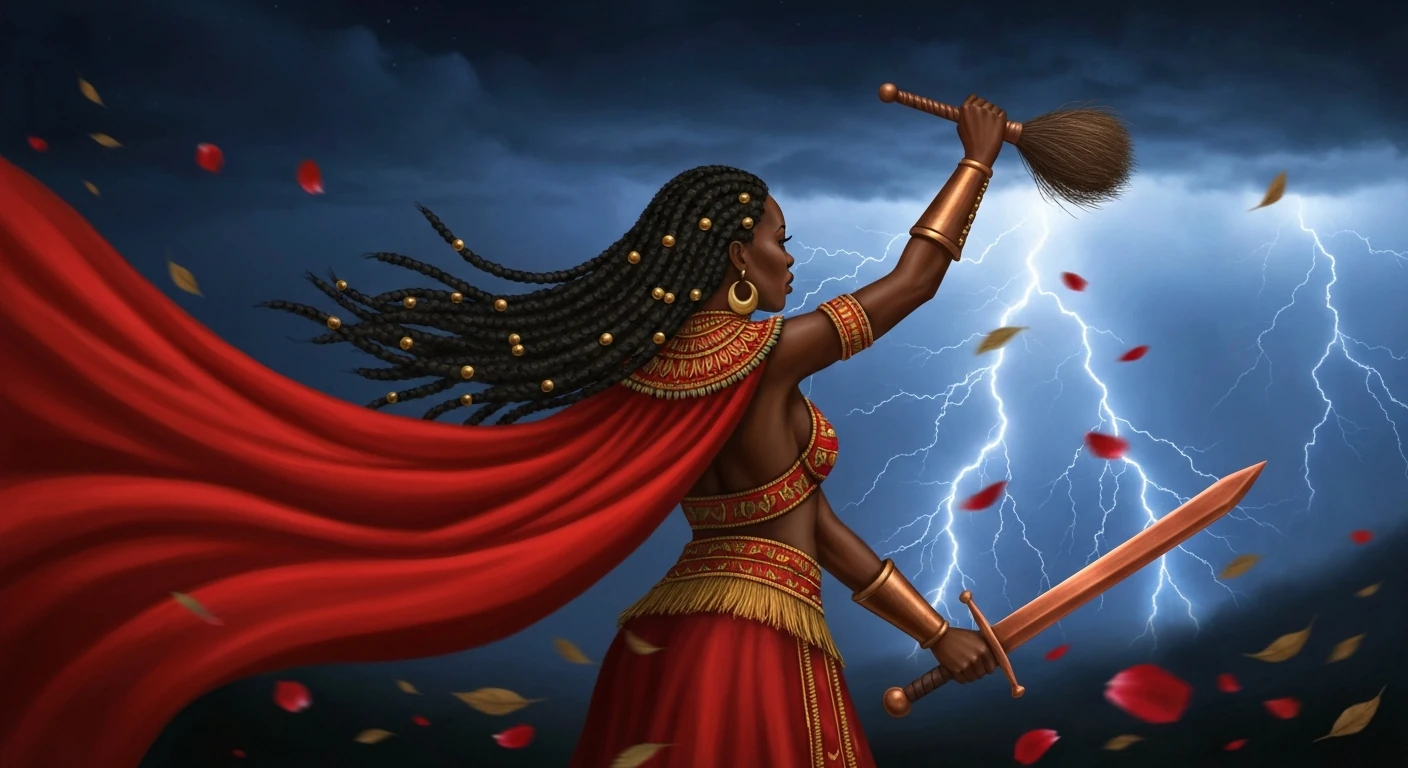
A daughter of Iansã enters no room without the air changing. This is how the phrase circulates in terreiros, and it says more about the wind than about the person. The portrait of children of Iansã is one of the most repeated on the internet, almost always without a source.
Here you see what tradition actually records about those of Oyá, in light and in shadow, and who truly confirms the owner of the head.
Where this portrait comes from
The sociologist Reginaldo Prandi, in African Gods in Brazil, does not use the word archetype. He uses stereotype, a term coined by anthropologist Claude Lépine in 1981. And he says where the material came from: 60 São Paulo Candomblé terreiros of the ketu tradition.
This changes the entire reading, because it is not intuition from an astrology portal but a description gathered from the people of santo.
About Iansã, he writes that her people are brilliant, talkative, flamboyant, outspoken, and courageous. That they hate doing small services for others, because they feel it goes against their majesty. And that they give their lives for the loved one, but never forgive a betrayal.
To know the divinity behind the portrait, the text is who is Iansã.
Two portraits that do not match
The two canonical sources on the subject describe the child of Iansã in very different ways, and almost no site mentions this.
Prandi pulls toward brilliance, speech, and courage. Pierre Verger pulls toward another place. He describes bold and authoritative women, of absolute loyalty in certain circumstances, capable of the most extreme anger when someone crosses their projects.
It is worth reading both as a portrait gathered in another era, not as a judgment. What the tradition celebrates in Oyá is autonomy, and the conservative reading has always reduced a woman's autonomy to a flaw.
If two serious researchers write portraits that do not overlap, the portrait is not a medical report. It is a model of collective identity, and it serves for the povo de santo to recognize themselves.
The characteristics, in light and in shadow
The list of flaws of those who are of Oyá is the same material as the list of virtues, seen from the other side, and no trait below was invented.
| In light | The same trait in shadow |
|---|---|
| Shines and occupies the environment without effort | Flamboyant, needs attention to feel whole |
| Says everything to your face, frankness without detour | Hurts without meaning to, and does not always review it afterward |
| Courage, enters what others avoid | Extreme anger when someone crosses their plans |
| Loyalty that gives its life for the loved one | Never forgives betrayal, and the door closes once and for all |
| Sense of their own greatness | Detests small service, feels it offends their majesty |
No orixá is entirely good, nor entirely evil. The phrase is by Prandi, and he completes it by saying that Western notions of good and evil do not organize the religion of the orixás in Brazil.
No one gathers all of this, and none of this is destiny. The virtue and the shadow of each head are in what your orixá says about you.
The portrait applies to men and women, and a son of Iansã is as frank and as master of his own decision as any daughter of the orixá.
The wind that only she carries: egum and eruexim
This is the axis that separates Iansã from all the others. Prandi describes her as the warrior orixá who takes the souls of the dead to the other world. She is the only iabá who conducts the egum, and from there comes much of the protection of those who belong to her.
Three points that the internet usually gets wrong:
- Oyá Igbalé is not a separate orixá. It is the set of qualities that deals with the dead, and some of them wear white.
- The eruexim is not an ornament. The horsetail whisk with a metal handle is a work tool, used in cleansing rites and as a mark of authority.
- Egum is not a spirit of evil. It is an ancestor, people who lived, and the foundation is in egum in candomblé.
The contrast with the closest brother of the same gender is striking: Xangô (Shango) does not deal with egum, and this organizes his protection, as seen in filhos de Xangô.
A firm caveat: each child's resguardo (ritual restrictions) is a matter for the house, and who tells you what you can do is your leader, never an article.
The quizila of pumpkin and lamb
Two foods appear as quizila for the filhos de Iansã in the table of taboos collected by Prandi: pumpkin and lamb.
The itan explains the first one. Pursued, Oyá hid in a pumpkin patch and the plant welcomed her, but the lamb, with its noise, denounced the hiding place. Thus, pumpkin is removed from the plate out of respect, and lamb because of the betrayal.
It is worth debunking a common rumor: okra is not from Iansã. Okra is the mark of Xangô, in the amalá, and the itan of the cut ear is from Obá (Oba). Her food is the acarajé.
The concept is in quizilas in candomblé, and the domestic offering in offering for Iansã.
Quality rewrites the filho de santo
Iansã is not just one. She runs in qualidades, also called paths, and the quality changes the profile entirely.
- Oyá Igbalé: the one who deals with egum, of silent worship. Some wear white, and the child leans toward the restrained.
- Oyá Onirá: queen of Irá, the sweet warrior linked to the waters of Oxum (Oshun), wears pink. The child leans toward the charm.
- Oyá Bagã: foundation with Ogum (Ogun), Oxóssi (Oshosi) and Exu (Eshu), the warrior of the winds and of the eruexim.
- Oyá Ijibé: wears white, is linked to Oxalá (Obatala) and the cold wind, and the child tends toward the serene.
A child of Igbalé, of white and silence, almost does not resemble a child of Onirá, and if a generic portrait were enough, the two would be the same person.
In her profile, the colors are brown, dark red, and coral, with white in the paths of Igbalé, and the number is nine. The day is Wednesday, the greeting is Eparrei, and the tools are the sword and the eruexim. The food is acarajé and the quizila of the children are pumpkin and lamb, and the syncretism appears in Saint Barbara and Iansã.
In the angola nation, the corresponding energy appears as Matamba, which is an inquice and has its own cult. In the Gaucho Batuque, she is Oiá, with its own foundation.
How the head orixá is confirmed
There is a single answer, and it is not on any website: whoever discovers someone's head is the babalorixá or the ialorixá, through cowrie-shell divination, and the confirmation comes later in the bori.
Add to this the second orixá. Prandi records that each person has an associated divinity, the juntó, with an important role in behavior. By crossing the one in front, the one next to it, the quality, and the odu, he concludes that the variations are almost inexhaustible. The subject is orixá de frente and de junto.
There is still a little-cited fact: Monique Augras and Angela Correa tested this portrait against a classic psychological exam in a 1979 study, in a quiet terreiro in Rio de Janeiro. They looked at 15 people, and exactly one was of Iansã. There was agreement, and the authors themselves warned that with this sample, one cannot speak of correlation.
The authors also left the most useful observation of all: the higher a person rises in the hierarchy of the terreiro, the less they risk guessing about someone else's orixá.
As an honest starting point, discover your orixá and take the result to a serious house. The complete path is in how to know which is my orixá.
Frequently asked questions
What are the characteristics of the children of Iansã?
Tradition describes brilliant, talkative, courageous, and direct people, who decide quickly and face what others avoid. The same traits appear in shadow as ostentation, anger toward those who cross their plans, and a door that closes forever after a betrayal.
What can the children of Iansã not eat?
The table of taboos collected in São Paulo terreiros records pumpkin and lamb as quizila of the children of Oyá. Each house may have its own precautions, and some appear only after the divination. Who confirms your list is the leader of your house, never a webpage.
Why does the child of Oyá not eat pumpkin?
The itan tells that Oyá hid in a pumpkin patch when she was being pursued, and the plant protected her. The lamb, with its noise, gave away the hiding place. Therefore, pumpkin is removed from the plate as a sign of respect, and lamb is removed because of the betrayal.
How to know if I am a child of Iansã?
By a list of characteristics, one does not know. Recognizing oneself in a portrait serves as a clue, nothing more. Who defines the owner of the head is the babalorixá or the ialorixá, through the jogo de búzios, and the bori confirms it later. Quality and the accompanying orixá still change the profile significantly.
Where to buy Iansã material
At Joia Mística Laroyê, you find the material of the lady of the winds:
- Bead necklaces in red, coral, and brown: assembled or in loose beads
- Eruexim: the horse tail with a metal handle
- Red and white candles: individual, seven-day, and in pairs
- Alguidares and clay quartinhas: for the consecrated foundation (assentamento)
- Fradinho beans, dendê, and pemba: for the acarajé and for the firmeza
Stop by the shop, at Rua Benedito Zingari, 460, Bela Vista, in Extrema-MG, or message on WhatsApp with delivery to all of Brazil.
The stereotype of Iansã served, in Prandi's research, as a model for the people of santo to recognize themselves, and it was never a sentence nor did it replace the cowrie divination of their house.
References
- Reginaldo Prandi: the stereotype of Iansã and the note of the 60 paulista terreiros, chapter of Herdeiras do Axé, on the author's page at USP
- Reginaldo Prandi: the periodical version, which credits Lépine, Horizontes Antropológicos, 1995
- Augras and Correa: the study with 15 filhos de santo and the hierarchy that avoids guesswork, Arquivos Brasileiros de Psicologia, 1979
- Candomblé: the qualities of Oyá, from Igbalé to Ijibé
- Wikipedia: the entry for Iansã, with the eruexim and the acarajé