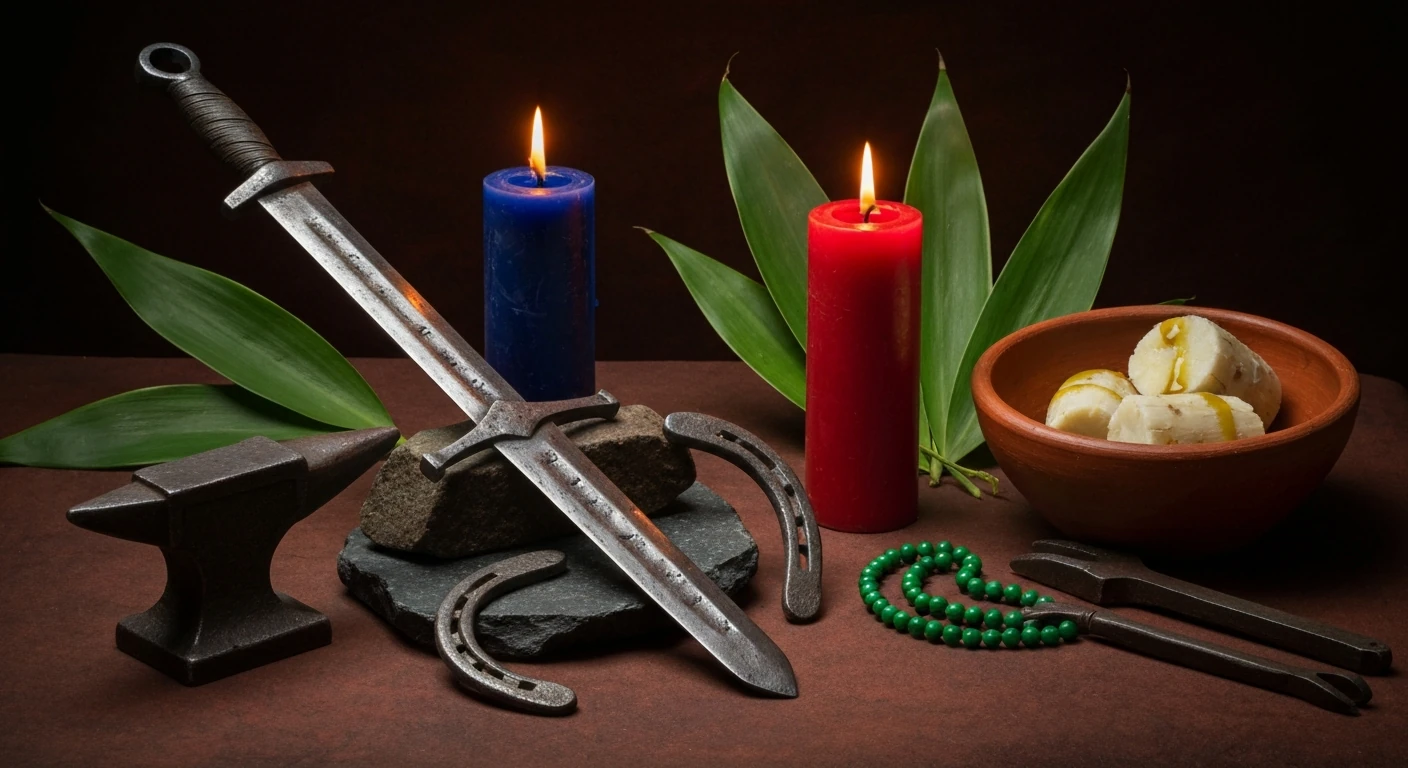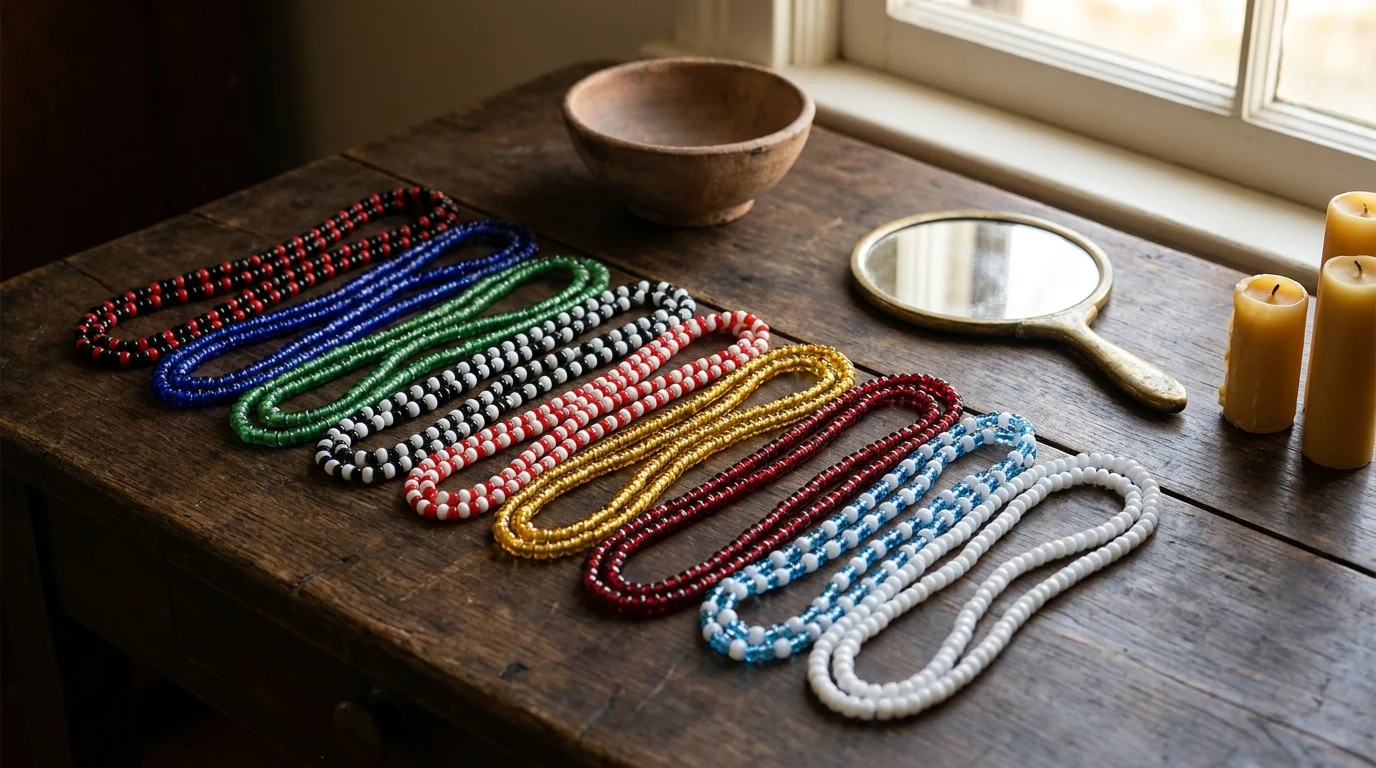
Whoever discovers whose head it is wants to know the same thing: what does this say about me? Tradition answers, and it answers with more care than internet lists suggest.
There is indeed a temperament attributed to each orixá, and it appears in the children. What almost no one tells you is that this temperament always comes in a pair: virtue and shadow are the same quality in different doses.
This guide gathers the overview of the orixás on a single page and shows what academic research confirms. It also explains why two children of the same orixá are never the same.
Archetype or stereotype? The right name changes everything
The word "archetype" caught on in the vocabulary of the terreiro and the blog, but it arrived by analogy with Jung. The term that academia uses is another: orixá stereotype, coined by Claude Lépine in 1981.
The difference is not pedantry, because a stereotype is a collective model that the community recognizes and uses. Roger Bastide already recorded in 1958 that the individual repeats the gestures of their orixá not only in trance, but in everyday behavior.
Reginaldo Prandi identified these traits in 60 São Paulo terreiros of Candomblé and verified them in Salvador, Rio, and Africa. His work, in the opening chapter of Herdeiras do axé, is the basis for what follows.
A reading caution matters here. Prandi always writes "the followers believe that," not "people are." He describes the belief of a community, he does not issue a report on anyone.
No orixá is entirely good, nor entirely evil. Western notions of good and evil are absent from the religion of the orixás in Brazil.
What tradition attributes to each orixá
The chart below summarizes the temperament recorded by Prandi, with virtue and shadow side by side. Each line is a summary, not a closed portrait.
| Orixá | Dominion | What tradition attributes to the children |
|---|---|---|
| Exu (Eshu) | Communication, crossroads, transformation | Quick intelligence, initiative, courage; the shadow is excess and impatience with rules |
| Ogum (Ogun) | Iron, ritual work, opening of the path | Firmeza, strength of ritual work, frankness; the shadow is hardness in affection |
| Oxóssi (Oshosi) | Hunting, abundance, knowledge of the forest | Elegance, curiosity, patience; the shadow is difficulty in committing |
| Obaluaê | Healing, disease, what is gathered | Reserve, resistance, persistence; the shadow is the withdrawal that pushes away |
| Xangô (Shango) | Justice, thunder, government | Sense of justice, leadership, organization; the shadow is greed for power |
| Oxum (Oshun) | Fresh water, gold, diplomacy | Sensitivity, ambition, power to convince; the shadow is the demand for affection |
| Iansã (Oya) | Winds, lightning, the eguns | Courage, firm word, authority; the shadow is not forgiving betrayal |
| Iemanjá (Yemoja) | Sea, motherhood, family | Protection, taste for ritual work, welcoming; the shadow is not keeping secrets |
| Oxalá (Obatala) | Creation, peace, the breath of life | Calm, taste for teaching, persistence; the shadow is stubbornness |
Four of these have a dedicated article, with the complete profile: filhos de Oxum, filhos de Ogum, filhos de Iemanjá and filhos de Oxóssi. For the myth and history of each one, the path is o que são os orixás.
An honesty that competitors do not offer: Oxumaré (Oshumare), Logunedé (Logun Ede), Obá (Oba), Ewá (Yewa), Nanã (Nana Buruku) and Iroko do not have a personality profile in academic sources. The case of Ewá, with what is said and what has no record, is in filhos de Ewá. What circulates about their children comes from terreiro material, and is legitimate as such, but does not have the same backing.
The study that tested the archetypes and did not confirm
In 1979, Monique Augras and Angela Maria Correa did something that no one else did. They spent 18 months in a Ketu terreiro in Rio, interviewed filhos de santo and applied Rorschach psychodiagnosis on 15 of them.
They then compared the result with the trait that the mythical typology predicted. The finding, published in the Arquivos Brasileiros de Psicologia, was honest and uncomfortable: the daughters of Oxum did not present the narcissism or sensuality expected.
The authors also could not obtain from the pai de santo a coherent framework of traits per orixá. The fantasy of a table taught to the daughters before initiation fell apart in the field.
They propose instead a better comparison: the identification of the owner of the head works as a mythic equivalent of psychodiagnosis. Equivalent, not a substitute.
Hence the honest limit of this article. The temperament of the orixá is a key for reading within a religious community, and it does not measure, clinically classify, or treat anything. Anyone who is suffering should seek a health professional.
Why two children of the same orixá are not equal
This is the part that internet tables erase, and it is decisive.
The juntó. Prandi records that each person has a second associated orixá, and that it plays an important role in defining behavior. It is said, "I am a child of Oxalá and Iemanjá." In the gaúcho Batuque the pair is called frente and junto, treated in orixá de frente and orixá de junto.
The quality. Each orixá has paths, and the nature changes with them. Bastide cataloged 21 qualities of Exu, 16 of Oxum, 14 of Omulu, and 12 of Xangô, and Oxaguiã, the young one, does not behave like Oxalufã, the old one. The qualities of Oxum show this range well.
The odu. João Ferreira Dias, in an article in the Horizonte magazine of PUC Minas, treats the ori as the bearer of personality and destiny. And he records the point that changes everything: the Yoruba position is one of mild determinism, in which destiny can be altered or enhanced.
Prandi summarizes the combinatorics in a single phrase: the variations that serve as models are almost inexhaustible. Therefore, the archetype is a path of ritual work, not a sentence.
The stereotypes that need to fall
Some traits circulate deformed, and the correction also has a source.
Oxum is not futility. The patronage that Prandi records includes gold, not just love. The daughters themselves interviewed by Augras speak of ambition and a taste for prominent positions. Oxum carries the title of Iyalodê, the woman who responds for the others and arbitrates the order of the market.
Iansã is not lack of control. Prandi describes her as brilliant, brave, and of firm word, even calling her a feminist spirit. The correct vocabulary is authority and command, not scandal.
Exu is not the devil. Prandi dedicated an entire article to the theme, Exu, from messenger to devil, showing that the association was born with the first missionaries. He concludes the text by defining Exu as a controversial and untamable orixá, yet neither saint nor devil. The full profile is in who is Exu.
About the fame that a son of Exu is not reliable: it comes from the function of the orixá as a principle of movement, the one who breaks the rule and promotes change. It is a description of a cosmological force, not of human character.
Orixá is not a zodiac sign, and the difference is not about accuracy
The comparison with horoscopes appears in every search, and it is worth dismantling calmly. Astrology is a legitimate tradition, it just does not answer this question.
A zodiac sign is calculated by date. The head orixá is revealed in oracle, by an initiated priest, and can be corrected later. Prandi is direct: discovering this mythical origin through cowrie-shell divination is the prerogative of the pai or mãe de santo.
There is still an ethnographic finding that closes the subject. Augras and Correa observed that the higher a person rises in the hierarchy of the terreiro, the less they risk guessing about the orixá of others. Those who know less, guess more.
If you want a first approximation, without foundational value, the test Discover your Orixá serves as an entry point. The firm path is in how to know which is your orixá and the concept of sacred head in what is Ori.
Frequently asked questions
Does the orixá even influence the person's personality?
Tradition says yes, and Bastide records that this influence appears in daily life, not just in trance. But the bond is read within a religious community, with its own vocabulary. When researchers tried to measure the correspondence with a psychological test in 1979, the result did not confirm what was expected.
Is orixá the same thing as a zodiac sign?
No. A zodiac sign is calculated by the date of birth and has twelve fixed types. The head orixá is revealed in the jogo de búzios, combines the orixá de frente and the juntó, varies by quality, and implies obrigação and community. The difference is not one of accuracy, it is one of nature.
Are two children of the same orixá similar?
Only to a certain point. The second orixá, the quality, and the birth odu change the temperament significantly. Prandi speaks of almost inexhaustible variations, and Cossard summarizes by saying that no child of Oxalá is equal to another.
What is birth odu?
It is the sign of destiny revealed in the oracle, linked to the ori, the head that carries personality and path. In the Yoruba reading, destiny is not closed: it can be worked on and enhanced. Odu is not calculated by adding digits of a date.
Where to buy
The Joia Mística Laroyê, in Extrema, Minas Gerais, has what devotion to your orixá requires:
- Bead necklaces and guias: in the colors of each orixá
- Candles by color: for your day and for the firmeza
- Statues of orixás: for the congá and the devotion spot
- Herbs, incense, and clay pottery: for ritual bath, offering, and cleansing
Call us on WhatsApp (35) 99156-5228 or stop by the shop at R. Benedito Zingari, 460, Bela Vista.
One last word. Knowing the nature of your orixá gives you the vocabulary to look at yourself with more calm. It is not a diagnosis, it is not destiny, and it does not replace the conversation with the one who leads your head.
References
- Reginaldo Prandi: African gods in Brazil, chapter of Herdeiras do axé (USP)
- Reginaldo Prandi: Exu, from messenger to the devil, Revista USP n. 50
- Monique Augras and Angela Maria Correa: the object of desire, the identification of the owner of the head in Candomblé, Arquivos Brasileiros de Psicologia
- João Ferreira Dias: Orí O! the idea of person and the ritual of bori, revista Horizonte (PUC Minas)