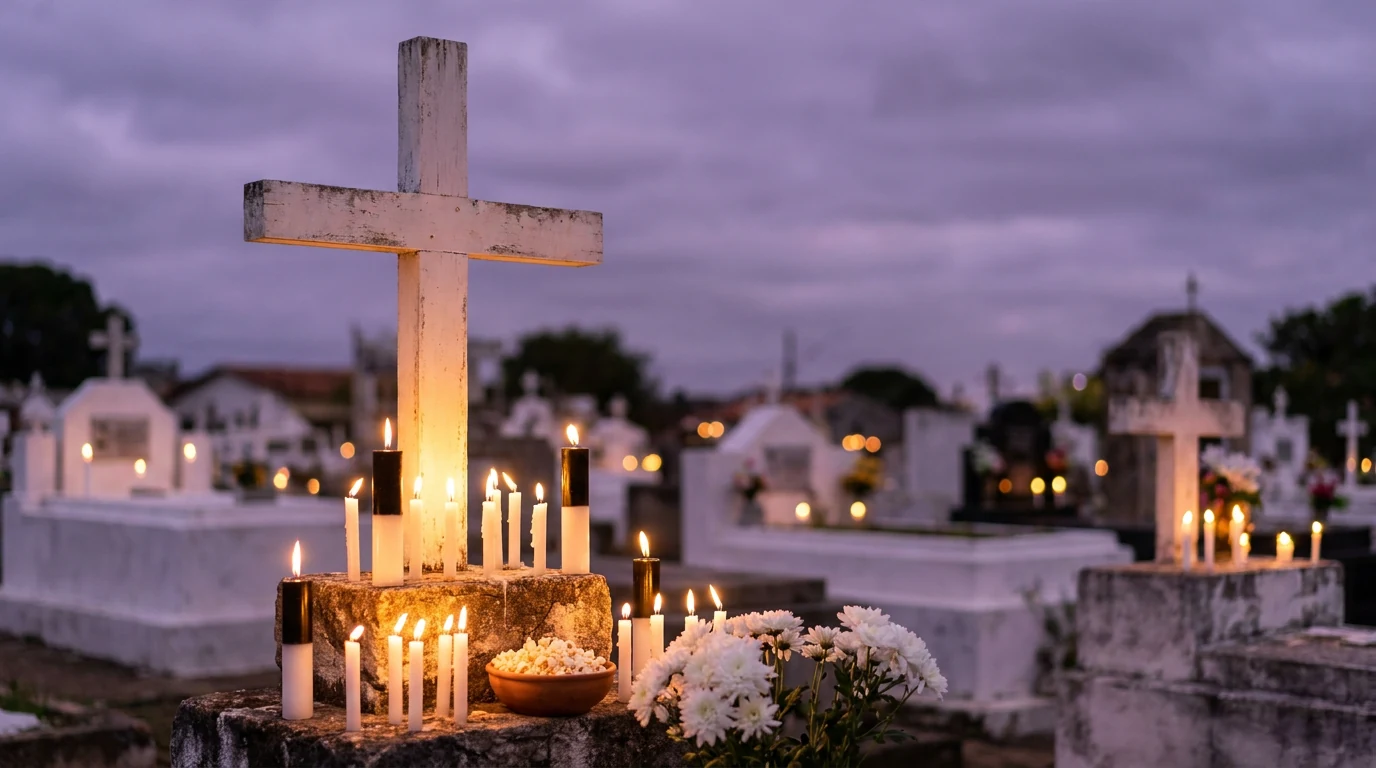
Lighting a candle for the souls is a Monday gesture, the day that popular Catholicism dedicates to the souls. It is done at home, in church, or at the foot of the cemetery cross, and no consulted source fixes a mandatory color or a number of candles.
What changes is who the candle is for. In Catholic devotion, it accompanies the prayer for the souls in purgatory. In Umbanda, it goes to the linha das almas and to the pretos-velhos, and the correct way to do it is that of the house you attend.
Lighting a candle for the souls: the short answer
Day: Monday | Where: at home, in church, or at the cruzeiro das almas | Most recorded color: white (some houses use white and black) | How many candles: no source fixes
In 2026, the two dates meet. All Souls' Day, November 2, falls on a Monday, the very day of the souls. What each tradition does on this date is in the guide for dia de finados na umbanda.
Before lighting, answer for whom the candle is: for the souls in general, for a relative, for the 13 blessed souls, or for the souls' line of the terreiro. In Catholic devotion, the prayer provides guidance. In Umbanda, it is the leader of your house.
Why Monday is the day of the souls
Monday is not a terreiro invention nor just a grandmother's custom. Researcher Michelle Ferreira Maia studied popular devotion in São Benedito, in Ceará, for the Mneme journal, from UFRN. She records that the almas benditas "are worshipped mainly on Monday, which is the day of the souls."
Maia also cites the anthropologist Oscar Calavia Sáez, for whom Monday is a "day consecrated by the Church to the cult of the souls." It is a second-hand citation, and as such should be read. Her point is another: the date has Catholic roots, and not just popular ones.
Umbanda inherited the date and gave it more layers. In a terreiro in Ribeirão Preto studied by USP, the leader explains that Monday is the day of the pretos-velhos, "which is the energy of the souls." The researcher notes that, in the same house, Monday is also the day of Exu (Eshu) and Obaluaê.
In Vitória (ES), researcher Barbara Thompson heard the same crossover. For the Umbandistas interviewed, Monday is the day of Exu; for Catholics, it is the day of the souls. She calls this "symbolic sharing" between the two religions.
Souls of purgatory, blessed souls and the 13 souls
Not every soul receives the candle for the same reason. Maia's research separates two groups in popular Catholicism.
- The souls that ask for prayer. These are the souls of purgatory, which receive prayers and masses for salvation. The candle, here, accompanies the suffrage.
- The souls that grant graces. They are, in the words of the devotees, "in a place of superior light" and help those who ask for their intercession.
The expression "afflicted souls" appears often in the search, but the sources consulted do not use it. What they describe, with another name, is the first group: the souls that still need prayer.
The candle for the 13 blessed souls
The 13 blessed and holy souls are, according to Maia, the most well-known case of the second group. The prayer circulates in a leaflet from a religious publisher in São Paulo. The researcher observes that it is an exception: a popular devotion that the Catholic officialdom recognizes.
The leaflet does not ask for 13 candles. It ends like this:
“Pray 13 Our Fathers and 13 Hail Marys, for 13 days.”
Brochure of the 13 Blessed Souls, transcribed by Michelle Ferreira Maia, Mneme, UFRN, 2011
It is 13 prayers over 13 days. Whoever lights a candle along with the prayer makes a gesture of devotion, and the number of candles is up to the person praying.
And the origin? It is said that the devotion was born from the Joelma Building fire in São Paulo in 1974. The EBC confirms that there is devotion to the "thirteen souls of Joelma": 13 victims never identified, buried side by side in the Vila Alpina cemetery. But it does not say that the prayer was born there. The origin of the prayer is not clarified in the sources consulted.
Umbanda also uses the number. In the terreiro in Ribeirão Preto studied by USP, there is the "current of the thirteen souls" within the souls line. It is a record of one house.
In Umbanda, the candle goes to the souls line and the pretos-velhos
In the terreiro, lighting a candle for the souls is the work of the souls line, and those who lead this line are the pretos-velhos. The leader of the house in Ribeirão Preto says so, in the research by Rafael de Nuzzi Dias: "the house of souls is a devotion of the pretos-velhos line". Those who work in this line, and why it changes from house to house, is in the souls line in Umbanda.
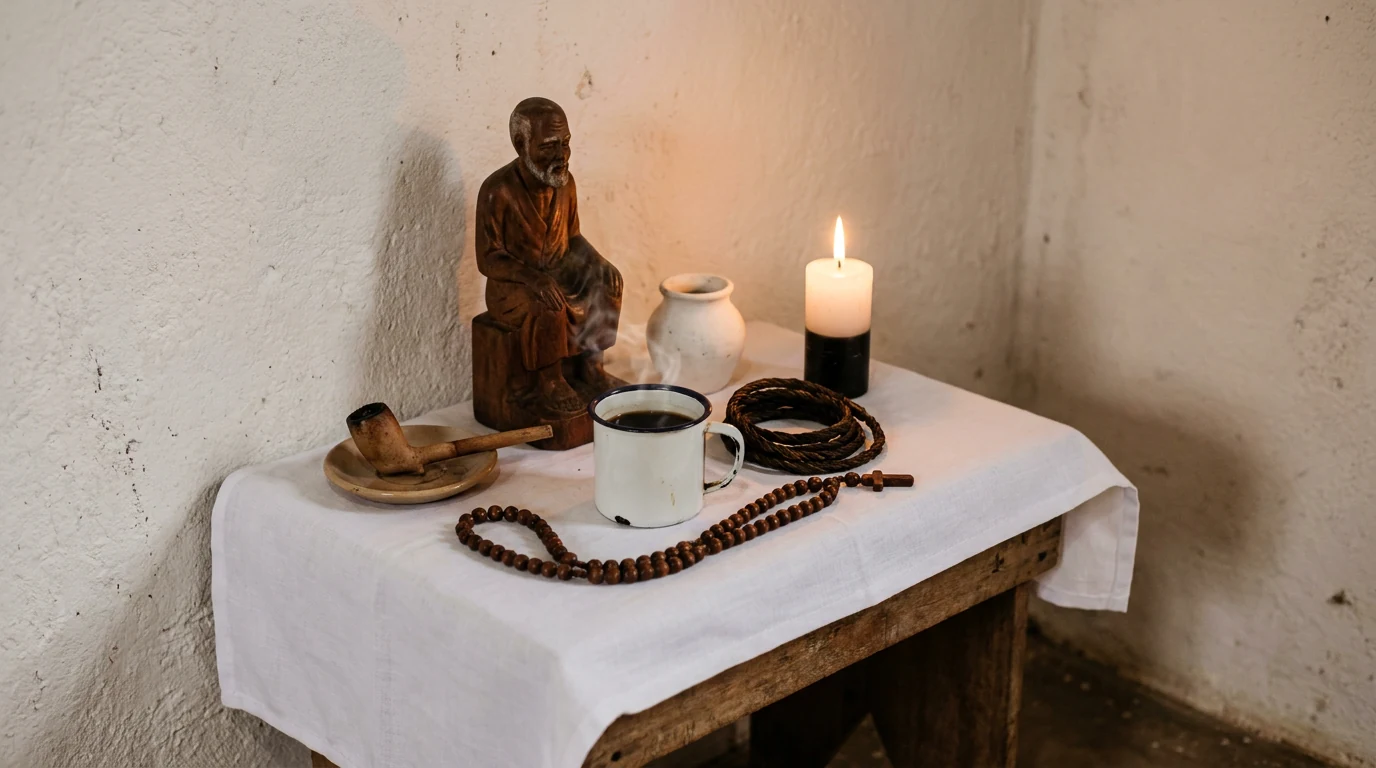
The same USP dissertation describes the house of souls of that terreiro, next to the tronqueira:
- a pepper tree (aroeira) cross driven into the dirt ground, with a rosary hanging;
- a quartinha of clay with water on the right side of the cross;
- a pipe and an alguidar;
- a white candle, which the leader "replenishes daily".
This is what a house does, not a recipe: there is a buried foundation there that only the leader knows. Setting up a house of souls is a matter for your pai or mãe de santo.
The color also varies. In the Cruzeiro de Vitória, the pretos-velhos receive white and black candles, according to Thompson's research. Other houses use only the white one. The use and herbs of the bicolor one are in the black and white candle sheet. If you are still in doubt about the color, the which candle to light test helps to start.
In the gira, the pretos-velhos are usually greeted with a phrase that the historian Lourival Andrade Júnior records as being "in most Umbanda terreiros in Brazil": "Adorei as almas".
At home, at the church, or at the cemetery: where to light
No consulted source prohibits lighting a candle for the souls inside the house, nor does it mandate going to the cemetery. Maia records that intentions for the souls are made "in churches, but to the same extent at home, in one's private and family stronghold."
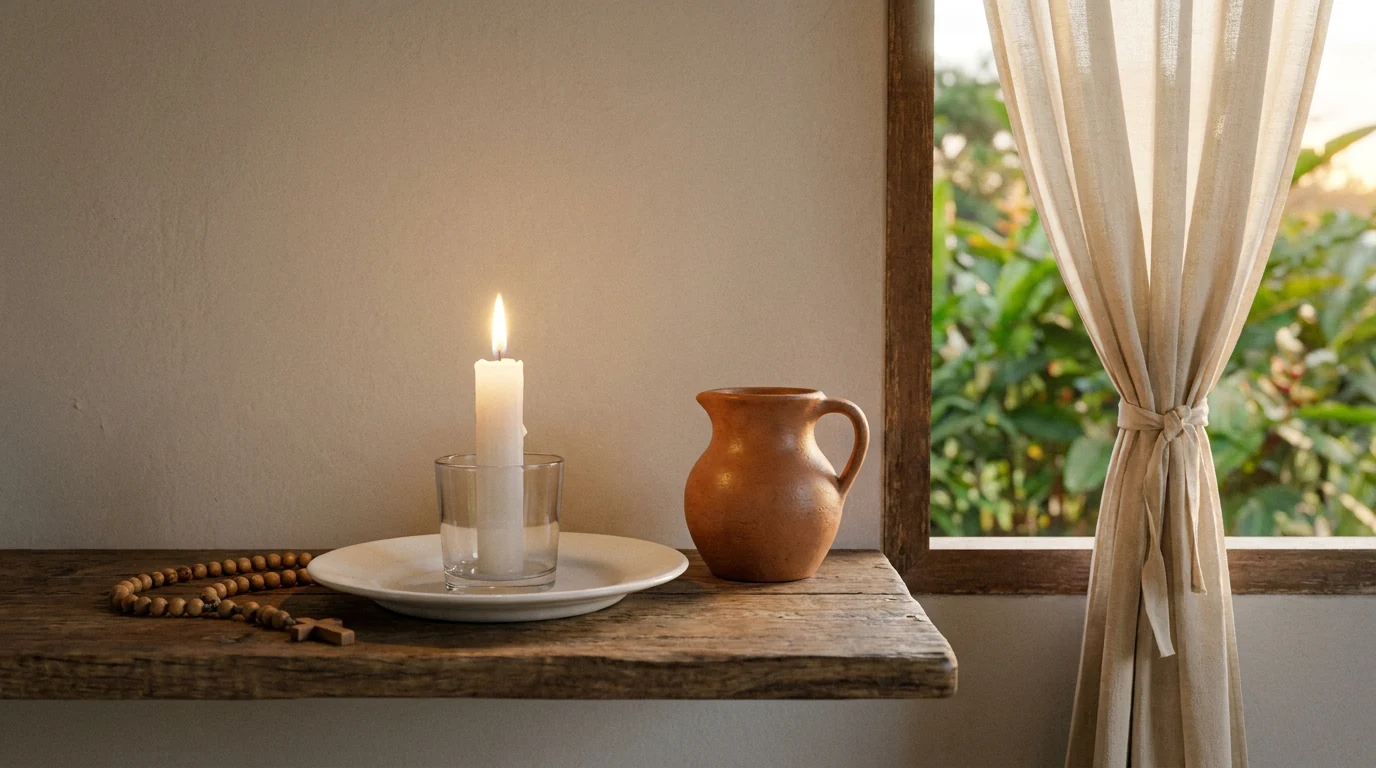
At home. The candle stays in a fixed, firm, and secure place, away from the bedroom. Many people place a glass of water next to it. It is a common custom, but the source we found speaks of something else: the quartinha with water in the house of souls of a terreiro.
In the church. This is where intentions for the souls are marked and celebrated, according to the same research. The candle there follows the parish rules.
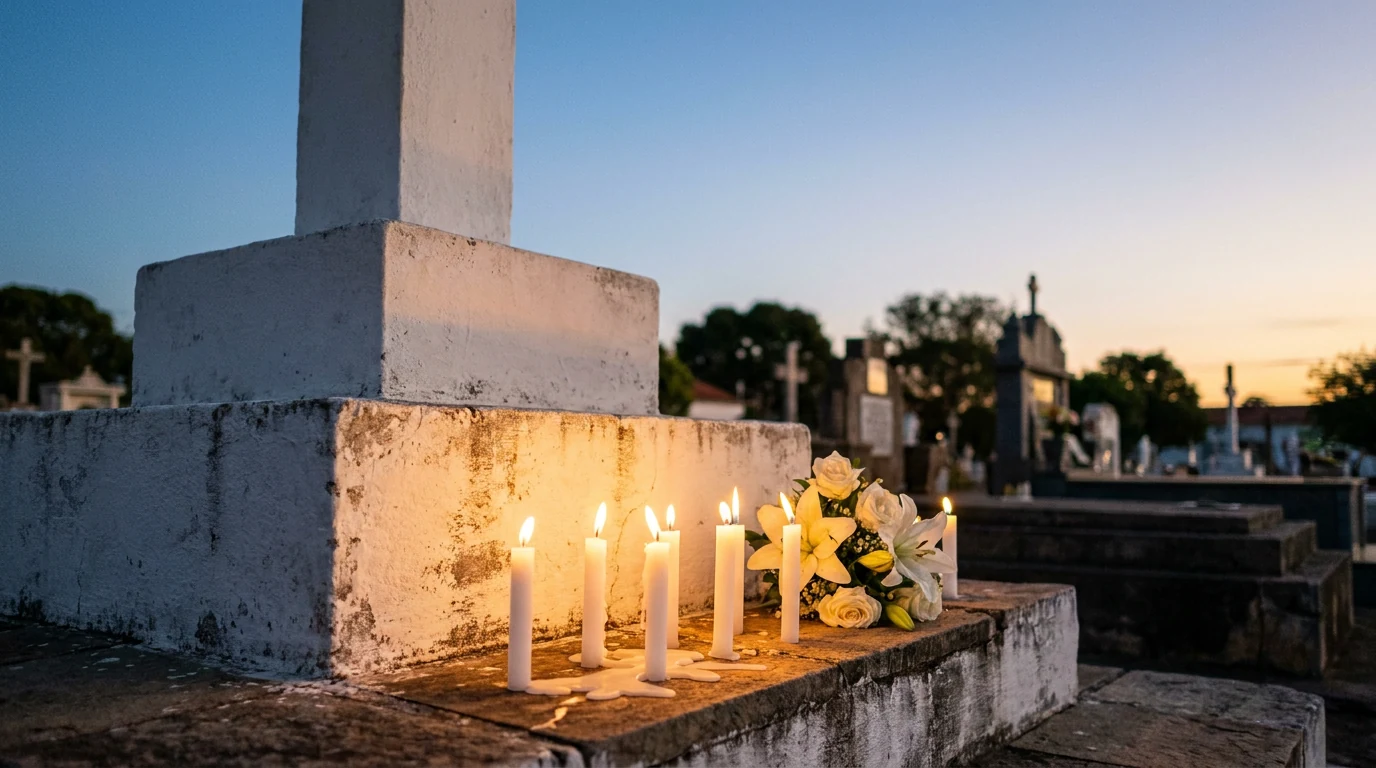
On the grave. For the Archdiocese of Rio, the candles lit on the graves symbolize faith in the resurrection of the dead. And also the hope that the souls rest in peace with God.
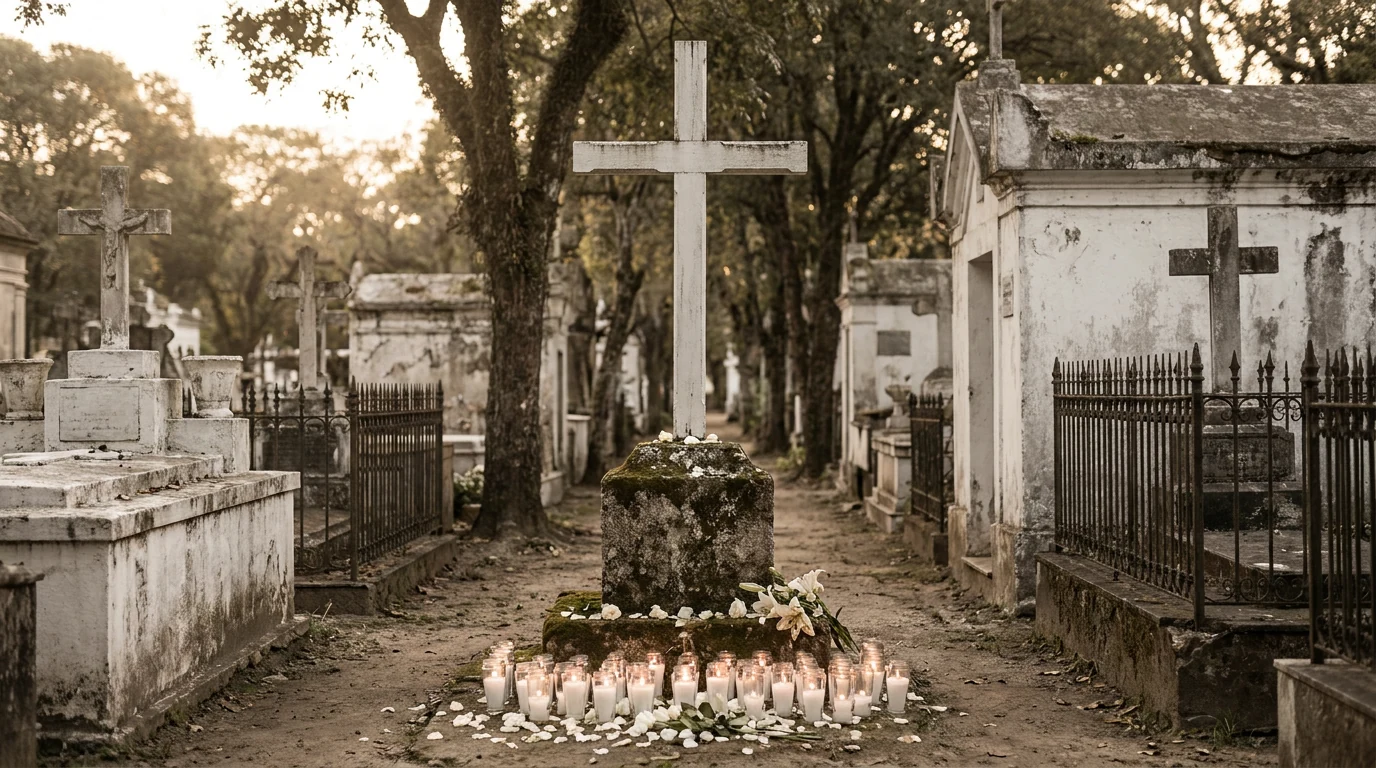
At the cross. Thompson describes the Cross of Souls (Cruzeiro das Almas) of the Santo Antônio cemetery, in Vitória, as a large white cross at whose feet people light candles for all the souls. There, the cross also allows one to remember those who were buried in other cemeteries. The history of this cross is in Cross of Souls (Cruzeiro das Almas).
In this cemetery, there are two crosses: one from the white line and another from Exu, or the black line, and the author warns that this only happens in some places. In the research, the offering to the pretos-velhos goes to the white cross.
Can you light a 7-day candle for the souls?
You can. No source consulted prohibits it, and the 7-day candle serves the intention of the person lighting it. What changes is the care: they are days of a lit flame, and someone needs to be nearby at all times. The step-by-step, from the plastic to the plate, is in how to light a 7-day candle. If your house requested the candle for seven days, agree with the leader on where it stays and who takes care of it.
The candle on All Souls' Day
On November 2, the cemetery fills with candles. In São Benedito, a devotee told Maia what the most visited tomb in the city looks like: "on All Souls' Day, the candles run from the tomb to the ground".
For the Church, the candle on the tomb is a sign of the light of resurrection and eternal life. For the Umbanda studied in Vitória, the day has another layer. Thompson records that, "especially on November 2", Umbandistas leave offerings on the cross and on the headstones, while Catholics pray for their deceased and for the souls in purgatory.
She also notes the order of the gesture on the worshiped tombs: "the first thing to be done is to light the candles". The offering comes later.
Here, the house rule applies. Lighting a candle on a relative's tomb is a devotion of any person. Offering and ritual work in the cemetery are a matter of the terreiro, with a leader, and not of an article. What Umbanda, Quimbanda, and Candomblé do, and what they do not do, on November 2, is in the guide of All Souls' Day in Umbanda.
What not to do when lighting a candle for the souls
Most errors with candles are safety issues, not matters of fundamento. The guidelines below are from the U.S. Fire Administration, the federal fire department agency of the United States, and the Goiás Fire Department handbook.
- Do not leave a candle lit without anyone nearby. The American agency instructs to extinguish it when leaving the room or house, and when going to sleep.
- Do not light it in the bedroom or bathroom. The same agency requests no lit candles in bedrooms, bathrooms, and sleeping areas.
- Do not use a wobbly support. The candle goes on a stable support, where it cannot be knocked over.
- Do not light it near fabric. Keep it about 30 cm away from anything that burns. The Goiás firefighters describe the classic scene: wind moves the curtain, it touches the flame. Keep away from curtains, rugs, and towels.
And there is what not to do out of respect:
- Do not treat the candle as a trade. A candle for the souls accompanies a prayer and remembrance. It is not a payment for a request, and no source promises results.
- Do not copy the terreiro's cruzeiro at home. The house of souls described by USP has the fundamento of the house. This is set up with the leader.
For the almas, the candle accompanies the prayer. Whoever lights it takes care of the flame until the end, or extinguishes and relights it later.
Frequently asked questions
Can you light a candle for the almas inside the house?
You can. Maia's research at UFRN records that intentions for the souls are made in churches and also at home. Choose a firm place, away from curtains and outside the bedroom, and extinguish the candle when leaving the room or going to sleep, as the firefighters instruct.
What is the color of the candle for the almas?
No consulted source fixes a mandatory color. White is the most recorded: in a house of Umbanda studied by USP, the leader replaces a white candle every day in the house of the souls. In Vitória, the pretos-velhos receive white and black candles at the cruzeiro. Follow the guidance of your house.
How many candles to light for the 13 blessed souls?
The prayer leaflet, transcribed in a UFRN study, does not mention candles. It asks for 13 Our Fathers and 13 Hail Marys, prayed for 13 days. They are 13 prayers, not 13 candles. Whoever lights a candle along with it makes a gesture of devotion, and the quantity is up to the person praying.
What is the best day to light a candle for the souls?
Monday, the day of the souls in popular Catholicism. In Umbanda, Monday is also the day of the pretos-velhos in many houses. In 2026, All Souls' Day, November 2, falls exactly on a Monday, joining the two dates.
White candle, black and white candle, 7-day candle, quartinha, rosary, and a preto-velho statue are in the shop in Extrema, Minas Gerais. If your house requested material for the Monday of the souls or for November 2, just call on the Joia Mística Laroyê WhatsApp.
References
- MAIA, Michelle Ferreira. "Between the request and the received." Mneme: Revista de Humanidades, UFRN, v. 11, n. 29, 2011. Article in PDF
- THOMPSON, Barbara. "At the gates, tombstones, and cruzeiros of the souls: Umbanda rituals at the Santo Antônio public cemetery, in Vitória-ES." Anais do IV Seminário de Ciências Sociais PGCS-UFES, 2019. Article in PDF
- DIAS, Rafael de Nuzzi. Ancestral chains: the pretos-velhos of the Rosary. Master's dissertation, USP Ribeirão Preto, 2011. Full text
- ANDRADE JÚNIOR, Lourival. "Adorei as almas: Umbanda, preto-velho e escravidão". Anais do XXVII Simpósio Nacional de História, ANPUH, 2013. Article in PDF
- Archdiocese of São Sebastião do Rio de Janeiro. All Souls' Day in the Catholic Church
- EBC, 2024. Caminhos da Reportagem addresses 50 years since the Joelma Building fire
- U.S. Fire Administration (FEMA). Candle fire safety
- Military Fire Department of the State of Goiás. Home accident prevention guide