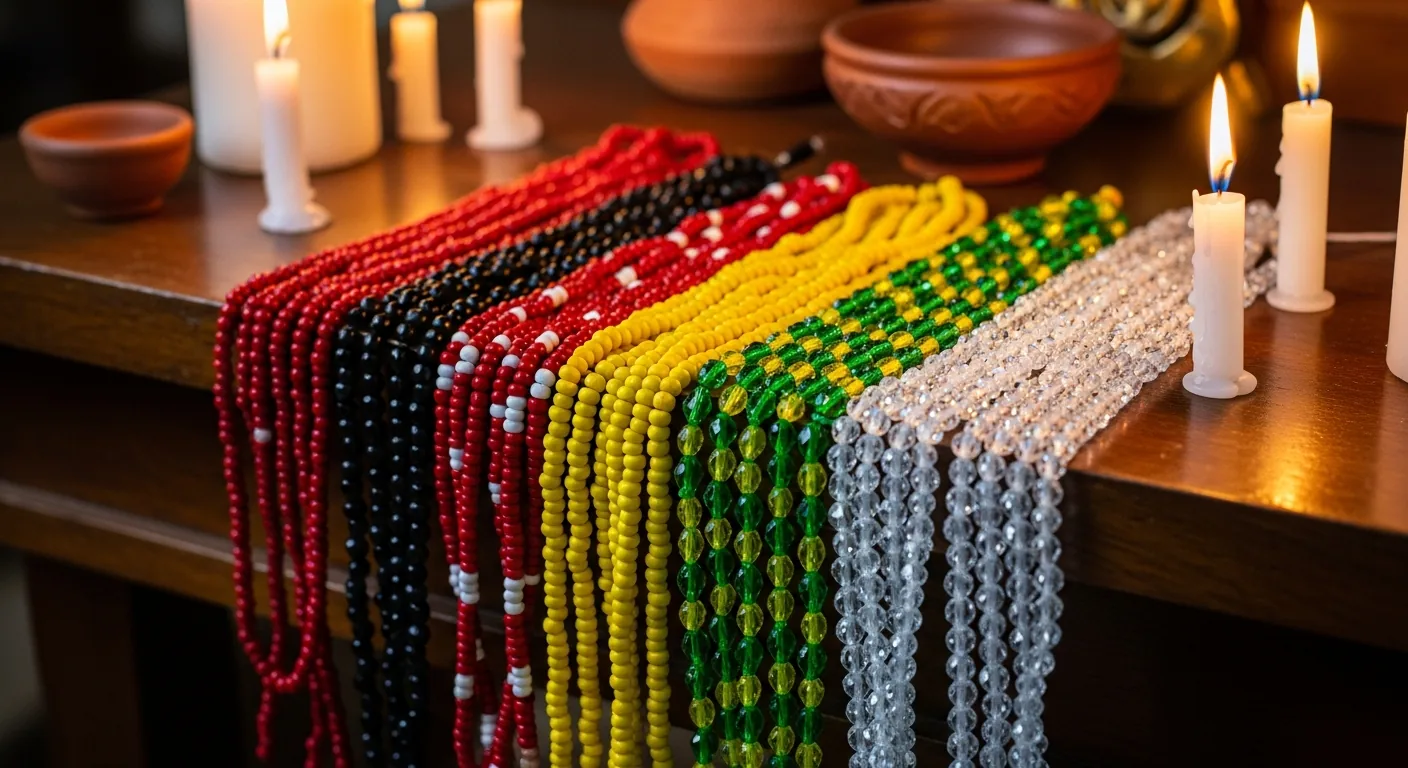
Those who come close to the Batuque discover early on that the Batuque clothing is not a costume or a uniform. It has its own name, has color rules, and changes as the person rises in the house, and almost none of this is written on the internet.
Here you see piece by piece what is worn in the hall. You also see why the bombacha separates the Batuque from everything else and when color gives way to white.
Axó: the name of the clothing in the Batuque
In the Gaucho Batuque, the religious clothing is called axó, also written as axô. The term covers the entire set, not just a single piece.
The cleanest ethnographic definition comes from anthropologist Rafael Cristaldo, from UFRGS. He describes the axó as religious clothing, white or colored, with bead necklaces, head cloths, and skirts for women. Researcher Cauê Fraga Machado, in an article in Religião e Sociedade, treats the axós as religious festival clothing. He also records that fathers and mothers of santo appear wearing axó in portraits kept by the houses.
It is worth remembering this word, because this is how the piece is requested. Whoever enters a store asking for axó is speaking the language of the house, and the Batuque has its own vocabulary for almost everything.
Machado also records a beautiful detail of the transmission: the clothing is something that photographs teach. Filhos de santo look at old portraits of the house to order the new clothing from the seamstress, because good axó is usually made to measure, not bought ready-made.
The bombacha, the Gaucho marker
This is the point that no article on Afro-Brazilian clothing mentions. In the Batuque, the man wears bombacha, the wide pants from the Gaucho costume, and it entered the rite as a religious piece.
The researcher Dênis Moura de Quadros, in a study published by UTFPR, places the bombacha next to Ogum (Ogun)'s roasted rib. According to him, these are the two adaptations that mark batuque in comparison to other African-rooted religions. He also notes that it usually appears in the color of the orixá.
The same study points to an ongoing movement. The bombacha is being set aside in some houses. In its place, cotton and lace clothes from Guinea-Bissau, Angola, and Nigeria are entering, in a movement that the author reads as an approximation of Candomblé. The Bará bell is also giving way to the adjá.
The researcher himself does not reach a conclusion on this and writes that only time will tell. This blog does the same, because internal disputes of tradition are resolved inside the terreiro, and not on a shop page.
Piece by piece: what is worn in the salão
What the sources of batuque effectively describe is a lean set. The general rule of the salão, in the most widespread terreiro formulation, is long pants for men and at least a skirt for women, provided it is not short.
- Bombacha or long pants: the man's piece, normally in the color of the orixá.
- Skirt: the woman's piece, flared and of a length that covers the knees.
- Head cloth: used by men and women, and in some houses follows the color of the head orixá.
- Axó de corpo: the top piece, like a long shirt, described as such in some houses.
- Guia: the bead necklace, which only becomes a guia after being washed and blessed by the house.
The bead necklace (guia) deserves separate attention, because it is the piece that carries fundamento and is not bought ready to use. Colors, assembly, and care are in bead necklaces in batuque, and the article here does not repeat that content.
A necessary honesty: anágua, pano da costa, metal adornment, and footwear rules appear in Candomblé sources, and not in those of Batuque. If your house adopts any of these pieces, ask inside, because the open Gaúcho bibliography does not support the claim.
The color of the axó divides the houses
Here is the doubt that reaches the counter most often, and it has no single answer. The sources diverge, and the divergence is real.
On one side, the color of the axó follows the color of the head orixá, on the cloth and on the body, and some houses alternate the color of the accompanying orixá. Quadros confirms the same pattern for the bombacha. Those who still do not know their own orixá can start by discover your orixá and take the result to a serious house. The pair of orixás is explained in front and accompanying orixá.
On the other side is the white of Oxalá. Babalorixá Hendrix Silveira, a doctor in theology, lists the moments when white is mandatory: omieró, oribibó, borí, apronte, ebomí, marriage, serão, termination, and funeral of the arissun.
The use of colorful clothes in these moments is a disrespect to the Great Orixá, Creator of the Universe. The phrase is from Silveira, and he opens the text by saying that he notices a lot of ignorance regarding the color of clothing in serões and Batuque festivals.
The safe synthesis is simple. Orixá color applies to festivals and for toque, white wins in foundation rites, and your house is what defines it. The nations Oió, Jeje, Ijexá, Cabinda, and Nagô have their own customs, and the differences are in the nations of Batuque.
What changes as the person rises in rank
The clothing follows the ritual path, and that is why no one puts on their own axó alone. Each step of the ladder, from having a washed head to being ready with axés, changes what the person can wear and carry. The entire path is in degrees of initiation in batuque.
There is also the new clothing. Machado records that, on the day of the walk, some people set aside at least one new piece, and some wear only newly purchased clothes. The justification gathered in the field is direct: it is an exit to a new life, therefore new clothes. The complete rite is in obrigação in batuque.
It is worth remembering that the axó is also read in the street. Cristaldo describes the tension of being in public in axó, because the clothing marks religious belonging and exposes who wears it. This is not a costume detail, it is religious intolerance lived on the skin.
Roupa de ração is a Candomblé term
Many people arrive looking for "roupa de ração" and leave confused. The name exists, but it is not from batuque.
Roupa de ração is the daily work attire of the Candomblé roça, in simple fabrics like morim and cretone, almost always white. It is divided into calça de ração and camisa de ração, and the houses list the piece as mandatory by rank and by degree.
In batuque, the name that the houses use is axó. The Brazilian market sells the piece with both names, and there is no problem with that. But those who want to speak correctly with the pai or mãe de santo use the word of tradition. The other differences between the two religions are in batuque and Candomblé, and the most iconic piece from the baiano side is in pano da costa.
Frequently asked questions
What is the male batuque clothing like?
The man wears bombacha or long pants, and the bombacha is the piece that marks the gaúcho batuque compared to other Afro-Brazilian religions. The top piece, the head cloth, and the bead necklace complete the set. The color usually follows the orixá, with the exception of foundation rites.
What is the female batuque clothing like?
The minimum composition described by ethnography is a skirt, head cloth, and bead necklace. The skirt is flared and cannot be short to enter the hall. Many houses also request the top piece in matching fabric, custom-made by a seamstress who already knows the axé of the house.
When must the batuque clothing be white?
In foundation rites. The most detailed list available includes omieró, oribibó, borí, apronte, ebomí, casamento, serão, terminação, and the funeral of the arissun. In these moments, the white of Oxalá prevails over the color of the head orixá, and wearing color is treated as disrespect.
Does the batuque clothing follow the color of my orixá?
In festa and in toque, almost always yes, and some houses alternate the color of the accompanying orixá. But this varies among the five nations and between terreiros of the same nation. Confirm with your leader before sending it to be sewn, because the color in batuque is foundation and not personal taste.
Where to buy the clothing and batuque material
At Joia Mística Laroyê, you find batuque material with provenance, and the guidance comes along:
- Fabric by the meter for axó: cotton and satin in the colors of each orixá and in white
- Skirts and head cloths: for festa, toque, and serão
- Beads and firma for bead necklace: individual pieces, for your house to wash and cross
- Candles, alguidares, and quartinhas: for the assentamento and for the obrigação
- Herbs and fundamento items: according to the list your leader provides
Stop by the shop, at Rua Benedito Zingari, 460, Bela Vista, in Extrema-MG, or message on WhatsApp with delivery to all of Brazil.
An honest request to close. Before choosing a color because you think it is prettier, ask at your house, because color in Batuque is fundamento. The shop provides the material, and who tells you what to wear is your pai or your mãe de santo.
References
- Dênis Moura de Quadros: the study that treats the bombacha as Batuque attire and records the exchange for African fabrics, R. Letras, UTFPR, 2020
- Cauê Fraga Machado: axó as festive clothing, the new clothes for the outing, and the clothing learned in photographs, Religião e Sociedade, 2015
- Hendrix Silveira: the list of rites in which white is mandatory in Batuque, babalorixá and doctor in theology, 2022
- Rafael Cristaldo: the definition of axó and the tension of being on the street in axó, 34th Brazilian Meeting of Anthropology, UFRGS, 2024