Whoever types Exu Sete Facadas into Google falls into a mess that no one can sort out. Half of the questions that appear on the screen are about a Pombagira, and the other half repeat a story of a wounded warrior that no terreiro has ever recorded.
This article separates the two spirits and explains what the word falange truly means. Then it delivers the practical profile of the falange do corte: day, colors, greeting, drink, fumo, tools, and offering. Where the houses diverge, you will read that they diverge.
Exu Sete Facadas is not the Pombagira Sete Facadas
The first thing to get right is the name. There are two different spirits working with the same number, and the Google search mixes the two all the time.
Exu Sete Facadas is a masculine falange of the povo de rua, linked to the crossroads and to the cut (corte). The Pombagira who carries seven stabs in the story is something else, with her own myth, her own ponto, and her own offering. If you arrived here looking for her, the path is the text about who is Pombagira.
Confusing the two is not a matter of curiosity. It changes the offering, changes the greeting, and changes the day the house firms. Whoever arrives at the terreiro asking for one knowing the other leaves there corrected.
What is a falange, and why does it change everything
In Umbanda and in Quimbanda, falange means a grouping of spirits that work under the same name, the same archetype, and the same mystery. It is not a person who died and came back with a stage name.
This immediately dismisses the most repeated version on the internet: that of the warrior who supposedly survived seven stabs and became a spirit. It is a beautiful story and circulates in various portals, but no terreiro record or research supports it. Falange does not have a birth certificate.
The reading of the foundation is different, and it makes more sense within the system. The seven knives are tools, not scars. Each blade responds to a sense of ritual work that the spirit opens or closes, within the limit that the Law imposes on every guardian.
If someone tells you the biography of a spiritual legion with a name, date, and city, be suspicious. What tradition keeps is the mystery and the tool, not the past life.
Quimbanda organizes this people into seven kingdoms and dozens of peoples of Exu. The organization varies from house to house, and Sete Facadas does not appear fixed in a single kingdom in public listings. Whoever says where she enters is the foundation of their house.
The profile of Exu Sete Facadas
This is the profile that circulates with the most convergence between houses of quimbanda and giras of the left. Read it as a starting point to talk with your leader, never as a closed rule.
- Where it is worshipped: quimbanda and gira of the left of Umbanda, in the line of the crossroads
- Colors: red and black
- Greeting: Laroyê, which translates as hail the messenger. Many houses of quimbanda also use Exu é mojubá
- Drink: cachaça, called marafo in the terreiro. Houses of finer treatment offer aged distillate
- Tobacco: cigar, and in some houses common cigarette
- Tools: the seven knives, the dagger, and the black and red cape
- Delivery location: crossroads, and the tronqueira of the house when the firmeza is of the terreiro
Two points remain open on purpose. The day of the week most cited is Monday, the day of the povo de rua, but many houses firm the tronqueira on Friday. And the ruling orixá has no consensus: the affinity with iron and blade pulls Ogum (Ogun) in many people's minds, but no serious source confirms it.
The one who resolves both is the leader of your house. This is not an evasive answer, it is how the fundamento works.
What the corte falange works on
The field of work of Sete Facadas is what the name announces: corte. Unmaking of a spell, breaking of an old demanda, and defense of those suffering a spiritual attack.
It is worth comparing with a neighboring falange so the reader does not get confused. Exu Tiriri is called to unearth and clean what was done and remained stuck in the path. Sete Facadas is called to cut the bond that keeps the problem fed. One unmakes the object, the other cuts the thread.
Corte, here, is always on the spiritual plane. Quimbanda has its own ethics, anchored in African cosmology, and this ethics does not authorize asking for harm to any person, as shown by Carvalho and Bairrão in a study published in Psicologia USP. A guardian is not a henchman.
There is also no promise. The spirit prepares, protects, and cleans the field. No serious terreiro sells results with a set date.
Povo de rua: why is this falange so sought after
Povo de rua is what the set of Exus and Pombagiras is called. Cruz and Arruda studied the povo de rua in terreiros of Rio de Janeiro and published the result in the Memorandum magazine of UFMG. The finding confirms what any gira attendee perceives: they are the spirits with the greatest proximity to the living.
They speak the language of everyday life. They deal with jobs, debts, neighbors, lawsuits, health, and home. That is why a cutting spiritual legion (falange) fills the terreiro on a Monday night.
The distinction that Quimbanda makes and prejudice erases is worth noting: kiumba is a disorderly and obsessing spirit, and it is not Exu. Confusing the two is the error that has fed the stigma for a century.
Offering and spiritual strengthening (firmeza): what to take and what to ask before
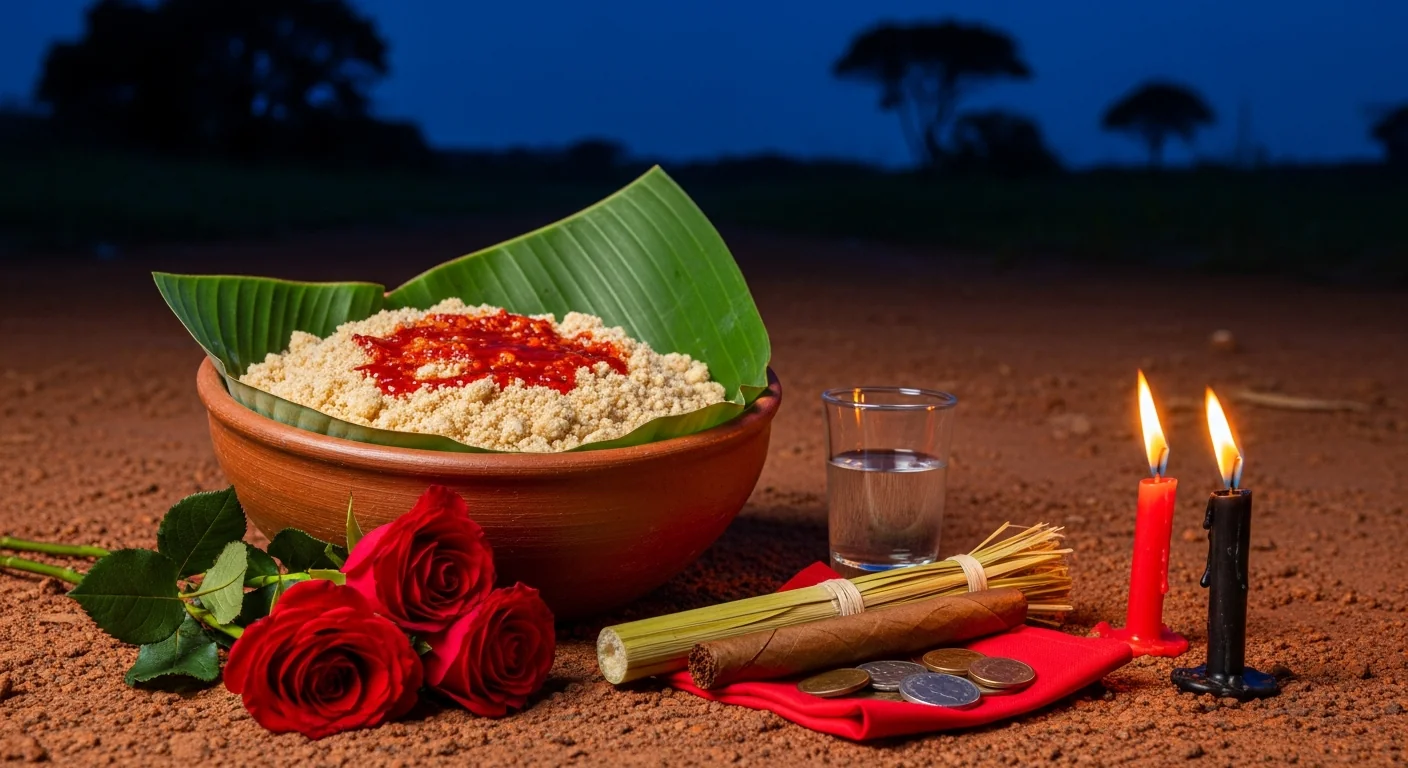
The Sete Facadas offering follows the line of the povo de rua. The basics that appear in almost every house are black and red candle, cigar, cachaça, and farofa de dendê, delivered at the crossroads. The complete step by step is in the offering for Exu guide.
Firmeza (ritual strengthening) is a different and more serious matter. To consecrate the spiritual legion (falange) at the house tronqueira is an act of foundation, done by someone who has the obrigação for it and inside the terreiro. It is not a home setup with materials bought on your own, and no blog article replaces this guidance.
Before setting up any guardian, ask your leader three things: if it is the time, if it is that falange, and what your house uses. His answer is worth more than the sum of everything you read on the internet.
Exu is not the devil
It needs to be said, because the name with a knife inside feeds the misunderstanding. The association between Exu and the Christian devil does not come from African tradition. It was manufactured in colonial contact and Catholic syncretism, as shown by Reginaldo Prandi in the article published in Revista USP.
In the African system, Exu is the principle of movement and communication, the one who opens and closes the path. The terreiro guardian works at the door, in the street, and at the crossroads because that is where life happens, not because there is anything infernal at the address.
If you want to understand the root before the falange, start with who is Exu and then come back here.
Frequently asked questions
Who was Exu Sete Facadas?
The question starts from a wrong premise. Sete Facadas is a falange, that is, a set of spirits under the same name and the same mystery. The story of the warrior who survived seven stabs circulates in portals, but there is no terreiro record or research that supports it.
What is the day of Exu Sete Facadas?
Monday is the most cited day for the povo de rua, and many houses also use this day for the falange. Others firm the tronqueira on Friday. There is no national rule, and the correct day is what your house practices.
What is the difference between Exu Sete Facadas and Pombagira Sete Facadas?
They are different spirits that share the number. Exu Sete Facadas is a male falange of the povo de rua, linked to cutting a demanda. The Pombagira has her own myth, ponto, and offering, and is the subject of another article. Swapping one for the other changes the entire offering.
Is Exu Sete Facadas good or evil?
The question arises from a morality that is not that of Quimbanda. A guardian is not divided into good and evil, he works within an order and a limit. Asking for harm to someone is not Exu's service, it is a deviation of the one who asks.
What is offered to Exu Sete Facadas?
Black and red candle, cigar, cachaça, and farofa de dendê form the basic accepted in most houses. The delivery is usually at the crossroads. What goes beyond that depends on the foundation of your house and the guidance of your leader.
Where to buy Exu material
At Joia Mística Laroyê, you find the material of the povo de rua with provenance:
- Black and red candles: individual, in pairs, and seven-day candles
- Black and red bead necklaces: assembled or in loose beads for the house to consecrate
- Alguidares, quartinhas, and clay pottery: for the delivery and for the ritual strengthening (firmeza) that the leader directs
- Cigar, dendê, flour, and pemba: the basics that every left line house consumes
- Statues and iron tools: dagger, trident, and pieces for assentamento
Stop by the shop, at Rua Benedito Zingari, 460, Bela Vista, in Extrema-MG, or message on WhatsApp with delivery to all of Brazil.
A final word. Almost every page about Exu Sete Facadas chooses a version of the story and sells it as fact. This text preferred to mark what tradition converges on, what it diverges from, and what no one knows. Take these three things to your home and ask there for the rest.
References
- Reginaldo Prandi: Exu, from messenger to the devil, on the demonization of the orixá in Catholic syncretism, Revista USP n. 50 (2001)
- Carvalho and Bairrão: Umbanda and Quimbanda as a black alternative to white morality, with the own ethics of the left line, Psicologia USP v. 30 (SciELO)
- Cruz and Arruda: research on the povo de rua in Umbanda terreiros of Rio de Janeiro, revista Memorandum (UFMG)
- Wikipedia: entry on Exu of Umbanda, with the definition of falange and the Laroiê greeting
- Wikipedia: entry on Quimbanda, with the Kimbundu etymology and the division of the povo da rua