Maria Farrapo is a spiritual legion (falange) of Pombagira from Umbanda and Quimbanda, one of the "Marias" alongside Padilha, Mulambo, and Quitéria. She is not the same Maria Mulambo: in a house in Paraná, she arrives as her companion. Research links her to the defense of women and the memory of enslaved women who resisted.
Family: Marias | Walks with: Maria Mulambo and Maria Quitéria, in a house in Paraná | Colors: red and black, those of Pombagira in general | Greeting: Laroyê, Maria Farrapo! Maria Farrapo is Mojubá! | Own day and orixá: none with a source
Who is Maria Farrapo?
Maria Farrapo is a Pombagira, that is, a feminine Exu, and her name is a spiritual legion (falange). For Reginaldo Prandi, from USP, Pombagira "is an Exu, or rather, an Exu-woman, as she herself likes to be called." Spiritual legion (falange) means that several spirits work with the same name.
Ana Laura Brito and Nara Takaki, from UFMS, explain that "there are several spirits who respond to this name (the spiritual legion) and who do not necessarily share the same history and life." They place Maria Farrapo among the spiritual legions (falanges) that use the name Maria, with Padilha, Mulambo, and Quitéria. The general concept is in who is Pombagira, and the other Marias in names of Pombagira.
She appears in real terreiros, not just on a list. A terreiro of Umbanda crossed with Candomblé in southwestern Paraná was studied for four years. The pombagiras of the house were Rainha das Sete Encruzilhadas, Maria Padilha, Maria Mulambo, Maria Farrapo, das Matas, and Capa-Preta. The record is by Jean Favaro, Josiane Wedig, and Hieda Corona, in the magazine Cadernos Pagu, from Unicamp.
Are Maria Farrapo and Maria Mulambo the same person?
No. No research treats the two as the same spirit. All those who mention Maria Farrapo place her alongside Maria Mulambo, as different names.
The clearest record comes from the thesis of Jean Favaro, at UTFPR. When his Maria Molambo was settled, she said she had brought the husbands, Exu do Lodo and Exu Molambo. Pai Aldacir's Exu Tranca Ruas completed that she brought "her companions to work together with you, Maria Quitéria and Maria Farrapo". In other words: Farrapo came with Mulambo, not in her place.
So why do so many people ask if they are the same? For three reasons with sources:
- The name. Mulambo means "rag, old cloth, old clothes", recalls Rafael Haddock-Lobo, cited by Clairí Zaleski at UERJ. Prandi describes Maria Molambo as "a pombagira who always dresses in rags".
- A Mulambo ponto. A ponto cantado of Maria Molambo, recorded by Raphaela Silva, from UFF, ends like this: "She is Maria Mulambo, she is rag only!"
- The same story. A Quimbanda book cited by Favaro tells of the two as enslaved black women who resisted.
Silva reads Molambo, Farrapo, and Maria do Trapo together, with Farrapo and Trapo "at the side" of Molambo. The profile of the other falange is in Maria Mulambo.
What does Maria Farrapo do in people's lives?
Research links Maria Farrapo, first of all, to the defense of women. Favaro records that she and the Dama da Noite "can be evoked in issues related to violence against women", such as harassment, according to a Quimbanda book by Coppini.
The same message is in a ponto that Nilza Lagos heard in terreiros in Porto Velho (RO), for the dissertation at the Methodist University of São Paulo:
“In the family of Pombagira / one does not mess with a woman / it is Maria Farrapo / Maria Molambo / Maria Padilha is also a woman”
For Lagos, in this chant, Pombagira treats women as a group that protects each other.
There are two other field records:
- Urgency. In Favaro's house, Exu Tranca Ruas recommended: “Only call Maria Farrapo in emergencies.” The same speech gives Maria Quitéria the cases of men who hit women.
- Children. At Casa Mãe Guacyara, in São Paulo, the mãe de santo Dagmar spoke to researcher Mariana Leal de Barros, from USP. One of her pombagiras is “from the line of the Farrapos” and “comes to care for abandoned children.”
Serious Pombagira does not sell miracles nor does she bind someone's will. What the research records is protection and counsel in the gira, not a service with a deadline or guarantee.
What is the story of Maria Farrapo?
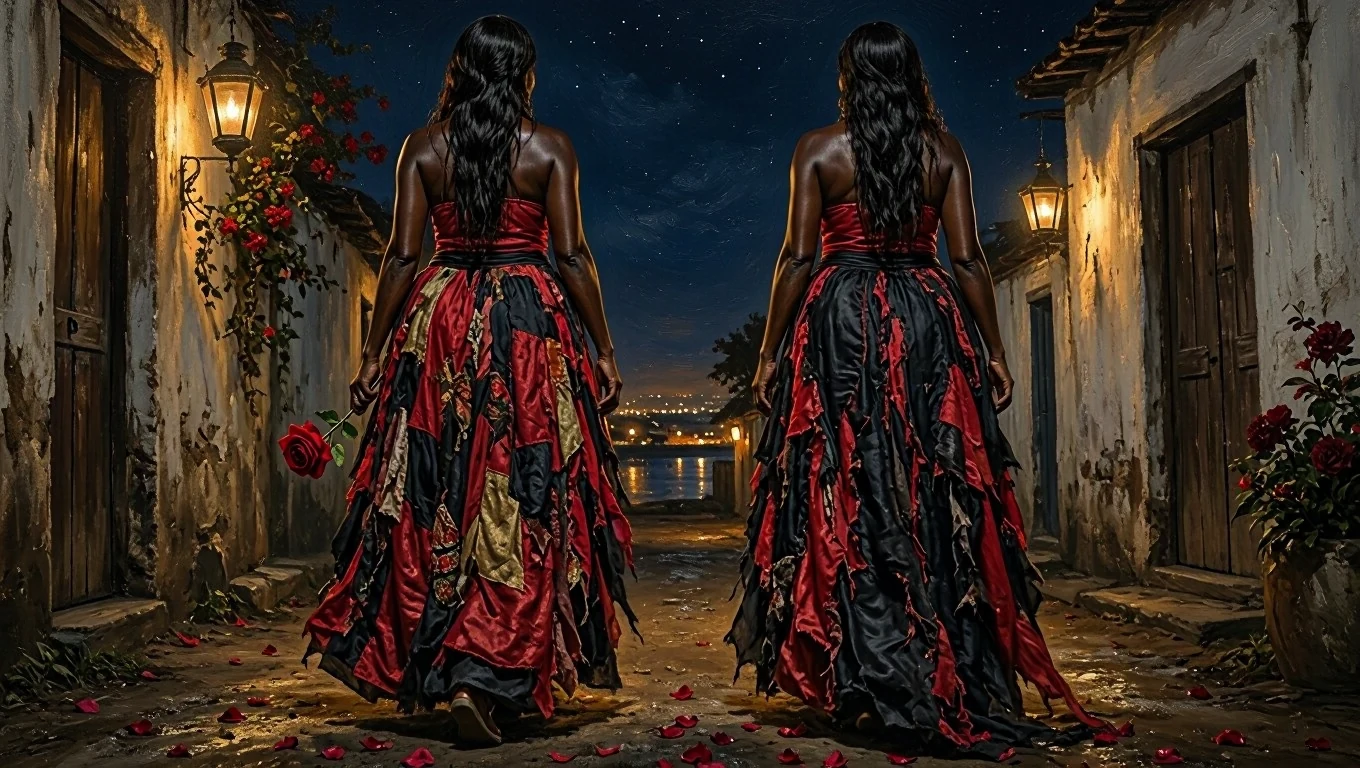
The most recorded story is that of a black enslaved woman who resisted. Based on Coppini, Favaro writes that Farrapo and Molambo “are alluded to as black women who were enslaved in Colonial Brazil.” According to this account, they resisted colonial humiliations.
Libertas, they managed to “get by in life, sometimes in the cabaret, sometimes on the street, they did what had to be done.” Favaro also notes that Molambo, Farrapo, and Exu Molambo would be souls of enslaved people, without material wealth in life.
This is not the official biography, because a falange does not have just one. Prandi recalls that many pombagiras are spirits of the dead, “some with a very popular mythical biography.” Each Maria Farrapo who arrives at a house can tell her life in a different way.
The name tells part of the story. For Silva, in the giras “the farrapo is not defeat, but path.”
What are the points of Maria Farrapo?
Two sung chants (ponto cantado) with her name are recorded in research, and a third cites her among the Marias. The first is from the early morning, in the calunga.
”At the break of dawn I saw Farrapo appear”
Clairí Zaleski and Luiz Rufino, from UERJ, published in the magazine Fronteiras, from UFGD, a sung chant (ponto cantado) collected in a terreiro de umbanda and sung for Maria Farrapo. It takes place in the calunga, the cemetery:
“It was inside the calunga / At the third bell (…) / At the break of dawn I saw Farrapo appear”
In the middle, the one singing prays before an open tomb, and a woman appears. More about the cemetery in calunga grande and calunga pequena.
”In Maria's family, only those who do not want to enter are kept out”
Brito and Takaki study a sung chant (ponto cantado) that calls the Marias together: “It is Maria Farrapo, Maria Padilha, Maria Mulambo”. The refrain says “In Maria's family / Only those who do not want to enter are kept out”. The third is from Porto Velho, cited above. Other sung chants (ponto cantado) from the line are in ponto de pomba gira.
Colors, offering, day and orixá: what has a source
No research gives Maria Farrapo her own color, day, orixá, or partner Exu. What exists is the general record of the Pombagira, and the rest is from the house.
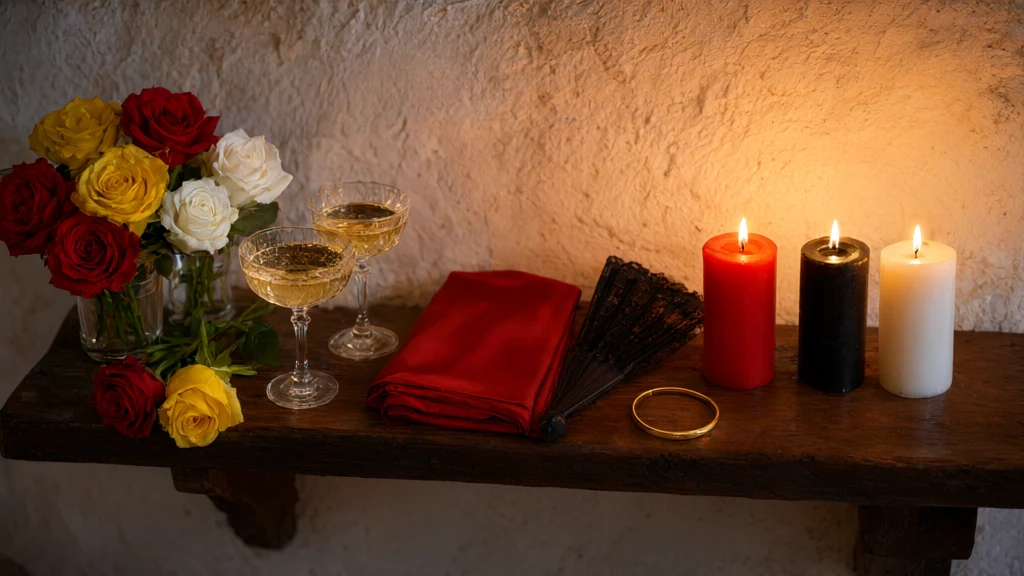
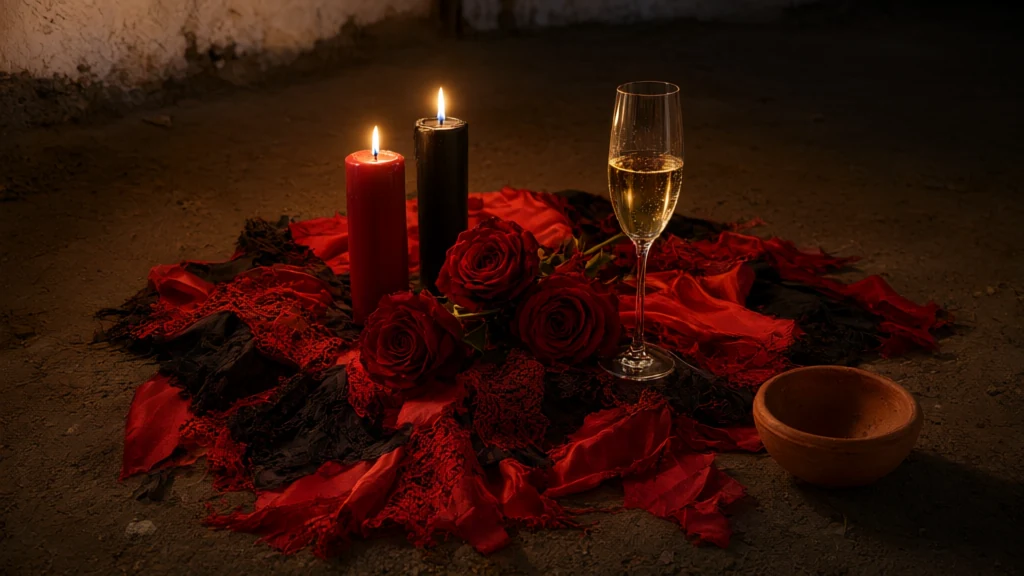
Prandi records for the Pombagira fabrics “in red and black colors, perfumes, jewelry and costume jewelry, champagne and other drinks” and “open red roses (never buds)”. The detail is in oferenda para Pombagira. If your house asked for a red and black candle, rose, or sparkling wine for the gira, you can check the material via the shop's WhatsApp.
Greeting: “Laroyê, Maria Farrapo! Maria Farrapo is Mojubá!” This is the way Fábio Gonçalves, from UFMG, recorded to greet Exu and Pombagira, with the name of each one.
The days and dates of Pombagiras in general are in pombagira day. The test What is my Pombagira does not have Maria Farrapo among the results. It shows the affinity with five falanges, among them Maria Mulambo, and who confirms your Pombagira is the gira.
Frequently asked questions
Which orixá does Maria Farrapo belong to?
No research links Maria Farrapo to an orixá. Pombagira is not an orixá, and the line of each falange changes from house to house. If your house places her in the line of the souls or in another irradiation, it is the leader who explains the foundation.
Which Exu works with Maria Farrapo?
There is no fixed partner Exu with a source. In the house studied by Favaro, she arrived along with Maria Molambo, whose husbands there are Exu do Lodo and Exu Molambo. Who announced her arrival was the Exu Tranca Ruas of Pai Aldacir.
Is there a Maria Farrapo of the Souls or of the Calunga?
The names circulate, but no research describes these qualities. As with every falange, the surname indicates the place of work. The sung chant collected by Zaleski and Rufino places Maria Farrapo in the calunga, the cemetery.
Does Maria Farrapo do love binding ritual?
No. Research links her to the protection of women and the care of those who are helpless, not to binding someone's will. Whoever promises love in return in her name does not speak for the spirit.
References
- Reginaldo Prandi, USP: Pombagira and the unconfessed faces of Brazil, chap. IV of Herdeiras do Axé, Hucitec, 1996
- Ana Laura Mota de Brito and Nara Hiroko Takaki, UFMS: Between words and sung chants, Revista Sede de Ler, UFF, 2025
- Jean Filipe Favaro, UTFPR: Territorialities of axé in the southwest region of Paraná, thesis, 2023
- Jean Favaro, Josiane Wedig and Hieda Corona: The face of the diabas, Cadernos Pagu, Unicamp, 2022
- Raphaela Maria Ribeiro da Silva, UFF: Pombagiric politics of the common: Trapo, Farrapo and Molambo, SciELO Preprints, 2026
- Clairí Zaleski and Luiz Rufino, UERJ: Fala a mulher da rua, Fronteiras, UFGD, 2022
- Clairí Zaleski, UERJ: Pombagira, a mulher que chega quando a gente sangra, dissertation, 2023
- Nilza Menezes Lino Lagos, UMESP: Arreda homem que aí vem mulher, dissertation, 2007
- Mariana Leal de Barros, USP: Labareda, teu nome é mulher, thesis, 2010
- Fábio da Silva Gonçalves, UFMG: Se me der de beber, também bebe, se me der de comer, também come, dissertation, 2017