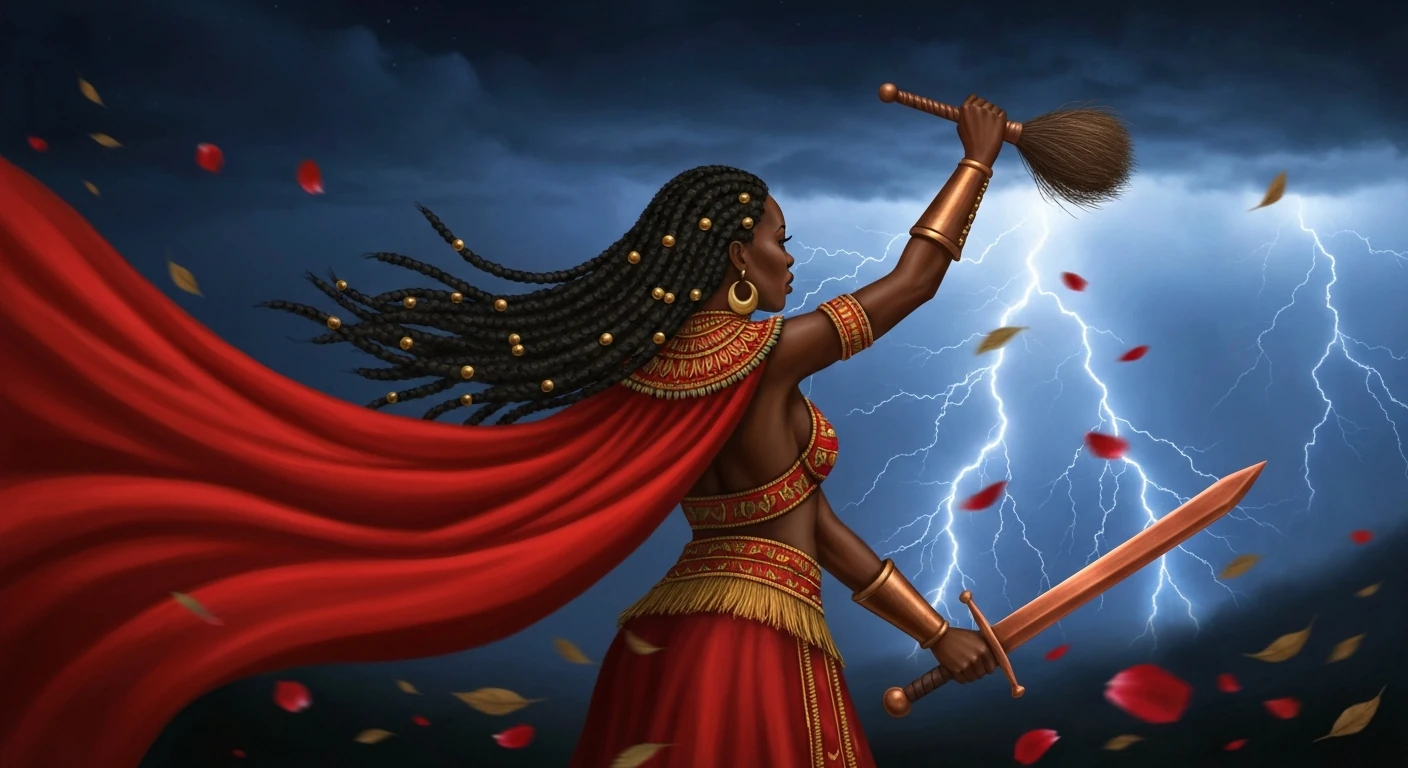
The qualities of Iansã are the paths of the same orixá, and each one has its own color, foundation, and ritual function. Onirá wears pink and walks near the waters of Oxum. Ijibé wears white and carries the cold wind of Oxalá. Those of Igbalé wear white with mariwô and deal with the egum.
This guide shows the qualities that houses mention most, organized by foundation and by color. I will say this in advance: your quality does not come from text on the internet, it comes from the cowrie-shell divination, in the house that cares for your head.
What is a quality of an orixá
Quality is the name that ketu Candomblé gives to the paths of the same orixá. They are not different orixás: it is the same force in another age, another mood, and another function within the worship.
The most cited definition is that of the sociologist Reginaldo Prandi. In African Gods in Brazil, he writes that the orixá of each person derives from a quality of the general orixá. This orixá can appear young or old, at peace or at war, as a king or as a subject, and the variations that serve as models are almost inexhaustible.
In Iansã, this becomes a wide list. Houses usually speak of nine qualities plus those of the Igbalé cult, and this nine is a traditional formula linked to the orixá herself, not a closed table.
The portrait of the orixá is in who is Iansã. Here the subject is different: which Iansã.
The qualities of Iansã by foundation
The key that most organizes the list is the foundation, that is, with which orixá each Oyá walks together. This is how houses explain the difference between one and another. The table brings together what is summarized in two or three independent terreiro lists, among them those of O Candomblé and Ilê Pai Joaquim e Mãe Maria.
| Quality | Foundation with | Brand |
|---|---|---|
| Oyá Petu | Xangô | the Oyá of lightning, of winds, and of trees |
| Oyá Kará | Xangô, the fire | red, and the acarajé ceremony |
| Oyá Onirá | the fresh waters, near Oxum | pink, queen of the city of Irá |
| Oyá Bagã | Oxóssi (Oshosi), Ogum (Ogun), Exu (Eshu) and egum | warrior of the winds |
| Oyá Ijibé | Oxalá, the cold wind | white |
| Oyá Biniká | Oxumaré (Oshumare) and Omolu (Omulu) | lady of the hot wind |
| Oyá Leié | Ewá, the wind of the birds | printed clothing |
| Oyá Senó | Airá and Iemanjá (Yemoja) | rare quality |
| Oyá Olokerê | Ogum and Oxóssi | warrior and hunter |
| Oyá Topè | real divergence between houses | see the next section |
Note what the table says: Iansã touches almost the entire pantheon, and therefore her list is one of the largest.
The color of the clothing says which Oyá it is
The second key is the color, and it stems from the foundation. Whoever saw one Oyá in pink and another in white at the same party did not see two orixás, they saw two paths.
- Pink: Onirá, for the fresh waters.
- Red: Kará, by the fire of Xangô.
- White with mariwô: the Oyás of Igbalé, from the cult of egum.
- Plain white: Ijibé, by the cold wind of Oxalá.
- Patterned: Leié, by the connection with Ewá.
It is worth correcting a piece of data that the internet repeats: the color of Iansã is not red and white. In Prandi's attachments, the ketu record is brown and dark red in the clothing and in the beads, and white enters through Igbalé and through Ijibé. The reading of red and white comes from Umbanda, because of Saint Barbara. The general logic is in colors of the orixás.
Two serious houses can name the same energy in different ways, and both will be correct within their own foundation. Topè appears linked to Oxum and Exu in one list, and to Ogum and Exu in another. This is not a research error, it is the foundation of the terreiro.
Oyá Igbalé are four, not one
This is the point that almost every text on the subject gets wrong. Igbalé is not a single quality nor an orixá separate from Iansã, it is the name of the group of Oyás who deal with the egum.
In the entry for Iansã in O Candomblé, the babalorixá Nelson Souza responds to a reader's question with the direct phrase: Igbalé is the denomination of several Oyás who deal with egum, not a single Oyá igbalé. The term in Yoruba, according to the text Oyá Ìgbàlè, the myth, names the sacred grove of the egúngun.
The terreiro sources record four, all in white with mariwô and with a foundation linked to Oxalá, Nanã (Nana Buruku), and the bamboo grove:
- Oyá Tanan, also called Furé, receives the dead at the portal.
- Oyá Funan separates and directs the dead.
- Oyá Padá illuminates the path of the dead.
- Oyá Egunitá lives and walks with the dead.

A note of respect: egum is ancestor, a person who lived and died, and has no relation to the Christian idea of an evil spirit. What happens in the bamboo grove is the foundation of an initiate and does not fit in a blog post, but the concept is explained in egum in Candomblé.
Iansã is the only large iabá that conducts the egum, and therefore is the only one with an entire liturgical subgroup in the list. The contrast helps: Xangô does not deal with egum, and his paths are organized by age and royalty, as shown in qualities of Xangô.
Iansã outside of ketu
The system of qualities is from ketu Candomblé, and outside of it, the question changes.
In jeje, the correspondence recorded by Prandi is Sobô. In the angola nation, the energy appears as Matamba, also called Bumburucema. Matamba is an inquice, from another system, and therefore does not have Iansã qualities: it has its own foundation. Whoever looks for Iansã qualities in angola starts from a premise that the religion does not sustain. The panorama is in candomblé nations.
In the gaúcho batuque, Oiá has its own worship and foundation, with adjuntó and passages organized in the style of Rio Grande do Sul, as shown in Oiá in batuque.
The house is the one that says the quality.
You do not discover your quality by reading a list, and recognizing yourself in a description proves nothing. The quality reveals itself in the cowrie-shell divination, performed by a babalorixá or ialorixá, and is confirmed in the initiation.
The best argument against self-diagnosis comes from the tradition itself. Prandi records that Candomblé even doubts the affiliation when the orixá characteristics do not fit the child. One then suspects the wrong orixá, and the solution is to discover the true orixá and reorder the initiation.
In other words: if inside the house the correction is ritual, here outside no text closes the matter. The divination is explained in what is cowrie-shell divination, and the orixá test serves as an entry point.
There is also the pair that finally resolves the confusion with the sign. An Oyá of Igbalé wears white, walks with mariwô and works in the silence of the worship of the dead, while Onirá wears pink and walks in sweet waters. It is the same orixá in opposite paths, and what separates the two is the foundation, not the personality, a subject that has its own page in children of Iansã.
Frequently asked questions
How many Iansã qualities exist?
There is no fixed number. Brazilian houses usually speak of nine qualities plus those of the Igbalé cult, which dialogues with the number nine of the orixá. Open terreiro lists record between seven and thirteen names, and Wikipedia brings a Yoruba inventory that does not coincide with the lists from here.
What is Oyá Igbalé?
It is the name of the group of Oyás who deal with the egum, not a single quality. Terreiro sources record four: Tanan or Furé, Funan, Padá and Egunitá, all in white with mariwô. Igbalé, in Yoruba, names the sacred grove of the egúngun, and the cult is conducted only by initiates.
Which quality of Iansã uses pink?
Onirá. She is the queen of the city of Irá and walks near the fresh waters, which explains the color and the proximity to Oxum. In some houses she also appears linked to the egum cult, and there are those who treat her as a separate orixá, a reading that terreiro sources contest.
How to know the quality of my orixá?
Through cowrie-shell divination, performed by a babalorixá or ialorixá, and confirmed in the initiation. There is no test or personality description that reveals this. Prandi records that even the identification made inside the house can be revised by ritual, which shows the care involved.
Does Iansã have qualities in Umbanda?
Not in the sense of Candomblé. Umbanda organizes the work by lines and vibrations, and not by the system of qualities, which involves assentamento, leaves and specific chants. An Umbandista may hear the names in a crossed house, but the foundation is from Candomblé.
Where to find items for Iansã
At Joia Mística Laroyê you find the material that houses usually request for the orixá:
- Red and white candles: individual, taper, and seven-day
- Brown and dark red bead necklace: the color of Ketu
- Eruexim: the horsehair fly-whisk, tool of the orixá
- Dendê and black-eyed peas: the base of acarajé
- Alguidar and clay quartinha: for offerings (agrado) and spiritual strengthening (firmeza)
- Iansã herbs and smoke cleansing incense blend (defumador): fresh and dry leaves
Stop by the shop, at Rua Benedito Zingari, 460, Bela Vista, in Extrema-MG, or message on WhatsApp with delivery to all of Brazil.
Buying the material is the easy step, and the path of your Oyá is a matter for your terreiro. The correct offering (agrado) has a page in offering for Iansã.
References
- Reginaldo Prandi: the academic text with the definition of quality, the notion of juntó, and the passage about the wrong orixá, Horizontes Antropológicos, 1995
- O Candomblé: the list of Oyá qualities with foundation and color, including the Igbalé group
- O Candomblé: the Iansã entry, with the note that Igbalé is not a single Oyá
- Ilê Pai Joaquim and Mãe Maria: the list of terreiro with foundation, color, and function of each quality
- O Candomblé: the text about Oyá Ìgbàlè and the meaning of the term