



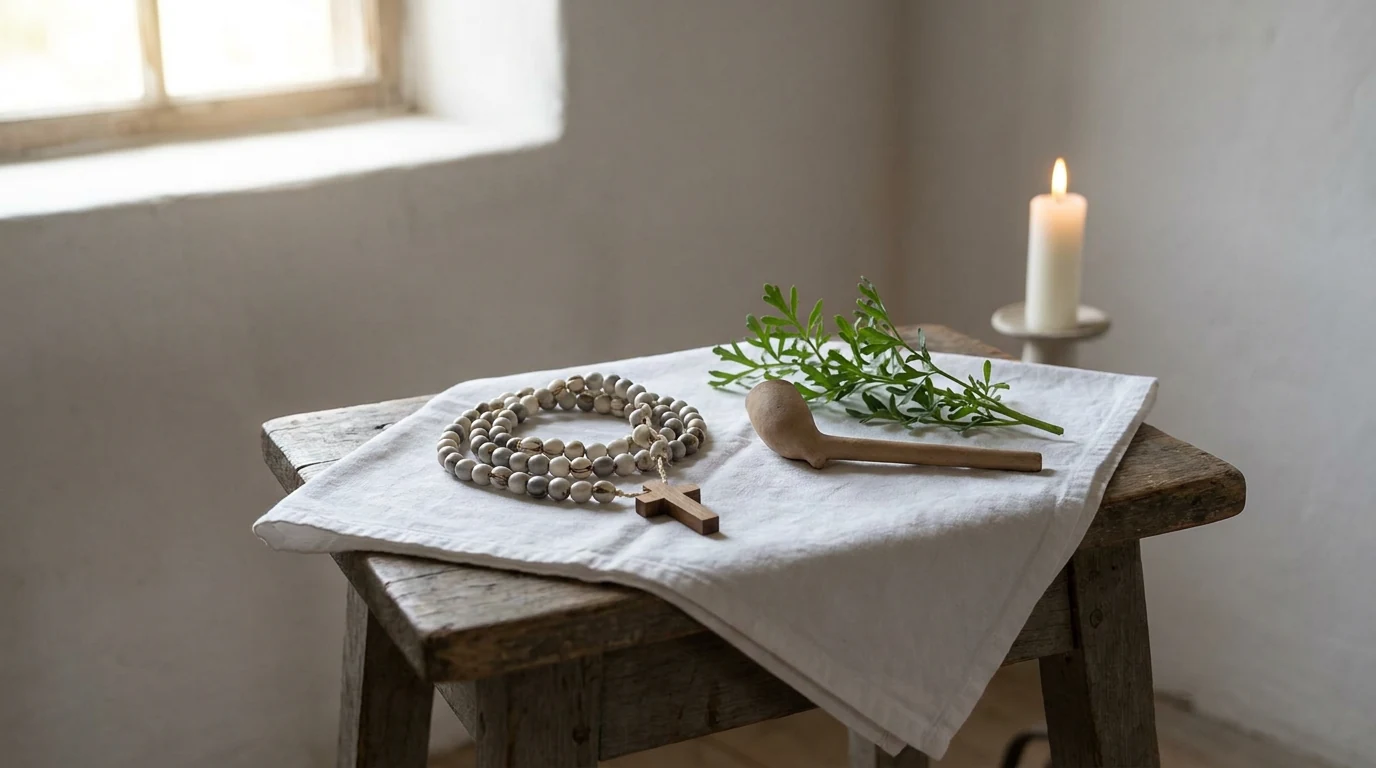
The preto velho ritual bead necklace can be used by whoever receives it from the spirit or from the house, even if they are not from Umbanda. The ritual work necklace is different: it belongs to the medium and only goes around the neck with authorization from the leader. In both cases, the piece is usually made of Job's tears seeds (lágrima-de-nossa-senhora) and becomes a ritual bead necklace after the house closes and crosses it.
Who can use the preto velho ritual bead necklace
Anyone who received the ritual bead necklace at the house can use it, whether they are a medium or a seeker. Researcher Patrícia Ricardo de Souza, in the thesis defended at USP, records that in Umbanda "it is not necessary for the person to be a follower of the religion to receive a ritual bead necklace". Casa do Vô Benedito, a terreiro in Campo Largo (PR), says the same in other words: any person can use a protection ritual bead necklace, but for the medium, it is an instrument of ritual work.
There are, therefore, two types of ritual bead necklaces with the same name.
- The protection ritual bead necklace of the seeker. The preto velho can give a ritual bead necklace or a rosary during the consultation. Historian Lívia Lima Rezende accompanied a consultation in which the seeker received from the incarnated medium "a rosary of tear beads" to pray. A medium says that these ritual bead necklaces are thinner and go under the clothes.
- The ritual work necklace of the medium. It appears as the medium develops, when the spirit itself asks for it. The house authorizes it beforehand: "request the proper authorization from the leader," advises Casa do Vô Benedito.
In any case, the bead necklace is personal. The USP thesis records that it cannot "even be touched by other people." Therefore, a preto velho bead necklace is not lent out. To find out which spirit you have an affinity with, the spirit test includes preto velho among the results. Who this spirit is, where they come from, and how they work is in pretos-velhos in umbanda, and what their names mean is in preto velho names.
What is the purpose of the preto velho bead necklace
The preto velho bead necklace (guia) serves to protect the wearer and to connect the person to the spirit. Casa do Vô Benedito summarizes it like this: the guias "are protection and connection with the Orixá or with the spiritual Entity".
Umbanda explains the protection with a physical image. Mãe Márcia de Iemanjá (Yemoja), a priestess heard in the USP thesis, says that "the bead necklace works as a protective shield for the medium's body." An umbanda course published by the Diário de Umbanda website compares the bead necklace to a lightning rod: the charge that would come to the medium discharges into the beads. It is a recorded belief of the religion, without a promise of results.
Lágrima-de-nossa-senhora, cross, and colors of the bead necklace (guia)
Most cited material: lágrima-de-nossa-senhora seed | Symbol that usually comes along: cross | Registered colors: white, black and white | Who firms: the house
The lágrima-de-nossa-senhora is the Coix lacryma-jobi, a grass native to Asia. The Herbário da Universidade do Estado do Pará records its other names, capim-rosário, capiá, and conta-de-lágrima, and the use of the seeds in rosaries and umbanda bead necklaces (guias). The Horto Didático da UFSC describes the fruit as hard and pearly, and the plant has spread across almost all of Brazil. Its entry on the site is that of capim-rosário.
For Rezende, "normally the rosaries and chaplets of pretos-velhos are made with this material". Umbanda houses confirm the request.
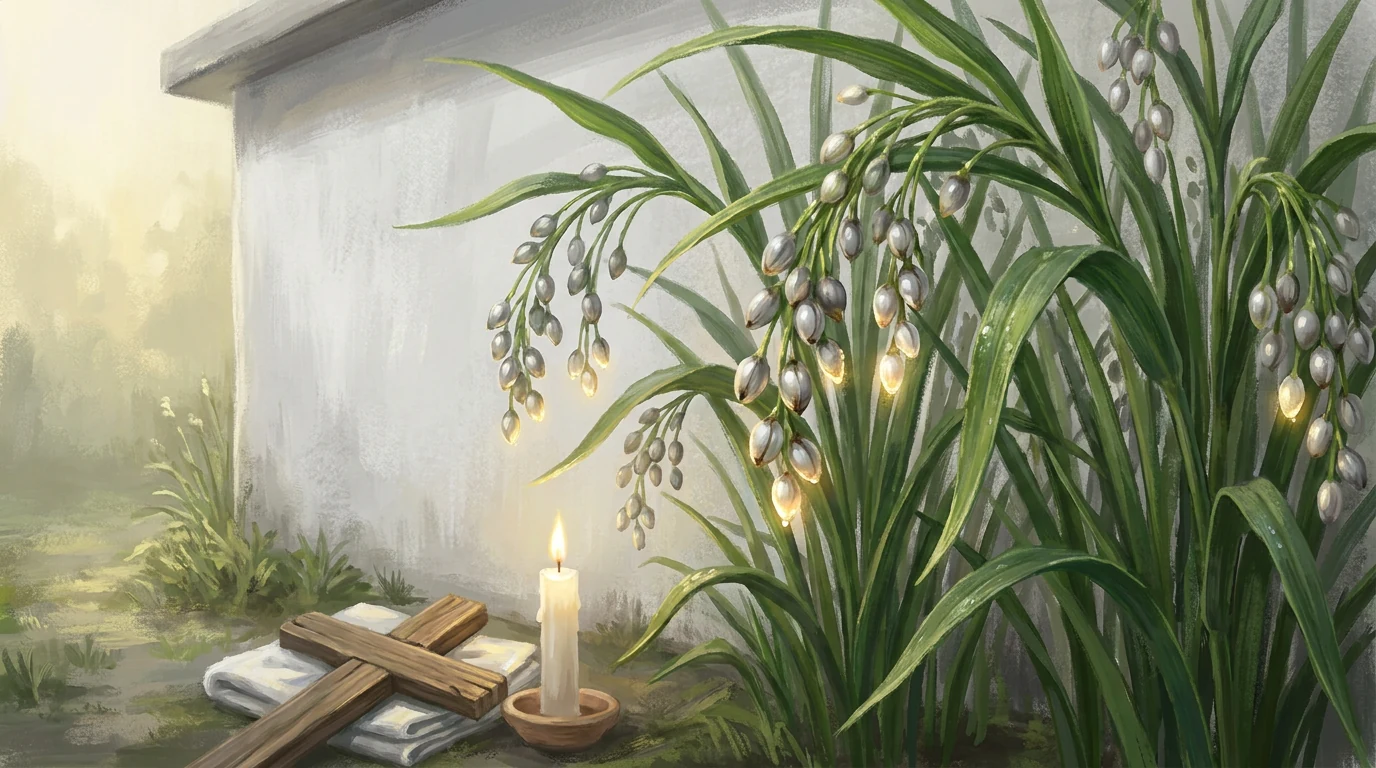
For this preference, there is a myth, which the UFJF thesis records: Our Lady supposedly appeared to a group of enslaved people and wept for them, and the tears sprouted in the form of the plant. In gratitude, they began to make their rosaries with the seeds. It is a report of tradition, not a historical fact. The name of the saint and the cross show the coexistence of Catholicism with African matrices in the figure of the preto velho. The researcher notes that the African elements remain there.
The cross appears in three different sources: in the Umbanda course, in a medium's blog, and in the book by anthropologist Raul Lody cited by the Revista Continente.
The color has no single rule.
- The Umbanda course on pretos-velhos records white or black and white ritual bead necklaces (guias).
- In Casa do Vô Benedito, white represents the line of the pretos-velhos.
- The USP thesis records, in Umbanda, black and white beads or yellow and black for Obaluaê, the orixá (orisha) to whom many houses link the line of the souls.
The house defines the color of your ritual bead necklace (guia). The tool which guia to use shows the colors of the orixá guias, such as that of Obaluaê, and has no result for preto velho. The colors of all lines are in the bead necklace guide in Umbanda.
How the bead necklace (guia) is consecrated in the house
Bought ready-made or assembled by the medium, the preto velho bead necklace (guia) is just a necklace until the house closes and crosses the piece. Without consecration, says the Umbanda course of the Sociedade Espiritualista Mata Virgem, it would be "just another necklace".
Each terreiro has its way:
- In one house, the head crosses the bead necklace with pemba or leaves the beads soaking in amaci for three days.
- At Vô Benedito's House, the medium strings the bead necklace (guia) without tying the knot and takes it to the terreiro. An authorized medium closes it, and the chief spirit crosses it.
- At Casa de Caridade Gauisa, the zeladora, the mãe pequena, or a spirit consecrates the bead necklaces (guias). The house allows the person to perform a ritual alone for a protection bead necklace.
“Every bead necklace (guia) must be closed and crossed by the chief of the terreiro, whether by the Mãe/Pai de Santo or by the Chief Spirit Guides of your terreiro.”
Umbanda Course from the Sociedade Espiritualista Mata Virgem
The crossing rite is not learned in an article. Whoever will use the guia asks the leader of their own house how it is secured there. The same logic appears in the guia de Ogum.
Care: sleeping, bathing, and cleaning
The rules for daily use vary from house to house. The Umbanda course instructs to remove the bead necklace to eat outside of the ritual, drink alcohol, go to the bathroom, and have sexual relations. An Umbanda practitioner writes the opposite for almost everything: you can eat, sleep, and bathe with it. The point where both sources agree is sex: the necklace comes off the neck.
In cleaning, the house also provides guidance.
- One house cleanses the bead necklace (guia) from time to time with seawater or rainwater and then energizes it with amaci, always with the advice of the leader.
- Another cleans the bead necklaces (guias) with smoke cleansing, herbal bath, or sacred waters.
When the preto velho bead necklace breaks
When the preto velho bead necklace (guia) breaks, look at the thread first. Casa de Caridade Gauisa instructs to check first if the break was physical: weak material, poorly tied knot, worn line. Then, speak with the leader. He advises remaking it with the same beads or making a new necklace, and the remade piece goes through the crossing again.
Umbanda understands that the bead necklace can break because it held a charge, as Mãe Márcia de Iemanjá describes: “sometimes the thread breaks in the middle of the ritual work”. The art historian Roberto Conduru studied the bead strands in the Studium magazine, from Unicamp. For him, the breaking can be “the beginning of a new cycle, a new start”.
Frequently asked questions
Can a crossed preto velho bead necklace be used?
It depends on the sense. Crossed on the chest, from one shoulder to the other side of the body, is the standard way in one house and forbidden in another, which leaves the bead necklace (guia) on the neck. Crossed in the sense of consecrated is what the house does for the bead necklace to be valid: without crossing, it is just a necklace.
What is the color of the preto velho bead necklace (guia)?
There is no single color. There are houses with a white bead necklace and others with black and white. The lágrima-de-nossa-senhora seed (Job's tears), pearly gray, is the most cited material.
Can a preto velho bead necklace be consecrated at home?
In the houses cited here, the one who closes and crosses is the terreiro. The Casa de Caridade Gauisa admits that the person can perform a ritual for the protection bead necklace (guia) alone, and this rite comes from the house, with its own way. Ask the leader before doing anything.
Where to buy a preto velho bead necklace (guia)
The bead necklace leaves the shop as raw material and becomes a consecrated guia in the rite of your house. At Joia Mística Laroyê you find:
- Preto velho bead necklaces (guias) of lágrima-de-nossa-senhora, ready for your house to close and cross
- Lágrima-de-nossa-senhora seeds individually, for the medium to assemble the bead necklace (guia) that the spirit requested
- Clay pipes for the preto velho gira
- White candles and black candles, taper and seven day
- Arruda and herbs for the ritual bath that the house indicates
Stop by the shop, at Rua Benedito Zingari, 460, Bela Vista, in Extrema-MG, or message on WhatsApp with delivery to all of Brazil.
References
- Lívia Lima Rezende: thesis on the pretos-velhos, UFJF, 2021
- Patrícia Ricardo de Souza: Axós and ilequês, doctoral thesis, USP, 2007
- Herbário Marlene Freitas da Silva, UEPA: Lágrimas de Nossa Senhora
- Horto Didático de Plantas Medicinais, UFSC: Lágrima de Nossa Senhora
- Roberto Conduru: Beleza por um fio, Studium, Unicamp, 2002
- Revista Continente: Fios e contas, símbolos de fé e proteção, 2013
- Sociedade Espiritualista Mata Virgem, on the Diário de Umbanda website: courses on fio de contas and pretos-velhos
- Douglas Rainho: Guias and bead necklaces (fios de conta) in Umbanda, 2015
- Casa do Vô Benedito: Guias
- Casa de Caridade Gauisa: Bead necklace (fio de contas) in Umbanda, 2022



