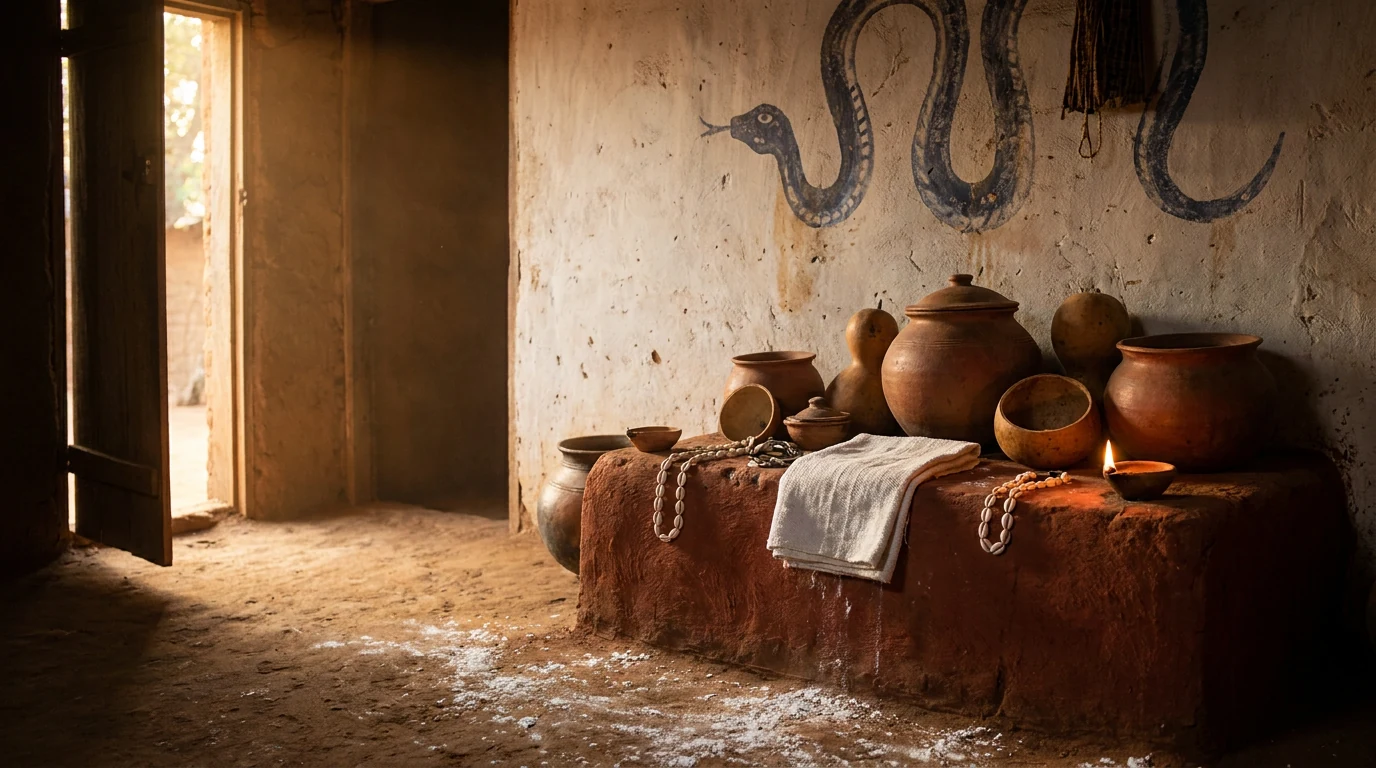
The voodoo doll exists, and the actual figure serves to protect. Among the Fon of Benin, it is called bocio, it is prescribed by priests and diviners and functions as a scarecrow: the evil that would come in the direction of the person attaches to the substitute figure, and the person remains protected. The pin-covered doll shown in cinema is something else, much newer, and comes from a place with a date and address.
What is the real voodoo doll for
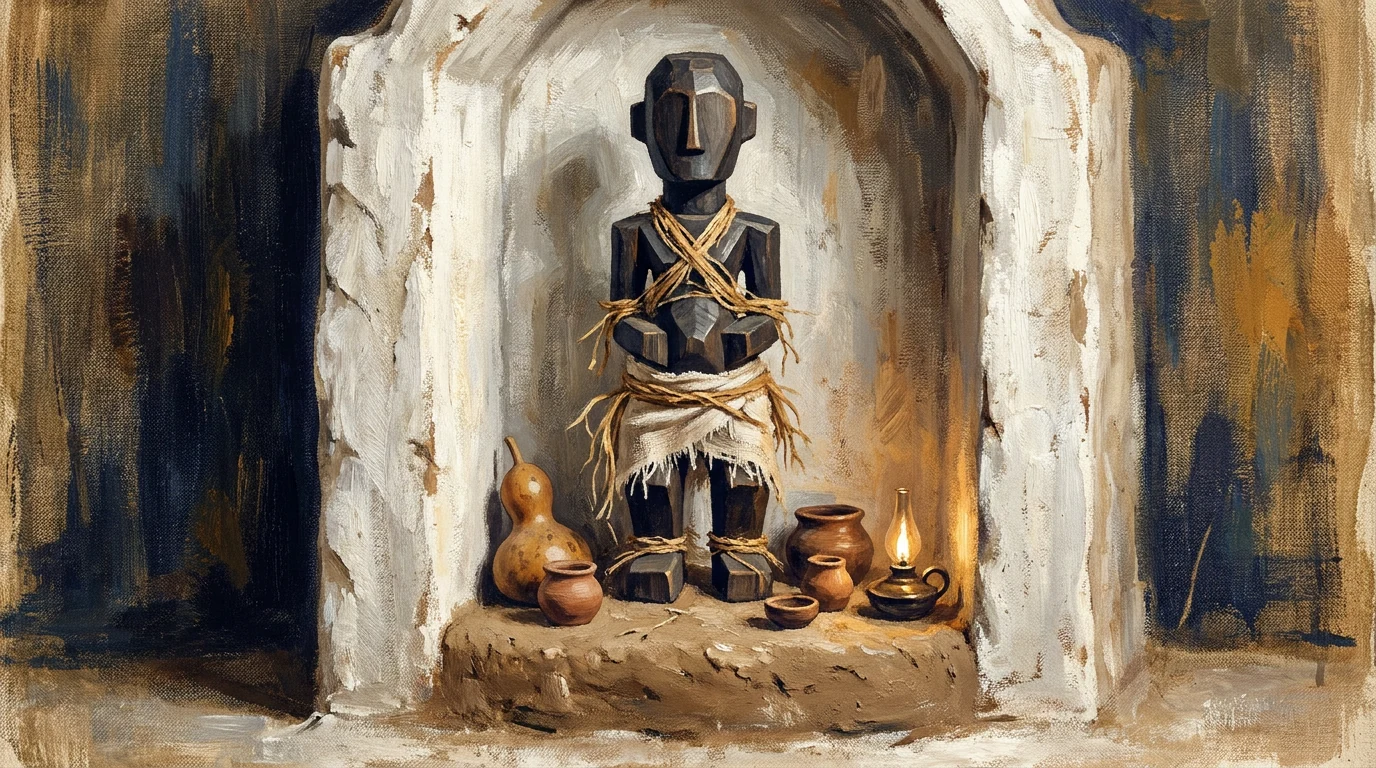
It serves to divert danger. The bocio is a figure carved by the Fon. The name means empowered corpse, in the reading of Suzanne Preston Blier, professor of African Art History at Harvard. Most are a preventive defensive mechanism, made to function as a decoy.
Before the object, it is worth knowing what Vodun is: an African-rooted religion born in ancient Dahomey, with priesthood, calendar, and initiation. The bocio is born within it, not on the margins.
The entry from the Michael C. Carlos Museum, at Emory University, is direct. The figure is a kind of decoy, made to trick death by substituting a real person, commissioned as a safeguard against misfortune. Whoever commissions it does not point the figure against anyone. It points against what comes.
The logic is the same as much of what the Brazilian terreiro knows: something stays in the place of the person and receives what was meant for them.
The cloth doll of the diaspora
The slave trade took Fon and Ewe to the Americas, and the object went along. The same Emory museum records that the dispersion created a Creole version of the bo in Haiti, and later among Haitians in the United States. There, cloth dolls fulfilled functions of protection and also of attack, linked to the dead and to cemeteries.
This is the point that almost every Portuguese text gets wrong. Saying that "no doll exists" is convenient and false. What exists is a family of ritual objects, made by people with fundamento, to protect the house and resolve affliction, within a religion that has a name, a people, and a country.
The object that became a cliché is another: the little cloth doll sold ready-made, with colored pins stuck in it, which no house of religion produced.
Where the pin came from
From the 20th century, and from a military occupation. The United States invaded Haiti in 1915 and stayed until 1934. Adam Michael McGee, in a thesis defended at Harvard, shows that this period was decisive in the formation of the American racial imaginary. It is from there that comes what he calls imagined voodoo, something distinct from Haitian Vodu.
His definition is useful: imagined voodoo is inspired from afar by real encounters with Afro-American religions, but it does not reproduce or represent any of them in a realistic way. It is a cultural product, and the pinned doll is its flagship.
The timeline is short and closes itself:
- 1915 to 1934: American military occupation of Haiti
- 1929: The Magic Island, by William Seabrook, imports the zombie to the American public
- 1932: White Zombie, the first zombie feature film, inspired by Seabrook's accounts
- 1934: Black Moon puts the voodoo doll on screen, what researchers treat as the classic representation of the cliché
Brazilian researchers record the same movement: during the domination of Haiti, voodoo returned to figure as an object of stereotype spread in the United States and in Europe by the press and especially by cinema. The history of the cult that was caricatured is in Haitian voodoo.
The pin that came from Europe
There is also a second origin, which usually stays out of the conversation. The pricked cloth dolls sold today are cataloged by a British museum as part of a centuries-old European tradition. There, the images were called poppets and were made of wax, clay, or cloth. Calling this a voodoo doll is a recent development.
And even in the European tradition, the most common use is not for a curse: the museum classifies its wax poppets in the category of herbs and healing. In other words, the object changed its name, changed continents, and gained a fame it did not have on either side.
The doll became a souvenir
Today, the pricked doll is a commodity. McGee describes the shops of the French Quarter, in New Orleans, where the business is selling trinkets to tourists, just a few blocks from the tomb of Marie Laveau. No tourist trap in the city is complete without a display of dolls. He calls the flood of objects and gestures that evoke voodoo in mass culture voodoo kitsch, and that is where the doll lives.
The scale of the joke measures how far the object has moved away from the religion: a French court even ruled that dolls of the then-president Nicolas Sarkozy should carry a label warning that pinning them could offend his dignity.
A note for those who arrived by another path: a large part of the search in Portuguese for voodoo doll is from video games. The official Terraria wiki in Portuguese has two items with this name, the Guide Voodoo Doll and the Clothier Voodoo Doll. They have no relation to religion.
Why this is also a problem for the Brazilian terreiro
Because the stereotype does not stand still in Haiti. The same Brazilian researchers observe that cinema has cultivated stereotypes that have fixed themselves in the collective imagination and affect Afro-Brazilian religions as a whole, and not just Haitian vodu.
It is the same mechanism that calls the assentamento a spell and that transforms Exu (Eshu) into the devil. Those who live through this recognize the pattern: the other's object of worship becomes proof of evil, and the scare sells more than the explanation. Therefore, the page of what is quimbanda needs to start by undoing the same confusion.
The Vodu page on the site gathers the rest of this story, and whoever wants to see where the voduns touch upon local practice can read about the voduns worshipped in Brazil.
Frequently asked questions
What is the purpose of the vodu doll?
In the tradition that produced it, it serves to protect. The bocio of the Fon works as a scarecrow and as a lure: what would come for the person attaches to the figure. Most are made as a preventive defense, commissioned from priests and diviners.
What is the vodu doll?
They are three different objects with the same nickname. The carved bocio from Benin; the cloth doll of the diaspora, documented in Haiti and among Haitians in the United States, linked to the dead; and the little doll pierced with pins, which is a product of mass culture of the 20th century.
Does the vodu doll really exist?
It exists, but not the way cinema shows it. The ritual figures exist and are ancient. What does not exist in the religion is the souvenir doll with colored pins, which was born in the American imagination during the occupation of Haiti.
Is the vodu doll from Candomblé or Umbanda?
It is from neither of the two. Bocio is Fon, from ancient Daomé, and in Brazil the heritage of this people is the Jeje nation of Candomblé, which worships voduns. Pin-studded dolls are not a matter of Brazilian terreiro, and the confusion comes from cinema.
References
- Michael C. Carlos Museum (Emory University): the record of the bocio power figure
- Harvard DASH: Imagined Voodoo, Adam Michael McGee's thesis on the cliché in American culture
- Belas Artes Magazine: Haitian Vodou and cultural demonization, by Araujo and Mathias
- Office of the Historian: the American occupation of Haiti, from 1915 to 1934
- Museum of the Moving Image: the racialized origins of the zumbi myth
- Museum of Witchcraft and Magic: the record of British poppets