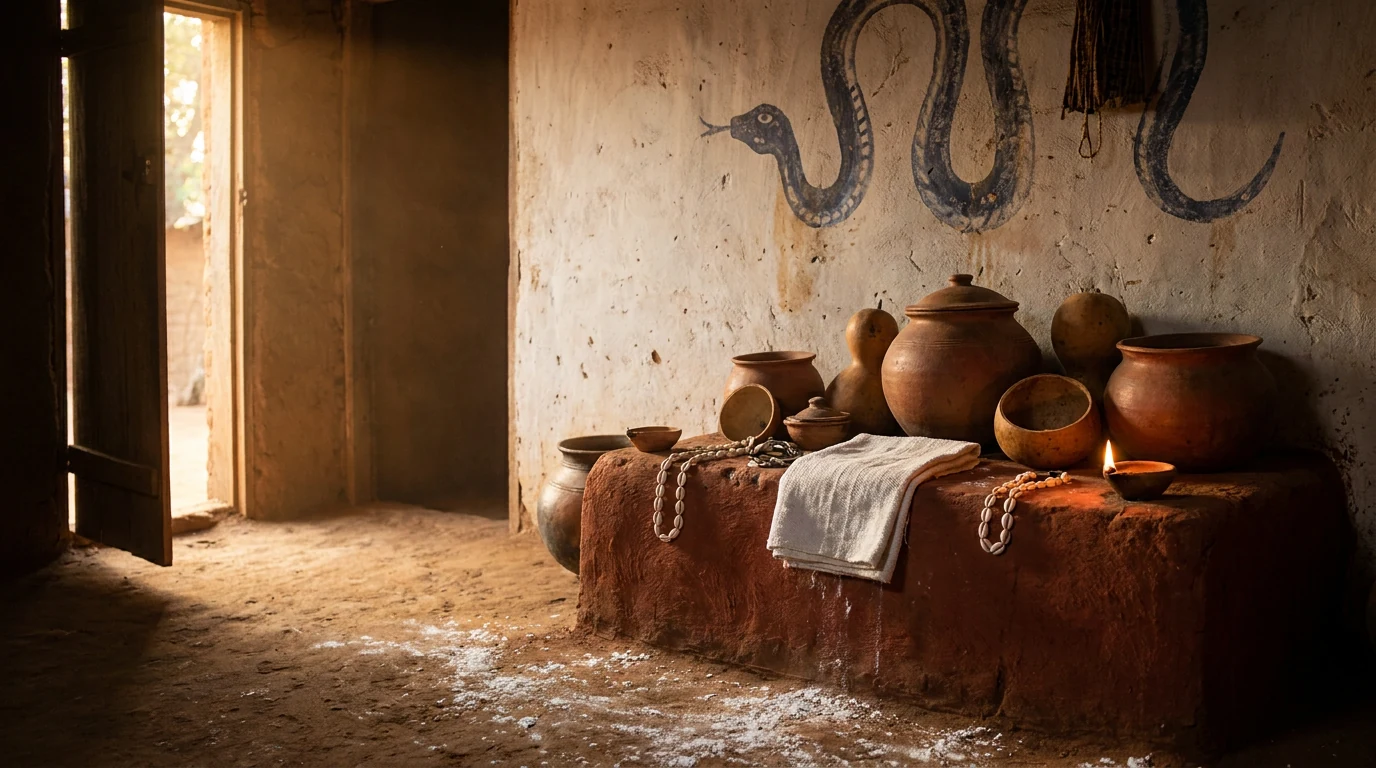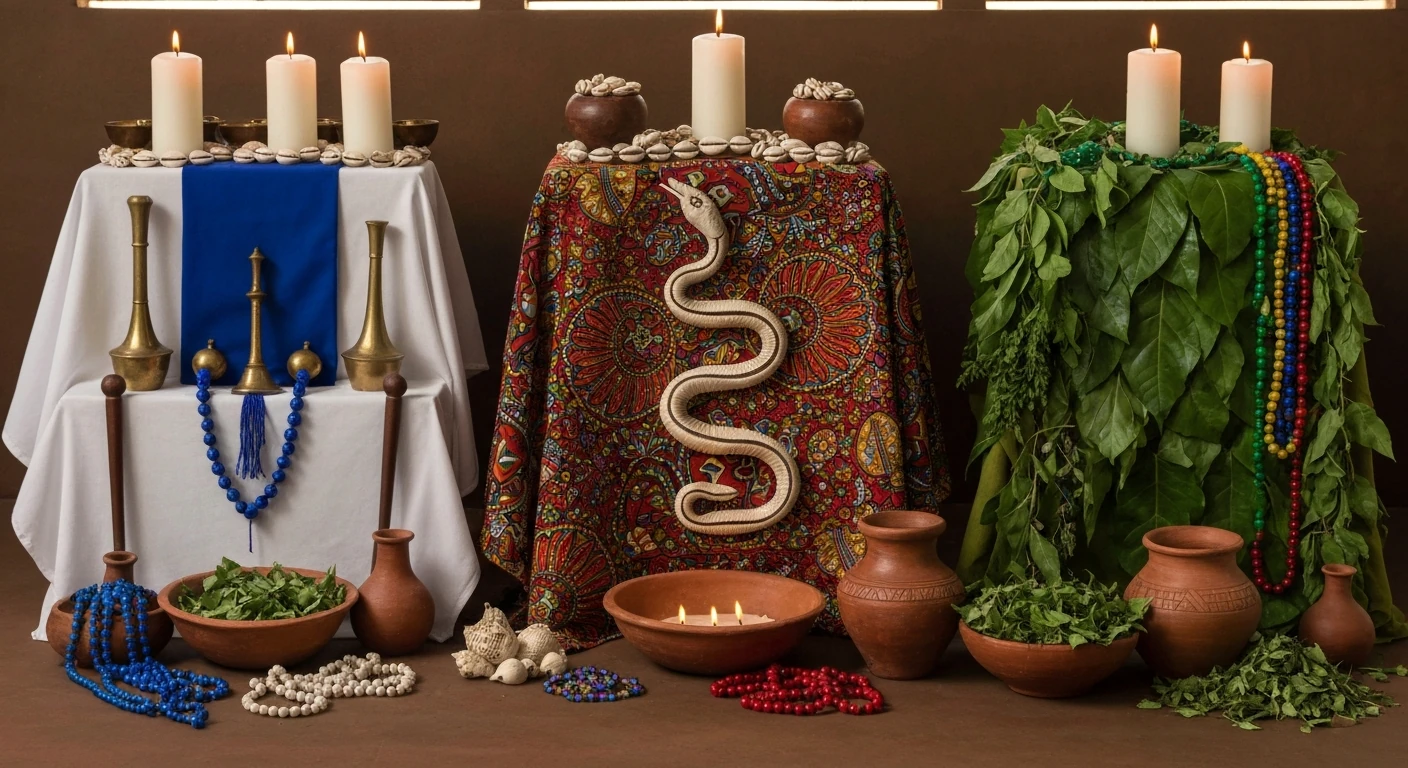
Haitian Vodou is the Afro-Caribbean religion that serves the lwa, the deities of the cult. It is a close relative of what is worshipped here: Haitian Vodou and Candomblé Jeje come from the same trunk, the old Slave Coast, where Benin is located today. Anyone from a house of the orixás (casa de santo) recognizes much of what happens inside, from the drum to the "horse" (medium) that receives them.
What is Haitian Vodou
It is a branch of the same religion that was born in the old Dahomey. The entire history, from Benin to Brazil, is in the article about what is Vodou.
The Vodou page on the site shows the other branches of this same tree. In Haiti, the supreme God is called Bondye and is above everything, distant from everyday things. Those who are served are the lwa, the deities who respond, protect, and demand. The architecture is the one the reader already knows: a distant creator, nearby intermediaries.
The lwa come from Ginen, which is Africa as a spiritual address. It is the same place that Umbanda calls Aruanda when speaking of the land of the elders.
The lwa and the nations
The lwa organize themselves into families, called nanchon. The two most well-known are Rada and Petwo, and they are not the only ones: the lists also include Nago, Kongo, Ibo, and Gède.
- Rada: the cool lwa, of healing and protection, considered reliable, with roots in Ginen. The name comes from Arada, a city in the old Dahomey
- Petwo: the hot lwa, demanding and of quick response. It was born in Haiti itself, within the conditions of slavery
Among the most remembered names is Papa Legba, guardian of the crossroads and of the doors between worlds. After him come Danbala Wèdo, the serpent, Ezili Freda, of love, Ezili Dantò, the protecting mother, Ogou, of iron and battle, Agwe, of the sea, and Bawon Samdi, of the cemetery.
Pay attention to a difference that confuses many people: in Brazil, nation is the house's matrix, ketu, jeje, or angola. In Haiti, nanchon is the family of the lwa, and the same house serves Rada and Petwo in the same calendar.
What the house of worship is like
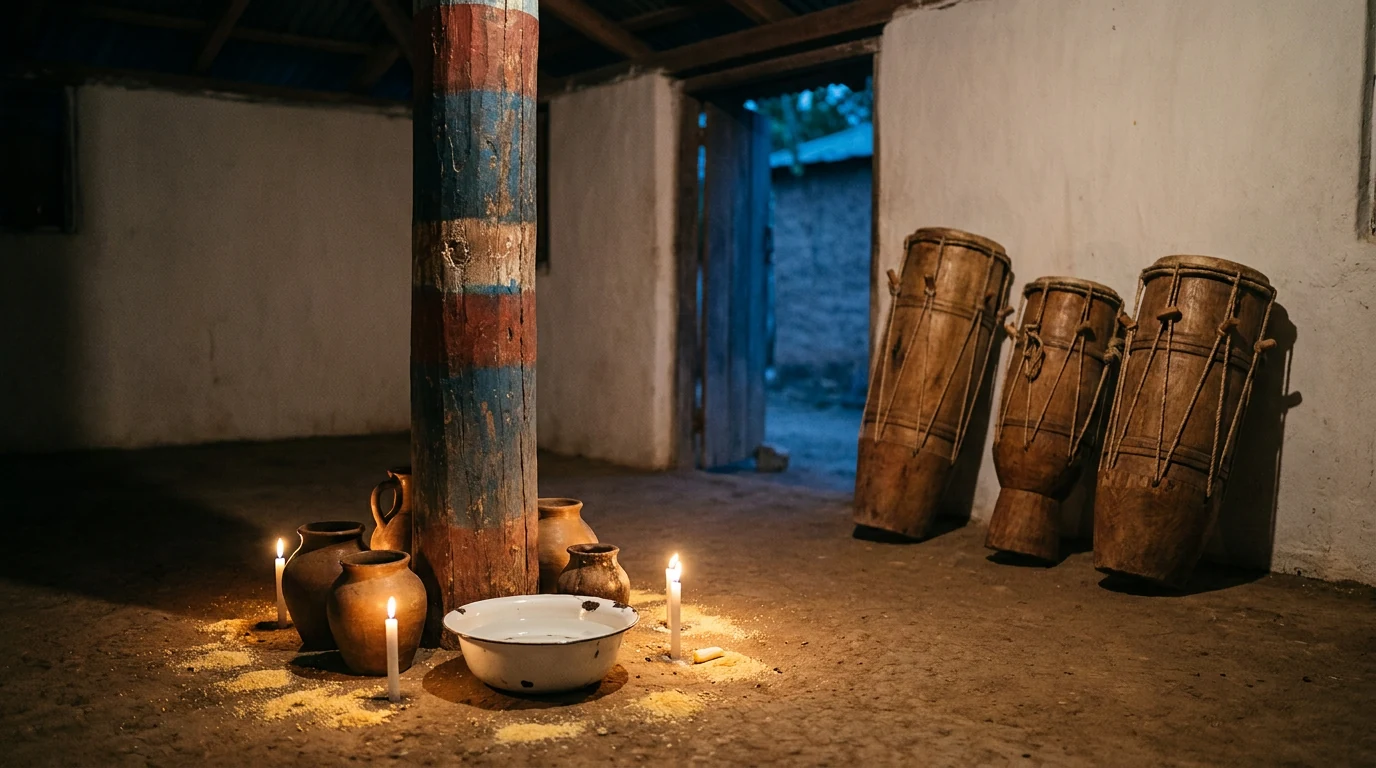
The temple is the ounfò (houmfò, in French spelling) and the hall where the ceremony takes place is the peristil. In the middle of the hall is the poto mitan, the central pillar, which is the axis through which the lwa descend to the world of the living.
The priest is the oungan (houngan) and the priestess is the manbo, with the same attributes and without gender restrictions in the hierarchy. The initiates are the ounsi, and the congregation of the house is the sosyete. There is no central hierarchy or single leader, and for this reason, the practice varies greatly from society to society. In Brazil, this is summarized in three words: it depends on the house.
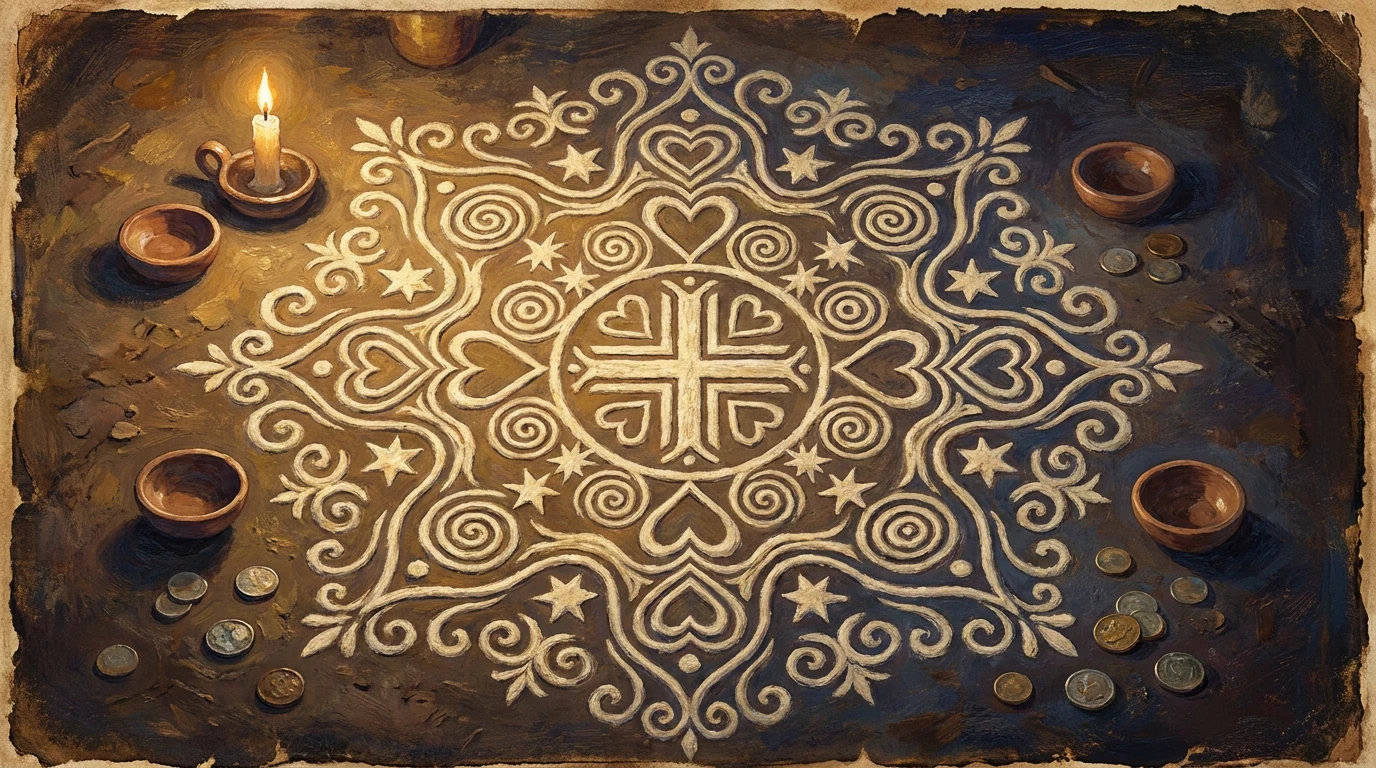
On the floor, the vèvè are traced, the ritual drawings of each lwa, always near the poto mitan. This practice came from Africa: in Daomé, dendê oil was used to trace geometric figures on the floor. Whoever draws ponto na umbanda is on this side of the same heritage, and whoever uses dendê knows where it comes from.
What resembles the Brazilian terreiro
The list is long, and that is why the subject interests those who are initiated in the religion (de santo). Whoever wants to review this side can find it in candomblé:
| In Haiti | In this terreiro |
|---|---|
| Distant Bondye and the lwa that respond | the creator and the orixás (orishas), voduns, or inquices |
| Ginen, the spiritual Africa from where the lwa come | Aruanda in Umbanda, the orum in Candomblé |
| The medium is the chwal, the "horse" of the lwa | the medium ("horse") of the orixá |
| Drum with its own rhythm for each family | the xirê and the rhythm (toque) of each orixá |
| Lwa festival on the day of the Catholic saint | the same calendar syncretism |
| Priestess with the same powers as the priest | ialorixá and babalorixá |
And there is what is not equal. Petwo was born in Haiti and has no direct correspondent in Candomblé. The Gede are the family of death, fertility, and laughter, with Bawon Samdi at the front. They are not pretos-velhos nor eguns, even if their festival begins on November 2, our All Souls' Day. Coincidence of date does not create identity of spirit. How the matrices separated over here is in Candomblé nations.
From a forbidden religion to a recognized religion
The revolt that opened the Haitian Revolution began on August 22, 1791. Haiti became the second independent country in the Americas, free in 1804. The Bois Caïman ceremony is remembered as the spark of this uprising. Historians diverge on it: some treat it as a national foundation myth, others as a real event. The oldest account comes from a settler who left the island in 1793.
Then came the United States military occupation, from 1915 to 1934. It is from this period that the cliché of the Vodou doll pierced with pins emerged, manufactured by the American press and cinema.
The legal turn is recent. The 1987 Constitution brought freedom of creed and took Vodou out of clandestinity. On April 4, 2003, a decree by President Jean-Bertrand Aristide recognized Vodou as a full religion, and from then on a marriage celebrated in the cult began to have the same registration as a Catholic one.
Haitian Vodou in Brazil
There are many Haitians here. Between 2010 and 2016, Brazil became the sixth destination of the Haitian diaspora, with 94,000 people, and in 2025 there were 51,200 Haitians with formal employment in the country, according to the 12th Annual Report of OBMigra.
Public worship, however, is not what the research finds. A field study with Haitians in Cambé, in Paraná, conducted between 2018 and 2022, shows something else. There, Vodou is taboo and is silenced by the immigrants themselves as a strategy for acceptance. The silence is not a lack of faith, it is defense.
The same happens with the official number. In the national Haitian survey EMMUS VI, only 1% of women and 3% of men declared themselves practitioners. The researcher himself says that this does not reflect the reality of the country. Those who follow the Brazilian census and the real size of Candomblé recognize the pattern.
Frequently asked questions
What is Haitian Vodou?
It is the Afro-Haitian religion that serves the lwa, deities organized in families called nanchon. It comes from the same trunk as Candomblé Jeje, the old Slave Coast. It has its own house of worship, priesthood, initiation, and calendar.
Vodu or voodoo: which is correct?
In Portuguese, the religion is written as vodu. The form with two "o"s stuck to cinema and tourism clichés, and it is not how the religion names itself. When a text writes voodoo talking about a staked doll, it is talking about the stereotype, not the worship.
Is Haitian Vodou similar to Candomblé?
In many ways. Bondye and the lwa resemble the architecture of the orixás. The medium is called a "cavalo", the drum has a toque by family, and the festivals fall on a saint's day. But nation there means a family of lwa, not a house matrix, and the Petwo rite was born in Haiti.
Is there Haitian Vodou in Brazil?
There are people, and little visible worship. Field research with Haitian immigrants in Paraná found Vodou as a silenced subject, avoided as a strategy for acceptance. There is no record, in the open bibliography, of organized Haitian houses of worship in the country.
References
- Interações (PUC Minas): Haitian Vodou and Candomblé Jeje, the same origin on the Slave Coast
- eScholarship (University of California): glossary of the lwa, the Rada and Petwo nations, and the worship vocabulary
- Lehigh University: the historiography on the Bois Caïman ceremony
- Haïti-Référence: the text of the arrêté of April 4, 2003
- The Globe and Mail: the decree that made Vodou a religion in Haiti
- Relegens Thréskeia (UFPR): Vodou as a silenced subject among Haitian immigrants in Brazil
- Agência Brasil: the numbers of Haitians in the Brazilian labor market, by OBMigra
- The Haitian Times: the Fèt Gede, the festival of the lwa of death, on November 2