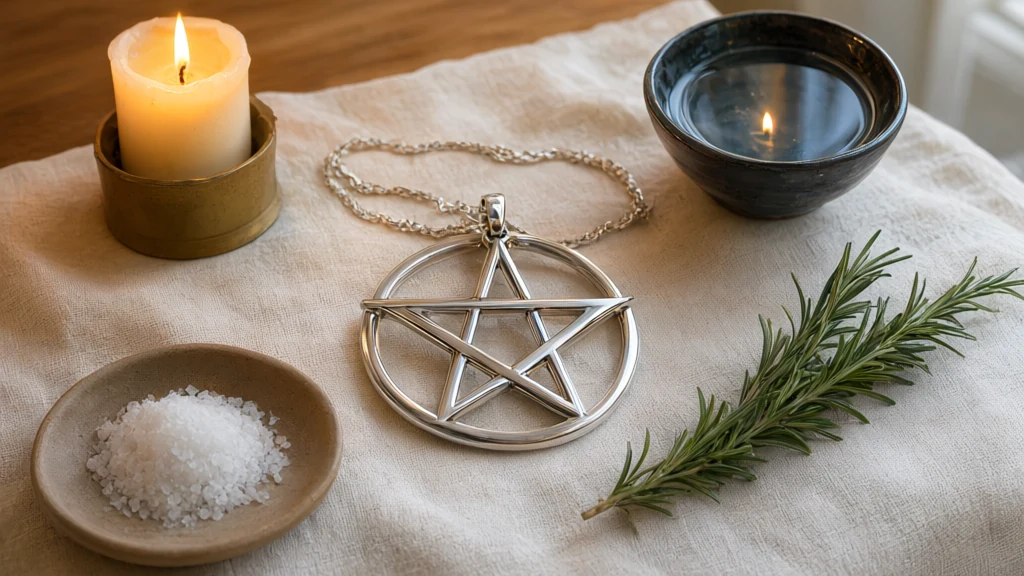
The pentagram is the five-pointed star drawn in a continuous line, without lifting the hand from the paper. The meaning of the pentagram in magic is protection and balance. The top point is the spirit, and the other four are the elements. With the point facing up, it has been an amulet for centuries.
What does the pentagram mean?
The pentagram means order: the spirit above matter, guarding whoever uses it. The word comes from Greek and means "five lines." The Priberam dictionary records two meanings. One is the five-line music staff. The other is the five-pointed star traced in a single line.
Points: five | Tracing: one continuous line | With circle: pentacle | Top point: spirit | Most common use: protection
The sense of protection spans the history of the symbol. The Pythagoreans called the star "Health", according to the Greek writer Luciano. In the 19th century, the French occultist Éliphas Lévi saw the human body in it. The head stays at the top point, and the four limbs on the others. Meanwhile, the line that does not break became the endless knot in an English poem from the 14th century.
What does each point represent?
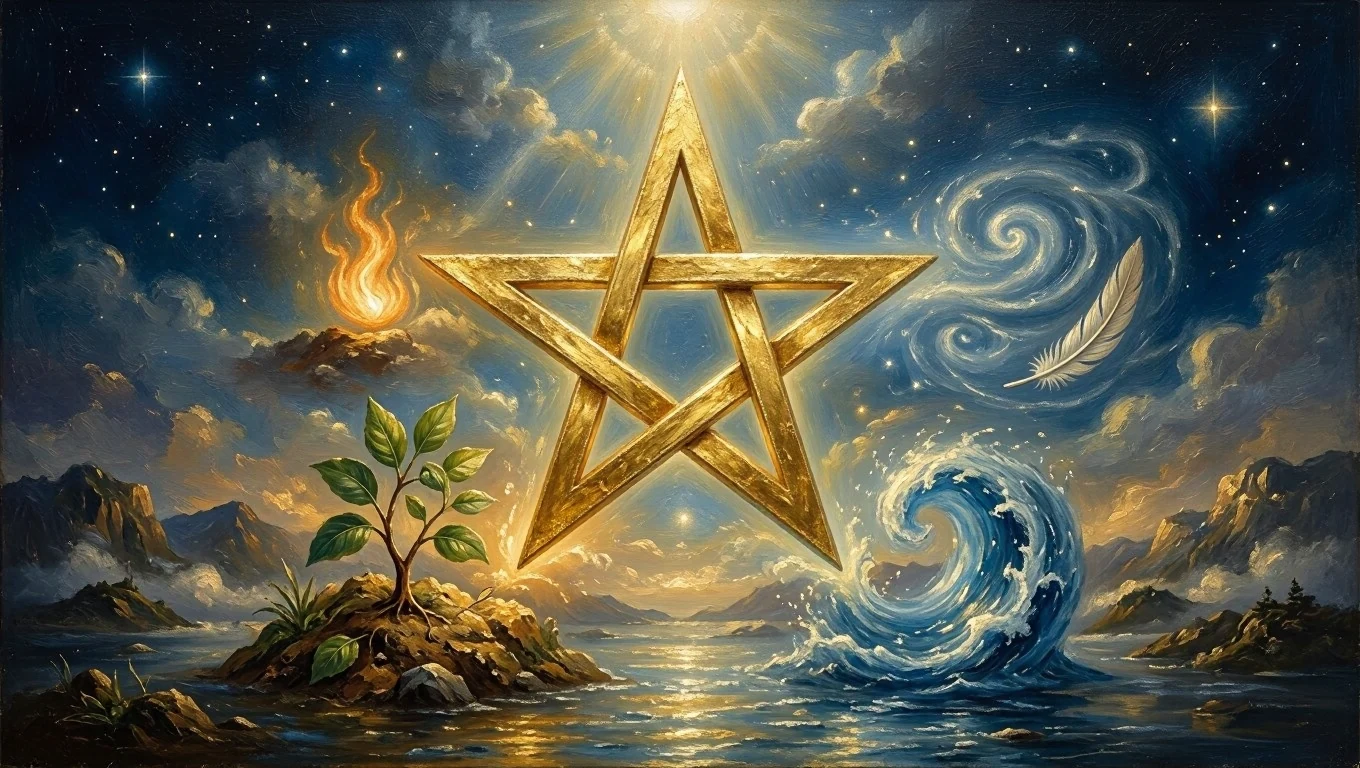
Each point of the pentagram represents one of the five principles of magic: the four elements (earth, water, fire, and air) and the spirit, which stays at the top point. Lévi describes the pentagram with the point facing up as the symbol of human intelligence. It is the head governing the body.
In the Renaissance, the German Agrippa linked the five points to the elements of ancient philosophy. In 1533, he wrote that the star has "great command" against evil spirits. The force would come from the number five.
In practice: the exact order of which element goes on which point changes from school to school. What everyone agrees on is the spirit at the top. If your group or your mistress teaches an order, follow your house.
Pentagram and pentacle: what is the difference?
A pentagram is a five-pointed star. A pentacle is the star inside a circle, or the disc with the star engraved. The dictionary treats both words as synonyms. In modern witchcraft, the difference matters.
In Wicca, the pentacle is one of the four altar instruments, alongside the athame, the wand, and the chalice. It is the "disc with magical signs, generally the five-pointed star," according to the thesis of Janluis Duarte, from UnB. Each instrument rules an element. The pentacle is earth and stays in the north of the altar.
The pentacle is so recognized that the government of the United States accepts it as an emblem of belief on military headstones, with the name "Wicca (Pentacle)". In tarot, the suit of Pentacles is also called Pentacles and speaks of the material world; it appears in the minor arcana of the tarot.
What does the inverted pentagram mean?
The inverted pentagram, with one point down, means inversion of order: matter above spirit. This reading was born in French occultism of the 19th century. Eliphas Levi saw in the upside-down figure the disorder and the loss of judgment.
In ancient sources, the position of the star did not matter. The Pythagoreans, the shield of the knight Gawain, and Agrippa speak of the star without a right or wrong side. It was only in the mid-19th century that occultists began to separate the two positions.
In the card of the Devil in the tarot, the inverted pentagram appears precisely as matter above spirit, attachment. For the white witch, the rule is simple: a protection amulet is used with the point facing up.
Which religions use the pentagram?
The pentagram was used by various traditions, each with its own meaning:
- Pythagoreans (Ancient Greece): the star was the sign of the school and was called "Health".
- Ancient Judaism: in the synagogue of Capernaum, from the 2nd or 3rd centuries, the pentagram appears side by side with the hexagram, and the two names were even swapped.
- Medieval Christianity: in the poem Sir Gawain and the Green Knight, the gold star on the knight's shield is the sign of Solomon. It recalls the five wounds of Christ and the five joys of Mary.
- Renaissance Magic: Agrippa draws the human body inside the pentagon.
- Wicca: modern witchcraft founded by the Briton Gerald Gardner, with books from 1954 and 1959, made the pentacle an instrument of the altar.
In Brazil, the UnB thesis states that esoteric shops began to sell pentagrams, athames, and cauldrons alongside incense. Today the symbol is in necklaces, rings, and altars of those who follow white magic.
How to use the pentagram as protection
The most well known use of protection is at the door. Lévi tells that the ancient magicians traced the sign on the house threshold. Thus evil did not enter and good did not leave. In modern witchcraft, the pentacle also goes on the neck, as a necklace.
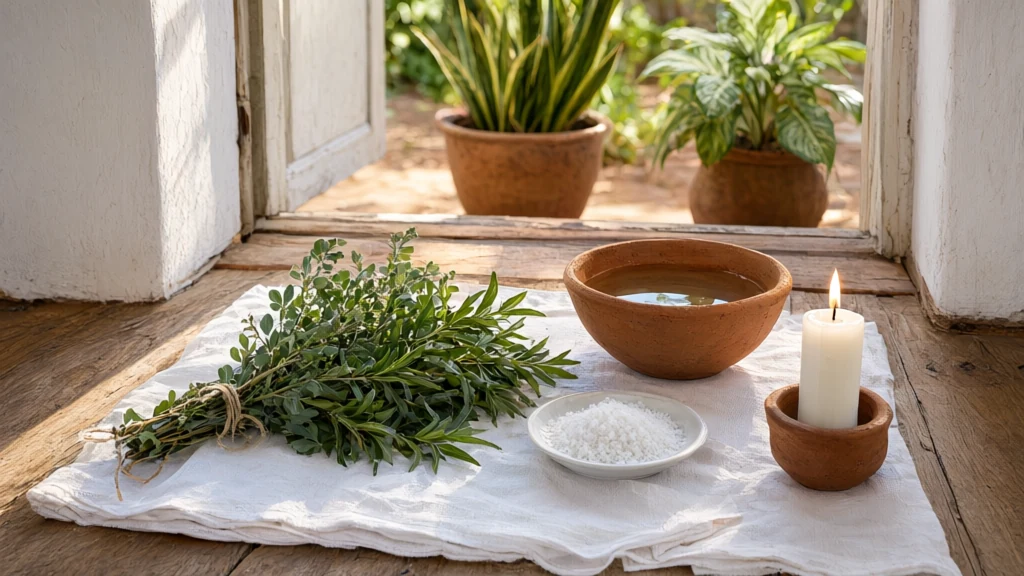
A simple consecration, inspired by what Lévi describes (the pentagram "consecrated with the four elements"):
- Clean the necklace or the drawing with water and a pinch of salt.
- Pass the piece through the smoke of an incense or a defumação, which is the air.
- Pass it over the flame of a white candle, which is the fire.
- Touch it to the soil of a pot or on a saucer of coarse salt, which is the earth.
- Hold it with the tip facing up and say your intention of protection in a low voice.
White witch's intention: "May this star guard my house and my path. May only what is good enter and may the good never leave."
The amulet does not replace other precautions for the house. Against envy and a heavy gaze, the pentagram works well with what the mau-olhado article teaches. At the shop in Extrema (MG), Joice, tarot reader and white witch, helps choose and consecrate the amulet; you can chat via WhatsApp.
The five-pointed star in Umbanda and Candomblé
In Umbanda, the star appears in pontos riscados of various spirits. In a study on more than 300 points of Exu (Eshu), historian Lourival Andrade Júnior reads the star as a "sign of evolution and wisdom". This star is a spirit's signature and is not the Wiccan pentagram; the subject is in the ponto riscado na umbanda article.
In Baiano Candomblé, a crown of Oxum (Oshun) kept in the Duke University collection features a five-pointed star because five is the number of Oxum. The imagem de Oxum shows other symbols of the orixá (orisha). These are the specific meanings of each religion, and not the same star with swapped readings.
Frequently asked questions
What is the difference between the Star of David and the pentagram?
The Star of David has six points: it is the hexagram, formed by two equal triangles superimposed in opposite directions. The pentagram has five points and is drawn in a single line. In Antiquity, the two went together, as in the synagogue of Capernaum, and the name "Seal of Solomon" came to apply to both.
Is using a pentagram evil?
No. With the point facing up, the pentagram was a sign of health for the Greeks, a Christian symbol on a knight's shield, and a protection amulet in magic. The negative fame comes only from the reading of the inverted one, created in the 19th century. For natural witchcraft, it is a symbol of balance.
Can I wear a pentagram necklace without being a witch?
You can. The pentagram does not belong to just one religion, and many people use it as a protection amulet or for taste. Those who follow magic usually consecrate the piece with the four elements before the first use. The care is to use the point facing up, which is the reading of protection.
How many points does a star have?
It depends on the symbol. The five-pointed star is the pentagram, the six-pointed one is the hexagram or Star of David, and the seven-pointed one appears in other traditions. In magic, the five-pointed one is the most used, because it represents the four elements and the spirit.
References
- Priberam Dictionary: entry "pentagram"
- Perseus, Tufts University: Luciano, on the Pythagoreans and "Health"
- Project Gutenberg: Sir Gawayne and the Green Knight, edition by Richard Morris
- Esoteric Archives: Agrippa, De occulta philosophia, book II, chap. 23
- Internet Archive: Éliphas Lévi, Transcendental Magic, translation by A. E. Waite
- UnB: Janluis Duarte, thesis on neopagan witchcraft in Brazil, 2013
- Jewish Virtual Library: Encyclopaedia Judaica, "Magen David"
- U.S. Department of Veterans Affairs: Available Emblems of Belief
- Mouseion: Lourival Andrade Júnior, drawn points and nominations, 2015
- Duke University: Crown of the goddess Oxum