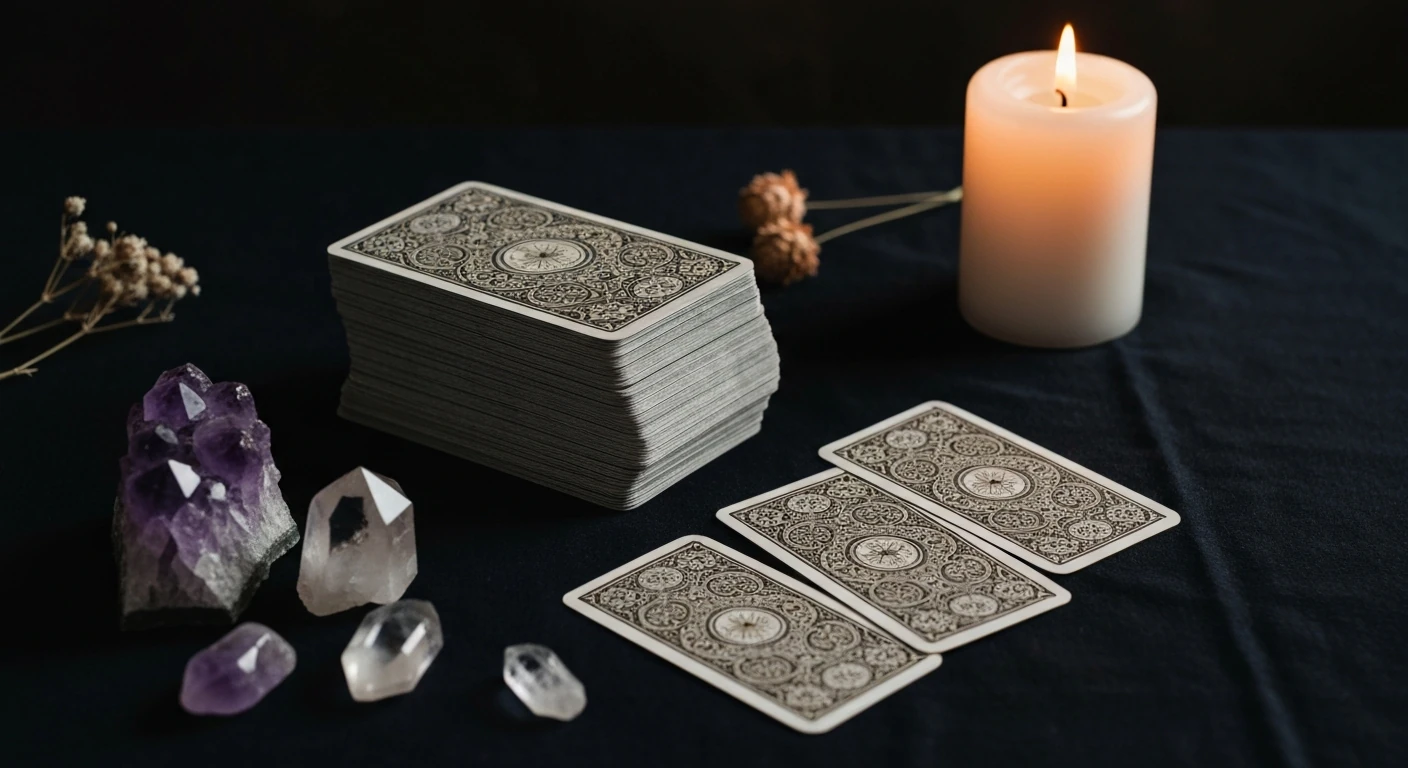
The minor arcana of the tarot are the 56 cards that speak of daily life: work, money, loves, fights, and the small decisions that fill life. If the 22 major arcana deal with great themes, the minor ones show how these themes unfold on the ground of everyday life.
This guide explains what the minor arcana are, the four suits and their elements, the progression of the numbered cards from Ace to Ten, the role of the court cards, and how all this changes a reading. It is the natural pair to our guide of the major arcana.
What are the minor arcana
A complete tarot deck has 78 cards, divided into two groups. The 22 major arcana carry the great lessons and forces of life. The 56 minor arcana take care of the rest: the practical situations, the emotions of the moment, how things happen.
Think of it this way: if the major arcana is the chapter title, the minor ones are the paragraphs that tell the story in detail. For a long time, they were seen as "secondary" cards, but those who study tarot seriously know that they are the ones who give texture and reality to a spread.
The minor arcana are organized into four suits, and each suit has 14 cards: ten numbered (from Ace to Ten) and four court cards. Four times fourteen gives 56.
The four suits and their elements
Each suit is linked to one of the four classic elements and an area of life. Understanding this logic is the shortcut to reading the minor arcana without memorizing disconnected meanings.
| Suit | Element | Speaks about |
|---|---|---|
| Wands (or Batons) | Fire | Action, creativity, initiative, work, and passion |
| Cups | Water | Emotions, love, relationships and intuition |
| Swords | Air | Thought, truth, conflicts and decisions |
| Pentacles (or Coins) | Earth | Money, body, matter and prosperity |
The names change from deck to deck. Wands appears as Batons or Staves; Pentacles appears as Coins or Discs. It is the same card in a different outfit. In the Rider-Waite tarot, the most used in the world, these are the four illustrated suits that consecrated the deck.
A simple way to feel the suits: Wands is what moves you, Cups is what touches you, Swords is what makes you think and Pentacles is what sustains you. When one suit dominates a reading, it shows in which area life is asking for attention.
The numbered cards: from Ace to Ten
Within each suit, the ten numbered cards tell a small journey, from the beginning to the conclusion. The number says at what point of the process the energy of that suit is found.
- Ace: the seed, the pure potential, the beginning of everything in that suit.
- Two to Four: the first choices, the foundations and the first stabilities.
- Five: almost always the card of challenge, loss or conflict. The point of tension of the suit.
- Six to Eight: the recovery, the movement, the effort and the maturation.
- Nine: the near-conclusion, with its charge (the loneliness of the Nine of Swords, the abundance of the Nine of Pentacles).
- Ten: the fullness, the end of a cycle of that suit, for good or for weight.
Thus, the Ace of Cups speaks of a love that is born, while the Ten of Cups speaks of a full and realized love. The same number, in different suits, changes the subject but maintains the same stage. This is why studying the minors by numbers saves a lot of memorization.
The court cards
The four court cards of each suit are the most confused by those who are starting. They can represent people, attitudes or stages of maturation within that element:
- Page (or Jack): the apprentice. Brings news, beginnings, and the curiosity of someone discovering the suit.
- Knight: the movement. Acts, advances, sometimes with too much impulse. It is energy in action.
- Queen: the inner mastery. Lives the suit from within, with maturity and sensitivity.
- King: the outer mastery. Represents authority, direction, and the suit already consolidated in the world.
In a reading, a court card can be someone involved in the issue, or it can describe the posture that the seeker themselves is taking. The context and the neighboring cards say which of the two. They function as a bridge between the daily life of the minors and the greater forces of the deck.
How the minors change the reading
In a spread, the major and minor arcanas work together, and each has a role. The major points out the central theme, the underlying lesson. The minors show the how: in what area of life that appears and in what way it unfolds.
Imagine The Tower (major arcana) appearing next to the Five of Pentacles (minor). The Tower announces a rupture; the Five of Pentacles says it touches finances, or brings a sense of lack. Without the minor, you would only have the shock of the theme; with it, you gain the concrete address of the issue.
That is why many people start by studying only the 22 majors and, later, add the minors by suit. It is the path we also suggest in the guide to the major arcana. To practice in short readings, the yes or no reading is a good initial exercise.
How to study the minor arcana
There is no mandatory gift for reading tarot. It is study, observation, and practice. Some tips to master the minors:
- Learn through the elements. First, fix what each suit means; half the work is already done.
- Follow the journey of the numbers. Ace begins, Five challenges, Ten concludes. This arc applies to all four suits.
- Use an illustrated deck. The Rider-Waite depicts scenes in all the cards, which helps the intuition of those who are starting.
- Read by the set. The same card changes according to the position, the neighbors, and the question asked.
- Reversed cards are optional. Not every reader uses them; when they do, they usually indicate blocked energy or excess.
And it is always worth remembering: tarot is a mirror, a tool for reflection and self-knowledge. It illuminates tendencies and feelings, but the one who decides the path is you. To know a reading of Afro-Brazilian roots, also see the tarot of the orixás.
Frequently asked questions
What are the minor arcana of tarot?
They are the 56 cards of the tarot that deal with daily life: emotions, work, money, relationships, and practical situations. They complement the 22 major arcana, which deal with the great themes of life. Together, majors and minors form the 78 cards of the complete deck.
How many minor arcana are there?
There are 56 minor arcana, divided into four suits of 14 cards each. In each suit, there are ten numbered cards, from Ace to Ten, and four court cards: Page, Knight, Queen, and King. Four suits times fourteen cards result in 56.
What are the four suits of the tarot and what do they mean?
They are Wands (fire: action and creativity), Cups (water: emotions and love), Swords (air: thought and conflicts), and Pentacles (earth: money and matter). Each suit is linked to a classic element and an area of life, which provides the key to interpreting the cards.
What are the court cards in the tarot?
They are the four figures of each suit: Page, Knight, Queen, and King. They can indicate people involved in the matter, the attitudes of the seeker, or stages of maturation within the element of the suit. The context of the reading reveals which of these meanings is at play.
What is the difference between major and minor arcana?
The 22 major arcana deal with the great lessons and forces of life, the profound themes. The 56 minor arcana deal with daily life, emotions, and practical situations, divided into four suits. In a reading, the major shows the central theme and the minor shows how it unfolds.
Where to find your tarot deck
At Joia Mística Laroyê, you find everything to start or deepen your studies:
- Tarot decks: Rider-Waite and other models, ideal for learning the suits
- Reading cloths: to cover the table and set concentration
- Crystals and candles: to harmonize the environment of the reading
- Tarot books and guides: support for studying card by card
Visit our shop in Extrema, Minas Gerais or talk to us via WhatsApp and we ship all over Brazil.
References
- Wikipedia: entry on Tarot, its structure and history
- Wikipedia: entry on the minor arcana of the tarot