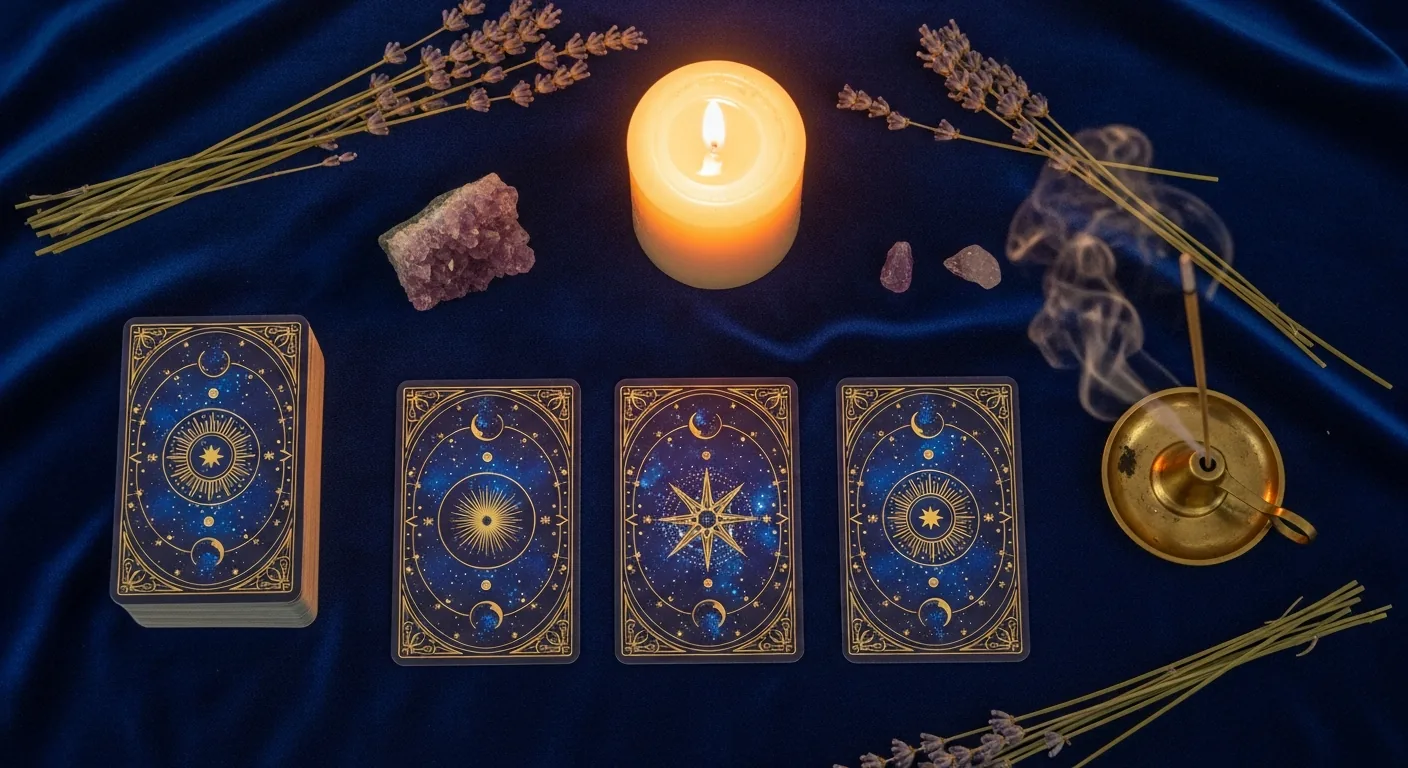
Tarot is a deck of 78 cards, 22 Major Arcana and 56 minor cards, which was born as a card game in Italy around 1430. Today it is used for symbolic reading: you ask a question, shuffle, draw the cards and read each one by the position in which it fell.
"To play tarot" is a literal expression. Before being an oracle, tarot was a trick-taking game of the Italian court, and this game is still played in Europe. Its use for divination only appeared in the 18th century. Knowing this changes the way the cards are read: they are images with a long history, not a secret code from another world.
What is tarot?
Tarot is a set of illustrated cards in which each card has an assigned meaning, and the reading arises from their combination in a question. For those who use it, it is a system of images: The Fool, Death, The Star, the Ten of Cups. Each figure carries a theme of life, such as beginning, loss, hope, or joy in the family.
Jungian analytical psychology reads these images as archetypal symbols, figures that appear in myths of many cultures and that the person recognizes without needing an explanation. The authors themselves who defend this use warn that it requires care, so that the consultation does not turn into just a game of divination. Jung, moreover, did not dedicate himself to studying tarot.
European tarot is also not the tarot of the orixás, which is another oracle, with its own symbology, nor the cigano deck, which has other cards and another way of reading.
How many cards does tarot have?
Tarot has 78 cards: 22 Major Arcana and 56 Minor Arcana. The minor ones are divided into four suits of 14 cards each, with ten numbered cards and four figures: Page, Knight, Queen, and King.
| Group | Cards | What is shown in the reading |
|---|---|---|
| Major Arcana | 22, from The Fool to The World | the great themes and turning points of life |
| Numbered Minor Arcana | 40, from Ace to Ten in the four suits | everyday situations |
| Court cards | 16, Page, Knight, Queen and King of each suit | people and attitudes involved in the matter |
The suits in Portuguese are Cups, Swords, Wands and Pentacles. The card by card meaning is on the pages of the 78 tarot cards and in the guides of the Major Arcana and the Minor Arcana.
Tip for beginners: you can learn just with the 22 Major Arcana and add the minor ones later. Many readers do it this way, because 22 images are memorized faster than 78.
From court game to oracle: the origin of tarot
Tarot was invented in Italy in the 1430s. Someone added to the common deck of four suits a fifth group of 21 illustrated cards, the trionfi ("triumphs"), and a single card, il matto, The Fool. By the end of the 15th century, these cards were already called tarocchi, a word that gave rise to "tarot". The researcher Michael Dummett reached the same date, around 1430, in the book The Game of Tarot, from 1980.
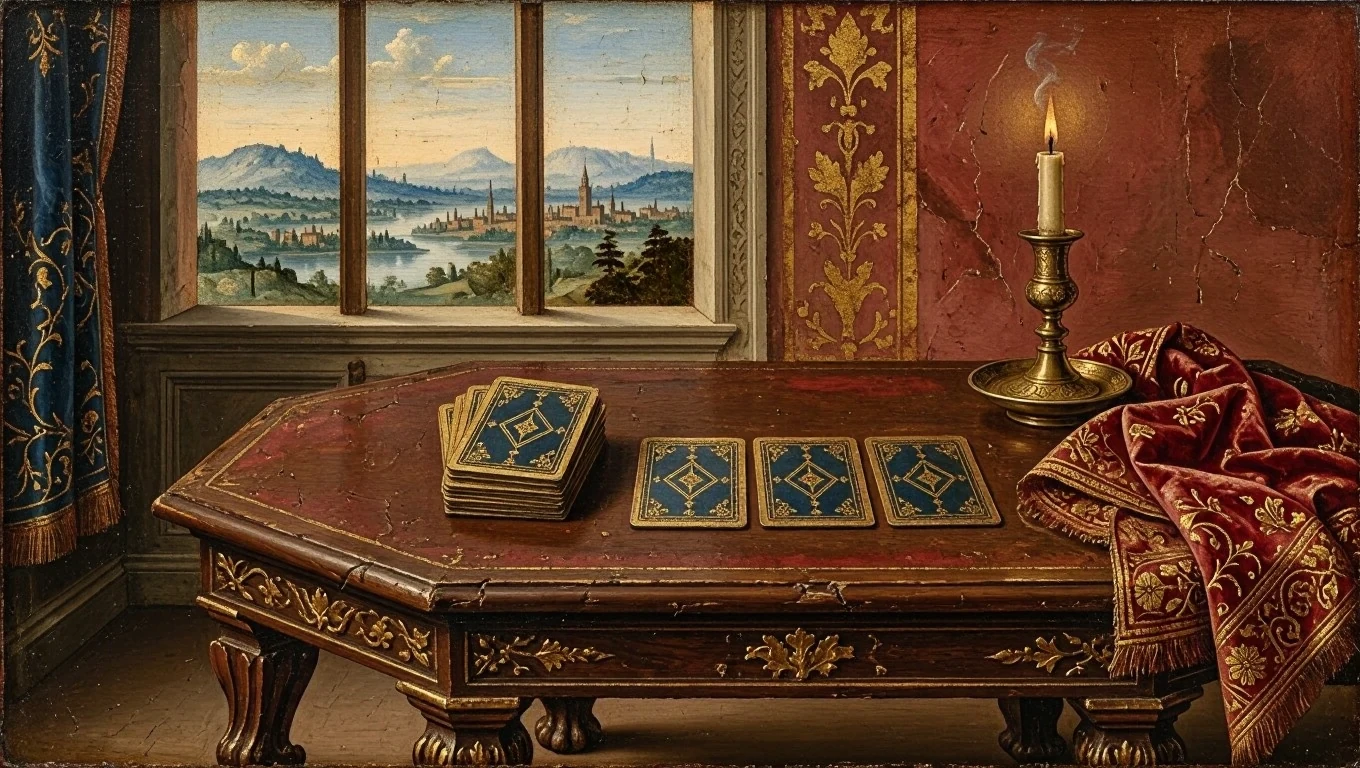
The oldest decks that survived are from noble families in Milan. The Visconti-Sforza was commissioned by the Visconti and the Sforza in the 15th century, and 74 of the 78 original cards exist to this day. Exactly The Devil, The Tower, the Three of Swords and the Knight of Pentacles are missing. The Yale library keeps another deck from the same period, the Visconti di Modrone, with 67 cards. In Italy at that time, tarot was a court game of skill, with nothing mystical.
The shift came at the end of the 18th century. In 1781, Antoine Court de Gébelin, a Protestant clergyman and Freemason, wrote that the Tarot de Marseille came from Egypt and brought the knowledge of Isis and Thoth, Egyptian gods. Shortly after, Etteilla, a pseudonym for Alliette, designed the first esoteric deck.
The Egyptian myth caught on, but it has no basis. Arthur Edward Waite himself, the creator of the most used deck today, wrote in 1910 that there was "no particle of proof" of the Egyptian origin of the cards. His deck, designed by the artist Pamela Colman Smith and published by Rider, was released in 1909. By the end of the 19th century, tarot was already firmly linked to occultism and divination.
How does a tarot reading work?
A tarot reading works like this: the person asking shuffles, the cards are arranged in a fixed design, and each card is read by the position it occupies. This design is called a spread. The simplest has one card; the 3-card spread reads past, present, and future; the Celtic Cross opens ten.
The position gives the meaning. The same Tower means one thing in the house of "obstacle" and another in the house of "advice". Therefore, the reading is not a dictionary of loose cards: it is a sentence assembled with the images that appeared.
Does tarot work?
There is no scientific proof that tarot predicts the future, and it is honest to say so. What research shows is another use. A thesis from UFPB interviewed tarot readers and clients in João Pessoa and described the path of the cards from an entertainment game to divination. Another study, published in 2025 by the magazine Religare, saw tarot linked to emotional well-being and personal development on social media.
In practice, the value lies in the pause that the card provokes. You look at the image, recognize something about your situation, and think about it from another angle. Tarot works better as a mirror than as a sentence.
Important: tarot does not replace a psychologist, doctor, or lawyer. In cases of emotional suffering, illness, or legal issues, seek a professional in that area.
How to play tarot: the first reading in 6 steps
To play tarot for the first time, you need a deck, a question about your life, and one or three cards. The rest is learned by doing.
- Choose the deck. To start, prefer a 78 card tarot deck that comes with a booklet. The Rider-Waite-Smith, conceived by Waite and designed by Pamela Colman Smith, is the school that the card guides of this blog follow. The shop sells tarot and Romani spirit (cigano) decks, and you can ask questions about which one to take via WhatsApp.
- Prepare the place. Clean table, phone away, and a few minutes without rushing. Many readers line the table with a cloth and light a candle, out of custom, not by rule.
- Formulate the question. Only one, open, and about you (see below how).
- Shuffle thinking about the question. Waite taught to shuffle and cut the deck three times, with the cards face down. Cutting with the left hand or in three piles are customs of the reader; follow what makes sense to you.
- Draw the cards. One card answers "what do I need to see today". Three cards, from left to right, tell the past, present, and probable future.
- Read by position. Look at the image before the booklet. Note what the card reminds you of in your situation and only then check the traditional meaning.
Start with all the cards upright. Reversed cards add a layer that becomes easier after you know the 78 images.
What to ask the tarot?
Ask about what is in your hands. "What do I need to understand about my work now?" yields more than "will I be promoted?". When the question is closed, there is the yes or no tarot reading, which has its own rules.
Avoid questions about illness, death, or the private life of another person. The card cannot answer for someone who is not at the table, and the reading loses focus on your decision.
If you want to see how a three card reading is prepared, the site's online tarot shuffles the 78 cards and shows the beginning of the reading for free.
Frequently asked questions
Can I pull tarot for myself?
You can. Many readers start precisely by pulling cards for themselves, and it is the best practice to learn the images. The difficulty is the bias: someone who really wants an answer tends to read what they desire. Write down the reading and reread it days later, with more distance.
Can I pull tarot every day?
You can pull one card a day as a study exercise, and many people do this to learn the deck. What does not help is repeating the same question several times until the card you want appears. One question, one reading, and wait for the situation to change before asking again.
Who can play tarot?
Anyone can learn to play tarot. There is no initiation, special gift, or mandatory religion to pull cards. What separates a good reading from a bad one is the study of the images, honesty with the person asking, and the care not to promise what the deck does not deliver.
Are tarot and the Romani deck (cigano) the same thing?
No. The tarot has 78 cards and was born in 15th century Italy. The baralho cigano is another oracle, with different cards and a different way of reading. At Joia Mística, Joice provides consultations with baralho and cigano tarot.
References
- Yale University Library: In the cards, about the Visconti di Modrone deck
- Smithsonian Magazine: Morgan Library exhibition on the Renaissance roots of tarot
- London Review of Books, Edmund Leach: review of The Game of Tarot, by Michael Dummett
- A. E. Waite: The Pictorial Key to the Tarot, part 1 and part 3
- Wikipedia: “Tarot” entry
- Conversas em Psicologia Magazine, Costa and Argollo: tarot in a Jungian approach
- UFPB Repository, Fernanda Pinheiro Cavalcanti: Tarot as an integrative practice, 2022 thesis
- Religare (UFPB), Elisabeth Eglem: Tarot in the digital age