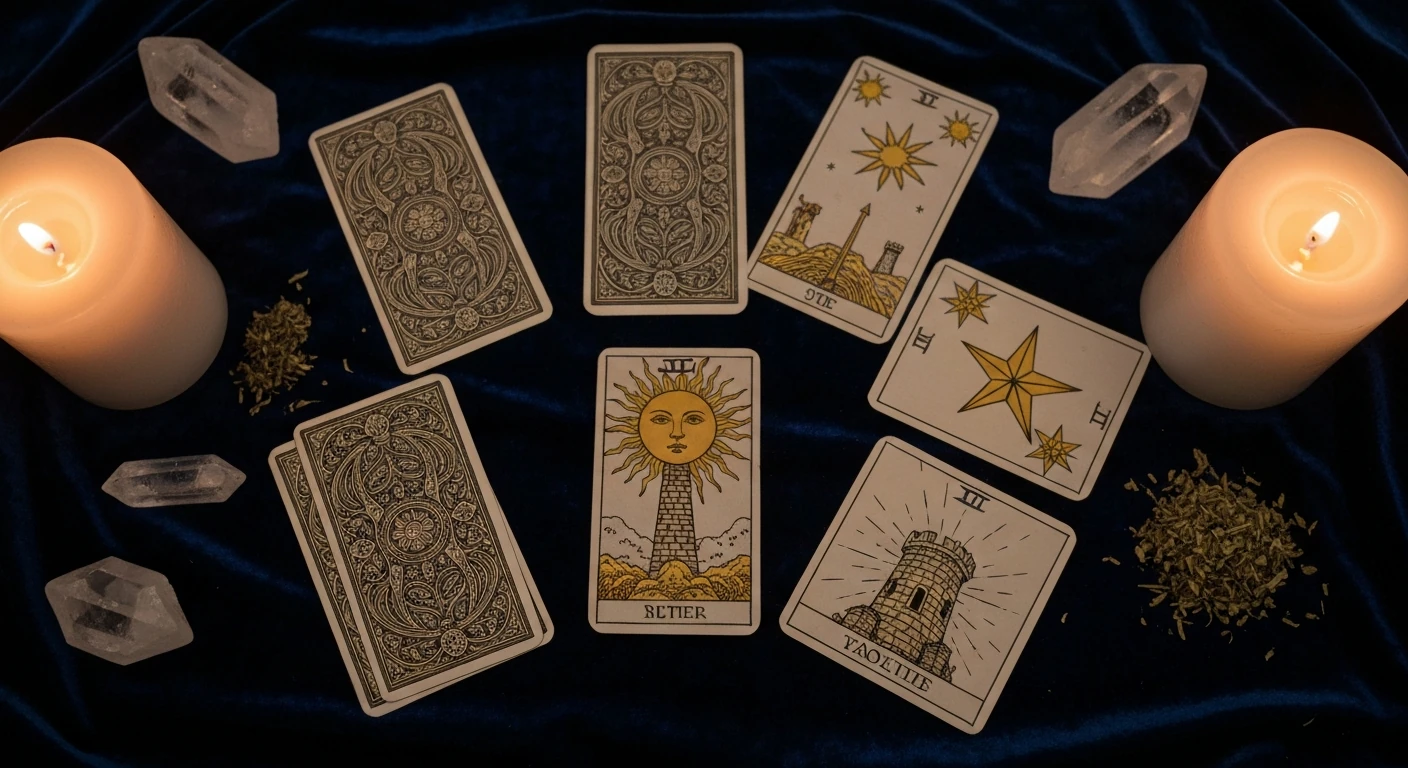
The major arcana of the tarot are the 22 most important cards in the deck, those that carry the great themes of life: beginnings, choices, losses, transformations, and achievements. When someone thinks of the classic tarot images, the Magician, Death, the Wheel of Fortune, The World, they are thinking of the major arcana.
This guide presents the 22 cards one by one, with the meaning of each arcana, explains the famous "Fool's journey" that connects them all, and dispels the most common fears, such as the idea that the Death card announces a real death. Everything with a focus on study and self-knowledge, not on closed predictions.
What are the major arcana (and the minor arcana)
A complete tarot deck has 78 cards, divided into two groups. The word "arcana" means mystery, secret.
- 22 major arcana: the archetypal forces, the great themes, and life's lessons. They are what give weight to a reading.
- 56 minor arcana: the day to day, the practical and emotional situations. They are divided into four suits (Wands, Cups, Swords, and Pentacles), each with numbered cards and the court figures (Page, Knight, Queen, and King).
In a spread, a major arcana usually indicates the central theme of the question, while the minor arcana show the details and how the situation unfolds. Therefore, those who are starting to study can focus first only on the 22 major ones.
The 22 major arcana and their meanings
The table below brings the 22 cards in the Rider-Waite-Smith tarot numbering, the most used deck in the world, with the meaning of each one in the normal position (the card facing up).
| No. | Card | Meaning |
|---|---|---|
| 0 | The Fool | Beginning, faith, a leap into the unknown, spontaneity |
| I | The Magician | Will, skill, potential put into action |
| II | The High Priestess | Intuition, mystery, inner knowledge |
| III | The Empress | Fertility, creativity, abundance, welcoming |
| IV | The Emperor | Structure, authority, order, stability |
| V | The Hierophant | Tradition, teaching, values, faith |
| VI | The Lovers | Choice, union, love and decision |
| VII | The Chariot | Determination, focus, victory through control |
| VIII | Strength | Serene courage, mastery of one's own instincts |
| IX | The Hermit | Introspection, inner search, wisdom |
| X | Wheel of Fortune | Cycles, change, the luck that turns |
| XI | Justice | Balance, truth, cause and consequence |
| XII | The Hanged Man | Pause, surrender, change of perspective |
| XIII | Death | End of a cycle, transformation, renewal |
| XIV | Temperance | Balance, moderation, patience |
| XV | The Devil | Attachment, materialism, vices, illusion of imprisonment |
| XVI | The Tower | Sudden rupture, fall of what was false, awakening |
| XVII | The Star | Hope, inspiration, healing, renewed faith |
| XVIII | The Moon | Illusion, fears, intuition, the unconscious |
| XIX | The Sun | Joy, clarity, success, vitality |
| XX | Judgement | Awakening, rebirth, a calling |
| XXI | The World | Realization, totality, complete cycle |
The names change slightly from deck to deck: The High Priestess also appears as The Popess, The Hierophant as The Pope, The Lovers as The Lover and Judgement as The Last Judgement. It is the same card in a different outfit.
Attention to a classic swap that confuses many people: in the tarot of Marseille, Justice is card VIII and Strength is XI. In Rider-Waite, Arthur Edward Waite inverted the two, leaving Strength in VIII and Justice in XI, to align the cards with astrology. If you compare two decks and the numbers seem swapped, that is why. See the confirmation in the entry for the major arcana.
The card of Death does not mean death
Of all the cards, Death is the one that scares those who do not know tarot the most, and it is precisely the most misunderstood. It does not announce physical death. No card in the tarot does that.
Death (XIII) speaks of end of cycle and transformation: something that ends so that something new can be born. The scythe reaps what is no longer useful, and the sun rising in the background of the classic card announces the restart. It is one of the most liberating cards in the deck, not a sentence.
The same applies to The Devil (XV). It does not represent a demon or a curse. It speaks of attachment, materialism, vices and the feeling of being trapped by something, a prison that, deep down, the person themselves can open. Reading these cards by the symbol, and not by the scare, is the first step for those who want to truly understand tarot.
The journey of The Fool
There is a beautiful way to read the 22 major arcana: as a single story. It is the so-called Fool's journey, an idea spread by author Eden Gray. The Fool, the card of number 0, is the protagonist. He represents pure potential, someone who sets out into the world without baggage, and crosses all the other 21 cards as stages of maturation.
One possible reading groups the journey into three phases:
- The material world (I to X): the Fool learns to use will (The Magician), intuition (The High Priestess), to create and to structure, to choose and to deal with the cycles of life.
- The inner trials (XI to XVII): come responsibility (Justice), surrender (The Hanged Man), great transformation (Death), the encounter with one's own shadow (The Devil), and the hope that is reborn (The Star).
- The spiritual path (XVIII to XXI): the dive into the unconscious (The Moon), clarity (The Sun), rebirth (Judgement), and, finally, full realization in The World.
Reading the arcana this way helps to memorize the cards and to understand that each one is a step, not an end in itself.
How to start studying the major arcana
You do not need a "gift" to learn tarot. It is study, observation, and practice. Some tips to start:
- First learn the central meaning of each card, without memorizing huge lists of loose words.
- Look at the context. In a spread, the same card says different things depending on the position, the neighboring cards, and the question asked.
- Unite symbol and intuition. Notice the colors, the figures, and the numbers, and let your internal reading complete what the image suggests.
- Start simple. Practice only with the 22 majors, in short spreads like the card of the day or three cards. The yes or no spread is a good initial exercise.
- Reversed cards are optional. Not every reader uses them. When used, they usually indicate blocked energy or excess, not the exact opposite.
And it is always worth remembering: tarot is a mirror, a tool for reflection and self-knowledge. It illuminates tendencies and internal states, but the one who decides the path is always you. To know a tarot reading with Afro-Brazilian roots, also see the tarot of the orixás.
Frequently asked questions
What are the 22 major arcana of the tarot?
They are, from 0 to XXI: The Fool, The Magician, The High Priestess, The Empress, The Emperor, The Hierophant, The Lovers, The Chariot, Strength, The Hermit, Wheel of Fortune, Justice, The Hanged Man, Death, Temperance, The Devil, The Tower, The Star, The Moon, The Sun, Judgement and The World.
What is the difference between major and minor arcana?
The 22 major arcana deal with the great themes and forces of life, the lessons and profound transformations. The 56 minor arcana deal with daily life, emotions and practical situations, divided into four suits. Together they form the 78 cards of the complete tarot deck.
What does the Death card mean in tarot?
Death symbolizes the end of a cycle, transformation and renewal, never physical death. It indicates that something is ending to open space for the new. It is one of the most positive cards in this sense, because it points to liberation and a new beginning, and not definitive loss.
What does the Devil card mean?
The Devil represents attachment, materialism, vices and the feeling of being trapped by something or someone. It is not a literal demon nor a curse. The card itself suggests that the prison is looser than it seems, and that recognizing the attachment is already the beginning of freedom.
Why do Justice and Strength switch numbers?
Because they follow different schools. In the Marseille tarot, Justice is VIII and Strength is XI. In Rider-Waite, Arthur Edward Waite reversed the two, leaving Strength in VIII and Justice in XI, to align the cards with astrological correspondences. Both numberings are valid.
Where to find your tarot deck
At Joia Mística Laroyê, you find everything to start or deepen your studies:
- Tarot decks: Rider-Waite and other models for beginners and experienced readers
- Reading cloths: to cover the table and set concentration
- Crystals and candles: to harmonize the environment of the reading
- Books and tarot guides: support to study the meaning of the cards
Visit our shop in Extrema, Minas Gerais or talk to us via WhatsApp and we ship all over Brazil.
References
- Wikipedia: entry on tarot, history and structure of the deck
- Wikipedia: entry on Rider-Waite-Smith tarot
- Wikipedia: entry on the major arcana of the tarot