In the Batuque of Rio Grande do Sul, the Ibeji are the twin orixás: two forces that form a single divinity, always in pairs. They are the orixás of childhood, worshipped in cases of grace, mercy, and children's health. They complete the list of the twelve orixás of the gaúcho rite and carry one of the most beloved cults of the people of santo.
This guide explains who the Ibeji are in Batuque and the profile of the orixá in the gaúcho rite. It also shows the table served to the children, the difference between Ibeji and erês, and the syncretism with Saint Cosme and Saint Damião.
Who are the Ibeji in Batuque
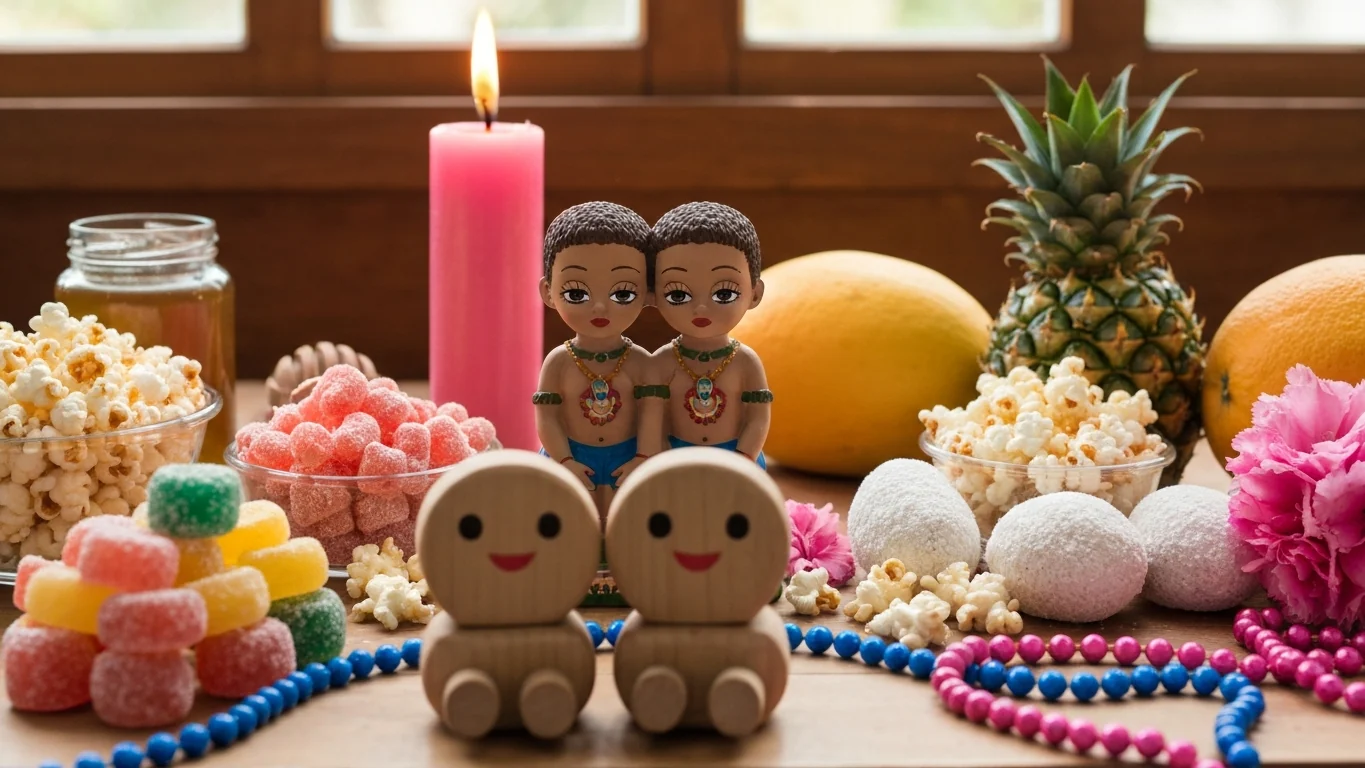
The Ibeji are twin spirits that form a single orixá, permanently double. They are not two separate orixás: they are two halves of the same force, and it is this pair that represents the principle of duality within the religion. Where there are two walking together, there is the mark of Ibeji.
In Batuque, the cult of the twins appears with more strength in the Ijexá and Cabinda nations. It is linked to the divinities of Xangô and Oxum, as recorded in the Batuque entry on Wikipedia. Not by chance: they are orixás of a full house, of abundance and of family, and the child is the crowning of this.
Ibeji governs what is most delicate in life: the beginning. Therefore, it is responsible for children's health, high-risk pregnancies, twins, and requests for grace involving the little ones. It is an orixá of joy, but of a serious joy, linked to care.
Ibeji is not a lesser orixá for being a child. It is the pair that sustains duality, and no house of Batuque closes the line of orixás without it.
Profile of the Ibeji in Batuque
| Field | Ibeji |
|---|---|
| Nature | twin orixás, a single orixá permanently double, child-orixá |
| Also called | the twins, Dois-Dois (popular name of the pair) |
| Nations where it is most worshipped | Ijexá and Cabinda |
| Connection | deities of Xangô and Oxum |
| Dominion | children, twins, health, grace, mercy |
| Colors | varied, except black |
| Syncretism | Saints Cosmas and Damian, celebrated on September 27th |
| Major tribute | the table (cloth spread on the floor), served only to children up to seven years old |
The usual caveat in Batuque applies: details of color, day, and obrigação vary from nation to nation and from house to house. The card above gathers what is most common in the sources, but who rules the foundation is the pai or mãe de santo of the house. To situate Ibeji among the others, it is worth reading the orixás of Batuque and the order of the line.
The table of Ibeji: the tribute of the children
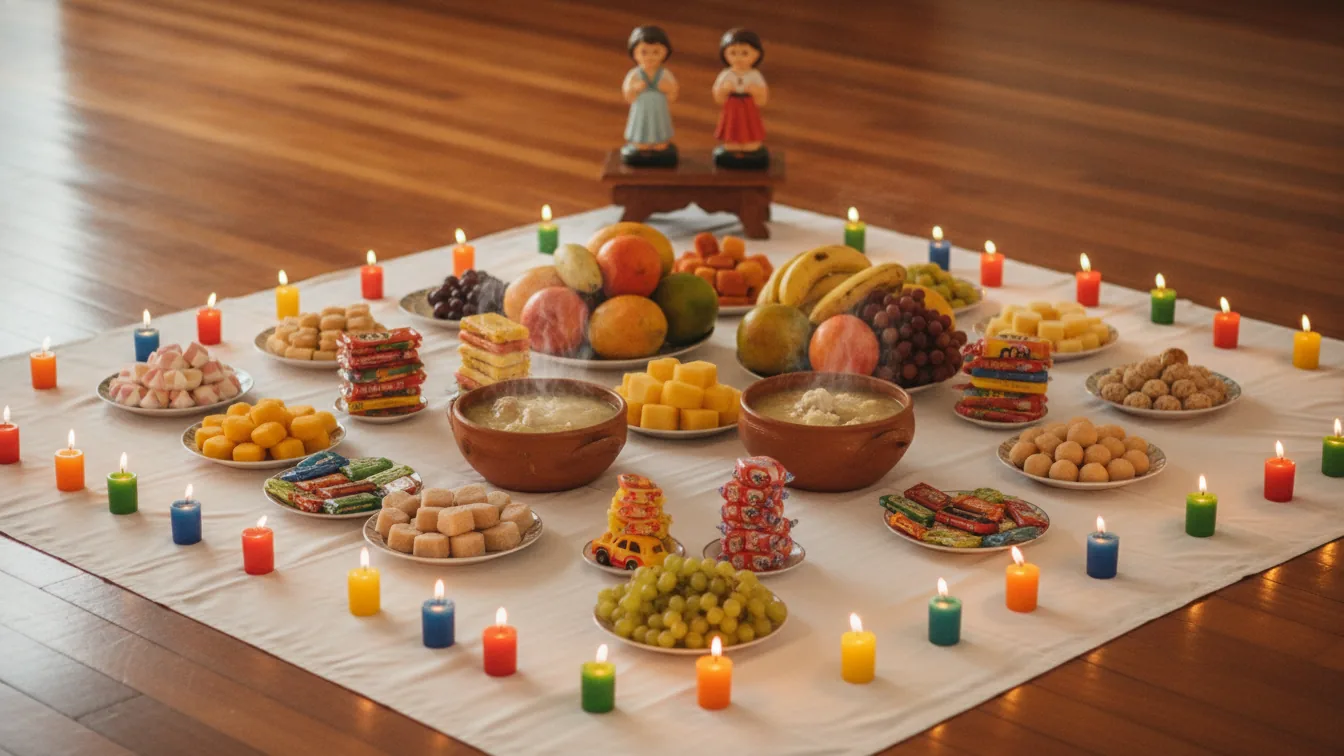
The greatest tribute to the Ibeji is the mesa: a cloth spread on the floor, abundant with food, served only to children. It is one of the most beautiful scenes of Batuque, and also one of the most misunderstood by those who see from the outside.
On the table, children's foods are included: canja, sweets, fruits, candies, and treats. The children present, generally up to seven years old, sit around and eat as they please. They are not just playing: they are the ones who receive the offering in the name of the orixá. To serve the little one is to serve Ibeji.
The mesa usually happens near the day of Cosme and Damião, when many houses and families distribute small bags of sweets. The gesture of giving sweets to children, so popular in Brazil, has its roots in this worship of the twins.
An important point of respect: the mesa of Ibeji is a house obligation, conducted by the pai or mãe de santo, with its own foundation. This article explains what it is and what it means, it is not a step by step to do alone. Each house has its precept, and it is with the leader that one learns to serve.
Ibeji and the erês: the difference that confuses
Many people swap Ibeji for erês, and they are different things. Confusing the two is the most common error for those arriving from another tradition.
In Batuque, the worship is done to the orixás. Ibeji is an orixá, a divinity, the child-force of the pantheon. He does not incorporate as a spirit guide who talks and gives consultations: he is revered as an orixá, with his cantigas, his mesa, and his obrigação.
The erês are something else. In Umbanda, the erês are child spirits who descend in the gira to work, play, and heal with lightness. They are spirits that present themselves and speak, not orixás of the pantheon. The connection with childhood brings the two closer in the imagination, but the nature is distinct: orixá on one side, spirit guide on the other.
Keeping this difference is a sign of respect for both traditions. Batuque has its orixás, Umbanda has its lines of work, and each one worships the child energy in its own way. To see how Ibeji appears in the broader Yoruba pantheon, the profile of who is Ibeji is worth checking out.
Ibeji and the syncretism with Cosme and Damião
In the syncretism formed during colonization, the Ibeji were associated with Saint Cosme and Saint Damian, the twin saints and doctors of the Catholic tradition, celebrated on September 27. The choice was not random: two twin saints, linked to healing and children, well mirrored the twin orixás of health.
Like all syncretism, this association was a historical survival strategy, not a doctrinal equality. Under the repression of Afro-Brazilian religions, worshipping the twins behind the image of Cosme and Damian was a way to keep the axé alive. Saint Cosme and Saint Damian continue to be Catholic saints; Ibeji continues to be an orixá. The two devotions coexist, each in its own house.
The custom of distributing sweets on the day of Cosme and Damian, today almost a national folklore, preserves this memory. Whoever hands out the little bag to the children is, without always knowing, repeating a gesture that speaks of Ibeji. To understand the bridge between the two devotions, see the article about Cosme and Damian in Umbanda.
In Batuque, serving the child is serving the orixá. The joy of the table is an offering, and the sweet in the small one's hand is axé in motion.
Frequently asked questions
Who are the Ibeji in Batuque?
They are the twin orixás, two forces that form a single permanently double orixá. They represent the principle of duality and govern children, health, and requests for grace. In Gaúcho Batuque, they are worshipped especially in the Ijexá and Cabinda nations, linked to the deities of Xangô and Oxum.
Which saint is Ibeji in syncretism?
Ibeji is syncretized with Saint Cosme and Saint Damian, the twin saints and doctors of the Catholic tradition, celebrated on September 27. The association was a historical strategy of resistance, not a doctrinal equivalence. The saints remain Catholic and Ibeji remains an orixá, each devotion in its own tradition.
What is the Ibeji table?
It is the greatest tribute to the twin orixás: a cloth spread on the ground, abundant with canja, sweets, fruits, and candies, served only to children up to seven years old. To serve the little one is to serve Ibeji. It is a house obrigação, conducted by the pai or mãe de santo, not a ritual to do alone.
What is the difference between Ibeji and the erês?
Ibeji is an orixá, a child-deity worshipped in the Batuque pantheon with chants and a specific table. The erês are child spirits who descend in the Umbanda gira to work. One is an orixá, the other is a guide spirit. The connection with childhood brings the two closer, but their nature is distinct.
What is the color of Ibeji?
The colors of Ibeji are varied, with one exception: black is not included. The choice matches the joyful and childish character of the twins. As with everything in Batuque, the detail may change from nation to nation and from house to house, so it is always worth confirming with the leader of your house.
Where to buy Batuque and Cosme and Damião items
At Joia Mística Laroyê, you find what you need to honor the twin orixás:
- Statues of Cosme and Damião: for the altar and the children's table
- Colored candles: in the colors of Ibeji, except black
- Sweets and table items: to set up the tribute to the children
- Bead strings and bead necklaces (guias): fixed in the house's assentamento
- Herbs and incense: for the cleansing before the obrigação
Visit our shop in Extrema, Minas Gerais or contact us on WhatsApp with delivery to all of Brazil.
To delve deeper into the gaúcho religion, the Batuque entry on Wikipedia and the material from the Sociedade Africana Reino de Xangô about the twins are worth checking.
References
- Wikipedia: Batuque (religion)
- Sociedade Africana Reino de Xangô: article about Xangô and Ibeji