Almost everyone arrives with the same question on the tip of their tongue: how long until I incorporate. Mediumship development in Umbanda does not answer that, and that is the first thing worth understanding.
It is not a course with a graduation date. It is a process of maturation within a chain, conducted by a leader, at each person's own pace. Some people feel it in the first gira and take years to firm. Some people spend months feeling nothing and then progress quickly.
This guide shows how to enter the chain and what happens in a development gira. It also brings the phases of irradiation to firmeza, what delays the process, and the honest answer about the time.
What is mediumship development in Umbanda
Development is the period in which the medium learns to work with the house's spirit guides under the guidance of the leader. It is not about gaining mediumship, but rather about learning to handle it: recognizing the energy, becoming passive, sustaining the manifestation, and exiting it safely.
The Wikipedia entry on Umbanda summarizes it well: incorporation involves ritual learning, emotional control, and integration into the norms of the religious group. It is not a gift that falls ready-made.
It is worth separating the traditions, because the confusion is constant. In Umbanda, the formation happens standing up, in the circle of the gira, with curimba and spirits working. In Kardecist Spiritism, mediumship education happens seated, in a closed room, with a small group. And in Candomblé, the feitura de santo is another rite, with its own structure by nation. If you want the basic concept of mediumship, it is in what is mediumship.
How to enter the chain of a terreiro
There is no single rite, and each house has its own rules. The most common path follows this order:
- Attend as an assistant. You go to open giras, observe, feel the environment, and are observed as well. The Tenda de Umbanda 2 Caboclos, in Bertioga, requests six months in this phase. The Terreiro Pai Maneco, in Curitiba, requires at least seven giras before formal admission.
- Study the house doctrine. Many houses require a course on the ritual, the hierarchy, and the rules before any development session.
- Serve as a cambono. This stage is truly formative. You learn the gira from the inside, serving the spirit and the medium, before entering the circle.
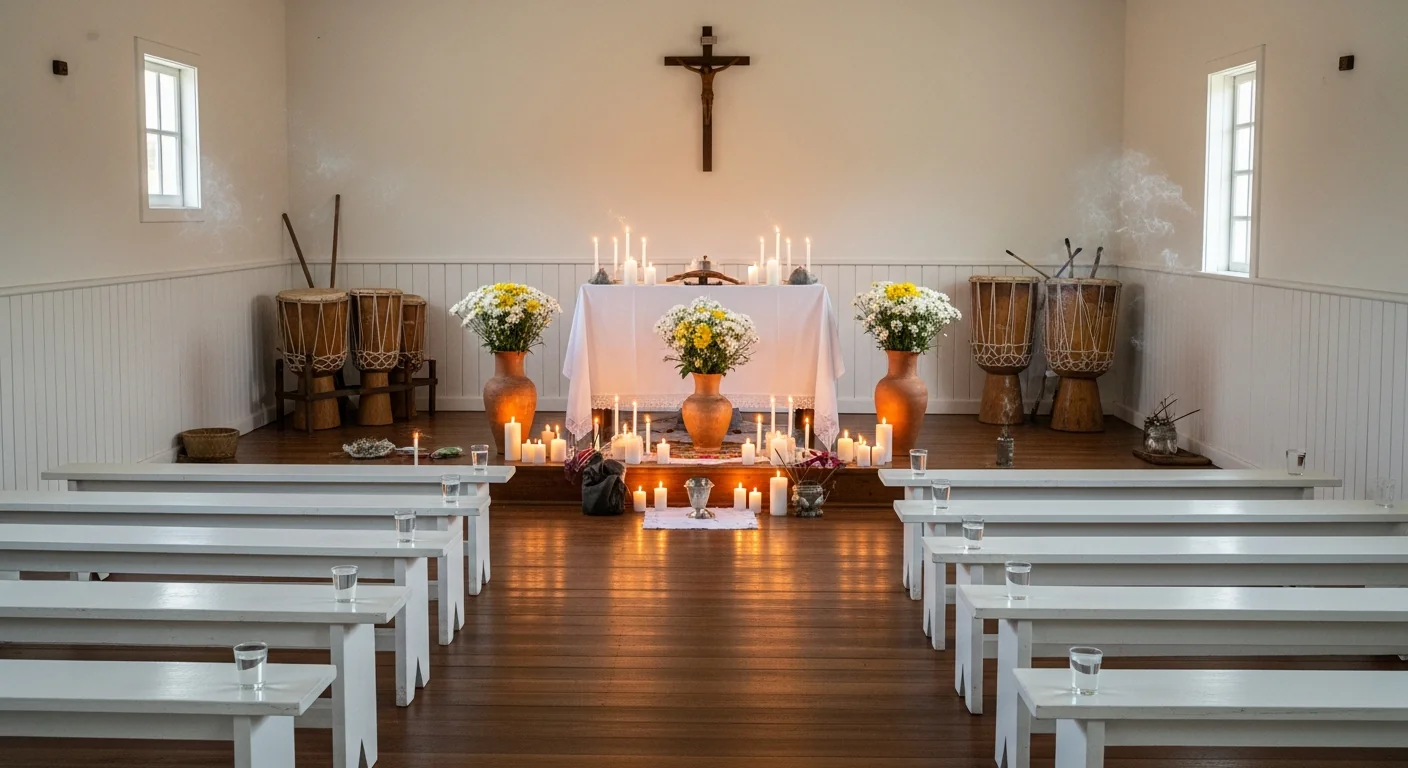
- Enter the development gira. It is closed, only for those who work in the house, without assistants present.
- Go through the house consecrations, when the leader understands it is time. The amaci is one of them.
- Be released to attend. A serious house does not let a medium in development give consultations.
No one develops alone in the house. Without a chain and without a leader, there is no one to correct the posture, identify what is happening, and end the manifestation safely.
What happens in a development gira
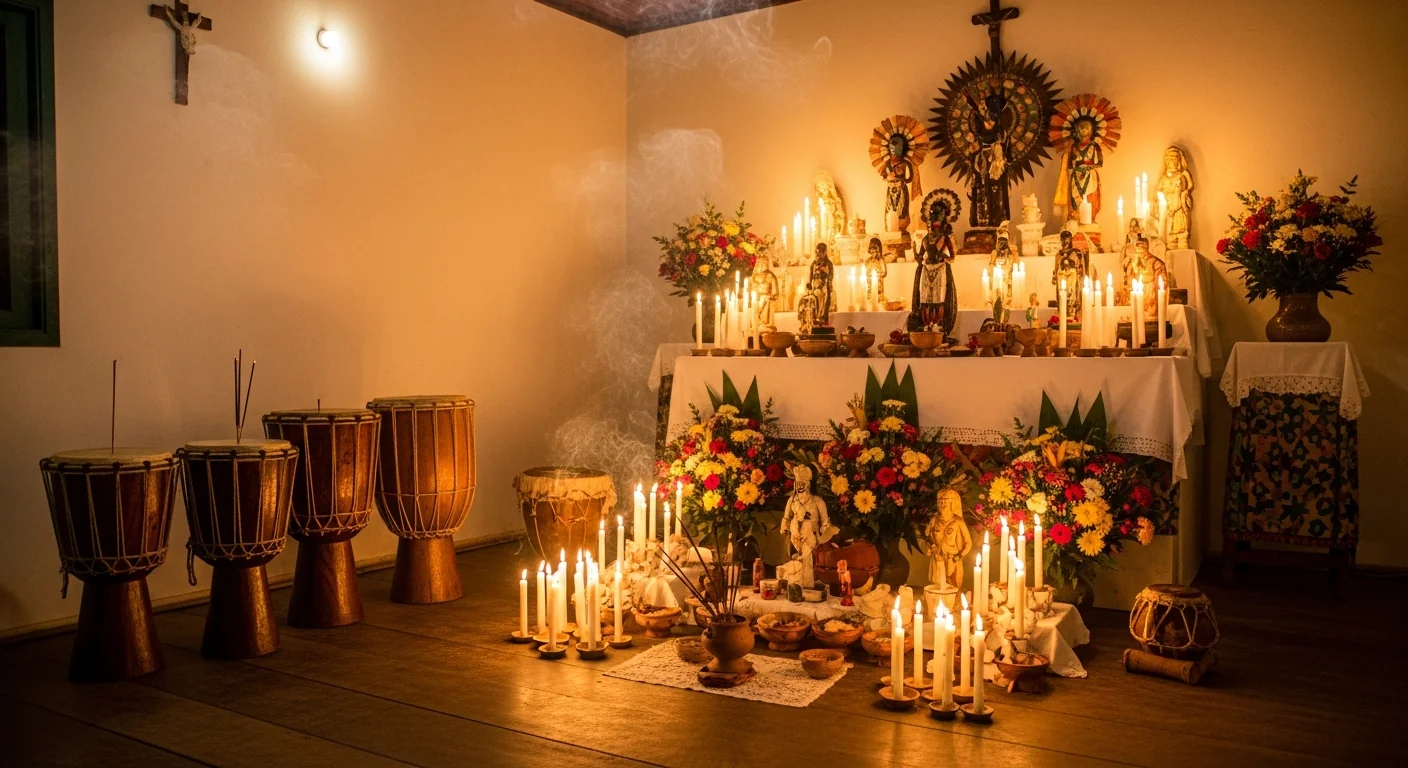
The development gira is quieter and more didactic than the consultation gira. Before it, the house establishes the entry points, performs the smoke cleansing (defumação), and greets Exu (Eshu), the guardian.
With the chain formed, the curimba plays the points that call the line of the day. The medium learns two things at the same time, and they seem opposite: not to resist and not to force. The middle ground between freezing and pretending is exactly what takes time.
The leader circulates through the circle the whole time. He corrects posture, applies a spiritual pass, notices when the medium is in an animic state, holds those who are going too fast, and ends the manifestation when necessary. The cambono accompanies them by the side: lights the candle, serves, organizes, and ensures the physical safety of the one who is incorporated, including at the time of disincorporation.
Academic research describes this accompaniment with precision. In the study on narratives of umbanda mediums, Scorsolini-Comin and Campos show a non-linear formation, with advances and setbacks. What the leader offers, above all, is time.
Irradiation, spirit incorporation, and firmeza: the phases
| Phase | What happens | What is felt |
|---|---|---|
| Sensitivity | subtle perception, thought that does not seem like your own | nothing visible from the outside |
| Irradiation | the energy of the spirit approaches and envelops, without assuming the body | body sways, cold hands, goosebumps, blurred vision |
| Spirit incorporation | the spirit manifests through the body of the medium | changes the expression, posture, voice, and gesture |
| Firmeza | the medium sustains the manifestation with clarity and control | smooth incorporation, understanding what the spirit wants |
Two points that avoid frustration. First: radiating does not mean that you will incorporate. Many mediums work for years in radiation, and this is legitimate ritual work, not a waiting phase. Second: in most houses, the Orixás do not incorporate fully in Umbanda. Those who work in the circle are the spirit guides of the falanges, such as caboclos and pretos-velhos, and the presence of the Orixá tends toward radiation.
How long does mediumship development take
The honest answer is that there is no deadline, and be suspicious of anyone who gives a fixed number.
The sources from the terreiro converge on this. Diamantino Trindade writes that only time forms a prepared medium. Marcos Adriano Vargas, from the Templo Escola de Umbanda Aranauam, records that the process can take months and even years. The Casa do Pai Benedito summarizes it in a phrase worth keeping: development is not measured in time, it is measured in quality.
The only reliable numbers are for the initial stage, and they apply to the house that published them: the six months of assistance in Bertioga, the seven minimum giras in Curitiba. None of them is a completion deadline.
What determines the pace is frequency, discipline, emotional maturity, and each person's own foundation. Two people who entered on the same night may take very different amounts of time, and this does not measure anyone's value.
What delays development
- Haste and skipping stages: the most cited error by the sources. Forcing manifestation before the time usually brings imbalance instead of axé.
- Animism: the medium projects themselves thinking they are the spirit. It is a common self-deception, part of the learning process, and the leader corrects it. Do not confuse it with mystification, which is pretending on purpose.
- Irregular frequency: missing and arriving late weakens the link of the chain.
- Comparison: measuring your development by that of the brother next to you hinders both.
- Arriving charged: without a ritual bath, with fresh anger, or after drinking. A herbal bath before the gira makes more difference than it seems.
- Changing houses all the time looking for who develops faster.
When the case is for a doctor, and not for a gira
This point is serious and needs clarity. Not every intense experience is mediumistic opening.
Persistent insomnia, anxiety crisis, constant fear, loss of functionality at work or in the family, thoughts of death: none of this should be read first as spirituality. It is time to seek medical and psychological evaluation.
There is a criterion for this distinction. In the work on differential diagnosis between spiritual experiences and mental disorders, Menezes Júnior and Moreira-Almeida point out signs of healthy experience:
- absence of psychological suffering
- absence of social and occupational impairment
- some control over the experience
- compatibility with the religious group
- personal growth over time
When these signs are missing, the guidance is to seek a health professional.
Caring for the spirit and caring for health do not compete. A serious terreiro never tells anyone to stop medication or abandon treatment, and research itself records experiences of mental health support within houses of Umbanda.
Frequently asked questions
How long does mediumship development last?
There is no fixed deadline, and it varies greatly by house and by person. Terreiro sources speak of months or years, without a fixed number. What exists are the initial stage rules of each house, such as a minimum time of assistance before entering the chain. Be suspicious of those who promise a date.
How do I know if I have mediumship?
Repeated sensations in a gira environment, recurring dreams, and subtle perceptions are usually the first signs. But none of this is confirmed alone. The one who evaluates is the leader of a serious house, with time for observation. Attending the gira as part of the audience (assistência) is the path to discover without rushing.
Can I develop mediumship at home?
No. All terreiro sources are unanimous on this point. Without a chain, without a leader, and without a ritual, there is no one to guide, correct, and safely conclude the manifestation. Support practices such as herbal bath and firmeza exist, but they accompany the work of the house, never replacing it.
What is the difference between irradiation and spirit incorporation?
In irradiation, the energy of the spirit approaches and surrounds the medium, who feels the body sway but remains conscious and in command. In spirit incorporation, the spirit manifests through the body, changing voice, posture, and gesture. Irradiating is not a minor phase, it is legitimate ritual work.
Is it me or is it the spirit guide?
This doubt appears in almost every medium in development and does not mean failure. The mixture between one's own emotion and the presence of the entidade has a name, animism, and is common at the beginning. Take the question to the leader: identifying this is part of what he was trained to do.
Where to find the items for development
At Joia Mística Laroyê, you can find via WhatsApp the kit for those entering the chain:
- White clothes and bead necklaces (guias): the basics for working in the gira
- Herbs for ritual bath: those used before the ritual work
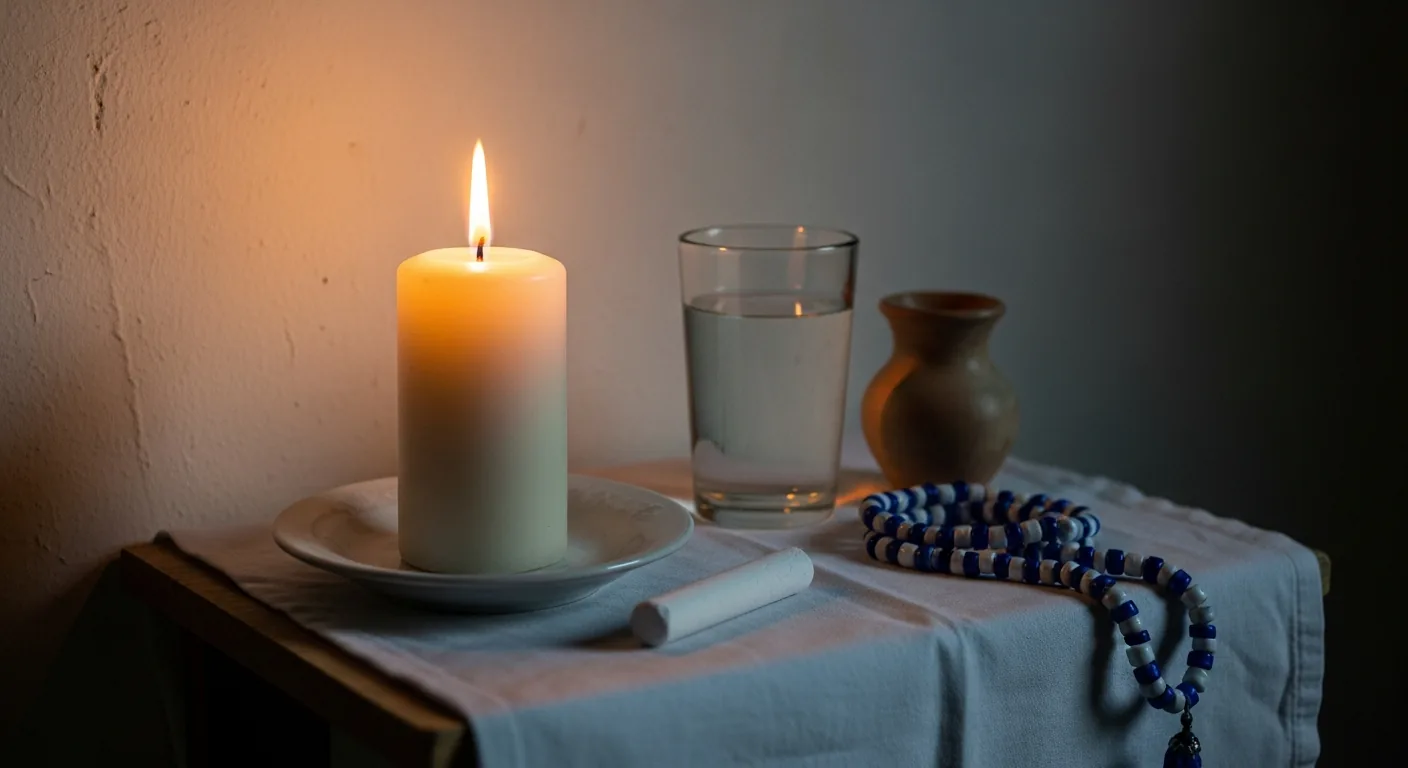
- Candles in the colors of the lines: for the firmeza at home
- Incense burners and incense: for cleaning the environment before and after
- Pemba, cigars and congá items: for the daily life of the house
Visit our shop in Extrema, Minas Gerais or buy via WhatsApp with delivery to all of Brazil.
For those who want to go deeper, it is worth reading the study on psychological attention and Umbanda, by Fabio Scorsolini-Comin, which shows the terreiro as a space of care and welcoming.
References
- Wikipedia: Entry on Umbanda
- Terreiro Pai Maneco: Guidelines for mediums
- PePSIC (Scorsolini-Comin e Campos): Narratives of Umbanda mediums about mediumship development
- Umbanda Eu Curto (Marcos Adriano Vargas): Skipping stages in mediumship development
- Revista de Psiquiatria Clínica, SciELO (Menezes Júnior e Moreira-Almeida): Differential diagnosis between spiritual experiences and mental disorders
- PePSIC (Fabio Scorsolini-Comin): Psychological attention and Umbanda as a space of care