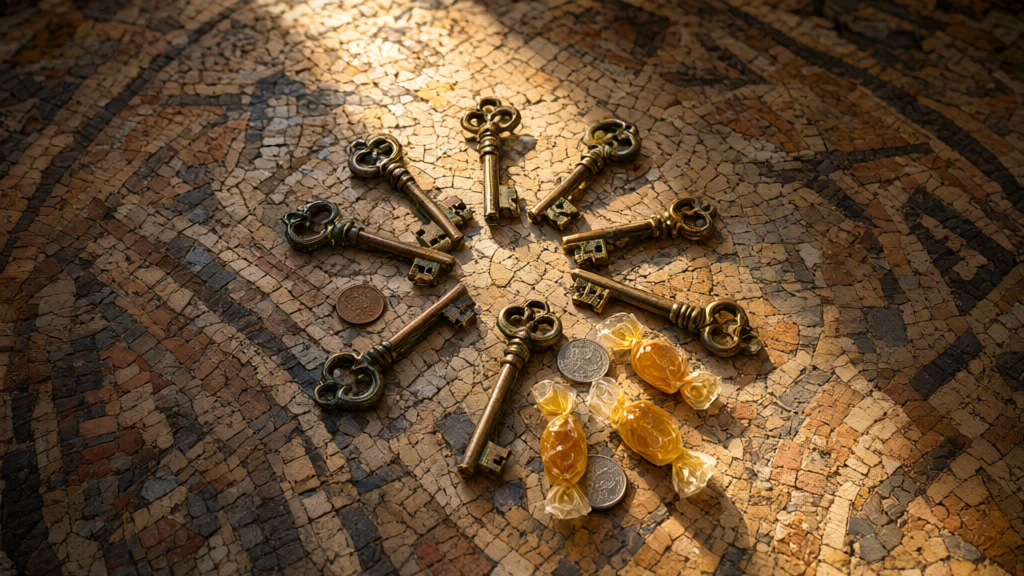
The Bará do Mercado is the assentamento of the orixá Bará in the center of the Porto Alegre Public Market, right at the intersection of the four internal aisles. On the ground, a mosaic of stones and bronze with seven keys marks the point that receives greetings, salutations, and offerings every day.
The mosaic is recent, from February 7, 2013. The worship in the place is old: there are reports that Bará has been celebrated there since at least the 19th century.
What are the seven keys on the floor of the Public Market
The mosaic shows seven keys attached to the ends of seven chains, in a ray over a red background. It entered the list of landmarks of the Museu de Percurso do Negro in Porto Alegre. The work came from a request by Afro-Brazilian houses to the city hall. The registration of Bará do Mercado as intangible heritage was requested by Mãe Norinha de Oxalá (Obatala), then president of CEDRAB, to the Municipal Secretariat of Culture.
The key is not an ornament. The anthropologist Vitor Queiroz, who researches the assentamento, explains the connection:
“He is associated with the key, because if he does not open or close, nothing happens. The crossroads is literally the place where everyone goes and from where everyone leaves. He is the doorman, the master of ceremonies.”
Vitor Queiroz, anthropologist at UFRGS, in an interview with Nonada Jornalismo
Ocutá, in Yoruba, means sacred stone. This is how the municipal law names what is settled there. What exists under the floor cannot be described, and field research records that this is not known. The orixá's profile, with colors, day, and salutation, is in the guide about who is Bará in Batuque.
Who settled Bará there: two versions
Research does not close the origin, and those who say it does are making it up. There are two versions in circulation, both recorded in academic work.
- The enslaved of the old square. The first attributes the assentamento to the enslaved people who lived in the space where the market was built.
- The Prince Custódio. The second attributes it to the African who lived in Porto Alegre at the beginning of the 20th century, and it is the most told in the city.
The surrounding building has its own history. The Mercado Público suffered four fires: 1912, 1976, 1979, and 2013. It became a cultural historical heritage of Porto Alegre in 1979, by municipal law 4317/77. These are two different heritage listings. One is the building, the other is the ocutá.
What the people of santo do when passing by
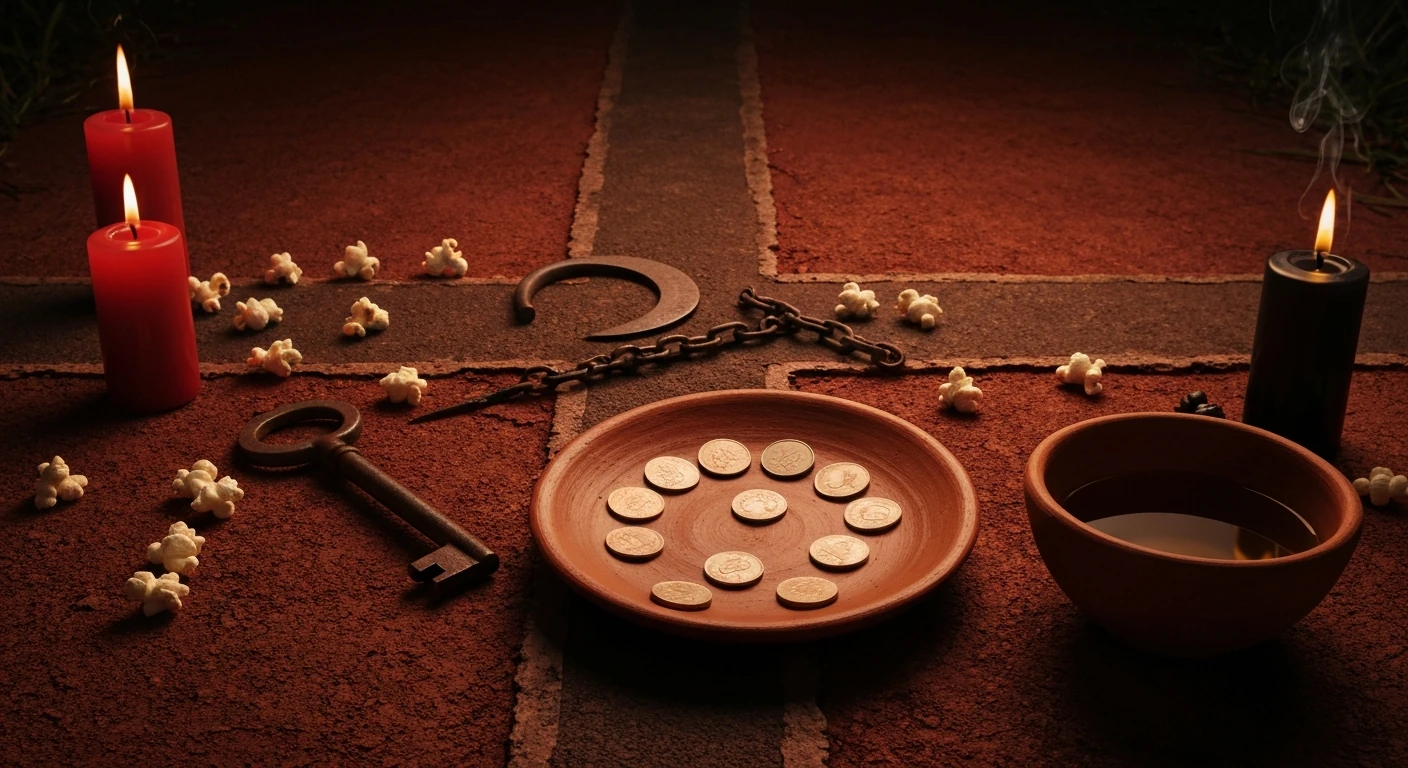
In daily life, the circular mosaic receives dozens of small offerings, especially coins and honey candies. Those of the religion greet and salute when crossing the intersection. The market continues to function around it.
The place is also a mandatory passage in the Batuque initiation, in a rite called passeio. The cycle of obrigações of the Batuque, in which the passeio fits, is explained in obrigação no batuque.
A field study accompanied one of these passeios. In that house, the babalorixá ordered to take seven coins to Bará. Three go with the right hand in the first crossing of the central cross, and four more in the second, towards the pier. The explanation was simple: the value does not matter, the number matters.
Keep this point in mind: this is the record of a house, within an initiation rite conducted by a babalorixá. It is not a recipe to repeat on your own. The one who guides your path is your house.
The heritage ocutá: what the law protects
Law No. 12,824, of March 17, 2021, declares the Ocutá of Bará at the Mercado Público as a cultural and historical heritage site of Porto Alegre. The Chamber approved the project in December 2020. The then mayor did not sanction it, and it was promulgated by the House president, councilman Márcio Bins Ely. The publication appeared in the Official Gazette on March 30, 2021.
The text is short and direct regarding what it prohibits:
“Excavations in the Ocutá of Bará at the Mercado Público, declared a heritage site by this Law, are prohibited, as are works or procedures that alter, modify, remove, render useless, damage, or decharacterize it.”
Article 3 of Municipal Law 12,824, of 2021
Any work at the site depends on prior approval from the competent body. When the press writes that the ocutá has been heritage "since 2020," it is counting the approval in the Chamber. The law is from 2021.
The dates: the June festival and the Bate Folhas da Virada
The festival at Bará do Mercado takes place on June 13 or 29. The choice depends on the religious line of the house. These are the same June dates that organize the day of Exu, June 13 in other traditions.
At the end of the year, the market hosts the Bate Folhas da Virada. The 2022 edition lasted three days, from 10:00 AM to 6:30 PM. Benzedeiras and herbalists applied purification baths and gave advice for the year ahead.
Bará candle and bead necklace are available at Joia Mística, in Extrema, Minas Gerais, via WhatsApp. The rite is of the house, with its babalorixá or its ialorixá.
Why Bará is said in Rio Grande do Sul
In the gaúcho Batuque, Bará is orixá. He has his own place in the pantheon, at the front of the paths, the doors, and the crossroads. In other traditions, the same force appears under another name and another foundation. Mixing the vocabularies confuses those who are learning.
The differences between Oyó, Jeje, Ijexá, Cabinda, and Nagô are gathered in the nations of Batuque. The entire religion is explained in what is Batuque.
Frequently asked questions
What is the Bará do Mercado in Porto Alegre?
It is the assentamento of the orixá Bará at the intersection of the internal aisles of the Mercado Público. On the ground, a mosaic of stones and bronze with seven keys marks the point. The place receives offerings and greetings every day and is a devotion of the gaúcho Batuque.
Who settled the Bará in the Mercado Público?
There are two versions recorded in research, without a verdict. One credits the assentamento to the enslaved people who lived in the space where the market was built. The other credits Prince Custódio, an African who lived in the city at the beginning of the 20th century, the version most told today.
Is the Bará do Mercado a heritage site?
Yes. Municipal Law 12.824, of March 17, 2021, designates the Ocutá of Bará as a heritage site. It prohibits excavations and requires prior approval for works at the location. The market building was already a heritage site since 1979, by another law.
What is the feast day of the Bará do Mercado?
The feast is on June 13 or 29, and the choice depends on the religious line of each house. In the last days of December, the Bate Folhas da Virada also takes place, with healers and herbalists in the market.
Is the Bará do Mercado de Pelotas the same?
No. They are distinct points of devotion, in different cities. The one in Pelotas is in the Mercado Central and has its own history, remembered in the article about the day of Exu. This article deals with the assentamento in Porto Alegre.
References
- UFRGS: ethnography of Bará in the Mercado Público, Alicia Cima Rodriguez's thesis, 2023
- Brazilian Anthropology Meeting: the sacred market, by Olavo Ramalho Marques, 2008
- Porto Alegre City Council: the Ocutá do Bará officialized as heritage, 2021
- Porto Alegre: text of Law No. 12.824, of March 17, 2021
- Nonada Jornalismo: interview about the ethnography of the Bará do Mercado, 2022
- Brasil de Fato RS: the Bate Folhas da Virada at the Bará do Mercado, 2022