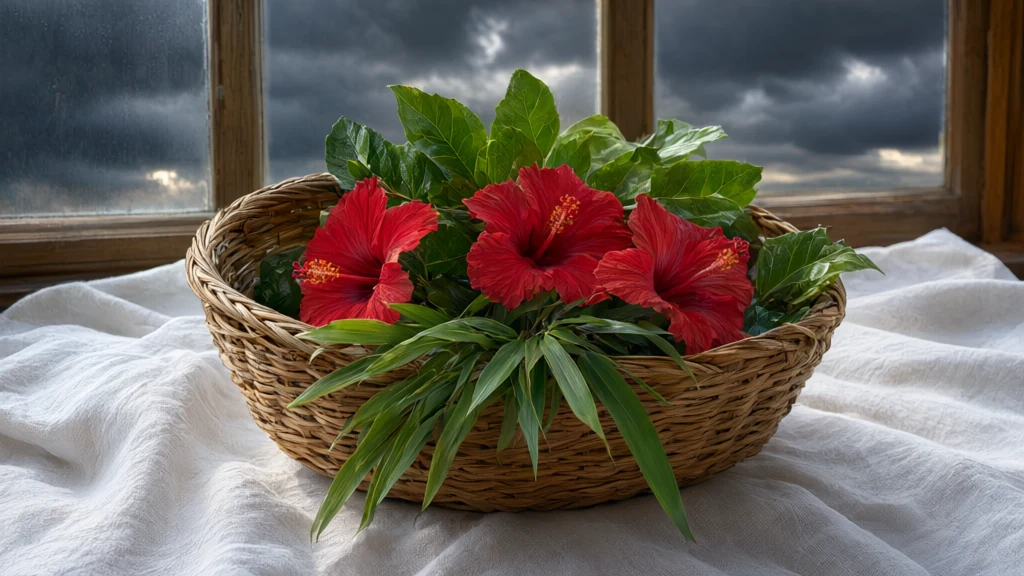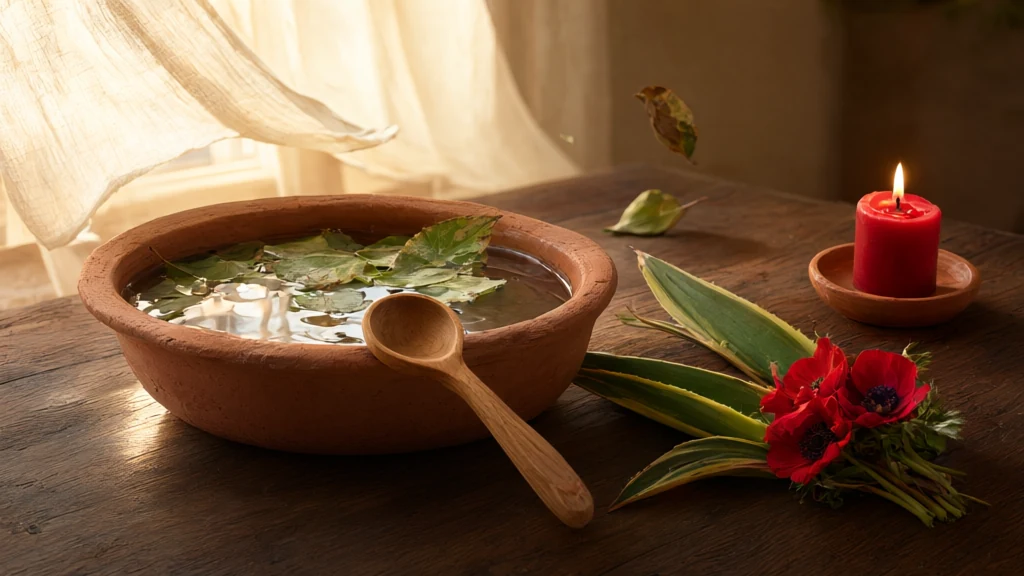
The Iansã ritual bath is a leaf bath of the orixá of the winds, poured from the neck down, preferably on Wednesday. In two Candomblé terreiros in Bahia, her leaves such as peregun-de-Oyá and folha-do-fogo enter into cleansing and descarrego baths. The preparation, cold or covered, varies from house to house.
Which herbs to use in the Iansã ritual bath?
The leaves with registered bath use for Iansã are the peregun-de-Oyá, the folha-do-fogo, the aroeira-branca and the urucum. The record comes from two ketu and ijexá terreiros in southern Bahia. The espada-de-iansã appears in bath, amaci and smoke cleansing (defumação) in 27 terreiros in Santa Catarina.
| Leaf | Why it appears | Where it was registered |
|---|---|---|
| Peregun-de-Oyá (Dracaena sp.) | body cleansing | ketu and ijexá terreiros, southern Bahia |
| Folha-do-fogo (Clidemia hirta) | cleansing bath (banho de descarrego) and altar decoration of Oyá | same terreiros |
| Aroeira-branca (Lithraea molleoides) | bath and sacudimento, with Exu (Eshu) and Iansã | same terreiros |
| Urucum (Bixa orellana) | bath for self-esteem | same terreiros |
| Espada-de-iansã (Sansevieria trifasciata var. laurentii) | ritual bath, amaci and smoke cleansing (defumação); tóxica | 27 terreiros in Santa Catarina Island |
The research is the dissertation of Bianca Purcino, from UFSB, conducted in houses of Arataca and Itabuna. The table provides the function, without quantity or combination. The sources we opened do not provide a recipe with the number of leaves or liters.
Other lists mention other leaves. FUCESP includes aguapé, espada de Iansã, carqueja, and bamboo leaves among "some of its herbs," without mentioning a ritual bath. In a gaúcho batuque house, espada de Iansã, arruda, and pitangueira leaf are used.
The complete list, with the reason why the lists do not match between houses, is in the guide of Iansã herbs.
Attention: the aroeira-branca in the Bahian table is Lithraea molleoides, not the aroeira-vermelha (pink pepper) sold at the market. If in doubt about the leaf, ask whoever collected it.
What is the Iansã ritual bath for?
The Iansã leaf ritual bath serves, in the research, for cleansing and spiritual cleansing (descarrego): removing the weight from the body before a new beginning. In 27 terreiros in Santa Catarina, UFSC researchers divide the baths into two types: the cleansing bath, to remove dense energies, and the harmonization bath, the "sweet" bath.
The Iansã leaves in the Bahian table fall into the first type, except for urucum, which is linked to self-esteem. In an Umbanda study in Espírito Santo, the spiritual cleansing (descarrego) and the recharging that follows can be done with macerated or cooked leaves.
The sources do not promise effects. Mãe Nilce de Iansã, an ialorixá interviewed by Agência Brasil, says that the prescription varies with each person and that there is no universal recipe. In the same article, the botanist Aline Saavedra, from UERJ, reminds that there is no research that measures the energy or the protection that the ritual bath provides.
How to do the Iansã ritual bath: cold or boiled?
The common leaf ritual bath is done in two ways, and which one is valid depends on the house: cold, with the leaf macerated in water, or steamed, with boiled water poured over the leaf.
- Separate the fresh leaves. In Santa Catarina, the priests order to harvest early in the morning or at dusk, never at noon.
- Use a pot or basin only for ritual baths. In an Umbanda terreiro in São Paulo, the mãe de santo asked that the food pot never be used.
- Choose the preparation. For the cold leaf, macerate the leaf in water, without fire. For the steamed, boil the water, put the leaf, wait a few seconds, and turn off the fire.
- Stir with a wooden spoon. In the same São Paulo terreiro, the rule was to never put your hand in the water during preparation and to "firmar a cabeça", that is, to think about what is being asked.
- Strain and wait to cool down. Take a hygiene bath before.
- Pour from the neck down. Boiled bath does not go on the head, according to FUCESP.
- Do not dry yourself and put on light-colored clothes. Return the used leaves to a garden or running water.
The difference between cold leaf and hot leaf has its own guide in hot and cold herbs. In the Terreiro de Mina Santa Bárbara, in Santarém, the cold plants go in natura and the hot ones, like comigo-ninguém-pode and espada-de-são-jorge, are boiled beforehand.
Does the Iansã ritual bath ward off egum?
None of the research we read describes an Iansã ritual bath made to ward off egum. What the sources record is the connection of the orixá with the dead: Pierre Verger writes that Oiá is "the only orixá capable of facing and dominating the Egúngún".
FUCESP notes as its particularity "Confronts the Eguns". In a USP dissertation on Ketu Candomblé, the Oyá of Igbalé "are directly linked to death". The author, Luiz Fernando Anastácio, calls Oyá the "keeper of spirits".
Egum is the spirit of someone who has already died, and in Candomblé the worship of ancestors has its own rites and priest, explained in egum in Candomblé. The leaf ritual bath taken at home is for cleansing. Those who need more take the question to the terreiro.
Leaf bath, amaci and abô: what stays with the house
The bath from the neck down can be taken at home; what goes on the head is from the house. In the São Paulo terreiro studied by Pedro Carlessi, the amaci is performed only by mães and pais de santo and iabás. FUCESP says that the amaci follows "the orientation of the pai or chief guiding leader".
In Ketu Candomblé, the abô comes from the rite in which the leaves are macerated while the cantigas are chanted, according to Anastácio. In an itã recorded by Reginaldo Prandi, the wind of Iansã scattered the leaves of Ossaim (Osanyin). He gave each orixá their own with the cantigas, "without which the leaves do not work".
What amaci is and who prepares it is in what is amaci; the abô, in what is abô.
What is the day to take the Iansã bath?
The day of Iansã in the week is Wednesday, the same as Xangô (Shango), according to Verger and FUCESP. In the year, it is December 4, the day of Saint Barbara in syncretism. In 2026, December 4 falls on a Friday, and the Wednesday of Iansã of that week is the 2nd.
Thursday is for Oxóssi (Oshosi), not Iansã. The dates and what is seen in the festivals are in day of Iansã, and what is taken to her, in offering for Iansã.
Care before preparing
Espada-de-iansã and comigo-ninguém-pode are toxic plants, researchers from UFSC warn. Therefore, in the house of Mina de Santarém, the two only enter after being boiled. The espada has its own page in espada-de-santa-bárbara and a listing in espada-de-iansã.
- Nothing goes into the mouth. The botanist from UERJ recommends caution with any ingestion.
- Do not mix on your own. The priest of Mina's house warns that the wrong combination of leaves can cause "shocks" and "aquizilamentos".
- Pregnant women: rue, which appears on the list of the batuque house, has its own alert in the guide of Iansã's herbs.
If the house you attend passed a leaf that you cannot find, Joia Mística helps check the material via WhatsApp.
Frequently asked questions
Can someone who is not a child of Iansã take the bath?
Yes. In 27 terreiros in Santa Catarina, common baths are indicated for initiates and non-initiates, and the one who chooses the leaf is usually the priest. Being of Iansã is not a condition for the cleansing bath. The amaci, however, follows the house leader.
Can I take an Iansã bath with pitanga leaf?
The pitangueira leaf appears among Iansã's herbs in a batuque house in Rio Grande do Sul, without the page stating it is for a bath. No other open source makes the connection. If your house uses pitanga, follow the house; outside of it, there is no record to support it.
How to do a bath with espada de Iansã?
Espada-de-iansã appears in bath, amaci, and defumação in terreiros in Santa Catarina, but it is toxic. In a house of Mina in Pará, it only enters boiled. Therefore, the bath with espada is done with the guidance of someone who knows the leaf, never drunk.
How many times can I take the Iansã bath?
No source gives a number of days or baths for Iansã. Mãe Nilce de Iansã, interviewed by Agência Brasil, says that the prescription varies with the person and the intention, and that there is no universal recipe. The correct frequency is the one your house indicates.
References
- Bianca Purcino, UFSB (2022): Ethnobotanical profile in Candomblé terreiros in southern Bahia
- Pedro Carlessi, Boletim do Museu Paraense Emílio Goeldi (2017): Ways, subjects and affects: possibilities of existence in Umbanda
- Luiz Fernando Anastácio, USP (2023): Igbasilẹ, the gesture of Ketu Candomblé
- Barboza and others, Nova Revista Amazônica, UFPA (2021): Without the plants, the religion would not exist
- Pagnocca, Zank and Hanazaki, Journal of Ethnobiology and Ethnomedicine (2020): The plants have axé
- Maria Sampaio do Nascimento, UFES (2019): Bantu therapeutic practices: healing through water and vegetables
- Pierre Verger, Corrupio (1981): Orixás: Yoruba gods in Africa and the New World
- FUCESP: Iansã
- FUCESP: Amacis, amalás, foods and drinks of santo
- Agência Brasil (2025): Tradition and faith drive the search for baths and herbs at the end of the year
- Ilé Àsé Odé and Iemanjá (Yemoja): Orixás, characteristics and peculiarities