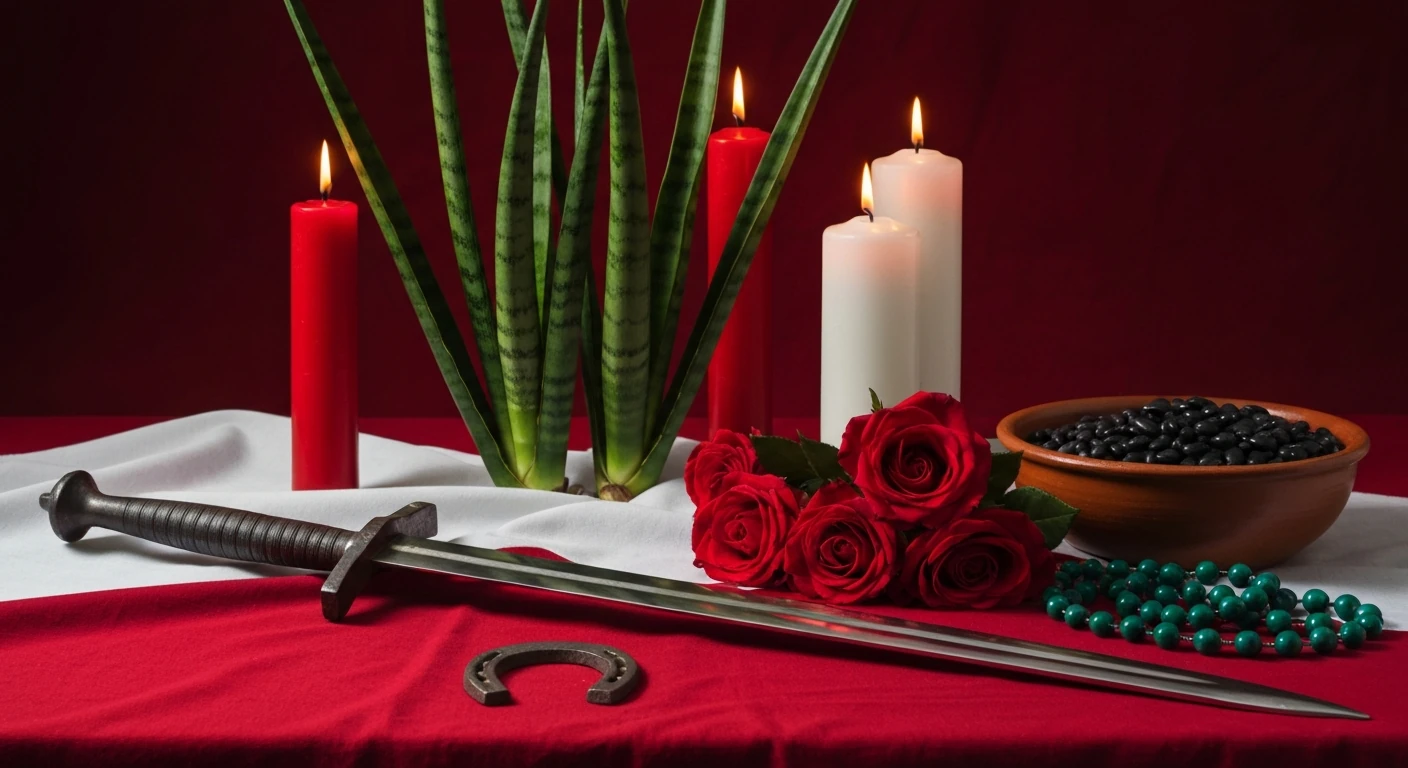
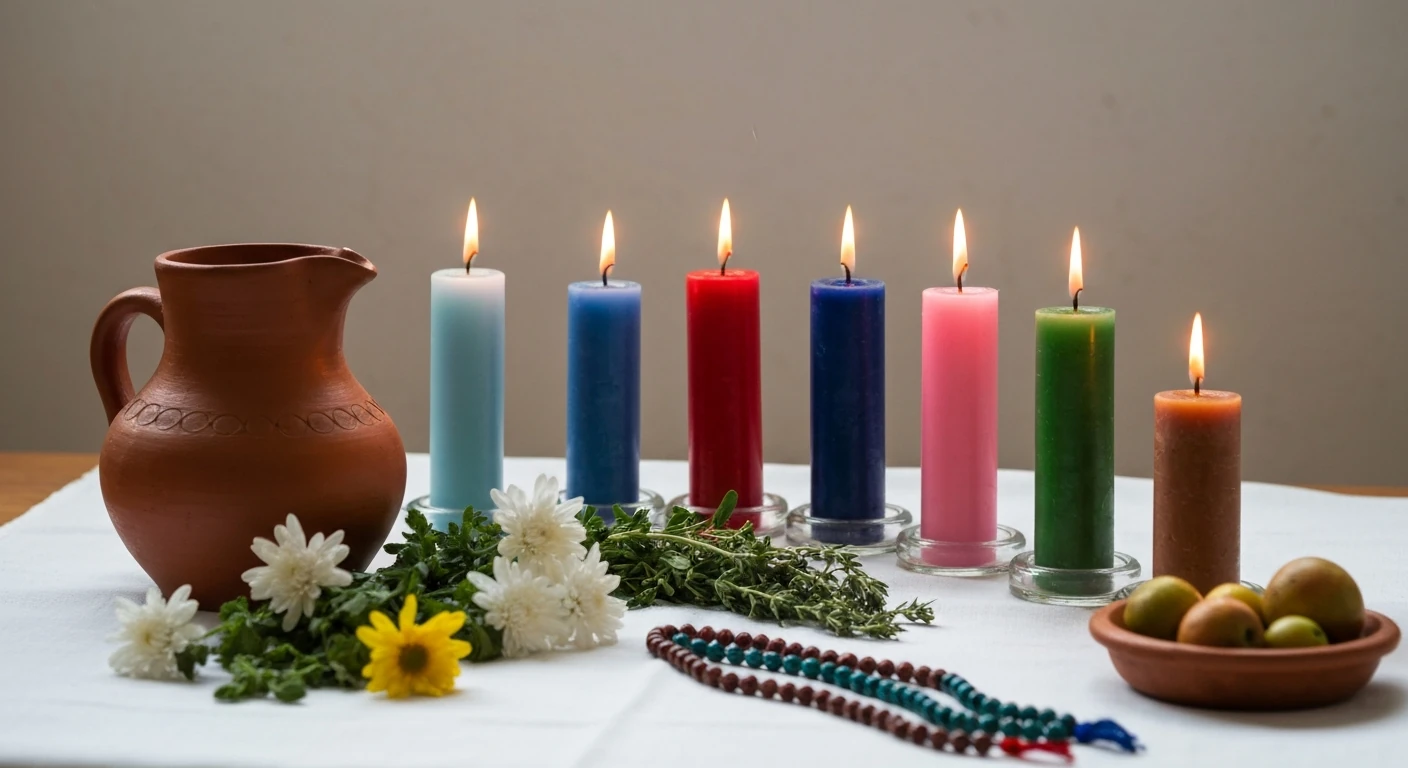
Saint Michael Archangel is one of the strongest devotions in Brazil and one of the most poorly explained. Almost every text about him responds on the second line that the archangel is syncretized with Ogum, and moves on as if the matter were resolved. It is not.
This guide brings who Saint Michael is and what the biblical passages actually say. It explains why September 29 became the feast of the three archangels, tells the real story of the prayer attributed to him, and shows the reason why he does not have a fixed corresponding orixá.
Who is Saint Michael Archangel
Michael is an archangel, not a saint canonized by process. The "Saint" he carries is a title of ancient veneration preceding the formal rite of canonization. This is the first precision that changes the rest of the understanding.
The name comes from Hebrew and has a rare detail: it is a question. Mikha’el breaks down into "who" plus "like" plus "God", that is, "Who is like God?". It is a rhetorical question whose answer is no one. Tradition reads in it the contrast between the humility of the archangel and the pride of the fallen angel.
In the Catholic tradition, he accumulates four roles: prince of the celestial militia, defender of the Church, angel of judgment and psychopomp, the one who leads the souls.
A fact that usually surprises: in the hierarchy of the nine angelic choirs, the archangels occupy the third and last hierarchy, alongside the principalities and the angels. The head of the militias does not come from the highest choir on the list.
Where Saint Michael appears in the Bible
There are four direct passages, and it is worth knowing each one:
- Daniel 10,13 and 10,21: Michael appears as "one of the first princes", protector of the people.
- Daniel 12,1: is called "the great prince" who rises in favor of the people.
- Judas 1,9: the only time the Bible literally calls him an archangel, in the dispute over the body of Moses.
- Revelation 12,7-9: the celestial battle against the dragon, the most represented scene in art.
There is also an indirect mention in 1 Thessalonians 4,16, which speaks of the "voice of an archangel". The Wikipedia entry gathers the references and the iconography with good detail.
A reading care is important here. The dragon of Revelation is an internal figure of the Christian biblical narrative. It has no relation whatsoever with Exu (Eshu), with Pombagira, with Quimbanda, or with any spirit of the Afro-Brazilian religions. Whoever makes this connection is not talking about religion, they are reproducing prejudice.
The scales: the most forgotten symbol of Saint Michael
The popular image shows the archangel in armor, with a flaming sword or spear and the dragon under his feet. It is correct, but it is only half.
His other attribute is the scales. In much of medieval art, the central scene is not the combat: it is Michael weighing the souls in judgment. This is the side of the arbiter, not the soldier. It is also what brings the archangel, on the symbolic plane, closer to the idea of justice that the terreiros associate with Xangô.
Regarding the color of the candle, the Church does not define an official color for Saint Michael. Popular use varies between red (fire and combat), blue, and gold. It is worth checking with your devotion and with the guidance of your house.
If you want to better understand this choice, the article about ritual candles and their meanings explains how the colors work.
September 29: why the feast became for the three archangels
The date is ancient. Around the year 530, Pope Boniface II dedicated a basilica to Saint Michael on the Via Salaria, in Rome, and the ceremonies began on September 29. The association of the date with the archangel is attested since the 5th century.
Until 1969, the day was only his. Gabriel had March 24 and Raphael had October 24, dates fixed in the beginning of the 20th century. With the liturgical reform that came into force in 1970, the three feasts were joined into one.
Today, September 29 is the feast of the Holy Archangels Michael, Gabriel, and Raphael. Michael is the defender, Gabriel is the messenger and Raphael is the one who heals. The CNBB describes the three roles and reminds us that many of the faithful do the novena of Saint Michael as preparation.
Do not confuse it with the memory of the Holy Guardian Angels, which falls on October 2. They are different feasts.
A point that many people got wrong: in September 2025, Law 15.219 was sanctioned, which included the Day of Saint Michael Archangel in the official Brazilian calendar. The news from the Senate is clear: the recognition is symbolic and does not create a holiday.
The prayer of Saint Michael Archangel and its real history
The prayer begins with the invocation that almost every devotee recognizes: “Saint Michael Archangel, defend us in the fight.”
The documented history is this. In 1884, Pope Leo XIII made the so-called Leonine Prayers mandatory at the end of Low Mass. In 1886, he added to this set the prayer to Saint Michael. It was prayed at the end of masses until September 26, 1964, when the instruction Inter Oecumenici suppressed it. On April 24, 1994, John Paul II recommended that the faithful not abandon the practice.
It is widely circulated that Pope Leo XIII wrote the prayer after a vision. Here, honesty is required: there is no official historical record of this scene. The account reached us through third parties and is treated as devotional tradition, even by the Catholic press. What is documented are the dates and the liturgical use.
The full text is in the public domain and can be read in Catholic sources and in its own Wikipedia entry. We chose not to reproduce it entirely here because the standard wording uses terms from Christian cosmology that, out of context, have already been used to attack Afro-Brazilian religions. Devotion, yes, room for intolerance, no.
Saint Michael in Umbanda and Candomblé: the syncretism that did not happen
Here is the answer missing from the internet. Saint Michael Archangel does not have a consolidated corresponding orixá.
Unlike Saint George and Ogum or Saint Barbara and Iansã, who established themselves in almost all of Brazil, the archangel entered the terreiros as an archangel.
There is a historical reason for this. Luso-Brazilian syncretism organized itself in the correspondence between canonized saint and orixá, based on statues, calendar feasts, and visible attributes. Michael is not a canonized saint and has no earthly biography. Furthermore, the symbolic places he could occupy were already taken by the pairs that consolidated earlier.
The result is an honest variation from house to house:
- Some houses bring him closer to Ogum because of the sword and the role of warrior. The relationship is described as a parallelism, not as an identity.
- Others bring him closer to Xangô (Shango) Aganju through the axis of justice, authority, and the scales.
- In esoteric umbanda, systematized by authors such as Lourenço Braga (1955) and W. W. da Matta e Silva (1956), the archangels gain a clear doctrinal function within the lines. This is a specific current, not the entire umbanda. For the general overview, see the 7 lines of umbanda.
- Many terreiros simply worship without any syncretism, with candle, water, and prayer.
In Candomblé the situation is different. A good part of the houses today explicitly rejects syncretism, understanding it as a remnant of persecution, not as theology. There is no consolidated pair with Saint Michael. An association with Logun Edé appears occasionally and in a non-normative way, cited in texts about orixás that were left without a clear Catholic correspondent. It is a variation, not a rule.
It is always worth remembering: syncretism was a historical survival strategy, not theological equivalence. Enslaved peoples used Catholic statues to continue worshipping under persecution. Whoever claims there is a single answer for Saint Michael is making it up.
Frequently asked questions
Who is Saint Michael Archangel?
He is an archangel, not a saint canonized by process. In the Christian tradition, he is the chief of the celestial militias, defender of the Church, and conductor of the souls in judgment. He appears in the Old and New Testament. The name comes from Hebrew and means "Who is like God?", a rhetorical question whose answer is no one.
Why is September 29 the day of Saint Michael?
The date dates back to the 6th century, when Pope Boniface II dedicated a basilica to him in Rome, with the ceremonies starting on September 29. Until 1969 the day was only for Michael. After the liturgical reform, the date became the joint feast of the archangels Michael, Gabriel, and Raphael.
Saint Michael Archangel is syncretized with which orixá?
There is no consolidated pair. Some houses associate him with Ogum because of the sword, others with Xangô Aganju because of the scales of justice, and many worship him as archangel, without syncretism. This happens because he is not a canonized saint and the symbolic places were already occupied by Saint George and Saint Barbara.
Who wrote the prayer of Saint Michael Archangel?
Pope Leo XIII, who added it in 1886 to the Leonine Prayers recited at the end of the mass. The mandatory use ended on September 26, 1964, and the devotion was resumed as a recommended practice by John Paul II in 1994. The history of the vision that supposedly inspired the text has no official record.
Is September 29 a holiday in Brazil?
No. Law 15.219, sanctioned in September 2025, included the Day of Saint Michael Archangel in the official Brazilian calendar, but in a symbolic character. There is no holiday, there is no suspension of business hours, and the State remains secular. It is a cultural recognition of a popular devotion.
Where to buy a statue and candle of Saint Michael Archangel
At Joia Mística Laroyê, you find the devotion items for the date and for the home altar:
- Statues of Saint Michael Archangel: in resin and plaster, various sizes
- Red, blue, and gold candles: taper, seven days, and large candles
- Medals, rosaries, and scapulars: for personal use and daily devotion
- Incenses and censers: myrrh, frankincense, and rosemary for preparing the environment
- Frames and prayer corners: to set up your prayer corner
Visit our physical store in Extrema, Minas Gerais or receive it at home with delivery to all of Brazil. If you have questions about what matches your devotion or your home, talk to us via WhatsApp.
References
- Wikipedia: entry about Michael (archangel)
- CNBB: text about the Archangels Michael, Gabriel, and Raphael
- Senate Agency: news about the law that establishes Saint Michael Archangel Day