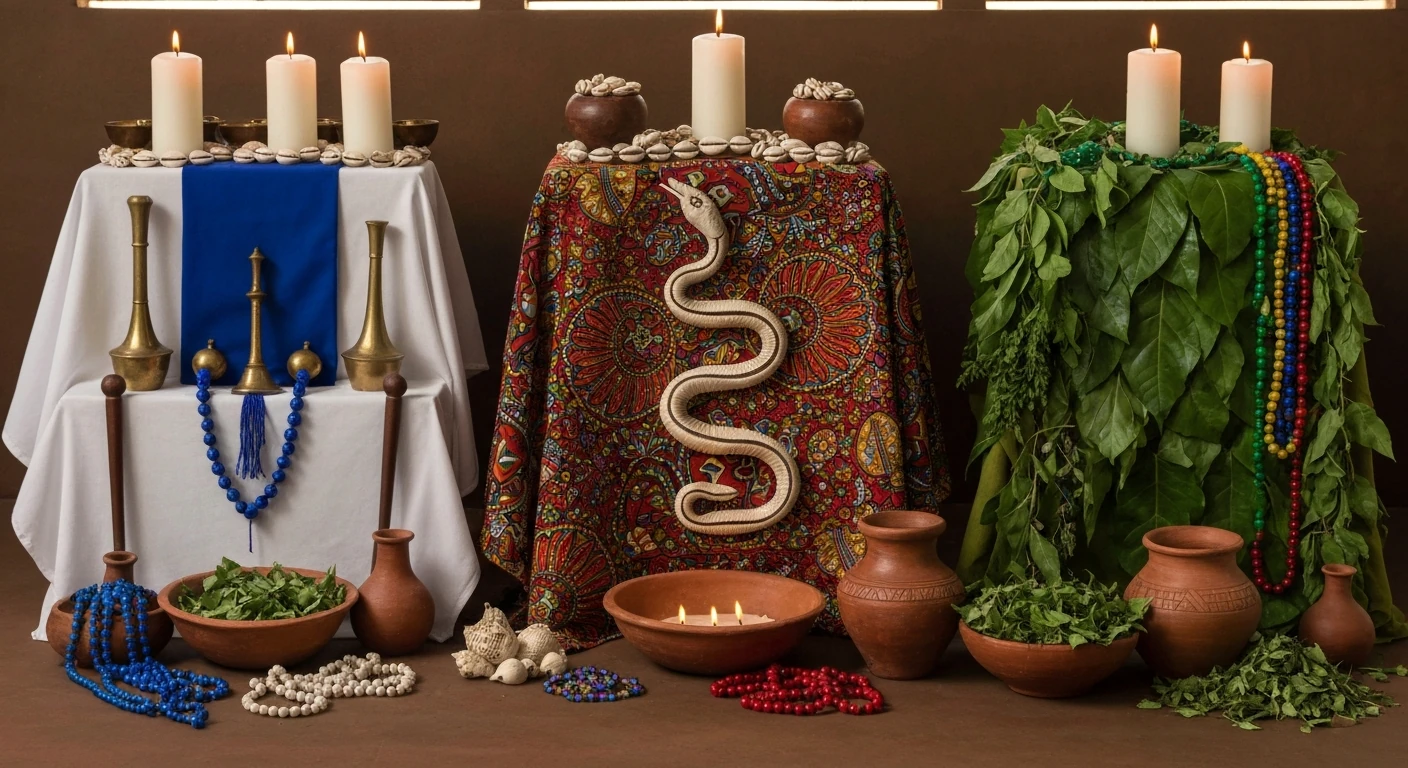
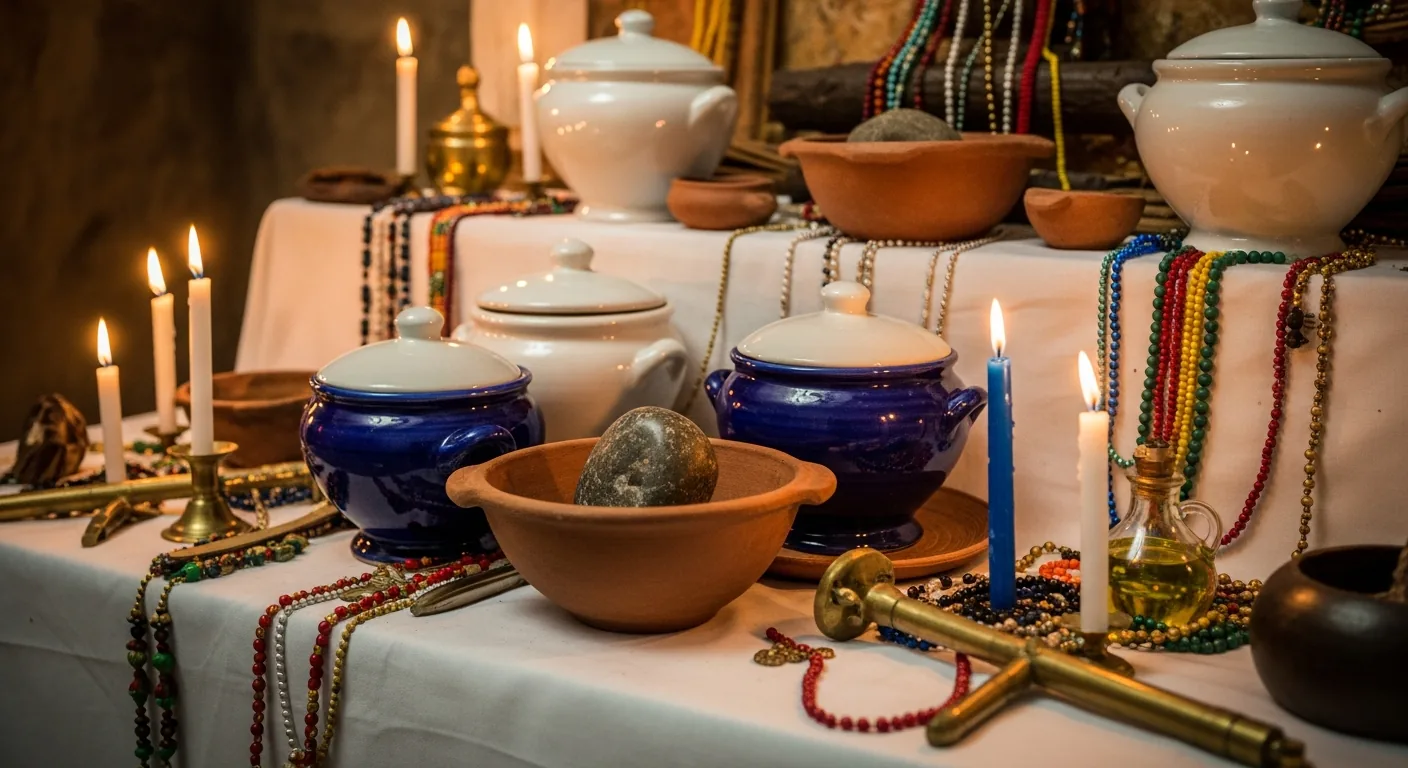
At the back of the terreiro, there is a large tree with a wide trunk, a white cloth tied at chest height. Those arriving from outside think it is a decoration. Those from the house pass by and greet it.
Iroko is the orixá who lives in this tree. He is not represented on the trunk: he lives in it. He is one of the oldest Orixás worshipped in candomblé ketu, linked to time, ancestry, and longevity.
This guide explains who Iroko is, which tree receives him in Brazil, and what is offered to him. It also shows why Iroko, Loko, and Tempo are not exactly the same thing.
Who is Iroko in candomblé
Iroko (also written as Iroco, Irôko, or Ìròkò in Yoruba) is worshipped as an orixá in the Ketu nation. The name comes from the African tree of the same name, the Milicia excelsa, which can live for over 200 years.
Yoruba myths tell that Iroko was the first tree planted. Through it, the other Orixás descended from Orum to Earth. For this reason, he receives the title of commander of the sacred trees.
This origin explains Iroko's domain. He governs tempo: the beginning, the duration, and the end of things. He is the orixá who demands the fulfillment of deadlines and pacts.
The tradition recorded by Pierre Verger and Melville Herskovits adds another function. Iroko is the guardian of the abiku, the infant spirits who are born and return early to Orum.
Iroko is not an orixá of haste. Those who work with him learn that maturation is also axé, and that fruit harvested before its time feeds no one.
The white gameleira: Iroko's tree in Brazil
The Milicia excelsa does not exist in Brazil. Enslaved Africans did what they did with almost all the cult: they adapted. They chose a local tree with similar stature, shade, and longevity.
This tree is the gameleira branca, of the Ficus genus. Sources diverge regarding the exact species, and you will find Ficus insipida, Ficus gomelleira and Ficus doliaria in the records. In the practice of the terreiro, the popular name is what matters.
A gameleira receives an ojá funfun, the white cloth tied to the trunk. At its foot is the consecrated foundation (assentamento), with quartinha, coins, and the day's offerings.
An important correction is needed here. The house does not worship the tree. The tree is a morada and a point of consecrated foundation (assentamento), just as the consecrated foundation of the orixá is the house of the Orixá inside the peji, and not the Orixá itself.
In houses of tradition, an Iroko tree is not cut for convenience. There is a specific rite before any serious pruning, and most terreiros simply do not touch it.
Technical sheet of Iroko
These are the most repeated data among ketu houses. Like all fundamento, they vary from terreiro to terreiro.
| Item | Iroko |
|---|---|
| Nation | Ketu (as Iroko); Jeje (as Loko); Angola (correspondence with Tempo) |
| Domain | Tempo, ancestry, longevity, cycles |
| Element | Earth and vegetable |
| Symbol | The living tree and the ojá funfun on the trunk |
| Colors | White, green and brown |
| Day | Tuesday |
| Annual date | October 4, in houses that adopt syncretism |
| Greeting | ”Iroko Issó!”, with the response “Eró!” |
Note that many houses do not fix a day of the week for Iroko and work only the annual date. If your house follows another day, follow your house. The blog has an overview of the days of the week of the Orixás for comparison.
About syncretism: some terreiros associate Iroko with Saint Francis of Assisi, celebrated on October 4, due to the connection of both with nature. This syncretism is minority and almost never appears in academic literature. It is a historical approximation, never a theological equivalence.
Iroko, Loko and Tempo: correspondence, not equality
This is the biggest confusion surrounding the theme, and the reason for so much discussion among practitioners.
In jeje, the corresponding vodun is called Loko (or Locô). Verger dealt with both in the same study, precisely because of this proximity.
In angola, the inquice Tempo appears, also called Kitembo. It shares the domain of time and the connection with the tree, and there the certain similarity ends.
The difference is of category, not of detail. Inquice is not Orixá. They are distinct religious systems, with their own liturgy, language, and foundation, as explained in the article about what is a nkise.
The translation between pantheons was a Brazilian resource for coexistence between houses of different nations. It helps to converse, but erases foundation when it becomes a sign of equality. Many angola houses refuse the equivalence, and with reason.
Practical rule to not make a mistake: say “Iroko, in ketu”, “Loko, in jeje”, “Tempo, in angola”. Never “the Iroko of angola”.
Offerings and worship to Iroko
The offerings to Iroko are simple and vegetable. The most consistent records mention:
- Breads and cakes of corn, millet, or rice
- Yam cooked, without strong seasoning
- Corn white or red, depending on the house
- Honey and fresh water
- Candles white and green lit at the foot of the tree
The delivery pattern is the same as any offering to the Orixás: clean food, clear intention, respect for the place, and seclusion of what remains. No plastic or glass left at the foot of the tree.
Direct children of Iroko are rare. He usually appears as an adjunct, not as a front Orixá. In terreiros, there is a description of a discreet, patient, and stubborn profile, but this is common talk and not a closed foundation.
If you do not have a consecrated tree, do not improvise. Seek your house. Iroko is a foundation of the terreiro, and not a loose backyard practice.
The Iroko of Sítio de Pai Adão
The Ilê Obá (Oba) Ogunté, known as Sítio de Pai Adão, is located in Água Fria, in Recife. It was founded in 1875 by Inês Joaquina da Costa, Tia Inês, a Nigerian. IPHAN recognized the terreiro as Cultural Heritage of Brazil on September 20, 2018. The list of listed terreiros is in the text about terreiros listed by IPHAN.
A gameleira worshipped as Iroko in the house was hit by an arson fire in November 2018. The tree fell in January 2019.
The community's response was to plant it again. The project "Tempo para Iroko" was born from that, created by the artist and professor Dália Rosenthal, from ECA-USP. It gathered audiovisual records, testimonies from the house leaders, and the collective cultivation of new white gameleira seeds. The USP Journal documented the work in 2021.
It is Iroko's lesson in action: whoever works with Tempo replants.
Frequently asked questions
What is Iroko's day?
Most ketu houses mark Tuesday as Iroko's day. However, a good part of the terreiros do not fix a day of the week and only work the annual date of October 4th. There is no single standard in Brazil. The correct day is always what the foundation of your house determines.
What is Iroko's tree in Brazil?
It is the white gameleira, of the Ficus genus. In Africa, Iroko inhabits the Milicia excelsa, which does not occur here. The gameleira was chosen for having similar size, shade, and longevity. The trunk receives the ojá funfun, the white cloth that marks the presence of the Orixá.
Are Iroko and Tempo the same Orixá?
No. Iroko is the Orixá of ketu, Loko is the vodun of jeje, and Tempo is the inquice of angola. The three share the domain of time and the connection with the tree. They are correspondences between pantheons, created for coexistence between houses, and not the same entity with different names.
What is offered to Iroko?
Vegetal and simple offerings: breads and cakes of corn, millet, or rice, cooked yam, corn, honey, and fresh water. White and green candles at the foot of the tree complete the preparation. The menu varies by house, and no list from the internet replaces the guidance of your zelador.
Is there a child of Iroko?
It is rare. Iroko almost never settles as a front Orixá and usually comes as an adjunct to another. When it appears, terreiros describe a discreet, patient, and quite stubborn person. Treat this as a common description among practitioners, not as a rule of fundamento.
Where to buy items for the worship of Iroko
At Joia Mística Laroyê, you will find:
- White and green candles: the colors used at the foot of the tree
- Ojá and cotton ribbons: white cloth for binding to the trunk
- Clay quartinhas: for the fresh water of the consecrated foundation (assentamento)
- Pure honey and ritualized honey: classic vegetable offering
- Bead necklaces in white and green: in the colors of the Orixá
Visit our shop in Extrema, Minas Gerais or talk to us via WhatsApp and we ship all over Brazil.
To delve deeper into the spellings, nations, and scientific names of the trees, the Iroco entry on Wikipedia is worth it. It gathers references from Verger, Herskovits, Nei Lopes, and Yeda Pessoa de Castro.
References
- Jornal da USP: report on the Tempo project for Iroko and the gameleira at Sítio de Pai Adão
- Wikipedia: entry on Iroco, with references from Verger, Herskovits, Nei Lopes, and Yeda Pessoa de Castro