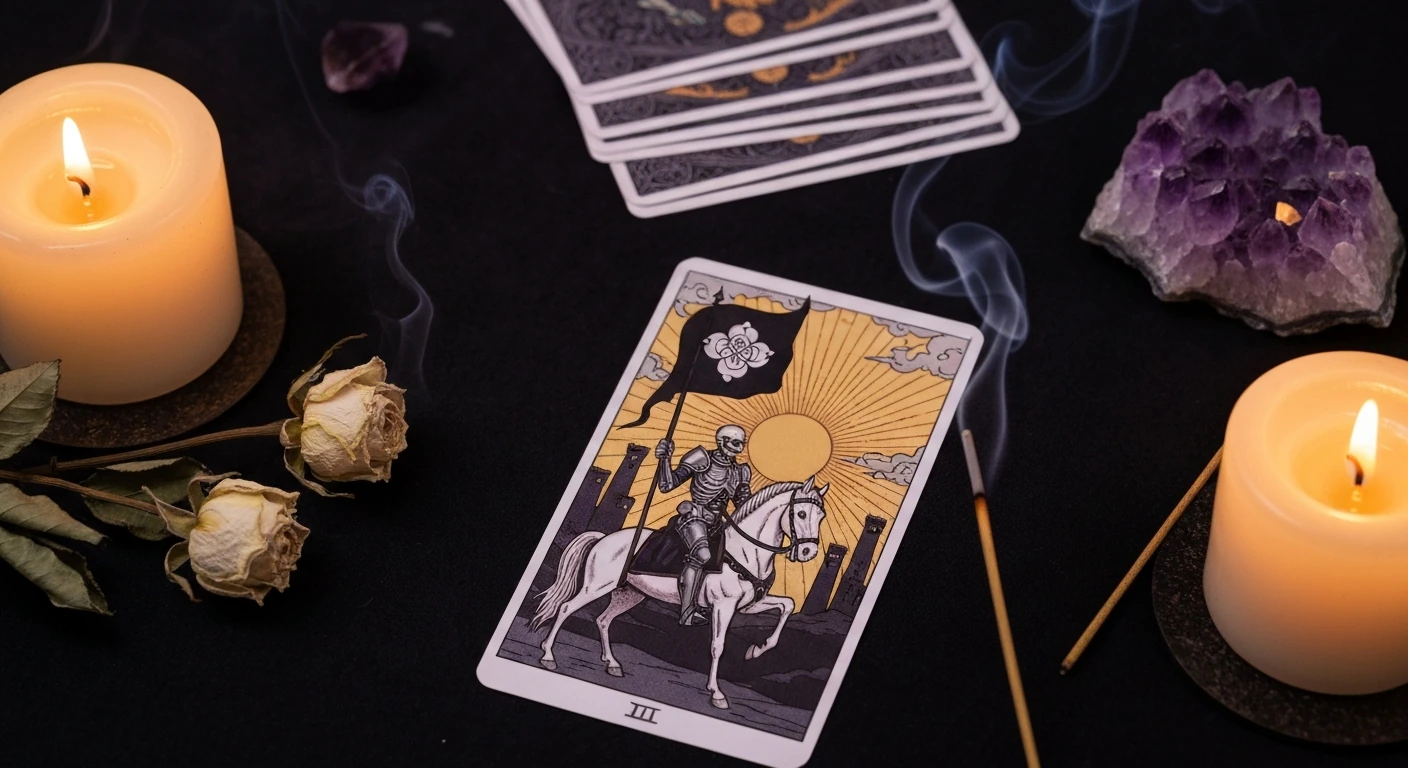
Drawing The Tower is the classic shock of the tarot table. The image does not help: a lightning bolt splits the tower in half, the crown at the top flies away, and two people plummet headfirst.
The question that follows is almost always the same: did they do something against me? No. The Tower in tarot does not speak of a curse or of ritual work done. It speaks of structure: that which you built, found solid, and are about to discover never had a base. This guide reads Arcano XVI symbol by symbol, tells the historical detail that almost no one tells, and teaches the upright and reversed reading.
Does the card The Tower mean a curse or something done?
No, it does not. It is worth taking this weight off your chest right at the beginning.
Tarot is a symbolic system of European esotericism. It was born in Italian decks of the 15th century and took shape in French workshops of the 17th and 18th centuries. No card of it describes the action of third parties against someone. All describe the moment of the person who asks.
The Tower, therefore, does not point outward. It points inward to the construction that was already cracked, and to the new fact that will make this visible.
A necessary distinction is still needed, since a good part of those who read this blog are from the axé. The Tower does not correspond to Xangô (Shango), Iansã (Oya), or Exu (Eshu). They are distinct systems, with their own origins, foundations, and uses. Those who seek the two traditions dialoguing with respect work with another deck: the tarot of the Orixás, which has its own structure.
The Tower does not announce punishment. It announces that the truth has arrived at the address and will not leave without entering.
Arcana XVI: the card's profile
The Tower is the sixteenth of the major arcana of the tarot, the group of 22 cards that form the symbolic column of the deck.
- Number: XVI (16)
- Name in other decks: La Maison Dieu (The House of God) in the Tarot de Marseille, La Foudre (The Lightning) in French decks, La Torre in Italian decks
- Title in the Waite book: The Tower Struck by Lightning, the tower struck by lightning
- Associated planet: Mars, the planet of the cut and impact
- Element: Fire
- Keywords upright: sudden rupture, revelation, structural collapse, forced liberation
- Keywords reversed: resistance to change, delay of the inevitable, silent collapse
A warning about the planet, because the Brazilian internet makes many mistakes on this point. The correspondence of The Tower is Mars. Capricorn and Saturn belong to the previous card, The Devil. They are neighboring arcana with different correspondences, and confusing the two changes the entire reading.
The Tower was not always a card of disaster
Here is the finding that changes everything, and that none of the big portals mention. The scary design of the card is relatively recent. It was fixed by a single engraver in the 18th century.
- Jacques Viéville, around 1650: the card didn't even have a tower. It showed a tree with a shepherd and his flock, and the shepherd opened his arms to receive what came down from the sky.
- Jean Noblet and Jean Dodal, until 1715: the tower already had an open top. But the flame rose toward the sun.
- Nicolas Conver, Marseille, 1761: turned the flame downward and extinguished almost the entire sun. It was this version that became the standard.
The original name is also misleading. Maison Dieu was neither a palace nor a cathedral. As the Tarot Heritage tarot history collection explains, the term designated the hospital for the indigent and the shelter for pilgrims. For those arriving there, that was usually the last stop.
Until 1715, the flame of this card rose toward the sun. The fear it provokes today began as a choice of engraving, not as a sentence.
The symbolism of the Tower card
In the Rider-Waite-Smith deck, the most used in Brazil, each element of the scene teaches the same lesson. The following description follows the Wikipedia entry on the card and the original text by Arthur Edward Waite.
- The tower on the rock: a tall and narrow construction, erected on a peak without a wide base. The drawing reveals the problem even before the lightning.
- The torn crown: the top of the tower is a golden crown, and the lightning displaces it. It is the authority that the person thought they had, and it falls first.
- The lightning: comes from outside, from above, in a zigzag. It is not divine punishment. It is the new fact that arrives and no longer fits into the old structure.
- The two falling figures: one has royal features, the other is common. The collapse does not choose social class.
- The flames in the shape of yod: the points around the tower have the shape of the Hebrew letter yod, the smallest of the alphabet and a symbol of the divine spark.
- The dark sky: unlike what happens in Death, here there is no sun rising on the horizon.
Two details deserve attention. The figures fall in the same position as the card The Hanged Man, and this suggests a change of perspective, not just a fall. And the flames continue to fall during the disaster: something of grace descends along with the debris.
Waite describes the scene as the tearing of a house of doctrine. In other words, what collapses there is a belief, not a building. The text is in the public domain on the Internet Archive.
La Maison Dieu: the same card in the Tarot de Marseille
Tarot is not just one deck. Card XVI changes face depending on the school, and this changes the reading on the table.
| Element | Tarot de Marseille (Conver, 1761) | Rider-Waite-Smith (1909) |
|---|---|---|
| Card name | La Maison Dieu, the House of God | The Tower, the tower |
| What hits the tower | A flame that descends from above, with the sun almost extinguished | A zigzag lightning bolt, sky completely dark |
| The top | Stone crowning that opens | Golden crown torn away by lightning |
| The colored dots | Globes and drops, read as divine grace | Flames in the shape of the letter yod |
| The figures | Two anonymous figures falling | One crowned figure and one common figure |
| Tone of the card | Forced humility, pride that dismantles | Unforeseen catastrophe and false construction that gives way |
In the Marseille reading, the card weighs like an intervention that corrects excess. In the Waite school, it becomes a study on foundation: what is built without a base cannot sustain itself, and the lightning only hastens the reckoning.
What The Tower means in a reading
In the normal position, The Tower points to the structure that will give way. The theme changes according to the area of life.
- In love: a revelation that changes the picture, a sudden ending, the end of the version the couple told about themselves. It is not always the end of the bond. Sometimes it is the end of the facade.
- At work: unexpected dismissal, canceled project, restructured company. It also appears when someone is about to discover something they will not be able to unsee.
- In money: sudden loss, emergency spending, a plan that was not sustainable. The account is usually already in the red before the shock occurs.
- In a yes or no question: it tends toward "no", or a "yes with damage along the path".
The combinations refine the message. With The Devil, the structure built on attachment collapses at once. With Death, the ending becomes definitive. With The Star, which comes right after it in the order of the arcana, the atmosphere is one of healing and reconstruction. In a three-card spread, observe the following card: it is the one that says what remained standing.
An honest disclaimer. When The Tower appears in questions about health, financial crisis, or job loss, it names the moment and nothing more. The tarot does not diagnose nor replace a doctor, therapist, or professional guidance.
The Tower reversed: the two readings
Here the schools diverge, and those who read seriously need to know both.
The most widespread reading today is that of delay. Inverted, the card indicates that the crisis is being avoided or resisted. The person holds up what should have already fallen, and the collapse happens from within, without external scandal. The practical warning is direct: the more one delays, the more violent the fall becomes.
The classic reading takes a different path. Waite describes the reversed card as oppression, imprisonment, and tyranny, in other words, the same disaster in a lesser and prolonged degree. The explosion turned into a routine, and the prison took the place of the outburst.
Which of the two to use? It depends on the surroundings. If the neighboring cards show movement and clarity, read it as a still reversible delay. If they show repetition and blockage, read it as Waite. The complete criteria are in the guide of reversed cards in tarot.
Frequently asked questions
What does The Tower card mean in tarot?
It means sudden rupture and revelation. The card points to a structure that is going to fall: a relationship, a job, a plan, or a belief that seemed firm and never had a solid base. It describes a collapse that reveals the truth, not an attack coming from outside.
Is The Tower a bad card?
It is not bad, it is uncomfortable and honest. It shows what was already fragile and only appeared whole. The pain of the fall is real, but what collapses was rarely solid. The space opened by the ruin is the only ground where it is possible to build again.
What does The Tower reversed mean in tarot?
In the most used reading today, it means that the crisis is being delayed or forcibly contained. In Waite's classic reading, it means oppression and imprisonment, with the disaster turning into a routine. The neighboring cards decide which of the two versions fits the spread.
Is The Tower in tarot a yes or no?
It tends toward no, or a yes that comes at a high cost. But the card responds better to another question: will this continue to stand? If the subject involves a fragile structure, The Tower warns that it will not survive the situation in question.
What is the planet of The Tower card?
Mars, the planet of cutting, impact, and sudden action. The correspondence matches the theme of the card. Capricorn and Saturn, mistakenly cited on many sites, belong to arcane XV, The Devil, and not XVI.
Where to buy your tarot deck
At Joia Mística Laroyê, you will find what you need to study the arcana at your own pace:
- Rider-Waite and traditional decks: the illustrated classic, ideal for reading symbol by symbol
- Romani decks and oracles: to expand the reading and cross systems
- Towels and reading cloths: to set the space for the reading
- Candles and incense: to prepare the environment before consulting
- Books and tarot guides: to deepen each card with a source in hand
Visit our physical store in Extrema-MG and we ship to all of Brazil. Talk to us via WhatsApp and Joice will help you choose the right deck for your moment.
References
- Tarot Heritage: article about the history of the card The Tower, from Trionfi to the major arcane
- Wikipedia in English: entry about the card The Tower in tarot
- Internet Archive: original text by Arthur Edward Waite, The Pictorial Key to the Tarot