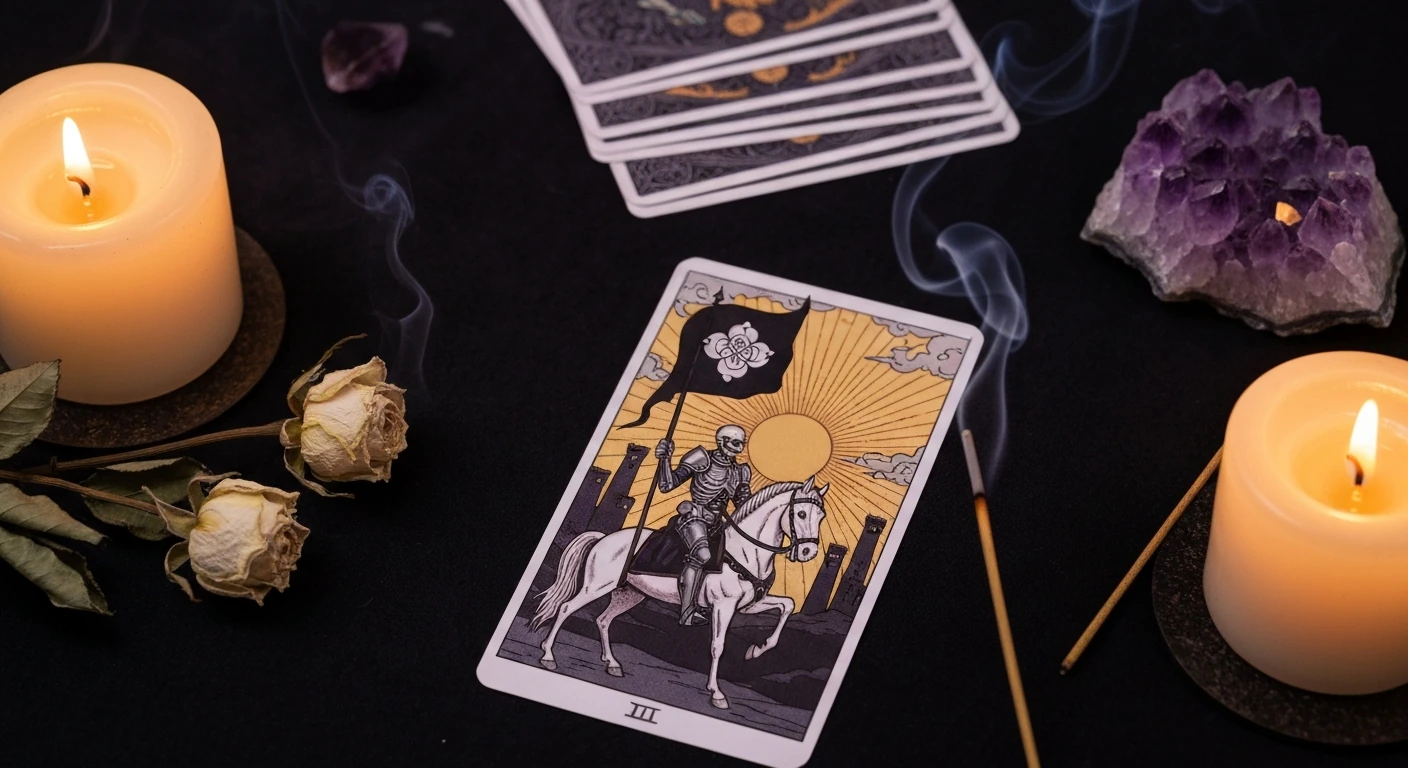
Few cards are as frightening as Death in the tarot. The skeleton mounted on a horse, the number thirteen, the name itself: everything seems to announce tragedy. And that is where the greatest misunderstanding of the entire deck lies.
The Death card almost never speaks of physical death. It is the arcana of transformation the end of a cycle so that another can be born. This guide explains what the card really means, the symbolism behind each detail, and how to interpret it in the upright and reversed positions, without fear and without fatalism.
Does the Death card mean someone is going to die?
No. That is the direct answer, and it is good to start with it to take the weight off your chest.
In the tarot tradition, Death does not predict anyone's passing. It represents a closure: the end of a phase, of a relationship, of a job, of an old way of being. It is the card that appears when something in your life has reached its natural end and needs to make room for the new.
The fear has an explanation. The number thirteen has carried superstition for centuries, and the image of the skeleton is intentionally impactful. But the tarot speaks through symbols, and the symbol of death here is the same as in nature: the autumn that drops the leaves so that spring can come. No one cries for the leaf that falls knowing that the tree will turn green again.
The tarot does not seal destinies. It shows the moment. Death does not say "you will lose everything," but rather "something is ending, what will you do with the space that opens up?"
Death in the tarot: Arcanum XIII
Death is the thirteenth of the major arcana of the tarot, the 22 trumps that form the symbolic backbone of the deck. Its profile helps to understand why it is so profound.
- Number: XIII (13), traditionally linked to the end of a cycle and to a new beginning
- Associated sign: Scorpio, the sign of death and rebirth in esoteric astrology
- Keywords: end of cycle, transformation, transition, letting go, renewal
A detail reveals the intention of the original creators of the tarot: in the Marseille tarot and in historical decks, this card often appears unnamed, known as the "Unnamed Arcana." The omission is intentional. Not writing "Death" was a way of saying that the card points to something greater than the literal end of life: it points to transformation itself.
The symbolism of the card Death
In the Rider-Waite-Smith deck, the most used in Brazil, each element of the card teaches the same lesson. According to the classic description by Arthur Edward Waite, the scene brings:
- The skeleton in armor: Death rides dressed in iron. The armor says that she is invincible: one cannot defeat transformation, only pass through it.
- The white horse: white is purity. Death is not revenge nor punishment; it is a neutral force that passes through everyone, clearing the path.
- The banner with the white rose: on the black flag shines a white rose with five petals. The contrast teaches that every end (the black) carries a promise of a new beginning (the rose). It is hope within the passage.
- The rising sun between two towers: in the background, the sun rises on the horizon. After the night, the day always comes. It is the promise of rebirth that the card holds.
- The fallen figures: a fallen king, a bishop, a child, a young woman. Death does not distinguish class, age, or position. Change arrives for everyone, and not even the crown can stop it.
Notice that there is nothing macabre in the reading. Each symbol points to the same place: the end that prepares the restart.
The meaning of the card Death in the upright position
When Death appears upright in a reading, it speaks of a transformation that is already underway or about to happen. The most common meanings are:
- End of an important cycle a phase of life is closing, with or without your permission
- Profound transformation you will not be the same person after what you are experiencing
- Letting go releasing habits, bonds, or identities that no longer fit who you are becoming
- Inevitable change the card asks for acceptance, because resisting only prolongs the pain
- Renewal in the space that opens up, something new can finally grow
Death upright is rarely a bad card. It is usually a disguised relief: the recognition that what weighed you down no longer needs to continue.
Death reversed: what changes
When the card comes out upside down, the meaning does not flip to "life" it points to resistance to transformation. Just like in reversed tarot cards in general, the energy becomes stuck. The most frequent meanings are:
- Fear of change you know a phase has ended, but you cling to it
- Stagnation the feeling of life at a standstill, trapped in a cycle that should have already closed
- Attachment insisting on a relationship, a job, or a routine only out of fear of the unknown
- Pattern repetition the same mistakes returning because the lesson has not yet been accepted
Death reversed is a harsher invitation: the change will happen regardless, and the more you hold on, the harder it becomes. The card asks for courage to let go.
How to interpret Death in a reading
No card is read alone. The meaning of Death changes according to the question and the neighboring cards in the spread. Some practical guidelines:
- In love: it usually indicates the end of a stage in the relationship, not necessarily the breakup, but a transformation. A couple that needs to change to continue, or an emotional cycle that is closing.
- In work: career transition, leaving a job, closing a project to make room for another.
- In a yes or no question: Death tends to point to "no" for the continuity of what exists today, because its nature is of closure, not of permanence.
- In a three-card spread: observe the card that comes after it. It is the one that shows what is being born from the end that Death announces.
The question the card asks is always the same: what needs to end so that the new can begin? View the tarot as a tool for self-knowledge, not as a sentence. Death does not decide for you; it illuminates the choice that is before you.
Frequently asked questions
Does the Death card in the tarot mean someone is going to die?
No. The card practically never indicates physical death. It symbolizes the end of a cycle and a profound transformation: the closing of a phase, relationship, or habit so that something new can be born. It is one of the most misunderstood cards in the deck.
Is the Death card positive or negative?
Neither of them in a fixed way. Upright, it is usually positive: a relief, a necessary renewal. Reversed, it points to resistance and stagnation. The tone depends on the question and the surrounding cards, but the core is always transformation, not tragedy.
What is the sign associated with the Death card?
Scorpio. In esoteric astrology, Scorpio is the sign of death and rebirth, of the ability to transform from within. Therefore, the card and the sign share the same energy of cycle's end and new beginning.
What does the reversed Death card mean?
Resistance to change. Reversed, the card speaks of fear of starting over, attachment to what has already ended, and stagnation. Transformation continues to be necessary, but the person clings to the past, prolonging the discomfort instead of letting go.
Why does the Death card cause so much fear?
Because of the strong image of the skeleton and the number thirteen, surrounded by superstition. But the scare is cultural, not real: in the symbolism of the tarot, Death represents the natural passage between one cycle and another, like the autumn that precedes spring.
Where to buy your tarot deck
At Joia Mística Laroyê, you find everything to start or deepen your practice with the tarot:
- Rider-Waite and traditional tarot decks: the classic illustrated, ideal for reading symbols card by card
- Romani decks and oracles: for those who want to expand the reading
- Towels and reading cloths: to set up your reading space
- Candles and incense: to prepare the environment before consulting
- Tarot books and guides: to study the arcanos in depth
Visit our physical store in Extrema, Minas Gerais or receive it at home with delivery to all of Brazil. Talk to us via WhatsApp and Joice will help you choose the right deck for your moment.
References
- Portuguese Wikipedia: entry on the card Death in tarot
- English Wikipedia: entry on the card Death in Rider-Waite-Smith tarot